
The Minor Nabiyaiym (Prophets) are the twelve shorter prophetic books of the Abariy Scriptures (Hebrew Bible), collectively spanning approximately 400 years of Yisharaliy (Israelite) history, from around 780 BC to 420 BC. The term “Minor Prophets” refers only to the length of each book, not to the significance or authority of its message. These twelve prophets ministered to Yisharaliym (Israel) and Yahudah (Judah) during the periods of Ashuriy (Assyrian) expansion, Babaliy (Babylonian) exile, and Parasiy (Persian) restoration, proclaiming warnings of judgment, calls to repentance, and promises of hope. Their names are Ahusha (Hosea), Yual (Joel), Amuts (Amos), Abadiyahu (Obadiah), Yunah (Jonah), Miykiyahu (Micah), Nahum, Habaquq (Habakkuk), Tsapaniyahu (Zephaniah), Hagiy (Haggai), Zakariyahu (Zechariah), and Malakiyahu (Malachi). Understanding the historical context of the Minor Nabiyaiym is the first step toward appreciating why their messages continue to speak with such power and relevance today.
What Are the Minor Nabiyaiym (Prophets), and Why Does the Label Matter?
The term “Minor Nabiyaiym (Prophets)” is an Early Believers (Christian) canonical label, but the Abariy (Hebrew) tradition uses a more revealing name: Tre 'Asar, meaning “The Twelve.” That name signals something important. These books were never meant to stand alone. The Abariy (Hebrew) tradition compiled them into a single scroll, treating them as one unified prophetic work rather than twelve separate compositions. That editorial decision shaped how generations of readers understood their message.
The word “minor” entered common usage through the Latin Vulgate tradition and refers only to the length of the books. Amuts (Amos) contains nine chapters, while Abadiyahu (Obadiah) contains just one. By contrast, Yisha’aiyahu (Isaiah) spans 66 chapters, and Yiramiyahu (Jeremiah) spans 52. The distinction is one of length, not authority. These shorter books carry the same covenantal weight as the major prophetic books, and their theological authority is equal to that of the longer prophetic writings in both the Abariy (Hebrew) and Early Believers (Christian) canons.

Pro Tip: When reading the Minor Nabiyaiym (Prophets), resist the urge to treat each book as a standalone message. Instead, read them in sequence as a single scroll. Doing so reveals recurring themes and theological connections that are often missed when each book is read in isolation.
Readers who dismiss these books as mere footnotes to the broader prophetic tradition overlook a sustained, centuries-long witness to covenant loyalty, set-apart (divine) justice, and the character of YAHUAH. The Minor Nabiyaiym (Prophets) are not minor in any theological sense. Rather, they form an essential part of the unified prophetic message preserved throughout the Scriptures.
What Historical Contexts Shaped the Messages of the Minor Nabiyaiym (Prophets)?
Three major historical periods shaped the prophetic messages found throughout these twelve books. Each period brought unique pressures upon Yisharal (Israel) and Yahudah (Judah), and the Nabiyaiym (Prophets) responded to those specific historical crises with messages from YAHUAH.
-
Asuriy (Assyrian) Dominance (roughly 780–620 BC): Ahusha (Hosea), Amuts (Amos), Yunah (Jonah), and Miykiyahu (Micah) all prophesied during this period. The northern kingdom of Yisharal (Israel) faced increasing military pressure and was eventually conquered by Ashur (Assyria) in 722 BC. These Nabiyaiym (Prophets) confronted a society that had grown wealthy but spiritually corrupt, worshiping foreign Alahiym (gods) while neglecting its covenant obligations.
-
Babaliy (Babylonian) Exile (roughly 620–539 BC): Nahum, Habaquq (Habakkuk), Tsapaniyahu (Zephaniah), and Abadiyahu (Obadiah) prophesied during the collapse of Yahudah (Judah) and the trauma of the Babaliy (Babylonian) conquest. Habaquq (Habakkuk) famously wrestled with why YAHUAH would use a wicked empire as an instrument of judgment. Their messages acknowledged the people’s suffering while affirming that set-apart (divine) justice would ultimately prevail.
-
Parasiy (Persian) Restoration (roughly 539–420 BC): Hagiy (Haggai), Zakariyahu (Zechariah), and Malakiyahu (Malachi) spoke to a community returning from exile. The challenge shifted from survival to faithfulness. Would a restored Yisharal (Israel) truly live differently? These Nabiyaiym (Prophets) urged the community to rebuild the Ahiykal (Temple), honor their covenant obligations, and prepare for future fulfillment.
Understanding these social and historical contexts is not optional background information. It is the key to interpreting what each Nabiya (Prophet) was actually saying and why those messages mattered so urgently to the original audience.
Pro Tip: Cross-reference each Minor Nabiya (Prophet) with a basic timeline of Asuriy (Assyrian), Babaliy (Babylonian), and Parasiy (Persian) history. Even a simple chart can transform confusing passages into clear, historically grounded messages.
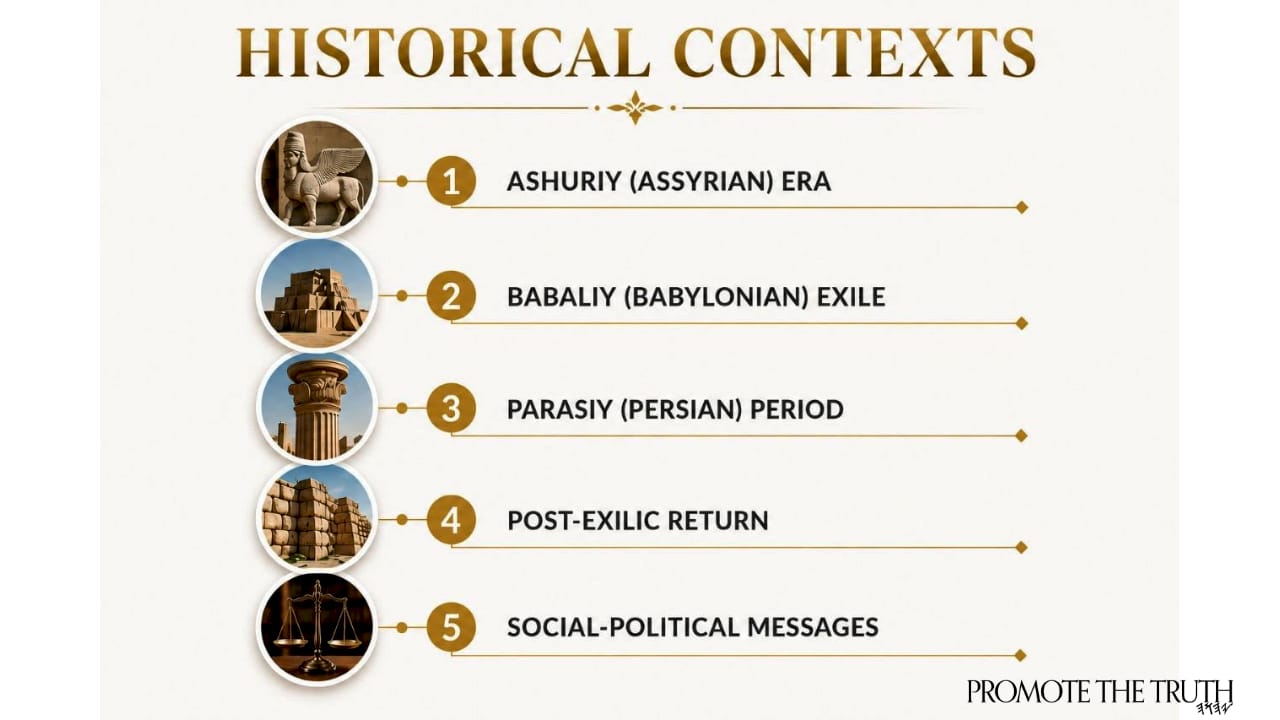
The Minor Nabiyaiym (Prophets) were not abstract theologians. They were politically active and socially provocative figures who confronted Malakiym (kings), kuhin (priests), and entire societies with powerful calls to justice and repentance during some of the most volatile periods in ancient Near Eastern history.
Why Are They Called Minor Nabiyaiym (Prophets) Compared to the Major Nabiyaiym (Prophets)?
The distinction between the Major and Minor Nabiyaiym (Prophets) is editorial, not theological. The Major Nabiyaiym (Prophets) in the Early Believers (Christian) Ta’anak (Old Testament) are Yisha’aiyahu (Isaiah), Yiramiyahu (Jeremiah), Aiykah (Lamentations), Yihazaqal (Ezekiel), and Daniyal (Daniel). Their books are substantially longer and were traditionally preserved on individual scrolls. By contrast, the Minor Nabiyaiym (Prophets) were compiled together on a single scroll.
| Category | Books | Approximate Length | Core Themes | |
|---|---|---|---|---|
| Major Nabiyaiym (Prophets) | Yisha’aiyahu (Isaiah), Yiramiyahu (Jeremiah), Yihazaqal (Ezekiel), Daniyal (Daniel) | Approximately 40–66 chapters each | Judgment, restoration, Messianic hope | |
| Minor Nabiyaiym (Prophets) | Ahusha (Hosea) through Malakiyahu (Malachi) (12 books) | Approximately 1–14 chapters each | Covenant faithfulness, justice, repentance, and hope |
The designation “minor” reflects only brevity, not a lower level of inspiration or importance. Miykiyahu (Micah) 6:8, one of the most quoted ethical statements in all of Scripture, comes from the Minor Nabiyaiym (Prophets). Amuts’ (Amos’s) thundering condemnation of economic injustice shaped the prophetic tradition for centuries. These are not minor voices.
Pro Tip: If you want to understand the role of prophecy throughout the Abariy Scriptures (Hebrew Bible), start with the Major Nabiyaiym (Prophets) for the broader scope, then read the Minor Nabiyaiym (Prophets) for greater specificity. Together, these two collections illuminate one another.
Who Were the Twelve Minor Nabiyaiym (Prophets), and What Did They Teach?
Each of the twelve books carries a distinct message shaped by its historical context, literary style, and intended audience. Here is a summary of each Nabiya (Prophet) and their core contribution.
-
Ahusha (Hosea) used his own broken marriage as a living metaphor for Yisharal’s (Israel’s) unfaithfulness to YAHUAH. His book is one of the most emotionally powerful in all of Scripture, combining grief with fierce love.
-
Yual (Joel) centered his prophecy on a devastating locust plague, interpreting it as a call to repentance and a sign of future restoration. His vision of the Spirit being poured out on all people became a defining passage for later communities.
-
Amuts (Amos) was a shepherd from Taqua (Tekoa) who delivered some of the sharpest calls for social justice in the Scriptures (Bible). He condemned the wealthy for exploiting the poor and declared that ritual worship without ethical living was worthless to YAHUAH.
-
Abadiyahu (Obadiah) is the shortest book in the Ta’anak (Old Testament), containing a single chapter directed against Adum (Edom) for its betrayal of Yahudah (Judah) during the Babaliy (Babylonian) invasion.
-
Yunah (Jonah) stands apart from the others in form. It is a narrative rather than a collection of oracles, following a reluctant Nabiya (Prophet) sent to the Ashuriy (Assyrian) city of Niynuah (Nineveh). Its central message is that YAHUAH’s compassion (mercy) extends beyond Yisharal’s (Israel’s) borders.
-
Miykiyahu (Micah) addressed both the northern and southern kingdoms, condemning corrupt leaders and false Nabiyaiym (Prophets) while offering one of Scripture’s clearest summaries of covenant living: to act justly, love, compassion (mercy), and walk humbly.
-
Nahum announced the fall of Niynuah (Nineveh), the Ashuriy (Assyrian) capital, as an act of set-apart (divine) justice. His book serves as a counterpart to Yunah (Jonah). Where Yunah (Jonah) recorded Niynuah’s (Nineveh’s) repentance, Nahum announced its eventual destruction.
-
Habaquq (Habakkuk) is unique because it takes the form of a dialogue between the Nabiya (Prophet) and YAHUAH. Habaquq (Habakkuk) openly questioned set-apart (divine) justice, wrestling with why evil seemed to go unpunished. His conclusion—that the righteous live by faith—became foundational for later theological reflection.
-
Tsapaniyahu (Zephaniah) proclaimed a coming “Day of YAHUAH” that would bring judgment upon Yahudah (Judah) and the surrounding nations, followed by restoration for a faithful remnant.
-
Hagiy (Haggai) delivered four short messages urging the returned exiles to prioritize rebuilding the Ahiykal (Temple) in Yirushalam (Jerusalem). His book is one of the most precisely dated in the Abariy Scriptures (Hebrew Bible).
-
Zakariyahu (Zechariah) combined immediate post-exilic encouragement with vivid apocalyptic visions, making it one of the most complex and richly symbolic books among the Twelve.
-
Malakiyahu (Malachi) closed the collection with a direct challenge to a community that had grown spiritually complacent after the restoration. His book ends with the promise of a coming messenger who would prepare the way.
The unified message across all twelve books is that true worship of YAHUAH is inseparable from ethical living and social justice. That theme runs from Ahusha’s (Hosea’s) opening grief to Malakiyahu’s (Malachi’s) closing challenge.
How Are the Minor Nabiyaiym (Prophets) Arranged, and Why Does Their Grouping Matter?
The order of the twelve is loosely chronological but is also shaped by thematic and editorial considerations. Some books, such as Hagiy (Haggai) and Zakariyahu (Zechariah), contain precise dates. Others, such as Yual (Joel) and Abadiyahu (Obadiah), have uncertain dates and were likely placed where they are because of their thematic connections to the surrounding books.
Reading the Twelve as a single collection, rather than as isolated texts, reveals patterns that individual readings often miss:
-
Recurring motifs: The “Day of YAHUAH” appears in Yual (Joel), Amuts (Amos), Abadiyahu (Obadiah), Tsapaniyahu (Zephaniah), and Malakiyahu (Malachi), creating a sustained theological thread that runs across centuries.
-
Call and response: Yunah’s (Jonah’s) account of YAHUAH’s compassion (mercy) toward Niynuah (Nineveh) is answered by Nahum’s announcement of Niynuah’s (Nineveh’s) fall, demonstrating that both compassion (mercy) and judgment are consistent with YAHUAH’s character.
-
Hope as the final word: Despite the severity of judgment found throughout many of these books, the collection consistently concludes with promises of restoration. Malakiyahu (Malachi) closes with expectation rather than despair.
The Abariy (Hebrew) tradition of compiling these books as Tre 'Asar on a single scroll was a deliberate theological statement. The compilers understood that the twelve voices together conveyed something that no single book could communicate on its own.
Pro Tip: Avoid the common mistake of reading only well-known passages, such as Miykiyahu (Micah) 6:8 or Habaquq (Habakkuk) 2:4, in isolation. Those verses gain their fullest meaning from their surrounding context and from the broader message of the Twelve as a unified collection.
Viewing the Minor Naniyaiym (Prophets) as a single theological voice reveals a depth of unity and continuity that centuries of reading them as separate books have often obscured. The prophetic roles these twelve men fulfilled were deeply connected to one another across time.
Key Takeaways
The Minor Nabiyaiym (Prophets) are twelve books of equal theological authority to the Major Nabiyaiym (Prophets), unified by themes of covenant faithfulness, justice, and hope across approximately 400 years of Yisharalite (Israelite) history.
| Point | Details |
|---|---|
| “Minor” means shorter, not lesser | The label refers only to the length of the books; their theological authority is equal to that of the Major Nabiyaiym (Prophets). |
| They span 400 years of history | From Asuriy (Assyrian) dominance through the Babaliy (Babylonian) exile to the Parasiy (Persian) restoration, each period shaped the prophetic message. |
| They were compiled as one scroll | The Abariy (Hebrew) tradition grouped them as Tre 'Asar to preserve their unified theological voice. |
| Each Nabiya (Prophet) has a distinct message | From Ahusha’s (Hosea’s) covenant grief to Malakiyahu’s (Malachi’s) promise of restoration, each book contributes a unique dimension to the collection. |
| Their core theme is covenant faithfulness | They consistently teach that true worship of YAHUAH cannot be separated from justice and ethical living. |
Why the Minor Nabiyaiym (Prophets) Deserve Your Full Attention
I have spent years reading these twelve books, and the single biggest mistake I see readers make is treating them as a warm-up to the “real” Nabiyaiym (Prophets). That instinct is understandable. Yisha’aiyahu (Isaiah) is majestic. Yiramiyahu (Jeremiah) is sweeping. But the Minor Nabiyaiym (Prophets) do something those longer books cannot do as effectively: they show the same covenant crisis from twelve different perspectives across four centuries, all in a concentrated form.
What strikes me most is Habaquq (Habakkuk). Here is a Nabiy (Prophet) who does not simply deliver a polished oracle. He argues with YAHUAH. He demands to know why injustice goes unanswered. That kind of raw theological honesty is rare anywhere in Scripture, yet it appears in a book that many readers skip. His conclusion—that the righteous live by faith even when circumstances make no sense—is not a platitude. It is a hard-won conviction from someone who faced real suffering and chose to trust YAHUAH anyway.
The Minor Nabiyaiym (Prophets) are also among the most socially specific books in the Abariy Scriptures (Hebrew Bible). Amuts (Amos) identifies the exact economic practices that YAHUAH condemns. Miykiyahu (Micah) identifies corrupt leaders by their actions. These are not vague spiritual warnings. They are precise, historically grounded indictments that translate directly to any era in which power is abused and the vulnerable are ignored.
My recommendation: Read all twelve books in order without stopping. The cumulative effect is unlike anything that reading a single book can produce. You will hear one sustained prophetic voice speaking across centuries, and that voice is worth every hour you give it.
— Maria
Deepen Your Study of the Prophetic Books with Promote The Truth
Promote The Truth exists to help you engage with the Scriptures at this level of depth. Whether you are reading the Minor Nabiyaiym (Prophets) for the first time or returning to them with fresh questions, the resources available through Promote The Truth are designed for serious, reverent, and Scripture-centered study.
Go beyond summaries and surface-level explanations. Explore the historical context, covenant themes, literary structure, and theological message of each Nabiya (Prophet) through carefully prepared articles, studies, and teaching resources. As you deepen your understanding of the Minor Nabiyaiym (Prophets), you will gain a richer appreciation for YAHUAH’s faithfulness, justice, and enduring covenant throughout the Scriptures.
If your desire is to study the Word of YAHUAH with greater clarity, historical insight, and Scriptural depth, Promote The Truth is here to support your journey.

The Scripture Study Series video channel offers in-depth visual teachings that guide you through the prophetic books with historical, cultural, and manuscript context, making the ancient text more accessible without sacrificing its depth. For structured learning, the digital video academy provides comprehensive courses on Scriptural teachings drawn from ancient Abariy (Hebrew) and Aramiy (Aramaic) manuscript sources. Promote The Truth also publishes the Truth Scriptures, a comprehensive English restoration of the Ta’anak, translated directly from the earliest available manuscript sources. This translation gives readers direct access to the Word of YAHUAH while preserving the richness, accuracy, and context of the original text.
These resources are designed for readers who desire more than a surface-level familiarity with the Word of YAHUAH. Whether you are beginning your study of the Minor Nabiyaiym (Prophets) or seeking a deeper understanding of the Scriptures, Promote The Truth equips you with trusted resources to help you study with greater clarity, historical insight, and Scriptural depth.
Frequently Asked Questions (FAQ)
What are the twelve Minor Nabiyaiym (Prophets) in order?
The twelve Minor Nabiyaiym (Prophets) in canonical order are Ahusha (Hosea), Yual (Joel), Amuts (Amos), Abadiyahu (Obadiah), Yunah (Jonah), Miykiyahu (Micah), Nahum, Habaquq (Habakkuk), Tsapaniyahu (Zephaniah), Hagiy (Haggai), Zakariyahu (Zechariah), and Malakiyahu (Malachi). Their arrangement is loosely chronological while also reflecting thematic and editorial considerations.
Why are they called “minor” if their messages are so significant?
The term “minor” refers only to the shorter length of these books compared to the Major Nabiyaiym (Prophets), such as Yisha’aiyahu (Isaiah) and Yiramiyahu (Jeremiah). It does not reflect their theological importance or prophetic authority.
What is the main message of the Minor Nabiyaiym (Prophets)?
The Minor Nabiyaiym (Prophets) consistently call Yisharal (Israel) and Yahudah (Judah) back to covenant faithfulness, warning that ritual worship without justice and ethical living is unacceptable to YAHUAH, while also proclaiming restoration and hope for those who return to Him.
How do the Minor Nabiyaiym (Prophets) relate to the Major Nabiyaiym (Prophets)?
Both groups address the same covenant relationship between YAHUAH and Yisharal (Israel), but the Minor Nabiyaiym (Prophets) do so through shorter, more concentrated books. The Abariy Scriptures (Hebrew Bible) groups the Twelve together on a single scroll called Tre 'Asar, emphasizing their unified theological message.
Which Minor Nabiy (Prophet) Is the Hardest to Understand?
Zakariyahu (Zechariah) is widely considered the most complex of the Minor Nabiyaiym (Prophets) because of its rich apocalyptic visions and symbolic imagery. Reading it alongside the historical context of the Parasiy (Persian) restoration period makes its message significantly clearer.