
Nabiyaiym (Prophets) in ancient Yisharal (Israel) are defined as set-apart (divine) messengers who delivered YAHUAH’s word directly to the nation, often using the formula, “Thus says YAHUAH,” to address current events, social injustices, and covenant faithfulness. Unlike other ancient Near Eastern prophets, who spoke primarily to malakiym (kings), Yisharaliy (Israelite) Nabiyaim (Prophets) addressed the entire nation on the basis of YAHUAH’s covenant with Yisharal (Israel). The role of Nabiyaiym (prophets) in ancient Yisharal (Israel) was never simply to predict the future. Their primary mission was to call the people back to their moral and spiritual obligations under YAHUAH’s covenant. Understanding this distinction transforms how you read the Ta’anak (Old Testament) and interpret its prophetic books within their historical and covenantal context.
What Were the Primary Functions of Ancient Yisharaliy (Israelite) Prophets?
The core function of a Yisharaliy (Israelite) Nabiya (prophet) was proclamation, not prediction. Nabiyaiym (prophets) served as set-apart (divine) spokespersons who interpreted current events through the lens of YAHUAH’s covenant with Yisharal (Israel). Their messages addressed Malakiym (kings), Kuhin (priests), merchants, and ordinary people alike. This broad reach set them apart from every other religious office in the ancient world.
The functions of ancient Nabiyaiym (prophets) covered several distinct areas:
-
Covenant enforcement. Nabiyaiym (prophets) measured Yisharal’s (Israel’s) behavior against the terms of the covenant and declared the consequences of violations. They acted as prosecuting attorneys in YAHUAH’s court.
-
Social critique. Nabiyaiym (prophets) confronted the exploitation of the poor, corrupt courts, and dishonest commerce. Amuts (Amos) condemned merchants who sold the needy for a pair of sandals, naming specific economic abuses.
-
Calls to repentance. Every major Nabiya (prophet) issued urgent calls for the people and their leaders to return to covenant faithfulness before judgment arrived.
-
Symbolic acts. Nabiyaiym (prophets) used physical demonstrations to reinforce their messages. Yiramiyahu (Jeremiah) wore a yoke to symbolize Babaliy (Babylonian) captivity. Yisha’aiyahu (Isaiah) walked barefoot for three years as a sign of coming exile.
-
Oracles of restoration. Alongside warnings, Nabiyaiym (prophets) proclaimed future hope. They announced that YAHUAH would restore Yisharal (Israel) after judgment if the people returned to Him.
Pro Tip: When reading prophetic texts, always identify the historical setting first. The message of Amuts (Amos) during the prosperous reign of Yiraba’am (Jeroboam) II reads very differently from Yiramiyahu’s (Jeremiah’s) warnings on the eve of Yirushalam’s (Jerusalem’s) fall.
The prophetic proclamation was grounded in covenant faithfulness and national transformation, not in mystical speculation. This is the foundation for understanding prophetic leadership in Yisharal (Israel) throughout every era of Scriptural (Biblical) history.

How Did the Prophetic Office Differ from the Priesthood?
The Kuhin (priest) and the Nabiya (prophet) served entirely different functions in ancient Yisharal (Israel). Yahudiym (Judaism) distinguishes the Kuhin (priest) and Nabiya (prophet) as two separate offices with distinct spiritual emphases. Kuhin (Priests) maintained the law and ritual purity through an institutional, dynastic structure. Nabiyaiym (prophets) delivered time-specific messages through charismatic, non-institutional authority.
| Feature | Priest | Nabiya (Prophet) |
|---|---|---|
| Appointment | Dynastic, inherited by birth | Non-dynastic, called by YAHUAH |
| Primary role | Maintain the law and ritual purity | Proclaim YAHUAH’s word for the present moment |
| Social position | Institutional and stable | Often isolated, countercultural |
| Audience | Ahiykal (Temple) worshipers | Entire nation, including Malakiym (kings) |
| Authority source | Luiym (Levitical) lineage | YAHUAH’s covenant message and its fulfillment |
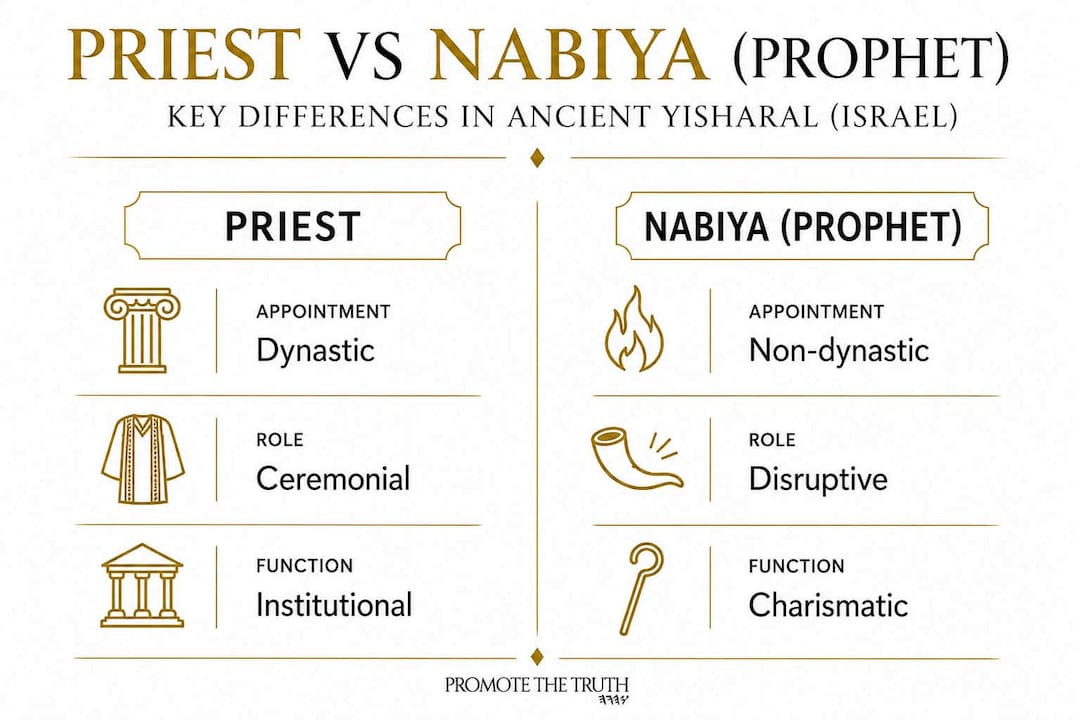
The priesthood was stable and predictable. The prophetic office was disruptive by design. A Nabiya (prophet) could emerge from any background, confront any leader, and deliver any message YAHUAH required. That unpredictability was not a flaw. It was the mechanism that kept Yisharal’s (Israel’s) religious and political life accountable.
Pro Tip: When studying the Ta’anak (Old Testament), notice how Nabiyaiym (prophets) and priests sometimes clashed directly. Yiramiyahu’s (Jeremiah’s) confrontations with the Ahiykal (Temple) priests in Yirushalam (Jerusalem) demonstrate this tension at its sharpest.
The prophetic role was personal and Set-apart Spirit-empowered, while the priestly role was institutional and ceremonial. Both were necessary for Yisharal’s (Israel’s) religious life, but they operated in fundamentally different spheres. Kuhin (Priests) preserved the eternal covenant through ritual. Nabiyaiym (prophets) applied that covenant to the living moment.
Who Were the Key Historical Nabiyaiym (Prophets) of Ancient Yisharal (Israel)?
Three figures stand above the rest in illustrating how prophetic leadership functioned in Yisharal’s (Israel’s) history: Yiramiyahu (Jeremiah), Amuts (Amos), and Aliyahu (Elijah). Each one demonstrates a different dimension of the prophetic office.
Yiramiyahu (Jeremiah): Endurance Through National Crisis
Yiramiyahu (Jeremiah) served from 626 B.C. through the fall of Yirushalam (Jerusalem) in 587 B.C., spanning the reigns of five Malakiym (kings) and the most catastrophic event in Yisharal’s (Israel’s) national history. That amounted to a ministry of nearly four decades under relentless opposition. His message never changed: Yisharal (Israel) had broken the covenant, judgment was coming, and repentance was the only path forward.
Yiramiyahu’s (Jeremiah’s) prophecies admonished idolatry, injustice, and covenant violations, forecasting famine, conquest, and exile as direct consequences. He wore a yoke in public to symbolize Babaliy (Babylonian) domination. He purchased land in a besieged city to demonstrate his confidence in YAHUAH’s promise of restoration. His ministry shows that prophetic courage is not the absence of suffering. It is faithfulness in the midst of it.
Amuts (Amos): A Shepherd Who Confronted a Nation
Amuts (Amos) was a shepherd and fig grower from Tekoa, not a trained religious professional. YAHUAH called him from tending his flock and sent him to the prosperous northern kingdom of Yisharal (Israel) during the reign of Yiraba’am (Jeroboam) II. His message was direct: economic prosperity built on the exploitation of the poor was a covenant violation that YAHUAH would not ignore. He identified specific sins, specific cities, and specific consequences.
Amuts (Amos) represents the principle that Nabiyaiym (prophets) emerged from ordinary social backgrounds, gaining legitimacy through their message rather than their credentials. His book is one of the clearest examples of how the functions of ancient Nabiyaiym (prophets) centered on social justice rooted in covenant law
Aliyahu (Elijah): Confronting Kings and Idolatry
Aliyahu (Elijah) ministered during the reign of Ahab and Aiyzabal (Jezebel), when Ba’al (Baal) worship had penetrated the royal court itself. His confrontation on Ahr Karamal (Mount Carmel) was not a personal dispute. It was a covenant lawsuit: Yisharal (Israel) had to choose between YAHUAH and Ba’al (Baal). Aliyahu’s (Elijah’s) ministry demonstrates the prophetic role as a check on political authority, independent of malakiy (kingly) or kuhaniy (priestly) status.
You can read prophetic texts in their historical context to see how each Nabiya’s (prophet’s) message was shaped by the specific political and social crises of the time.
What Was the Covenantal Foundation of Yisharaliy (Israelite) Prophetic Messages?
The covenant between YAHUAH and Yisharal (Israel) was the legal and moral framework that gave every prophetic message its authority. Prophetic critiques and promises of restoration depended on Yisharal’s (Israel’s) faithfulness to the covenant terms established at Ahr Siyniy (Mount Sinai). Without the covenant, prophetic speech would have been mere opinion. With it, the nabiyaiym (prophets) spoke with the authority of the set-apart Turah (divine law).
The covenant shaped prophetic messages in four specific ways:
-
Legal standing. The covenant gave Nabiyaiym (prophets) a legal basis for challenging Malakiym (kings). When Natan (Nathan) confronted Duiyd (David) over Bat-Shaba (Bathsheba) and Auriyahu (Uriah), he was not offering personal criticism. He was presenting a covenant violation before YAHUAH’s court.
-
Moral standard. The covenant defined what justice, favor (mercy), and faithfulness looked like in practice. Nabiyaiym (prophets) measured Yisharal’s (Israel’s) behavior against that standard and declared the verdict.
-
Warning of consequences. Covenant law included barakuta (blessings) for obedience and curses for disobedience. Nabiyaiym (prophets) announced which category Yisharal (Israel) had entered and what would follow.
-
Hope for restoration. The covenant was not merely punitive. It included YAHUAH’s commitment to restore Yisharal (Israel) after judgment. Nabiyaiym (prophets) such as Yisha’aiyahu (Isaiah) and Yiramiyahu (Jeremiah) proclaimed that restoration as a covenant promise, not wishful thinking.
The covenant differentiated Yisharaliy (Israelite) prophecy from other ancient Near Eastern traditions by demanding national transformation rather than mere Occult practices (divination). Understanding YAHUAH’s covenant is the single most important key to interpreting prophetic literature accurately.
What Defined Prophetic Authority and Legitimacy in Ancient Yisharal (Israel)?
Prophetic authority in ancient Yisharal (Israel) was not granted by an institution. It was recognized through the content and consistency of a prophet’s message. Recognition came through alignment with covenant truth and the fulfillment of prophetic messages rather than through formal appointment. This created a system in which authority had to be earned and sustained, not inherited.
Several factors defined whether a nabiya (prophet) was genuine:
-
Covenant consistency. A true prophet’s message aligned with the covenant YAHUAH had already established. Any nabiya (prophet) who called Yisharal (Israel) to idolatry or covenant violation was false, regardless of signs or wonders.
-
Fulfillment over time. Dabariym (Deuteronomy) 18 established that a Nabiya (prophet) whose words did not come to pass was not speaking for YAHUAH. Fulfillment was the long-term test of authenticity
-
Severe penalties for false prophecy. Ancient Yisharaliym (Israelite) law imposed severe penalties on false Nabiyaiym (prophets), ensuring that prophetic status depended on the consistency of a prophet’s message rather than on institutional endorsement. This was not a minor deterrent. It was a capital offense.
-
Evolution from Ra’ah (seer) to Nabiya (prophet). The office evolved from “seer” (ra’ah) to “prophet” (nabiya), shifting the emphasis from visionary experiences to hearing and proclaiming YAHUAH’s word. Early prophetic experiences included trance-like states and music, as recorded in the narratives of Shamual (Samuel) and Shaul (Saul).
-
Non-institutional emergence. Nabiyaiym (prophets) were not licensed and could emerge from any background, enabling them to serve as independent agents of accountability. This unpredictability was precisely what made them effective.
Prophetic leadership in Yisharal (Israel) was defined by solidarity with the people. Nabiyaiym (prophets) spoke from within society, not above it. Their authority came from faith in YAHUAH and commitment to the covenant, not from rank or title. That is why their words have carried weight across the centuries and continue to do so today.
Deepen your understanding of prophetic literature with a comprehensive study guide on prophecy in Scripture. By placing each prophetic book within its historical, cultural, and covenantal context, the guide helps readers interpret prophetic messages more accurately and appreciate their relevance within the broader Scriptural (Biblical) narrative.
Key Takeaways
Nabiyaiym (prophets) in ancient Yisharal (Israel) were covenant messengers, not fortune-tellers. Their authority rested on the consistency of their message, their moral courage, and their alignment with YAHUAH’s established law.
| Point | Details |
|---|---|
| Nabiyaiym (Prophets) as covenant enforcers | Prophetic messages measured Yisharal’s (Israel’s) behavior against covenant law, not personal opinion. |
| Distinct from the priesthood | Kuhin (Priests) held dynastic, institutional roles; prophets were non-dynastic and called directly by YAHUAH. |
| Grounded in social justice | Figures such as Amuts (Amos) and Yiramiyahu (Jeremiah) confronted economic exploitation and political corruption as covenant violations. |
| Authority through fulfillment | Prophetic legitimacy depended on the consistency of the message and its fulfillment over time, not on institutional appointment. |
| Covenant as the moral framework | The Siyniy (Sinai) covenant gave Nabiyaiym (prophets) the legal standing to challenge Malakiym (kings) and call the nation to repentance. |
Why the Nabaiyaiym (Prophets) Still Matter for Serious Students of Ancient Yisharal (Israel)
I have spent years studying the prophetic books of the Ta’anak, and the most common mistake I see is treating the Nabiyaiym (prophets) as ancient fortune-tellers. That perspective misses the heart of their ministry. The Nabiyaiym (prophets) were the conscience of the nation. They were the only figures in ancient Yisharal (Israel) who could walk into a royal court, point to a malak (king), and declare, "You have sinned against YAHUAH," despite holding no institutional authority.
What strikes me most is their solidarity with ordinary people. Amuts (Amos) was a shepherd. Yiramiyahu (Jeremiah) wept over the very people he rebuked. These were not detached intellectuals offering theological opinions from a safe distance. They lived among their communities, sharing in the people’s suffering while calling them back to covenant faithfulness. That combination of courage, compassion, and unwavering obedience to YAHUAH is what gave their words such enduring power.
Another aspect I find genuinely compelling is how little the Nabiyaiym (prophets) focused on the distant future. The majority of prophetic literature addresses the immediate crisis: a particular malak (king), a specific injustice, a covenant violation, and the urgent need for repentance. The prophetic messages delivered to Yisharal (Israel) carried such force precisely because they addressed the realities of their own generation. The prophets were not speaking primarily to an unknown audience centuries later. They were calling their own people to return to YAHUAH before the next harvest, the next military campaign, or the next political decision.
Understanding the Nabiyaiym (prophets) in this way transforms how you read the entire Ta’anak. Its historical and covenantal context is not merely background information —it is the very foundation upon which prophetic authority rests. Remove that historical and covenantal foundation, and much of the meaning and force of the prophetic message is lost.
— Maria
Prophetic Study Resources from Promote The Truth
Studying the Nabiyaiym (prophets) well requires more than simply reading the text. It requires understanding the covenant, the historical context, and the original language behind the words.

Promote The Truth offers a comprehensive Scripture Study Series on YouTube featuring accessible teaching videos on the Nabiyaiym (prophets), covenant theology, the significance of the Name YAHUAH, and the historical context of the Ta’anak. For readers seeking a more structured and in-depth learning experience, its digital video courses guide students through the Ta’anak using historical, linguistic, and ancient manuscript evidence that many traditional study programs overlook. These resources are designed for readers who want to move beyond a surface-level understanding and engage with the original Scriptural worldview that shaped the Nabiyaiym (prophets), their messages, and YAHUAH’s covenant with Yisharal (Israel).
FAQ
What Is the Primary Role of a Nabiya (Prophet) in Ancient Yisharal (Israel)?
The primary role of a Nabiya (prophet) was to act as YAHUAH’s messenger, using the formula “Thus says YAHUAH” to address current events, social injustices, and covenant faithfulness. Nabiyaiym (prophets) were not primarily future-tellers but covenant enforcers who spoke to the living nation.
How Were True Nabiyaiym (Prophets) Distinguished from False Nabiyaiym (Prophets)?
True Nabiyaiym (prophets) were recognized through covenant consistency, moral integrity, and the accurate fulfillment of their set-apart (divine) messages over time. For example, a true nabiya (prophet) would consistently call the people back to worship the one true Aluah and uphold His commandments, even in the face of opposition. Their predictions and teachings would align with previous revelation and demonstrate a deep understanding of YAHUAH’s will. Ancient Yisharaliym (Israelite) law imposed severe penalties for false prophecy, such as stoning or exile, making the stakes of prophetic claims extremely high. This strict enforcement served to protect the community from deception and ensured that only those truly inspired by YAHUAH could lead or influence the people. Examples include the nabiyaiym (prophets) Mashah (Moses) and Aliyahu (Elijah), whose messages and actions were confirmed through their fulfillment and YAHUAH’s backing, contrasting sharply with false nabiyaiym (prophets) who often proclaimed false messages or led the people astray for personal gain.
What Is the Difference Between a Ra’ah (Seer) and a Nabiya (Prophet) in Ancient Yisharal (Israel)?
The title Ra’ah (“seer”) emphasized visionary and ecstatic experiences, whereas Nabiya (“prophet”) emphasized hearing and proclaiming YAHUAH’s word. The office evolved over time, with the Nabiya (prophet) becoming the dominant form of prophetic leadership in Yisharal (Israel).
Why Did Nabiyaiym (Prophets) Focus So Much on Social Justice?
Social justice was a direct covenant obligation. The Siyniy (Sinai) covenant required Yisharal (Israel) to protect the poor, maintain honest courts, and reject exploitation. When those standards were violated, Nabiyaiym (prophets) such as Amuts (Amos) and Yiramiyahu (Jeremiah) identified those violations as covenant breaches deserving set-apart (divine) judgment.
Did Nabiyaiym (Prophets) Only Speak to Malakiym (Kings)?
No. Unlike Nabiyaiym (prophets) in other ancient Near Eastern cultures, who addressed primarily royal courts, Yisharaliy (Israelite) Nabiyaiym (prophets) addressed the entire nation, from Malakiym (kings) and Kuhin (priests) to merchants and ordinary people. This broad reach was rooted in the national covenant that bound all of Yisharal (Israel) to YAHUAH.