
A Scriptural (Biblical) covenant is a solemn, binding agreement initiated by YAHUAH that establishes a relationship with defined obligations, barakut (blessings), curses, and witnesses, following a specific ancient treaty pattern. Understanding Scriptural (Biblical) covenant structure unlocks the organizing framework of all Scripture. The Abariy (Hebrew) term berith and the Yuuniy (Greek) term diatheke both point to this reality: covenants are not casual promises but blood-sealed commitments initiated by set-apart (divine) sovereignty, not mutual negotiation between equals. The major covenants of Scripture, including the Abarahmiy (Abrahamic), Mashahiy (Mosaic), Duidiy (Davidic), and Bariyt Hadash (New Covenant), each follow this formal structure. Grasping that structure changes how you read every page of the Ta’anak (Old Testament) and the Bariyt Hadash (New Testament).
What are The Structural Components of Scriptural (Biblical) Covenants?
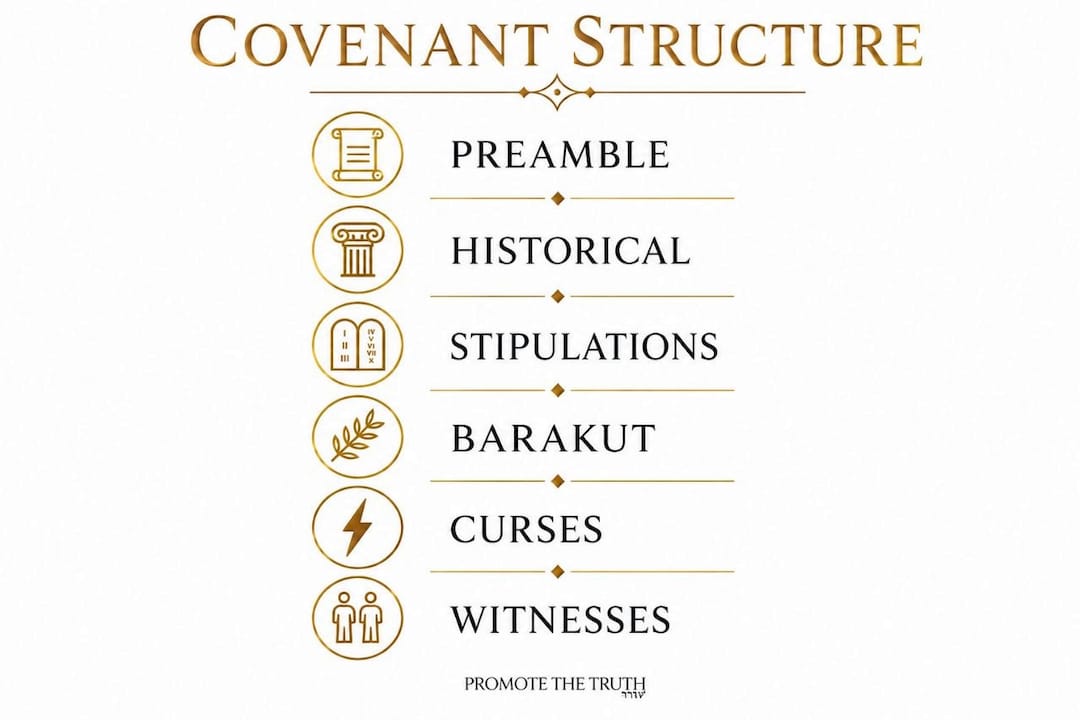
Scriptural (Biblical) covenants follow a six-part suzerainty treaty structure drawn directly from ancient Near Eastern diplomatic practice. Scholars consistently recognize these elements across covenant texts in both the Ta’anak (Old Testament) and the Bariyt Hadash (New Testament). Each component serves a specific theological function that shapes how the covenant communicates authority and relationship.
The six components are:
-
Preamble — Identifies the covenant-maker. In Shamut (Exodus) 20:2, YAHUAH opens with, “I am YAHUAH your Aluah…” This establishes who holds authority before any terms are stated.
-
Historical prologue — Recounts what the sovereign has already done for the vassal. The Shamut (Exodus) narrative serves this role in the Mashahiy (Mosaic) covenant, grounding obligation in prior compassion (grace).
-
Stipulations — List the required conduct of the vassal. The Ten Commandments in Shamut (Exodus) 20 and Dabariym (Deuteronomy) 5 are the clearest example…
-
Barakut (Blessings) — Describe the rewards for faithfulness. Dabariym (Deuteronomy) 28:1–14 catalogs the barakut (blessings) promised to Yisharal (Israel) for obedience.
-
Curses — Describe the consequences of covenant violation. Dabariym (Deuteronomy) 28:15–68 details these in stark terms, and their fulfillment is recorded in the exile narratives.
-
Witnesses — Call upon parties to confirm the covenant. Heaven and earth are invoked as witnesses in Dabariym (Deuteronomy) 30:19.
| Component | Function | Scriptural Example |
|---|---|---|
| Preamble | Identifies the sovereign | Shamut (Exodus) 20:2 |
| Historical prologue | Establishes prior grace | Shamut (Exodus) 19:4 |
| Stipulations | Defines required conduct | Shamut (Exodus) 20:3–17 |
| Barakut (Blessings) | Rewards for faithfulness | Dabariym (Deuteronomy) 28:1–14 |
| Curses | Consequences for breach | Dabariym (Deuteronomy) 28:15–68 |
| Witnesses | Confirms the covenant | Dabariym (Deuteronomy) 30:19 |
The origin of this structure in ancient Near Eastern suzerainty treaties is not incidental. YAHUAH communicated the covenant in forms that His people already understood. Recognizing these components in a text immediately signals that you are reading a covenant passage, which shapes every interpretive decision that follows.
Pro Tip: When you encounter a passage in Dabariym (Deuteronomy) or Yahusha (Joshua) that lists barakut (blessings) and curses side by side, you are almost certainly reading a covenant renewal passage. Identify all six components before drawing theological conclusions.

How Do Conditional and Unconditional Covenants Differ?
Two primary covenant types govern Scriptural (Biblical) theology: conditional covenants, which depend on human obedience, and unconditional covenants, which rest entirely on YAHUAH’s sovereign promise. Confusing these two categories produces some of the most persistent interpretive errors in Scriptural (Biblical) studies.
Conditional covenants carry the following characteristics:
-
They require human obedience to receive barakut (blessings).
-
Failure to obey triggers the covenant’s curse provisions.
-
They are bilateral in structure, meaning both parties bear obligations.
-
The Mashahiy (Mosaic) covenant is the defining example. Yisharal’s (Israel’s) continued possession of the land depended on faithfulness to the Turah (Torah).
Unconditional covenants work differently:
-
YAHUAH alone bears the oath, regardless of human response.
-
Barakut (Blessings) are guaranteed by set-apart (divine) promise, not by human merit.
-
They are unilateral in structure, meaning YAHUAH initiates and sustains them.
-
The Abarahmiy (Abrahamic) covenant in Barashiyt (Genesis) 15 is the clearest example. YAHUAH alone passed between the divided animals while Abaram (Abram) slept, taking the self-maledictory oath entirely upon Himself.
The Duidiy (Davidic) covenant shares this unconditional character. YAHUAH promised Duiyd (David) an eternal throne in 2 Shamual (2 Samuel) 7:12–16 without conditioning it on Duiyd’s (David’s) personal performance. By contrast, the Mashahiy (Mosaic) covenant was explicitly conditioned on Yisharal’s (Israel’s) obedience, as Dabariym (Deuteronomy) 28 makes unmistakably clear
Misinterpretations arise when readers apply the temporary, conditional terms of the Mashahiy (Mosaic) covenant to the eternal, unconditional promises made to Abarahm (Abraham) and Duiyd (David). That confusion generates theological disputes that careful covenant categorization can resolve immediately.
Pro Tip: Before interpreting any covenant passage, ask one question first: Who bears the oath? If YAHUAH alone swears the oath, the covenant is unconditional. If both parties swear the oath, it is conditional.
What Are the Major Scriptural (Biblical) Covenants, and How Do They Fit the Framework?
Five covenants form the backbone of Scripture’s redemptive narrative. Each carries a distinct structure, sign, and theological role. Together, they progressively build toward the Bariyt Hadash (New Covenant).
-
Nahahiy (Noahic) Covenant — Barashiyt (Genesis) 9:8–17 — Unconditional. YAHUAH promises never to destroy the earth by flood again. The sign is the rainbow. This covenant is universal in scope, covering all living creatures.
-
Abarahmiy (Abrahamic) Covenant — Barashiyt (Genesis) 12, 15, and 17 — Unconditional. YAHUAH promises land, descendants, and barakut (blessings) to Abarahm (Abraham) and his descendants. The sign is circumcision. The unilateral oath in Barashiyt (Genesis) 15 makes this covenant irrevocable.
-
Mashahiy (Mosaic) Covenant — Shamut (Exodus) 19–24 and Dabariym (Deuteronomy) — Conditional. YAHUAH establishes Yisharal (Israel) as His covenant people, with the Turah (Torah) serving as its stipulations. The sign is the Sabbath (Shamut (Exodus) 31:13). The barakut (blessings) and curses are explicit and were historically fulfilled.
-
Duidiy (Davidic) Covenant — 2 Shamual (2 Samuel) 7:12–16 and Tahliym (Psalm) 89 — Unconditional. YAHUAH promises an eternal dynasty to Duiyd (David). The sign is Duiyd’s (David’s) throne. This covenant finds its ultimate fulfillment in Yahusha who is YAHUAH (Yeshua) as the eternal King.
-
Bariyt Hadash (New Covenant) — Yiramiyahu (Jeremiah) 31:31–34 and Luqah (Luke) 22:20 — Unconditional. YAHUAH promises to write His Turah (Torah) on the heart, forgive iniquity, and pour out His Spirit. The sign is the blood of Yahusha who is YAHUAH (Yeshua).
| Covenant | Type | Sign | Scope |
|---|---|---|---|
| Nahahiy (Noahic) | Unconditional | Rainbow | Universal |
| Abarahmiy (Abrahamic) | Unconditional | Circumcision | Abraham’s descendants |
| Mashahiy (Mosaic) | Conditional | Shabat (Sabbath) | Yisharal (Israel) |
| Duidiy (Davidic) | Unconditional | Duiyd’s (David’s) throne | Yisharal (Israel) and the nations |
| Bariyt Hadash (New Covenant) | Unconditional | The blood of Yahusha who is YAHUAH (Yeshua) | All who believe |
Progressive revelation is the key interpretive principle here. Each covenant does not cancel its predecessor but builds upon it. The Abarahmiy (Abrahamic) promises find their fullest expression in the Bariyt Hadash (New Covenant). The Mashahiy (Mosaic) covenant’s stipulations are not abolished but internalized.Understanding Old Testament covenant history as a progressive sequence helps prevent the error of reading each covenant in isolation.
How Does the New Covenant Differ from Earlier Covenants?
The Bariyt Hadash (New Covenant) is the theological apex of Scripture’s covenant sequence. The Yuuniy (Greek) term diatheke appears more than 33 times in the Bariyt Hadash (New Testament), carrying the dual meaning of covenant and testament. That dual meaning is not accidental. A testament becomes effective upon the testator’s death, which is precisely what the blood of Yahusha who is YAHUAH (Yeshua) accomplishes.
The Bariyt Hadash (New Covenant) differs from earlier covenants in four specific ways:
-
Internalized law. Yiramiyahu (Jeremiah) 31:33 promises that YAHUAH will write His Turah (Torah) on the heart rather than on stone tablets. Obedience becomes a matter of transformed desire, not external compulsion.
-
Universal knowledge of YAHUAH. Yiramiyahu (Jeremiah) 31:34 states that everyone will know YAHUAH, from the least to the greatest. This surpasses the mediated knowledge available under the Mashahiy (Mosaic) covenant.
-
Complete forgiveness. The Bariyt Hadash (New Covenant) promises that YAHUAH will remember sin no more. No annual sacrifice could accomplish this. Only the blood of Yahusha who is YAHUAH (Yeshua) provides permanent atonement.
-
The gift of the Spirit. Yihazakal (Ezekiel) 36:26–27 connects the Bariyt Hadash (New Covenant) to the indwelling Spirit, who enables the obedience that the Mashahiy (Mosaic) covenant required but could not produce.
The Bariyt Hadash (New Covenant) surpasses ancient treaty forms through its eternal, unilateral nature and the blood of Yahusha who is YAHUAH (Yeshua) as its binding seal. This distinguishes it in both form and substance from earlier suzerainty-vassal covenants, making its fulfillment certain and its inheritance irrevocable.
The Abariy (Hebrew) and Aramiyt (Aramaic) origins of the Bariyt Hadash (New Testament) illuminate its covenant language with a precision that Yuuniy (Greek) translations sometimes obscure. The testamentary character of diatheke’s emphasizes a permanent set-apart (divine) gift rather than a bilateral, reciprocal obligation. That distinction reshapes how you understand favor (grace), law, and the entire Bariyt Hadash (New Testament).
How to Study and Interpret Scriptural (Biblical) Covenants Accurately
Accurate covenant interpretation requires a disciplined approach. The following principles guard against the most common interpretive errors that theology students encounter.
-
Read each covenant according to its type. Apply conditional terms only to conditional covenants. Apply unconditional promises only to unconditional covenants. Mixing these categories distorts both the Turah (Law) and favor (grace).
-
Reject modern contract thinking. A Scriptural (Biblical) covenant is not a business agreement between equals. YAHUAH initiates the covenant from a position of absolute sovereignty. The vassal responds but never negotiates.
-
Identify the six structural components. Use the suzerainty treaty framework as a diagnostic tool. When you locate the preamble, historical prologue, stipulations, barakut (blessings), curses, and witnesses in a text, you have identified a covenant passage and can interpret it accordingly.
-
Honor progressive revelation. Later covenants interpret and fulfill earlier ones. The Bariyt Hadash (New Covenant) does not erase the Abarahmiy (Abrahamic) promises; it fulfills them through Yahusha who is YAHUAH (Yeshua). Read both forward and backward through the covenant sequence.
-
Recognize blood as the covenant seal. The Abariy (Hebrew) phrase karath berith, meaning “to cut a covenant,” reflects the ancient practice of passing between divided animals as a self-maledictory oath. Blood seals every major Scriptural (Biblical) covenant, culminating in the blood of Yahusha who is YAHUAH (Yeshua).
-
Consult the original languages. Berith and diatheke carry nuances that English translations often flatten. Studying these terms in their linguistic context sharpens your understanding of what each covenant promises and requires.
Understanding YAHUAH’s covenant in its original Scriptural (Biblical) context is the foundation of sound covenant theology The role of community in study also matters. Covenant texts were read aloud in the assembly, and their meaning deepens when studied with others who hold one another accountable to the text.
Pro Tip: When studying a covenant passage, write all six suzerainty treaty components in the margin before reading any commentary. Your own structural analysis will often be more accurate than that of a secondary source that overlooks the covenant framework.
Key Takeaways
Scriptural (Biblical) covenant structure is defined by six ancient treaty components, two primary covenant types, and a progressive sequence of five major covenants that culminate in the unconditional Bariyt Hadash (New Covenant), sealed by the blood of Yahusha who is YAHUAH (Yeshua).
| Point | Details |
|---|---|
| Six-part structure | Every major Scriptural (Biblical) covenant follows a preamble, historical prologue, stipulations, barakut (blessings), curses, and witnesses. |
| Two covenant types | Conditional covenants require human obedience; unconditional covenants rest entirely on YAHUAH’s sovereign promise. |
| Progressive sequence | Five major covenants build upon one another, each advancing YAHUAH’s redemptive plan toward the Bariyt Hadash (New Covenant) |
| New Covenant apex | The Bariyt Hadash (New Covenant) internalizes the Turah (Law), guarantees forgiveness, and is sealed by the blood of Yahusha who is YAHUAH (Yeshua) as an irrevocable testament. |
| Interpretive discipline | Accurate covenant study requires identifying the covenant type, applying the suzerainty treaty framework, and interpreting Scripture through the lens of progressive revelation. |
Why Covenant Structure Is the Lens That Changes Everything
I have spent years studying Scripture through various frameworks, and none has proven more clarifying than covenant structure. When I first encountered the suzerainty treaty model applied to Dabariym (Deuteronomy), the entire book reorganized itself in my mind. What had seemed like repetitive legal code became a precisely structured covenant renewal document with a preamble, historical prologue, stipulations, and a full barakut (blessings) and curses section. That recognition did not just satisfy academic curiosity. It changed how I prayed, how I read the Nabiyaiym (Prophets), and how I understood the stake (cross).
What strikes me most is how consistently Scripture resists the modern instinct to flatten YAHUAH’s relationship with humanity into a transaction. Every covenant in the Scriptural (Biblical) record is initiated by YAHUAH, sealed by blood, and sustained by His faithfulness rather than by human performance. That truth is not a minor theological footnote. It is the organizing conviction of the entire Scriptural (Biblical) narrative. When you see the Abarahmiy (Abrahamic) covenant’s unilateral oath in Barashiyt (Genesis) 15 and then trace it forward to the blood of Yahusha who is YAHUAH (Yeshua) in Luqah (Luke) 22, you are watching one continuous set-apart (divine) commitment unfold across millennia.
My counsel to theology students is this: resist the urge to jump straight to systematic theology categories. Sit with the covenant texts themselves first. Identify the six components. Ask who bears the oath. Follow the progressive sequence. The structure will do much of the interpretive work for you if you let it. Water immersion (baptism), for example, carries covenant significance that makes its fullest sense when understood within the blood-sealing pattern that runs through every major covenant. The Bariyt Hadash (New Covenant) sign is not arbitrary. It is the culmination of a pattern YAHUAH established from the very beginning.
— Maria
Resources for Deeper Covenant Study from Promote The Truth
Promote The Truth exists to help readers move beyond surface-level Scripture (Bible) reading to a deeper understanding of Scriptural (Biblical) truth. For theology students and serious students of Scripture exploring covenant theology, the organization provides resources grounded in manuscript research, historical context, and the study of the original Abariy (Hebrew) and Aramiyt (Aramaic) languages.
The Scripture Study Series on the Promote The Truth YouTube channel explores covenant passages with historical, linguistic, and Scriptural depth, helping readers understand the text within its original context. Whether you are new to covenant theology or seeking a deeper understanding of Scripture, these teachings provide a valuable companion to your personal study.
For readers who want to engage directly with the original text, the Truth Scriptures digital collection offers a meticulously translated English restoration of the Ta’anak and Bariyt Hadash, translated from ancient Abariy (Hebrew) and Aramiyt (Aramaic) manuscript sources. This allows readers to examine the Scriptural text alongside the linguistic and historical foundations that shape its meaning.
For a more structured learning experience, the Digital Video Academy provides in-depth courses on covenant theology, the Name YAHUAH, the original Scriptural worldview, and the manuscript traditions behind the Scriptures. Together, these resources are designed to help readers move beyond a surface-level understanding and develop a deeper, manuscript-based approach to studying Scripture.
FAQ
What Is a Scriptural (Biblical) Covenant?
A Scriptural (Biblical) covenant is a solemn, binding agreement initiated by YAHUAH that establishes a relationship with defined obligations, barakut (blessings), curses, and witnesses. It is not a mutual contract between equals but a hierarchical commitment sealed by blood.
What Are the Six Parts of a Scriptural (Biblical) Covenant?
Scriptural (Biblical) covenants follow a six-part suzerainty treaty structure consisting of the preamble, historical prologue, stipulations, barakut (blessings), curses, and witnesses. Scholars consistently recognize these components across the major covenant texts of Scripture.
What Is the Difference Between Conditional and Unconditional Covenants?
Conditional covenants, such as the Mashahiy (Mosaic) covenant, require human obedience to receive barakut (blessings). Unconditional covenants, such as the Abarahmiy (Abrahamic) and Duidiy (Davidic) covenants, rest entirely on YAHUAH’s sovereign promise, regardless of human performance.
How Does the Bariyt Hadash (New Covenant) Differ from the Mashahiy (Mosaic) Covenant?
The Bariyt Hadash (New Covenant) internalizes the Turah (Torah) within the heart, guarantees complete forgiveness, and is sealed by the blood of Yahusha who is YAHUAH (Yeshua) as an irrevocable testament. The Mashahiy (Mosaic) covenant was conditional and temporary, whereas the Bariyt Hadash (New Covenant) is unconditional and eternal.
What Does Berith Mean in Abariy (Hebrew)?
Berith means covenant and is associated with the concept of “cutting,” referring to the ancient practice of passing between divided animals as a self-maledictory oath. This ritual underscored the serious consequences of breaking the covenant bond.