
Yahudiym (Jewish) women are generally exempt from wearing tzitzit, yet many rabbinic authorities permit—and, in some circumstances, encourage—their voluntary observance. This conclusion is rooted in the command given in Bamadabar (Numbers) 15 and in the halakhic tradition that developed through the Talmud, Rambam (Maimonides), the Shulchan Aruch, and later rabbinic authorities.
YAHUAH spoke to Mashah, saying, “Speak to the children of Yisharal and tell them to tie several pieces of thread together. Tie them to the corners of your clothes. Put a blue thread in each one you tie. Wear them throughout your generations. It shall be a tassel for you to look at, so that you remember and do all the Commandments of YAHUAH. Then you shall not follow your own heart and eyes, which lead you astray. Remember to guard all My Commandments. Then you shall be Set-Apart to your Aluah. I am YAHUAH, your Aluah, who brought you out of the land of Matsar, to be your Aluah. I am YAHUAH, your Aluah.” Bamadabar (TST) 15:37–41
The halakhic framework rests on a single classification: tzitzit is a mitzvat aseh she’hazman gerama—a positive, time-bound commandment. Although Bamadabar (Numbers) 15:37–41 commands the children of Yisharal to wear tzitzit, the passage itself does not distinguish between men and women. The traditional exemption developed through Talmudic interpretation, which classifies tzitzit as a positive, time-bound commandment. Because women are generally exempt from such commandments, the obligation to wear tzitzit does not ordinarily apply to them. Rambam (Maimonides), the Shulchan Aruch, and the Rema all affirm this exemption. At the same time, they do not uniformly prohibit women from wearing tzitzit. Instead, the discussion centers on how, when, and under what circumstances a woman may wear tzitzit, rather than on whether she is categorically forbidden from doing so.
Quick Reference:
-
Women are generally exempt, but not categorically forbidden, from wearing tzitzit according to many major rabbinic authorities.
-
Private practice (tallit katan under clothing) is widely uncontroversial
-
Private observance (such as wearing a tallit katan beneath one’s clothing) is generally less controversial than public practice.
-
Publicly wearing tzitzit has traditionally raised concerns about yuhara (spiritual pride or arrogance) in some Orthodox communities.
-
Barakah (Blessing) practices vary. Sephardic authorities generally do not recite the Barakah over tzitzit when women wear them, while some Ashkenazic authorities permit reciting the Barakah under certain circumstances.
-
Questions regarding the keli gever prohibition (wearing clothing associated with the opposite sex) are often addressed by using garments specifically designed for women.
-
Consult your rabbi before adopting a public practice or reciting the Barakah, as customs differ among Jewish communities.
Table of Contents
-
What Are the Main Rabbinic Arguments For and Against Women Wearing Tzitzit?
-
How Do American Yahudiym (Jewish) Communities Handle Women Wearing Tzitzit Today?
-
Where Does the Tzitzit Commandment Come From, and How Did it Become Gendered-Specific?
-
What Question Should You Ask Your Rabbi Before Wearing Tzitzit?
What Do Halakhic Sources Say About Tzitzit for Women?
The exemption is not a rabbinic invention. Rather, it is rooted in the Turah (Torah) itself and in the Talmudic interpretation that shaped subsequent halakhic rulings.
The Scriptural and Talmudic Foundation
Bamadabar (Numbers) 15:37–41 commands the Yisharaliym (Israelites) to place tzitzit (fringes) on the corners of their garments. The Talmud, in Menaḥot 43a, derives from the phrase u’reitem (“and you shall see them”) that the commandment applies during the daytime, thereby classifying tzitzit as a positive, time-bound mitzvah. Because women are traditionally exempt from positive, time-bound commandments, the obligation to wear tzitzit does not ordinarily apply to them within the halakhic framework.
Rambam (Maimonides) codifies this ruling in Mishneh Torah, Hilkhot Tzitzit 3:9, classifying tzitzit as a positive, time-bound mitzvah and explicitly stating that women who choose to wear tzitzit may do so without reciting a Barakah (blessing). His ruling is permissive rather than prohibitive. Peninei Halakha summarizes this position clearly, noting that private observance by women is generally permitted, while the practice of reciting the Barakah differs between Ashkenazic and Sephardic traditions.
How the Shulchan Aruch and the Rema Shaped the Ruling
The Shulchan Aruch, Orach Chaim 17:1–2, follows Rambam’s permissive approach: women are exempt from the commandment to wear tzitzit, but voluntary observance is permitted. The Rema’s gloss introduces an important qualification. He discourages women from wearing tzitzit publicly because doing so could be perceived as yuhara (spiritual pride or arrogance), which traditional Yahudiym (Jewish) teaching regards as inappropriate. Even so, private observance remains generally acceptable under the Rema’s more cautious approach.
Later authorities developed this discussion in different directions. Rav Moshe Feinstein, one of the foremost Ashkenazic poskim of the twentieth century, expressed concern about the public wearing of tzitzit, particularly when it could be perceived as departing from established communal practice. Rav Eliezer Melamed, author of Peninei Halakha, adopts a more permissive position, arguing that when a woman’s motivation is l’shem shamayim (“for the sake of Heaven”) and her observance remains private, yuhara is generally not considered a significant halakhic concern. Rav Aharon Lichtenstein, of Yeshivat Har Etzion, likewise recognized the legitimacy of voluntary observance while emphasizing the importance of sensitivity to one’s community, its customs, and its established practices.
Timeline of Key Rulings
| Period | Authority | Ruling |
|---|---|---|
| 12th century | Rambam (Maimonides) | Women are exempt from wearing tzitzit, but voluntary observance is permitted without reciting a Barakah (blessing). |
| 16th century | Shulchan Aruch (Rabbi Yosef Karo) | Confirms the exemption while permitting voluntary observance. |
| 16th century | Rema (Rabbi Moses Isserles) | Discourages the public wearing of tzitzit because of yuhara (spiritual pride), while permitting private observance. |
| 15th century | Maharil (Rabbi Yaakov Moelin) | Cautions against women publicly wearing tzitzit. |
| 20th century | Rav Moshe Feinstein | Expresses concern about the public wearing of tzitzit, while viewing private observance as less problematic. |
| 20th-century | Rav Eliezer Melamed | eaches that private observance motivated by l’shem shamayim (“for the sake of Heaven”) does not generally constitute yuhara. |
| 20th–21st century | Rav Aharon Lichtenstein | Recognizes voluntary observance as legitimate while emphasizing sensitivity to community customs and context. |
What Are the Main Rabbinic Arguments For and Against Women Wearing Tzitzit?
The discussion is not simply a matter of permissive versus restrictive views. Each position is grounded in recognized halakhic sources and carries practical implications for how a woman may choose to observe the mitzvah of tzitzit.
Arguments Against or Qualifying the Practice: Keli Gever
The discussion of keli gever is rooted in the Scriptural command found in Dabariym (sn-Deuteronomy) 22:5:
“A woman must not wear men’s clothing, and a man must not wear women’s clothing. Whoever does these things is an abomination to YAHUAH, your Aluah.” — Dabariym (TST) 22:5
Rabbinic authorities have long debated how this command applies to tzitzit. Yeshivat Har Etzion’s analysis explains that many poskim regard the traditional tallit katan as a distinctly male garment. As a result, they apply the keli gever prohibition to women wearing a standard tallit katan unless the garment is clearly designed for women. This interpretation concerns the type of garment rather than the commandment of tzitzit itself, which is why some later authorities permit women to wear tzitzit when attached to clothing that is recognizably feminine in design.
The practical implications of these halakhic positions are straightforward. Those who follow Rambam’s permissive approach may choose to wear tzitzit privately without reciting a Barakah (blessing). Those who follow the Rema’s more cautious position generally refrain from wearing tzitzit publicly. Others adopt a middle approach by wearing a feminine-cut tallit katan, seeking to address keli gever concerns in light of Dabariym (sn-Deuteronomy) 22:5, while keeping the garment beneath their clothing to avoid concerns about yuhara (spiritual pride or arrogance).
How Do Women Who Choose to Wear Tzitzit Practice It?
In practice, women who choose to wear tzitzit generally follow the halakhic principles discussed above. Many begin with private observance and consult a qualified rabbi before adopting any public practice. Deracheha’s survey notes that wearing a tallit katan beneath one’s clothing is among the most widely accepted and least controversial approaches.
Common Practical Approaches
- Feminine-cut tallit katan — A garment designed specifically for women, with a feminine cut, style, or fabric, may help address keli gever concerns while allowing women to wear tzitzit. Yeshivat Har Etzion notes that many halakhic authorities recognize attaching tzitzit to a garment that is clearly feminine in design as a legitimate way to address the concerns raised by Dabariym (sn-Deuteronomy) 22:5.
Barakah (Blessing) Practices
Whether a woman should recite the Barakah (blessing) over tzitzit is a question best answered in consultation with a qualified rabbi. Ashkenazic practice, following the Rema, generally does not require women to recite the Barakah, since they are not obligated to perform the commandment. However, some Ashkenazic authorities permit reciting the Barakah when a woman has voluntarily accepted the practice as personally binding. Sephardic authorities, following the Shulchan Aruch, generally maintain that a Barakah should not be recited over a mitzvah for which one is not obligated. Yeshivat Har Bracha’s clearly explains these differing approaches and recommends consulting a qualified posek before adopting any particular practice.
Pro Tip: If you are beginning the practice of wearing tzitzit, start by wearing a tallit katan beneath your clothing and refrain from reciting the Barakah (blessing) during the initial period. This approach keeps the practice private, helps avoid concerns about yuhara (spiritual pride or arrogance), and gives you time to discuss the question of the Barakah with your rabbi, drawing on practical experience rather than theory.
How Do American Yahudiym (Jewish) Communities Handle Women Wearing Tzitzit Today?
The practice of women wearing tzitzit in the United States varies significantly among Yahudiym (Jewish) communities. Differences in denomination, local custom, and rabbinic leadership all influence what is considered appropriate and acceptable.
| Denomination | General Approach | Barakah (Blessing) Practice | Common Form of Practice |
|---|---|---|---|
| Orthodox | Cautious; private observance generally permitted | Barakah generally omitted | Tallit katan worn beneath clothing, if practiced |
| Modern Orthodox | Varies; active rabbinic discussion continues | Depends on the posek followed | Primarily private practice; some public observance in egalitarian minyanim |
| Conservative | Generally permissive | Barakah often recited | Tallit gadol commonly worn in the synagogue |
| Reform | Fully permissive | Barakah generally recited | Tallit gadol commonly worn during services |
| Reconstructionist | Fully permissive | Barakah generally recited | Tallit gadol, sometimes custom designed |
Observable Patterns in American Yahudiym (Jewish) Communities
-
In many Orthodox synagogues, women publicly wearing tzitzit remains uncommon and may receive communal criticism, whereas private observance is generally less controversial.
-
Modern Orthodox communities, particularly those associated with Yeshiva University, continue to debate the issue. A personal account published in the YU Commentator describes both encouragement and skepticism experienced by women who choose to wear tzitzit in those settings.
-
Conservative congregations affiliated with the United Synagogue of Conservative Judaism (USCJ) generally regard women’s tzitzit practice as consistent with the movement’s egalitarian halakhic decisions.
-
Reform and Reconstructionist communities typically view the tallit as a shared ritual garment for all members, making women’s tzitzit practice a normal part of congregational life.
-
Orthodox feminist and partnership minyanim occupy a middle position. Women may wear tallitot during prayer, but the practice is generally understood to be voluntary and is often accompanied by a decision not to recite the Barakah.
The Forward has documented how some observant women began producing feminine-style tzitzit and tallitot to address both halakhic concerns and personal expressions of devotion. This development has generated both appreciation and debate within traditional Yahudiym (Jewish) communities.
For additional historical context, The Role of Women in Ancient Scripture provides helpful background on how gender-specific ritual roles developed over time and why discussions surrounding women’s tzitzit continue to be significant today.
Where Does the Tzitzit Commandment Come From, and How Did It Become Gender-Specific?
The commandment to wear tzitzit originates in Bamadabar (Numbers) 15:37–41, where YAHUAH instructs the Yisharaliym (Israelites) to place fringes (tzitzit) on the corners of their garments as a visible reminder of His commandments. The passage itself does not distinguish between men and women. The gender-specific application of the commandment developed later through Talmudic interpretation and the historical development of Yahudiym (Jewish) dress and halakhic practice.
Key Developments in the Historical Record
-
Menaḥot 43a derives the time-bound nature of the mitzvah from the word u’reitem (“and you shall see them”), classifying tzitzit as a positive, time-bound commandment. This Talmudic interpretation became the basis for the traditional exemption of women.
-
During the Scriptural (biblical) period, four-cornered outer garments were commonly worn by both men and women. The commandment applied to anyone wearing such a garment.
-
As Yahudiym (Jewish) clothing changed during the medieval period, four-cornered outer garments gradually fell out of everyday use. The tallit katan was developed to preserve the commandment of tzitzit, eventually becoming a garment primarily associated with men in most Jewish communities.
-
Rambam (Maimonides) reflects this development in his Mishneh Torah, where the mitzvah is applied to a purpose-made garment worn specifically to fulfill the commandment rather than to an ordinary article of clothing.
-
The Rema’s discussion of keli gever in the sixteenth century reflects a period in which the tallit katan had become so closely associated with male practice that a woman wearing one could raise questions regarding cross-dressing under halakhic law.
Historical Development of the Tzitzit Commandment
| Source | Key Contribution |
|---|---|
| Bamadabar (Numbers) 15:37–41 | Records the original commandment to wear tzitzit without explicitly distinguishing between men and women. |
| Menaḥot 43a | Classifies tzitzit as a positive, time-bound mitzvah, forming the traditional basis for the exemption of women. |
| Rambam, Mishneh Torah | Codifies the exemption while permitting voluntary observance by women. |
| Shulchan Aruch, Orach Chaim 17:1–2 | Confirms the exemption and permits voluntary observance. |
| Rema’s Gloss | Introduces concerns regarding yuhara and discourages the public wearing of tzitzit by women. |
For additional historical context, Ancient Abariy (Hebrew) Worship Practices provides insight into how ritual garments functioned in early Yisharaliym (Israelite) worship before later rabbinic distinctions became established.
Both Tzofia’s overview and First Fruits of Zion’s analysis trace the historical development of women’s tzitzit and demonstrate that the gender-specific application of the commandment emerged gradually through centuries of halakhic interpretation rather than through a single authoritative ruling.
What Question Should You Ask Your Rabbi Before Wearing Tzitzit?
A private halakhic consultation is one of the most important steps before adopting any new ritual practice. Because customs and rulings vary among Yahudiym (Jewish) communities, speaking with a qualified rabbi can help you make an informed decision rooted in both halakhic tradition and the customs of your local community. Consider asking the following questions:
-
What is the local custom (minhag hamakom)?
Community practice matters. A rabbi who knows your synagogue and community can explain whether women wearing tzitzit is accepted, debated, or discouraged in your local setting. -
Which poskim do you follow on this question?
The difference between Rambam’s permissive ruling and the Rema’s more cautious approach is significant. Understanding your rabbi’s halakhic framework will help you understand the reasoning behind the guidance you receive. -
Should I recite a Barakah (blessing)?
This remains one of the most debated practical questions. Explain whether you are Ashkenazic or Sephardic, since practices regarding the Barakah differ between these traditions. -
Would you recommend private or public observance?
A rabbi who understands your community, circumstances, and intentions can provide guidance that is tailored to your situation rather than offering only a general ruling. -
What type of garment best addresses keli gever concerns?
Ask whether a feminine-cut tallit katan, a particular fabric, or another garment design would satisfy halakhic considerations while addressing concerns related to clothing traditionally associated with men. -
How should I explain my practice to others?
A rabbi can help you explain your sincere intentions in a respectful way that minimizes misunderstanding and demonstrates sensitivity to your community's traditions.
After your consultation, a reasonable next step may be a period of private observance. Wear a tallit katan beneath your clothing for several weeks, refrain from reciting the Barakah (blessing) unless your rabbi advises otherwise, and return with any questions that arise through practical experience. Many women find that the experience itself helps clarify what additional guidance they need. Studying the relevant halakhic texts with a study partner or participating in a class can also deepen your understanding before—or alongside—your practice.
Key Takeaways
Women are generally exempt from wearing tzitzit because it is classified as a positive, time-bound mitzvah. However, Rambam (Maimonides), the Shulchan Aruch, and many later halakhic authorities permit voluntary observance, making sincere, private practice the least controversial approach within traditional Jewish law.
| Point | Details |
|---|---|
| Exempt but Permitted | Women are not obligated to wear tzitzit, but many major halakhic authorities permit voluntary observance. |
| Private Practice Is the Least Controversial | Wearing a tallit katan beneath one’s clothing helps address concerns regarding both yuhara (spiritual pride) and keli gever (cross-dressing). |
| Barakah (Blessing) Practices Differ | Ashkenazic and Sephardic traditions differ regarding the Barakah (blessing). Consult your rabbi before reciting a Barakah over tzitzit. |
| A Feminine Garment Can Address Keli Gever Concerns | A tallit katan that is clearly feminine in design, cut, or fabric is recognized by many halakhic authorities as a way to address keli gever concerns. |
| Promote The Truth Study Resources | Promote The Truth provides manuscript-based study resources, including the Truth Scriptures and Scripture Study Series, for readers who want to examine Bamadabar (Numbers) 15, the Talmud, and classical responsa firsthand. |
A Balanced Perspective on Women and Tzitzit
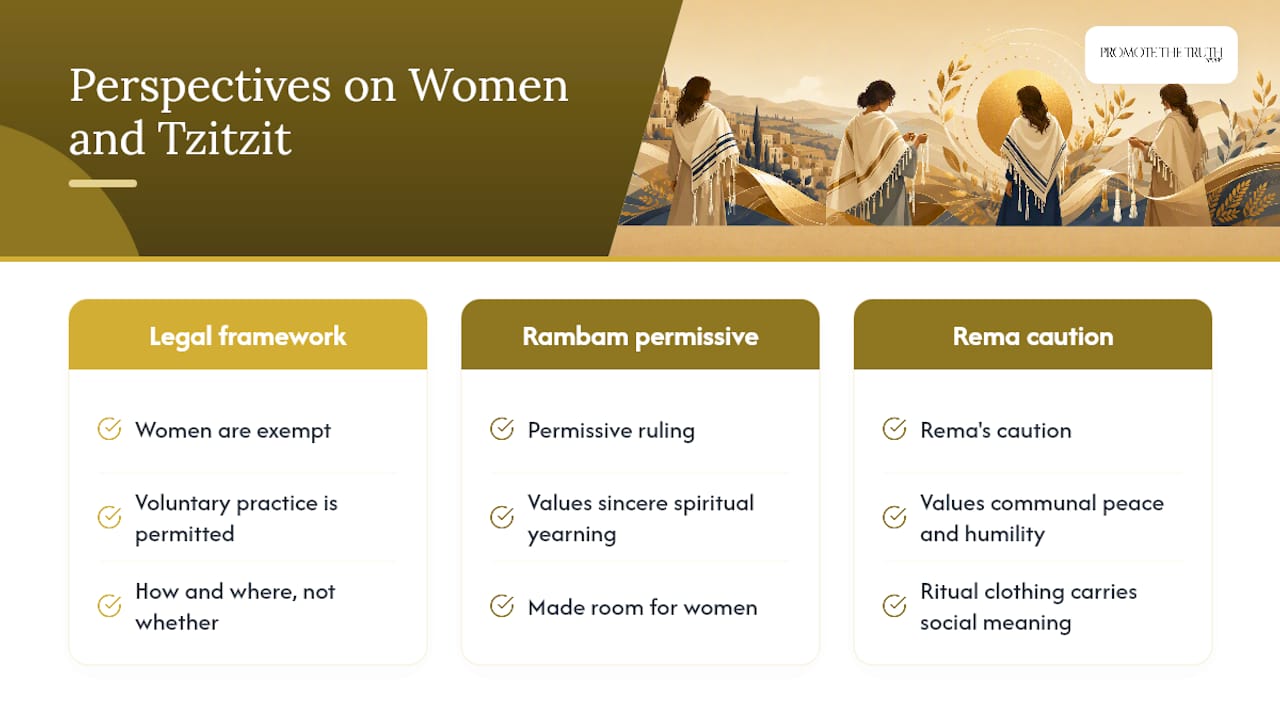
The halakhic discussion surrounding women wearing tzitzit is, at its heart, a conversation about sincerity, humility, and community. The legal framework is relatively clear: women are exempt from the commandment, voluntary observance is generally permitted, and the primary questions concern how and where the practice is observed rather than whether it is permitted. What makes the subject especially meaningful is that ritual garments carry significance beyond their legal function. A tallit or a set of tzitzit is more than clothing—it is a visible expression of faith, and within a community, that expression naturally invites attention and interpretation.
A careful reading of the classical sources suggests that the tradition has long made room for women who sincerely desire to draw closer to YAHUAH through this practice. Rambam’s permissive ruling reflects an appreciation for genuine spiritual devotion, while the Rema’s caution emphasizes the importance of humility and sensitivity to one’s community. Holding these two principles together—rather than reducing the discussion to a simple “yes” or “no”—reflects the balanced approach that careful study of the primary halakhic sources encourages.
Ultimately, there is no substitute for studying the primary texts themselves. Reading Bamadabar (Numbers) 15, the Talmudic discussion in Menaḥot, and the classical responsa in their original context provides a far richer understanding than any summary can offer. That is where the conversation has taken place for centuries, and it remains the best place for serious students to deepen their understanding.
Promote The Truth Resources
The halakhic discussion in this article is grounded in primary sources, including Bamadabar (Numbers) 15, Menaḥot 43a, Rambam’s Mishneh Torah, and the responsa of leading poskim. Studying these foundational texts in a faithful, carefully restored translation can significantly deepen your understanding of their meaning and application.

Promote The Truth publishes the Truth Scriptures, a carefully restored English translation of the Ta’anak and Bariyt Hadash, translated from ancient Abariy (Hebrew) and Aramiyt (Aramaic) manuscript sources. By preserving the original names, key terms, and important textual readings, the Truth Scriptures helps readers engage more closely with the manuscript tradition.
For those seeking guided study, the Scripture Study Series offers verse-by-verse video teachings that explore primary Scriptural texts, historical context, manuscript evidence, and the significance of the Name YAHUAH. If you prefer a structured learning path, the Digital Video Academy provides in-depth courses on the Truth Scriptures, Abariy (Hebrew) roots, restoration translation principles, and the historical background of the Scriptures.
If your desire is not simply to read about the Scriptures but to understand them more deeply, begin with the primary text. Build your understanding on the manuscript evidence, examine the historical context, and let the Word of YAHUAH shape your convictions. A careful study of the Scriptures is one of the most rewarding journeys a truth seeker can undertake, and every step begins by returning to the text itself.
Useful Sources and Further Reading
The following primary and secondary sources were referenced in this article. Each provides valuable insight for readers who wish to explore the topic of women wearing tzitzit, halakhic interpretation, and Jewish tradition in greater depth.
-
Women and Tzitzit — Peninei Halakha
-
Women and Tzitzit I: Keli Gever — Yeshivat Har Etzion
-
Can a Woman Wear Tzitzit or a Tallit? — tzofia.org
-
Tzitzit I: Keli Gever — Deracheha
-
I Am a Woman and I Wear Tzitzit: Here’s Why — YU Commentator
-
I Am a Woman and I Wear Tzitzit: Here’s Why — YU Commentator
This article is intended for educational purposes and provides an overview of the relevant halakhic sources and historical background. For personal guidance regarding wearing tzitzit, reciting a Barakah (blessing), or related practices, consult a qualified halakhic authority who is familiar with your community, tradition, and individual circumstances.