
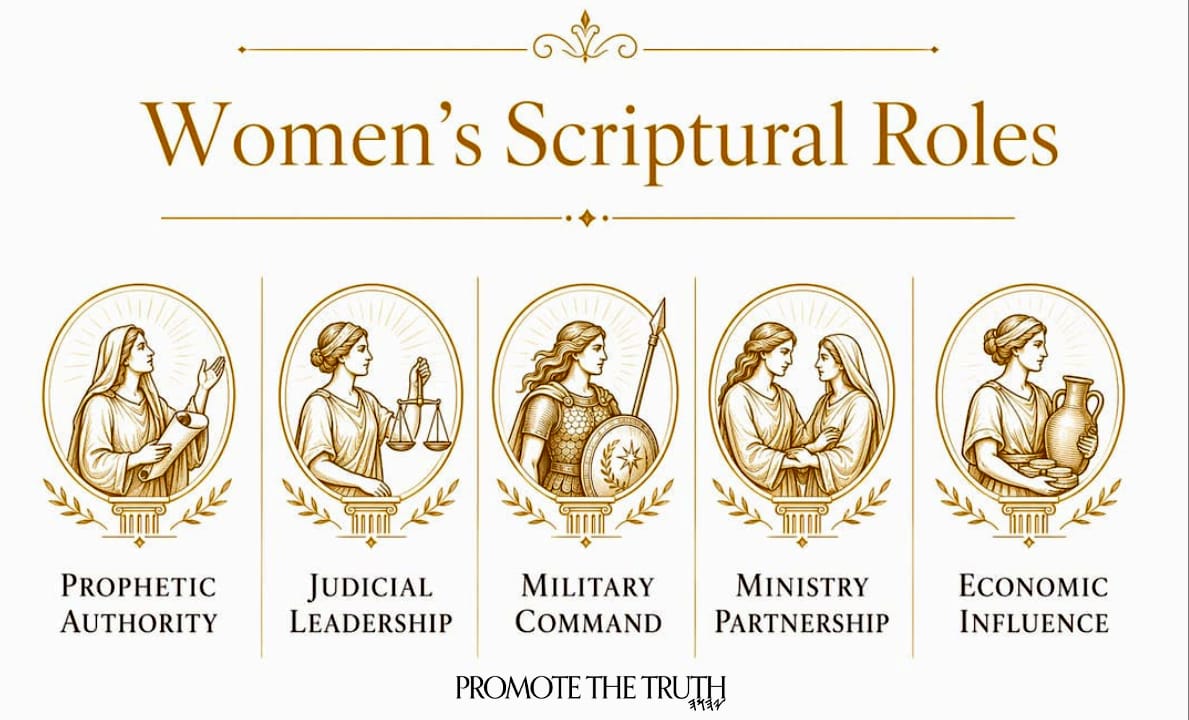
The role of women in ancient scripture is defined by active leadership, prophetic authority, and ministry partnership across both the Ta’anak (Old Testament) and the Bariyt Hadash (New Testament). These are not peripheral figures tucked into footnotes. Daburah (Deborah), Asatar (Esther), Piybiy (Phoebe), Pariysaqah (Priscilla), and Mariym Magadala (Mary Magdalene) each held recognized positions of authority within their communities, and the original texts say so plainly. What modern readers often encounter is not the original record but centuries of interpretive tradition layered on top of it. Stripping those layers back reveals something striking: women in religious texts were shapatiym (judges), patrons, teachers, and apostolic emissaries.
What leadership roles did women hold in the Ta’anak (Old Testament)?
Women’s leadership in scripture spans judicial authority, political influence, teaching ministry, and ecclesial service, with figures like Daburah (Deborah) and Asatar (Esther) standing as the clearest examples. These roles were not honorary. They carried real responsibility and real consequence.
Daburah’s (Deborah’s) case is the most thoroughly documented. Daburah (Deborah) served as nabiya (prophetess), shapat (judge), military leader, and poet in ancient Yisharal (Israel) for approximately 60 years, with her leadership recorded across Shapatiym (Judges) 4 and 5. What makes her account remarkable is not just the breadth of her roles but the community’s response. The Yisharaliym (Israelites) accepted her authority without any recorded dissent. That detail matters enormously. In a patriarchal ancient Near Eastern society, the absence of opposition to a female Shapat (judge) and military commander signals that her authority was understood as divinely granted, not culturally imposed.
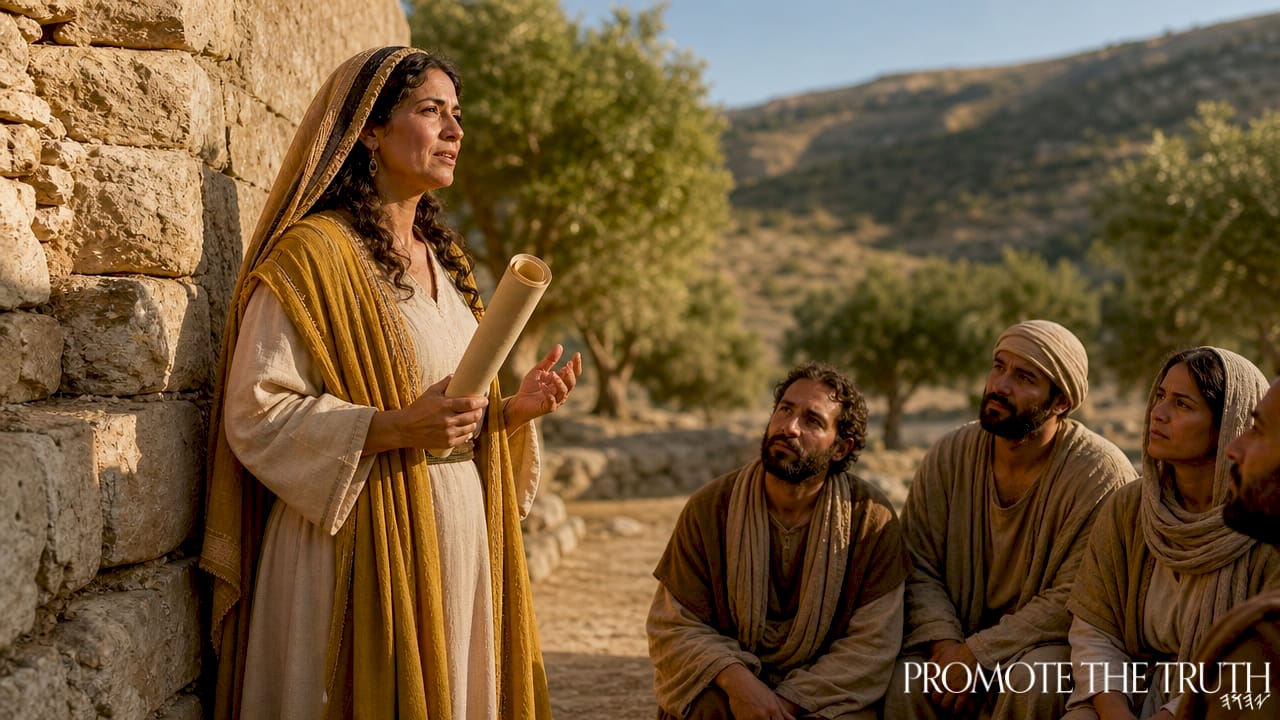
Daburah’s (Deborah’s) leadership recognized through divine appointment rather than gender norms is the interpretive key the text itself provides. She did not hold authority because no man was available. She held it because she was called and gifted for it, and the community recognized that calling.
Asatar (Esther) presents a different but equally instructive model. Her influence operated within the Parasiy (Persian) court, where she navigated political danger with strategic precision. She did not lead armies or pronounce judgments. She used access, timing, and moral courage to reverse a decree of genocide against her people. Her story illustrates that women’s influence in ancient texts took multiple forms, and political intelligence was one of them.
Other figures deserve attention alongside Daburah (Deborah) and Asatar (Esther):
-
Ya’al (Jael) Shapatiym (Judges) 4:17-22 acted decisively at a critical military moment, fulfilling Daburah’s (Deborah’s) prophecy that the enemy commander would fall at the hand of a woman.
-
The wise woman of Abal (Abel) 2 Shamual (Samuel) 20:16-22 negotiated directly with a military commander to save her city, demonstrating recognized civic authority.
-
Haladah (Huldah) the prophetess 2 Malakiym (Kings) 22:14-20 was consulted by Malaki (King) Yashiyahu’s (Josiah’s) officials when the Book of the Turah (Law) was discovered, making her the authoritative voice on one of the most significant religious events in Yisharaliy (Israelite) history.
Pro Tip: When studying female figures in scripture, read the original Abariym (Hebrew) text alongside a reliable translation. Titles and descriptions often carry weight that gets softened or omitted in later versions.
The pattern across these accounts is consistent. Leadership in the Ta’anak was linked to character, divine calling, and community recognition. Gender was not the determining factor the text presents.
How did women contribute to early Yahudiym, followers of the Savior (Christian) communities?
The Bariyt Hadash (New Testament) record of women in ministry is more quantitatively specific than most readers realize. Rumaiym (Romans) 16 names 29 individuals, 10 of whom are women, with 7 described in ministry contexts. That is not a marginal presence. It is a ministry network in which women held central positions, documented by Shaul’s (Paul’s) own hand.
Piybiy (Phoebe) is the most precisely described. Shaul (Paul) commends Piybiy (Phoebe) as minister and patron of the congregation at Qanatsariyah (Cenchrea) in Rumaiym (Romans) 16:1-2. This is the same word Shaul (Paul) uses to describe his own ministry and that of Tiymutiy (Timothy). The term carries weight. It is not a diminutive title. It describes someone who serves in an official, recognized capacity within the community of faith.
“I commend to you our sister Piybiy (Phoebe), a minister of the congregation which is at Qanatsariyah (Cenchrea), that you receive her in the Master, in a manner worthy of the set-apart ones, and assist her in whatever business she has need of you; for indeed she has been a helper of many and of myself also.” — Rumaiym (Romans) 16:1-2
Shaul’s (Paul’s) commendation of Piybiy (Phoebe) also identifies her as a prostatis, meaning patron or benefactor. This was a recognized social role in the Rumaiy-Yun (Greco-Roman) world, carrying legal and financial authority. Piybiy (Phoebe) was not simply a helper in the informal sense. She was a woman of means and standing who used both in service of the early congregations.
Pariysaqah (Priscilla), named alongside her husband Qalal (Aquila), appears in Ma’ashiym (Acts) 18 and Rumaiym (Romans) 16. She is notable for two reasons. First, her name appears before her husband’s in several passages, which in ancient letter-writing conventions often indicated the more prominent partner. Second, she and Qalal (Aquila) together corrected the theology of Palal (Apollos), described in Ma’ashiym (Acts) 18:26 as a man who was “eloquent” and “mighty in the scriptures.” Pariysaqah (Priscilla) taught a man of significant learning, and the text records no objection to this.
Pro Tip: Cross-reference Shaul’s (Paul’s) greetings in Rumaiym (Romans) 16 with a concordance that tracks the original Yuuniy (Greek) terms. The ministry language applied to women in that chapter is identical to the language applied to men.
The women named in Rumaiym (Romans) 16 include Mariym (Mary), Tryphena, Tariypusah (Tryphosa), and Parasiys (Persis), all described as those who “labored much in the Master.” Women are explicitly named as teachers, prophets, and leaders in Shaul’s (Paul’s) letters, which directly challenges the narrative that early Yahudiym, followers of the Savior (Christian) women were silent or marginal.
What misconceptions does scholarship challenge about women’s roles?
The most persistent misconception is that women in ancient scripture were uniformly subordinate and excluded from religious authority. Textual analysis and socio-historical scholarship challenge this on multiple fronts.
-
The “silence” passages are contextual, not universal. Passages like 1 Qaranatiym (Corinthians) 14:34-35 address specific disruptions in specific congregations. Reading them as blanket prohibitions on female speech ignores the same Shaul (Paul) who praised Piybiy (Phoebe), Pariysaqah (Priscilla) and the women Nabiyaiym (prophets) of Qaranat (Corinth) in 1 Qaranatiym (Corinthians) 11.
-
Terminological translation has obscured original roles. The word diakonos applied to Piybiy (Phoebe) was translated as “servant” in many English versions while the same word applied to male figures was translated as “minister” or “deacon.” This is not a neutral translation choice. It shapes how readers understand who held authority.
-
Later theological traditions restricted what the original texts did not. Later traditions varied in affirming or restricting women’s leadership, but the original texts consistently show that divine calling and community acceptance were the foundational criteria, not gender.
-
Modern office categories do not map onto ancient roles. Terms like “pastor,” “bishop,” and “deacon” carry institutional meanings shaped by centuries of qahal, Assembly of YAHUAH (church) history. Applying those modern categories backward onto first-century texts produces anachronistic readings that distort the original record.
-
The presence of women in ministry was quantitatively significant. The letter greetings in Rumaiym (Romans) 16 function as a social network map of Shaul’s (Paul’s) ministry partners, and women occupy a substantial portion of that network. This is Shaul’s (Paul’s) own record, not a later editorial addition.
Scholarship from researchers like Marg Mowczko and institutions like the Biblical Archaeology Society has made these textual realities more accessible. The evidence is in the original language and social context of the texts themselves.
How did ancient culture shape women’s scriptural roles?
Ancient Near Eastern and Rumaiy-Yun (Greco-Roman) societies were structured around patriarchal household economies. Men held formal legal authority in most public domains. This context is real and must be acknowledged honestly. What is equally real is that women operated with significant agency within and sometimes beyond those structures.
The Mashaliym (Proverbs) 31 woman, often cited as a domestic ideal, is actually a portrait of economic activity. She buys and sells land, manages servants, produces goods for market, and provides for her household through commerce. This is not a passive figure. She is a property-owning, trade-conducting woman whose influence extends well beyond the home.
| Domain | Women’s documented activity |
|---|---|
| Commerce | Buying and selling land, producing goods for market Mashaliym (Proverbs) 31 |
| Prophecy | Daburah (Deborah), Haladah (Huldah), Ana (Anna), and the daughters of Piyliyp (Philip) Ma’ashiym (Acts) 21:9 |
| Political influence | Asatar’s (Esther’s) court advocacy, Abagiyl’s (Abigail’s) diplomatic intervention |
| Ministry and patronage | Piybiy (Phoebe), Ludiyah (Lydia) Pariysaqah (Priscilla), and the women who funded Yahusha’s ministry |
| Judicial authority | Daburah (Deborah) as Shapat (judge) over all Yisharal (Israel) |
Ludiyah (Lydia) of Tiyatiyrah (Thyatira), described in Ma’ashiym (Acts) 16, is another instructive example. She was a dealer in purple cloth, a luxury trade that required significant capital and commercial networks. When she came to faith, she opened her home as a congregation base, functioning as a patron in the same mode as Piybiy (Phoebe). Her household became a ministry center, and her economic resources made that possible.
The interplay between religious Turah (law), cultural tradition, and women’s agency is complex. Scriptural portrayals of women sometimes reflect the constraints of their world and sometimes transcend them entirely. Mariym Magadala’s (Mary Magdalene’s) role as the first to witness and announce the resurrection is the clearest example of the latter. In a legal culture where women’s testimony was not accepted in court, the risen YAHUAH Mashiyha chose a woman as the first herald of the most significant event in the faith. That choice was deliberate and its implications are recorded in all four Bashurah (Gospel) accounts.
Key takeaways
The role of women in ancient scripture is defined by active leadership, prophetic authority, and ministry partnership, documented across both Ta’anak and Bariyt Hadash (Testaments) with specific names, titles, and community recognition.
| Point | Details |
|---|---|
| Ta’anak (Old Testament) leadership was multifaceted | Daburah (Deborah) held judicial, prophetic, military, and poetic roles simultaneously, with full community acceptance. |
| Bariyt Hadash (New Testament) ministry was quantitatively significant | Rumaiym (Romans) 16 names 10 women, with 7 described using the same ministry language applied to male leaders. |
| Translation choices have shaped perception | The word diakonos was rendered “servant” for Piybiy (Phoebe) but “minister” for male figures, distorting the original record. |
| Cultural context explains but does not erase women’s agency | Figures like Ludiyah (Lydia), Asatar (Esther), and the Mashaliym (Proverbs) 31 woman operated with real economic and political authority. |
| Divine calling was the foundational criterion | Scripture consistently presents gifting and community recognition, not gender, as the basis for leadership authority. |
Why these women deserve more than a footnote
We have spent years studying ancient manuscripts and the figures within them, and the women of scripture are among the most consistently underread subjects in religious history. Not because the texts are ambiguous. Because the interpretive tradition that sits between us and those texts has done significant work to minimize what is plainly there.
What strikes us most is not the dramatic figures like Daburah (Deborah) or Asatar (Esther), though they are extraordinary. It is the quiet specificity of Rumaiym (Romans) 16. Shaul (Paul) names women. He names them with ministry titles. He calls them his co-laborers. He does this in a letter he knew would be read publicly across congregations. That is not the behavior of someone who considered women marginal to the faith community.
The practical implication for anyone studying these texts today is this: read the original language, or as close to it as you can get. Read the socio-historical context. And be willing to let the text say what it actually says rather than what later tradition assumed it must mean. The women of scripture were not waiting in the background. They were in the room, doing the work, and the texts record it faithfully.
— Maria
Deepen your study of women in scripture
If these figures have sparked your curiosity, the original texts themselves are the best place to continue. Promote The Truth publishes the Truth Scriptures, a meticulous English restoration of the Ta’anak and Bariyt Hadash translated directly from ancient Hebrew and Aramaic manuscript sources. Reading Piybiy’s (Phoebe’s) commendation or Daburah’s (Deborah’s) song in a translation that honors the original language changes how you understand both the figures and the faith.

Promote The Truth also offers a Scripture Study Series with video teachings that explore Scriptural (biblical) figures including Pariysaqah (Priscilla), Asatar (Esther), and Mariym Magadala (Mary Magdalene) in their historical and textual context. For those who want to go deeper into the original manuscripts, the original scriptures resource provides access to study materials grounded in scriptural authenticity. These are not surface-level overviews. They are resources built for people who want to understand what the texts actually say.
FAQ
Who was the most powerful woman in the Ta’anak (Old Testament)?
Daburah (Deborah) holds the broadest documented authority, serving simultaneously as prophetess, judge, and military leader over all Yisharal (Israel) for approximately 60 years. Asatar’s (Esther’s) political influence within the Persian court also ranks among the most consequential acts of female leadership in the Ta’anak.
What role did Piybiy (Phoebe) play in the early Qahal (church)?
Piybiy (Phoebe) is identified as a minister and patron of the congregation at Qanatsariyah (Cenchrea) in Rumaiym (Romans) 16:1-2, using the Yuuniy (Greek) term diakonos, the same word Shaul (Paul) uses for his own ministry. She likely delivered Shaul’s (Paul’s) letter to Rum (Rome) and held recognized authority within the early faith community.
How many women are named in Rumaiym (Romans) 16?
Rumaiym (Romans) 16 names 10 women out of 29 individuals, with 7 described using ministry language identical to that applied to male leaders. This makes Rumaiym (Romans) 16 one of the most significant textual records of women’s participation in early Yahudiym (Follower of the Savior) leadership.
Did women teach in the early Qahal (church)?
Yes. Pariysaqah (Priscilla) is recorded in Ma’ashiym (Acts) 18:26 as correcting and instructing Palal (Apollos), a learned teacher, alongside her husband Qalal (Aquila). Shaul’s (Paul’s) letters also reference women who prophesied and labored in ministry, using the same Yuuniy (Greek) terms applied to his own apostolic work.
Why have women’s scriptural roles been historically minimized?
Later theological traditions varied in affirming women’s leadership, and translation choices often rendered ministry titles for women in weaker terms than those applied to men. Reading the original language and socio-historical context restores a more accurate picture of what the texts actually record.