
Wisdom literature in scriptures is defined as a distinct genre of set-apart (sacred) writing that teaches readers how to live rightly, act justly, and walk in reverence before the Creator. The term “wisdom” (Hakamah) appears 222 times in the Ta’anak (Hebrew Bible), placing it alongside kindness and justice as a central pillar of scriptural teaching. That frequency is not accidental. It signals that the ancient writers understood wisdom as foundational to human flourishing, not a secondary concern. The role of wisdom literature in scriptures spans books like Mashaliym (Proverbs), Aiyub (Job), and Qahlat (Ecclesiastes), each offering a distinct and sometimes challenging perspective on what it means to live faithfully before YAHUAH.
What is wisdom literature and which scriptural (biblical) books are included?
Wisdom literature is a genre of set-apart (sacred) writing produced by leaders (sages) who reflected on virtue, set-apartness (divinity), and the patterns of human experience. These teachers were not legislators or Nabiyaiym (prophets) in the traditional sense. They observed life carefully and drew conclusions about how to live well within the order that the Creator established.
The primary scriptural (biblical) books classified as wisdom literature are:
-
Mashaliym (Proverbs): Short, memorable sayings that present wisdom as accessible and desirable for daily life.
-
Aiyub (Job): A dramatic exploration of suffering and set-apart (divine) justice, where wisdom appears desirable but frustratingly out of reach.
-
Qahlat (Ecclesiastes): A reflective, sometimes bleak examination of life’s meaning, where wisdom is accessible yet brings its own form of grief.
-
Tahliym (Psalms): Frequently included for its wisdom Tahliym (psalms), which meditate on the righteous life and the fear of YAHUAH.
-
Shiyr D' Shalamah (Song of Solomon): Occasionally grouped here for its poetic reflection on human love and set-apart (divine) beauty.
Wisdom literature stands apart from other scriptural (biblical) genres. The Turah (Law) commands. Prophecy warns and calls to repentance. History records. Wisdom literature reflects. It sits with the reader in the middle of ordinary life and asks hard questions about suffering, speech, relationships, and the nature of justice.
The genre itself is ancient. Wisdom literature dates back to approximately 2500 BC in ancient Aram Nahr (Mesopotamia) and Matsar (Egypt). That origin matters because it shows that the scriptural (biblical) wisdom writers were engaging a universal human conversation, then grounding it firmly in the revelation of YAHUAH rather than in human speculation alone. Promote The Truth’s work in restoring the Ta’anak from ancient Abariy (Hebrew) and Aramiyt (Aramaic) sources gives readers direct access to these texts in their most original form.

| Genre | Primary Function | Key Books |
|---|---|---|
| Turah (Law) | Commands and covenant obligations | Barashiyt (Genesis) through Dabariym (Deuteronomy) |
| Prophecy | Warning, correction, and future hope | Yisha'aiyahu (Isaiah), Yiramiyahu (Jeremiah), Amuts (Amos) |
| History | Recording events and covenant faithfulness | Malakiym (Kings), Dabariy ah Yimiym (Chronicles) |
| Wisdom | Reflection on life, virtue, and set-apart (divine) order | Mashaliym (Proverbs), Aiyub (Job), Qahlat (Ecclesiastes) |
What are the key themes in wisdom literature scriptures?
The fear of YAHUAH is the foundation of all scriptural (biblical) wisdom. This phrase does not mean terror. It describes relational awe and reverent humility before the Creator whose ways exceed human understanding. Every other theme in wisdom literature flows from this starting point.
The major theological themes include:
-
The retribution doctrine: The idea that righteousness leads to favor (blessing) and wickedness leads to suffering. Mashaliym (Proverbs) leans into this principle most directly.
-
The wisdom quest: The active pursuit of understanding as a lifelong discipline, not a one-time achievement.
-
Creation order: The belief that YAHUAH built patterns of cause and effect into the fabric of reality, and wisdom means learning to live within those patterns.
-
Righteousness and justice: Treating others fairly as an expression of covenant loyalty to YAHUAH.
The three primary wisdom books do not agree with each other on every point, and that disagreement is intentional. Mashaliym (Proverbs), Aiyub (Job), and Qahlat (Ecclesiastes) present conflicting views on the desirability and accessibility of wisdom. Mashaliym (Proverbs) says wisdom is available and worth pursuing. Aiyub (Job) says wisdom is real but largely beyond human grasp. Qahlat (Ecclesiastes) says wisdom is attainable but brings its own kind of sorrow. This tension is not a flaw in the canon. It is the canon inviting you into an honest conversation about faith.
scriptural (biblical) wisdom is theological, not merely practical. It presents what it means to live in harmony with YAHUAH’s created order, where failure arises not from bad luck but from ignoring the grain of that order. Human intellectual wisdom, by contrast, relies on observation and reason alone. Scriptural wisdom begins with reverence and then applies reason within that framework.
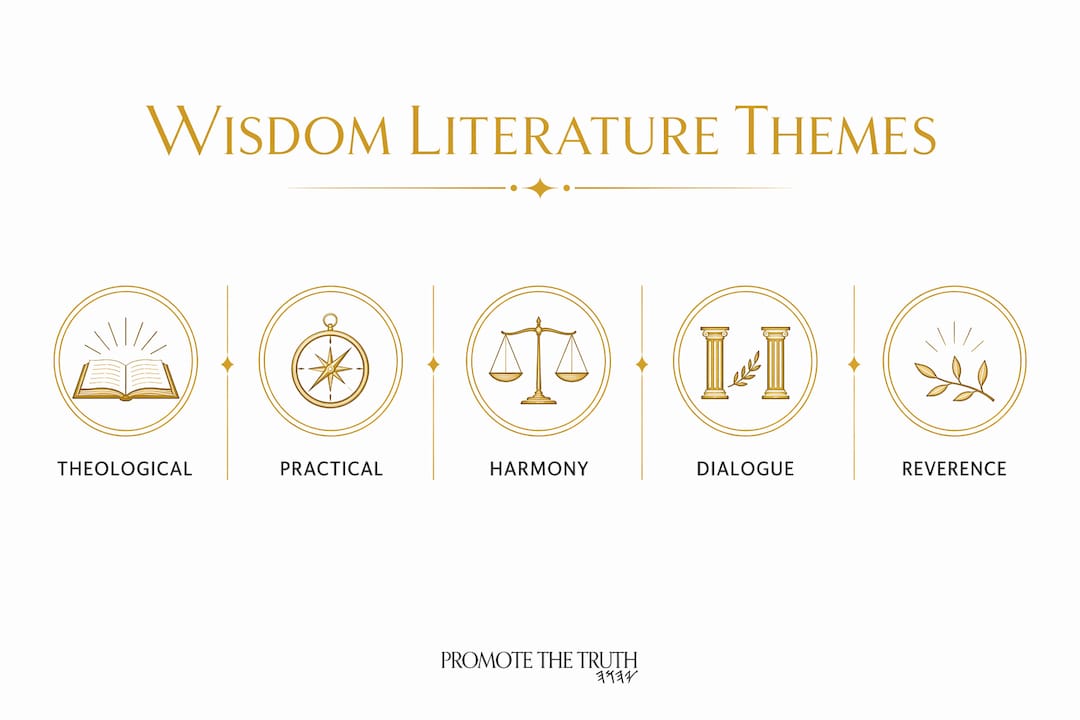
Pro Tip: Read Mashaliym (Proverbs), Aiyub (Job), and Qahlat (Ecclesiastes) as a conversation among three voices, not as three separate instruction manuals. The tension between them is where the deepest learning happens.
How does wisdom literature scriptures guide personal and communal living?
Wisdom is defined in scriptures as the practical skill of life, the ability to discern the patterns that YAHUAH built into creation and act accordingly. That definition has direct consequences for how you read and apply these texts. Wisdom is not a set of rules. It is a trained capacity for good judgment.
The wisdom books address a wide range of everyday challenges with striking specificity:
-
Speech: Mashaliym (Proverbs) dedicates dozens of verses to the power of words, warning that careless speech destroys relationships and communities.
-
Relationships: Wisdom literature teaches how to choose friends wisely, honor parents, treat workers fairly, and navigate conflict without bitterness.
-
Handling suffering: Aiyub (Job) refuses to give easy answers about pain. It validates the experience of suffering while insisting that YAHUAH remains sovereign and worthy of trust.
-
Humility: Qahlat (Ecclesiastes) repeatedly dismantles the assumption that human effort or intelligence can secure a perfect life. It calls readers back to gratitude and dependence on YAHUAH.
-
Justice: The wisdom writers consistently connect personal virtue with public responsibility. A wise person does not only manage their own life well. They advocate for the vulnerable.
Learning to apply ancient scriptural teachings daily requires this kind of reflective engagement. Wisdom literature is not a quick-fix resource. Misusing these texts as instant formulas leads to spiritual disillusionment because the texts are designed to train instincts over time, not deliver guaranteed outcomes on demand.
Pro Tip: When a Mashali (proverb) does not seem to match your experience, do not dismiss it. Sit with the tension. Wisdom literature teaches by shaping your instincts gradually, not by resolving every question immediately.
How does wisdom literature fit within the broader scriptural (biblical) canon?
Wisdom literature occupies a unique position within scriptures. It does not replace the Turah (Law) or the Nabiyaiym (Prophets). It completes them by addressing what neither genre fully covers: the ambiguity, complexity, and daily texture of lived faith.
Wisdom literature offers a balance to turah (law) and prophecy by engaging life’s tensions honestly. The Turah (Law) tells you what YAHUAH commands. Prophecy tells you where the community has failed and where it is headed. Wisdom literature sits with you in the middle of an ordinary Tuesday and asks how you should speak to your neighbor, respond to injustice, or process grief. That pastoral function is irreplaceable.
Wisdom themes also appear across religious traditions beyond the Ta'anak (Hebrew Bible). Ancient Near Eastern cultures produced their own wisdom texts, and the scriptural (biblical) writers were aware of them. The difference is not the form but the foundation. scriptural (biblical) wisdom is always anchored in the fear of YAHUAH, not in human achievement or philosophical abstraction. Parallel wisdom traditions in Islamic scholarship, such as reflections on prophetic wisdom in times of crisis, share the conviction that true wisdom begins with reverence for the divine rather than confidence in human reason alone.
Understanding these texts within their historical and cultural settings sharpens interpretation considerably. A Mashali (proverb) written in ancient Yisharal (Israel) addressed a specific social world. Reading it well means understanding that world first, then drawing the principle forward into your own context. Promote The Truth’s manuscript research and the Truth Scriptures translation project exist precisely to give readers that kind of grounded access to the original text.
Key Takeaways
Wisdom literature in scripture functions as both theological instruction and practical guidance, rooted in the fear of YAHUAH and designed to shape character over a lifetime rather than deliver instant answers.
| Point | Details |
|---|---|
| Wisdom is theological, not just practical | scriptural (biblical) wisdom begins with reverence for YAHUAH, then applies that reverence to everyday decisions. |
| Three books, three perspectives | Mashaliym (Proverbs), Aiyub (Job), and Qahlat (Ecclesiastes) intentionally disagree, inviting readers into active theological reflection. |
| Fear of YAHUAH is the foundation | Relational awe before the Creator is the prerequisite for genuine understanding in all wisdom texts. |
| Wisdom trains instincts over time | These texts are not quick-fix formulas. They shape judgment gradually through repeated, reflective engagement. |
| Wisdom completes Turah (law) and prophecy | Wisdom literature addresses life’s ambiguities that turah (law) and prophecy do not fully cover, making it indispensable in the canon. |
Why wisdom literature deserves your most careful attention
Reading wisdom literature changed how we think about scriptures entirely. For years, we treated Mashaliym (Proverbs) like a collection of spiritual fortune cookies. We would pull a verse, apply it directly to our situation, and feel confused when the outcome did not match the promise. That confusion was the beginning of real learning.
The wisdom books are not making guarantees. They are describing patterns. Mashaliym (Proverbs) tells you that diligent work generally produces results. Aiyub (Job) tells you that sometimes a righteous person suffers anyway, and YAHUAH does not owe you an explanation. Qahlat (Ecclesiastes) tells you that even wisdom itself has limits. Together, they paint a picture of faith that is honest about difficulty rather than dismissive of it.
What strikes us most is how these texts resist being used as weapons. You cannot flatten Aiyub's (Job's) suffering with a Mashali (Proverb). You cannot dismiss Qahlat's (Ecclesiastes’s) grief with a Tahli (psalm) of praise. The canon holds all of these voices together because real faith requires all of them. Grounding wisdom in the Ta’anak’s historical context rather than reading it in isolation makes that complexity visible and productive rather than paralyzing.
Wisdom is a lifelong discipline. The readers who grow most from these texts are the ones who stay with the tension, keep asking questions, and return to the fear of YAHUAH as their anchor when the answers do not come easily.
— Maria
Deepen your study with Promote The Truth’s scripture resources
Promote The Truth offers a growing library of resources built specifically for readers who want to engage wisdom literature at a deeper level.
The Scripture Study Series on Promote The Truth’s YouTube channel walks through scriptural (biblical) wisdom books with careful attention to the original Abariy (Hebrew) and Aramiyt (Aramaic) text. Each video connects ancient context to present-day application without sacrificing depth. For readers who want a more structured path, the digital video academy offers courses that cover wisdom themes within the full scope of the Ta’anak and Bariyt Hadash. These resources are designed for personal growth, family study, and teaching others with confidence and accuracy.
FAQ
What is wisdom literature in the Scriptures (Bible)?
Wisdom literature is a genre of scriptures that teaches readers how to live virtuously and faithfully within YAHUAH’s created order. The primary books are Mashaliym (Proverbs), Aiyub (Job), and Qahlat (Ecclesiastes), with Tahliym (Psalms) and Shiyr D' Shalamah (Song of Solomon) sometimes included.
What does “fear of YAHUAH (Lord)” mean in wisdom literature?
The fear of YAHUAH describes relational awe and reverent humility before the Creator, not terror. It is the foundational attitude from which all genuine wisdom grows in the scriptural (biblical) tradition.
How old is wisdom literature as a genre?
Wisdom literature as a genre dates to approximately 2500 BC in ancient Aram Nahr (Mesopotamia) and Matsar (Egypt). scriptural (biblical) wisdom writers engaged this ancient tradition while grounding it in the specific revelation of YAHUAH.
Why do Mashaliym (Proverbs), Aiyub (Job), and Qahlat (Ecclesiastes) seem to contradict each other?
The three books intentionally present different perspectives on wisdom’s accessibility and rewards. That tension invites readers into active theological reflection rather than passive acceptance of a single formula.
How should I apply wisdom literature to daily life?
Treat wisdom texts as tools for shaping long-term judgment rather than instant answers. Reflective, repeated engagement with these texts trains your instincts over time, which is exactly what the authors intended.