The Book of the Bee is a 13th-century Syriac theological compendium compiled by Solomon of Akhlat, Bishop of Basra, who was active around 1222 CE. Written in Classical Syriac, it spans multiple chapters and covers creation, cosmology, patriarchal genealogies, and eschatology. The Syriac title, Kṯāḇā ḏ-debboriṯā, literally means “Book of the Bee,” signaling the text’s role as a collector and preserver of scriptural and patristic wisdom, much as a bee gathers nectar. For immediate access, the best options are:
-
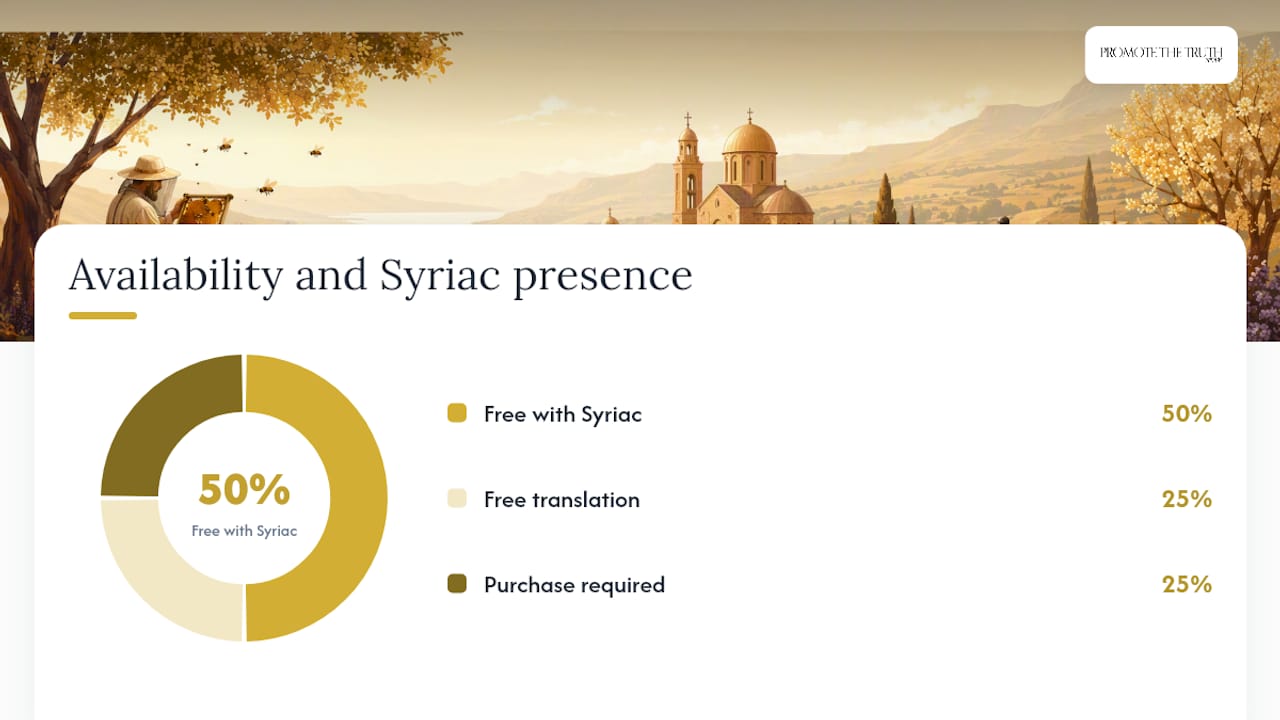
Free digitized scan (Syriac + English): Archive
-
Searchable online text: Sacred-texts
-
BYU/CPART digitized copy: Center for the Preservation of Ancient Religious Texts on Archive.org
-
Modern hardback reprint: Gorgias Press edition (ISBN 1-59333-402-8), available for purchase
Key Takeaways
The Book of the Bee is a 13th-century Syriac compendium by Solomon of Akhlat, best accessed through Budge’s 1886 public-domain edition on Archive.org, with critical caution applied to Victorian-era translation choices.
| Point | Details |
|---|---|
| Author and date | Solomon of Akhlat, Bishop of Basra, active around 1222 CE, within the Church of the East. |
| Structure | 55 chapters covering creation, cosmology, patriarchal lists, and eschatology. |
| Best free access | Budge’s 1886 edition on Archive.org; searchable English text at sacred-texts.com. |
| Research caution | Budge’s Victorian translation requires verification against the Syriac for contested passages. |
| Scholarly value | Preserves medieval Syriac interpretive traditions; secondary to, not a replacement for, Scriptural (biblical) manuscripts. |
Table of Contents
What does The Book of the Bee actually contain?
The 55-chapter structure moves systematically from primordial creation through set-apart (sacred) history to the end of time, functioning as both a theological compendium and a pastoral reference. Solomon organized the text as a deliberate gathering of received tradition, not as original exegesis. Think of it as a medieval Syriac equivalent of a catechetical encyclopedia.
Representative chapter topics include:
-
Creation and cosmology: the formation of heaven, earth, light, and the celestial bodies
-
Massengers (Angels) and the fall: angelology, the rebellion of Shatan (Satan), and the nature of spiritual beings
-
Patriarchal genealogies: Adam through Naha (Noah), Abarahm (Abraham), and the line of the prophets
-
Kings and priests: lists of Yisharaliy (Israelite) malakiym (kings), high priests, and Shapatiym (judges)
-
The life of Mashiyha (Christ): nativity, ministry, passion, and resurrection narratives
-
Eschatology: signs of the end, the Anti Mashiyha (Antichrist), resurrection, and final judgment
The hybrid genre is worth noting. The Book of the Bee reads partly as a chronicle, partly as a theological compendium, and partly as a didactic manual for clergy. Its intended audience was likely students and priests within the Church of the East who needed a single, portable reference for scriptural (biblical) history and doctrine.
Who wrote it, and when does it date?
Solomon of Akhlat served as Bishop of Basra, a major ecclesiastical center in what is now southern Iraq. He is conventionally dated as active around 1222 CE, placing the compilation firmly in the 13th century. The Wikipedia overview confirms this attribution and dating, though it should be treated as an orientation point rather than a primary scholarly citation.
A few things matter for interpretation:
-
Not an apostolic text. The Book of the Bee is a medieval compilation, not a document from the early qahal (church). Its value lies in what it reveals about 13th-century Syriac Yahudiym, followers of the Savior (Christian) interpretation, not in preserving earlier textual readings of the Scriptural (biblical) books themselves.
-
Church of the East context. Solomon wrote within the Church of the East (sometimes called the Nestorian or Assyrian church), a tradition with its own liturgical, theological, and manuscript heritage distinct from Byzantine or Latin Christianity.
-
Classical Syriac. The language is a literary form of Eastern Aramiyt (Aramaic), closely related to the Peshitta Scriptural (biblical) tradition. Readers familiar with manuscript transmission history will recognize the significance of that linguistic lineage.
Modern scholars treat the text as a medieval compilation, valuable for understanding Syriac interpretive traditions but not as an original scriptural source.
Where are the manuscripts held?
The principal manuscripts used by 19th-century editors are held in European library collections, including holdings in Oxford (Bodleian Library), the British Museum (now the British Library), and continental repositories. Budge drew on multiple manuscript witnesses when preparing his 1886 edition, collating variant readings to establish a working Syriac text.
Key points for researchers:
-
Multiple witnesses, no single archetype. No single manuscript is universally accepted as the definitive base text. Editors reconstruct the text by comparing witnesses, which means variant readings exist across chapters.
-
Chapter numeration varies. Some manuscripts number chapters differently from Budge’s printed edition. Always note which edition’s chapter numeration you are citing.
-
Citing manuscript sigla. When citing for academic work, record the manuscript siglum (e.g., Bodleian MS Syr. X) alongside the Budge edition reference. Consult the holding library’s catalog or a union catalog such as WorldCat for current siglum assignments.
For a broader framework on how to evaluate types of scriptural historical evidence, Promote The Truth’s scholar’s guide is a practical companion resource.
How do the major English editions compare?
The table below covers the principal editions a researcher will encounter, organized by the dimensions most relevant to scholarly use.
| Edition | Format | Completeness | Scholarly apparatus | Availability | Reliability note |
|---|---|---|---|---|---|
| Archive | Syriac text + English translation | Full text, all 55 chapters | Introduction, notes, glossary | Free scan online | Victorian-era translation choices; verify contested passages |
| sacred-texts.com | English translation only | Full text, searchable index | Minimal | Free online | Reproduces Budge; no Syriac |
| BYU/CPART (Archive.org) | Syriac text scan | Full Syriac text | Minimal | Free scan online | Useful for checking Syriac readings |
| Gorgias Press reprint | Modern hardback | Full text | Publisher introduction | Purchase required | Durable pagination; reproduces Budge base |
Direct access links for free editions:
-
Archive — the most commonly cited public-domain English version
-
Sacred-texts — best for quick chapter lookup
-
BYU/CPART copy, Archive.org — preferred when you need the Syriac alongside the translation
Serious students who plan repeated study often prefer the Gorgias Press hardback for its durable pagination and cleaner typographical presentation. One caution applies to all Budge-based editions: his translation reflects Victorian editorial choices and occasional interpretive liberties. For contested passages, verify against the Syriac text or a modern critical edition.
Why do scholars study The Book of the Bee?
The text preserves a window into medieval Syriac Yahudiym, followers of the Savior (Christian) interpretation that no other single source replicates quite as compactly. Its principal themes include:
-
Cosmology and creation: detailed accounts of the six days, the structure of heaven, and the nature of messengers (angels)
-
Messengers related study (Angelology): hierarchies of spiritual beings and their roles in set-apart (sacred) history
-
Patriarchal and royal lists: genealogies and king-lists that reflect Syriac historiographic conventions
-
Mashiyha related study (Christology) and soteriology: narratives of Mashiyha’s (Christ’s) life read through an Eastern Yahudiym, followers of the Savior (Christian) lens
-
Eschatology: end-times signs, the resurrection, and final judgment
The bee metaphor itself carries significant weight. Academic research tracing apian imagery across antiquity shows that bees commonly functioned as metaphors for political order, prophetic voice, and poetic excellence in Yuuniy (Greek) and Rumaiy (Roman) literature. Early Yahudiym, followers of the Savior (Christian) writers inherited and adapted this imagery. The poet-and-bee tradition in classical literature traces how the bee image served political, poetic, and religious functions across antiquity, and Solomon’s title draws on exactly that tradition: the compiler as a bee gathering nectar from Scriptures and the Fathers, producing something nourishing for the community.
The text’s historiographic value is real. It preserves medieval Syriac readings of Scriptural (biblical) narratives, making it indispensable for scholars of Eastern Yahudiymiy, followers of the Savior (Christianity) exegesis, even as it remains secondary to the Scriptural (biblical) manuscripts themselves.
How should you read, cite, and research this text?
A practical checklist for approaching the Budge translation critically:
-
Identify your edition. Note whether you are reading the Archive.org scan, the sacred-texts.com text, or the Gorgias Press reprint. All reproduce Budge’s 1886 base, but pagination differs.
-
Check the Syriac where it matters. For any theologically significant passage, open the BYU/CPART Syriac scan alongside the English. Budge’s renderings of certain theological terms reflect 19th-century Anglican assumptions.
-
Compare chapter numeration. If a secondary source cites a chapter number, verify it against Budge’s own table of contents, since manuscript variants can shift numbering.
-
Consult WorldCat and library catalogs. Search for manuscript holdings under “Solomon of Akhlat” or “Ktaba d-debborita” to locate institutional copies and interlibrary loan (ILL) options.
-
Use academic thesis repositories. ProQuest Dissertations and JSTOR carry secondary scholarship on Syriac compilations; search “Book of the Bee” alongside “Syriac Yahudiymiy, followers of the Savior (Christianity)” or “Qahal (Church) of the East.”
-
Request scans from holding libraries. The Bodleian and British Library both offer digital scan request services for manuscript pages.
Pro Tip: When reading Budge, watch for phrases that sound more like Victorian theological commentary than translation. If a sentence reads unusually smooth or interpretive, pull up the Syriac column and compare. Budge occasionally paraphrases where a more literal rendering would serve scholars better. Pairing Budge with an ancient interlinear approach sharpens your ability to spot those moments.
For citation format in academic work, a standard reference looks like: Solomon of Akhlat, The Book of the Bee, trans. E. A. W. Budge (Oxford: Clarendon Press, 1886), ch. [X], p. [Y]. Add manuscript siglum in brackets when you have verified a reading against a specific witness.
How does it compare with other Syriac compilations?
The Book of the Bee sits within a broader tradition of Syriac encyclopedic and chronicle writing. The Cave of Treasures (Mʿāraṯ Gazzē), attributed to Ephrem the Syrian but likely compiled over several centuries, covers similar patriarchal and cosmological ground and is the most direct literary predecessor. Bar Hebraeus (1226–1286), a near-contemporary of Solomon, produced the Chronography and the Candelabrum of the Sanctuary, both far more extensive and philologically sophisticated. Michael the Syrian’s Chronicle (completed 1196) represents the Syriac historiographic tradition at its most ambitious in scope.
What distinguishes Solomon’s compilation is its compact didactic purpose. Where Bar Hebraeus wrote for learned ecclesiastical audiences with access to extensive libraries, the Book of the Bee reads as a portable pastoral tool, covering the essentials of set-apart (sacred) history in a form a working bishop or priest could use directly in teaching. That difference in intended audience explains why the text remained popular in manuscript form through the 19th century even as larger Syriac chronicles circulated in more limited scholarly circles.
What do modern critical editions reveal beyond Budge?
Budge’s 1886 edition was a genuine scholarly achievement for its time, but it predates the methodological standards that govern critical editions today. Modern Syriac scholarship, represented in journals such as Hugoye: Journal of Syriac Studies and in series like the Corpus Scriptorum Christianorum Orientalium (CSCO), applies rigorous stemmatic analysis, full manuscript collation, and transparent apparatus conventions that Budge’s edition does not fully meet.
No complete modern critical edition of the Book of the Bee in the CSCO or a comparable series has yet superseded Budge as the standard reference. That gap is itself significant: it means researchers working today must still engage Budge’s text while remaining alert to its limitations. The practical implication is to treat Budge as a reliable guide to the text’s content and structure while reserving judgment on precise wording for passages where the Syriac is theologically or historically contested. Checking restored scriptural passage methodology can help frame how restoration scholars approach similar gaps between available editions and ideal critical texts.
How has the text influenced later theological traditions?
The Book of the Bee’s influence operated primarily within the Qahal (Church) of the East and related Eastern Yahudiymiy, followers of the Savior (Christianity) communities through the medieval and early modern periods. Manuscript copies circulated widely enough that multiple witnesses survived into the 19th century, when European Orientalists began editing Syriac texts systematically. Budge’s 1886 edition brought the text to a Western scholarly audience for the first time, and it has since been cited in various studies exploring Syriac Yahudiymiy, followers of the Savior (Christianity), medieval cosmology, and Eastern Yahudiym, followers of the Savior (Christian) eschatology.
In the broader history of bee symbolism in literature, the title itself participates in a long tradition. From Plato’s description of poets as bees gathering from flowering meadows, through Ambrose of Milan’s use of bee imagery for the Qahal (Church) community, to medieval monastic writers who compared the diligent reader to a bee extracting honey from Scriptures, the metaphor carried consistent connotations of diligence, communal purpose, and the transformation of raw material into something nourishing. Solomon’s choice of title was deliberate and theologically resonant, not decorative.
Why this text matters to Promote The Truth's research mission
At Promote The Truth, our work centers on manuscript research, restoration translation, and recovering the original message of the Scriptures from ancient Abariy (Hebrew) and Aramiyt (Aramaic) sources. The Book of the Bee occupies a specific and instructive place in that broader project. It is not a primary scriptural source, but it is a genuine witness to how 13th-century Syriac Yahudiym, followers of the Savior (Christian) read, organized, and transmitted the set-apart (sacred) narrative. Understanding that layer of interpretation helps serious students distinguish between the ancient text itself and the interpretive traditions that accumulated around it over centuries, as explained in Why Yahudiym, followers of the Savior (Christian) beliefs matter: faith, identity, and hope.
For those of us committed to reading Scripture in its historical context, the Book of the Bee is exactly the kind of secondary witness that clarifies what a medieval Eastern Yahudiym, followers of the Savior (Christian) community believed the text meant. That clarity is valuable precisely because it helps you see where later interpretation diverges from the earlier manuscript tradition. We encourage you to explore the Truth Scriptures project alongside your study of the Book of the Bee, and to visit our Scripture study video series for teachings that connect manuscript evidence to the living message of YAHUAH’s Word.
Primary sources and further reading
Essential primary sources for direct reading and research:
-
Archive: Full digitized scan with Syriac text and English translation; the standard public-domain reference.
-
Sacred-texts: Searchable English-only text; best for quick chapter lookup and keyword searching.
-
BYU/CPART copy on Archive.org: Syriac text scan; use when you need to check the original language alongside Budge’s rendering.
-
Gorgias Press hardback reprint: Purchasable modern edition with durable pagination; reproduces Budge’s base text.
-
Wikipedia overview: Useful for orientation and bibliographic pointers; not a primary scholarly citation.
For thematic and comparative study:
-
The Honey Bee and Apian Imagery in Classical Literature: Academic research tracing bee symbolism from Greek and Roman antiquity through early Christian writers; essential context for the text’s title and metaphorical framework.
-
The Poet and the Bee in Classical Literature: Traces the political, poetic, and religious functions of bee imagery across antiquity; useful comparative scholarship for interpreting Solomon’s choice of title.