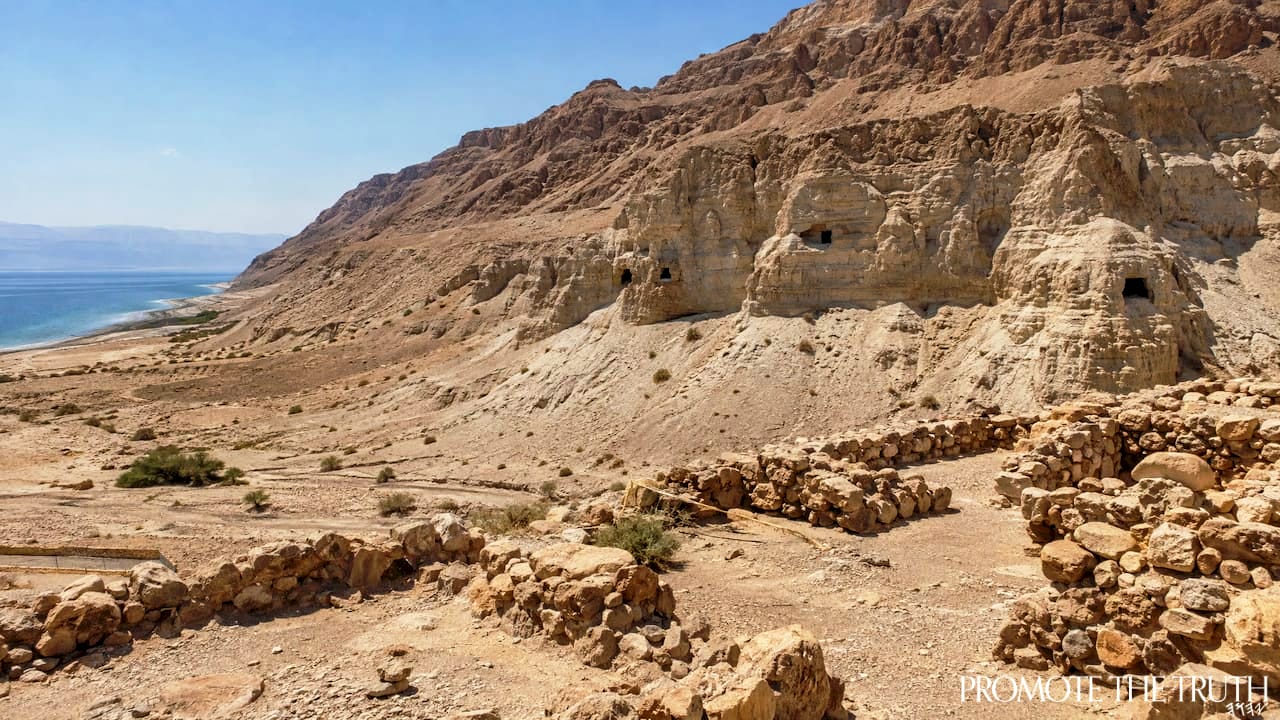
What is the Qumran Calendar, and how did the ancient Yahudiym (Jews) use it to determine the appointed Feasts? The Qumran Calendar is a 364-day calendar system preserved in the Dead Sea Scrolls, consisting of 52 complete weeks, four seasons of 91 days each, and 12 months arranged in a repeating pattern of 30, 30, and 31 days.
Unlike calendars that determine the beginning of each month through lunar observation, the Qumran Calendar follows a fixed weekly structure in which the year begins on the fourth day of the week (Wednesday). Because 364 days divide evenly into 52 weeks, the same calendar dates fall on the same weekdays every year. This arrangement places the principal appointed Feasts on consistent weekdays and keeps them distinct from the weekly Shabat (Sabbath).
The calendar is especially significant for understanding ancient Yahudiy (Jewish) practices during the Second Ahiykal (Temple) period, when different communities followed or debated various systems for determining set-apart (sacred) times.
However, because the actual solar year is longer than 364 days, questions remain concerning how the calendar was adjusted to remain aligned with the seasons.
In this study, we will explore how the Qumran Calendar worked, its connection to the Dead Sea Scrolls, the communities associated with its use, its relationship to the appointed Feasts of YAHUAH, and what the surviving manuscripts reveal about ancient Scriptural timekeeping.
Key Takeaways
-
The Qumran Calendar follows a fixed 364-day year, consisting of 52 complete weeks, four quarters of 91 days each, and 12 months arranged in a repeating 30–30–31-day pattern. Its year always begins on Wednesday, the fourth day of the week.
-
The Qumran Calendar differs from ancient lunar and lunisolar calendars. Unlike calendars based on lunar months of approximately 29 or 30 days, its fixed weekly structure allows the principal appointed Feasts of YAHUAH to fall on the same weekdays every year, without coinciding with the weekly Shabat (Sabbath)**.
-
The Dead Sea Scrolls preserve important evidence of the 364-day calendar. Approximately 20 calendrical manuscripts have been identified among the scrolls. A scholarly reconstruction published in 2017 examined manuscript 4Q324d, revealing references to additional agricultural festivals, including the Festivals of New Wine and New Oil, which are not separately commanded among the seven appointed Feasts in Uiyqara (Leviticus) 23.
-
The Qumran Calendar is widely associated with the Essenes, an ancient Yahudiy (Jewish) religious movement during the Second Ahiykal (Temple) period. However, the identification of the Qumran community with the Essenes remains a scholarly hypothesis rather than an established historical certainty.
-
The 364-day calendar also appears in the Book of Hanuk (Enoch) and the Book of Yubal (Jubilees). These writings preserve earlier calendrical traditions that share the Qumran system’s fundamental structure, although their surviving descriptions are not identical in every detail. This connection explains why the system is frequently called the Hanuk (Enoch) Calendar.
-
The calendar’s relationship to the spring equinox remains an important historical question. Although its structure is associated with seasonal turning points, scholars continue to debate how the ancient community maintained alignment between the fixed 364-day year and the longer astronomical solar year.
Table of Contents
-
What Is the Qumran Calendar, and Where Did It Originate?
-
How Does the Qumran Calendar Work? Understanding the 364-Day Year
-
What Do the Dead Sea Scrolls Reveal About the Qumran Calendar?
-
Fixed 364-Day Qumran Calendar vs. Lunar and Lunisolar Calendars
-
The Spring Equinox and the Beginning of the Qumran 364-Day Year
-
The Essenes and the Qumran Calendar: Who Used the 364-Day Calendar?
-
Was the 364-Day Calendar Used in Ancient Scriptural Times?
-
How to Study the Qumran 364-Day Calendar Using the Scriptures and Dead Sea Scrolls
-
Our Perspective on the Qumran Calendar and the Appointed Feasts of YAHUAH
-
Continue Your Study of the Qumran Calendar with the Truth Scriptures™
-
Frequently Asked Questions (FAQ) About the Qumran 364-Day Calendar
-
Sources
What Is the Qumran Calendar, and Where Did It Originate?
The Qumran Calendar takes its name from Qumran, an archaeological site near the Dead Sea, close to the caves where the Dead Sea Scrolls were first discovered in 1947.
Its most distinctive feature is its fixed 364-day year, consisting of 52 complete weeks and four seasons of 91 days each. Unlike the approximately 354-day year of a twelve-month lunar calendar, the Qumran Calendar follows a structured weekly cycle in which the same calendar dates consistently fall on the same days of the week.
Scholars describe this system as a fixed, schematic 364-day calendar. Its use was an important distinguishing feature of the community associated with the Dead Sea Scrolls and contributed to religious differences concerning the observance of appointed Feasts and set-apart days during the Second Ahiykal (Temple) period.
The Connection Between the Qumran Calendar, Yubal (Jubilees), and Hanuk (Enoch)
The 364-day calendar was not exclusive to the Qumran manuscripts. Earlier Yahudiy (Jewish) religious writings also preserve this calendrical tradition.
The system appears prominently in the Book of Yubal (Jubilees) and the Astronomical Book of 1 Hanuk (Enoch), which describe calendrical arrangements based on a structured year of 364 days.
A scholarly study titled The 364-Day Year in the Dead Sea Scrolls and Jewish Pseudepigrapha examines the relationship between these ancient writings and the calendar traditions preserved at Qumran.
This connection suggests that the community associated with Qumran inherited and developed an existing 364-day calendrical tradition, rather than creating the entire system independently.
Further evidence comes from approximately 20 calendrical texts discovered among the Dead Sea Scrolls, most dating to the first century BCE.
In his academic study Astronomy and Calendars at Qumran, scholar Jonathan Ben-Dov explains that these manuscripts reflect the importance of the 364-day year within the community’s religious and calendrical system.
Why Is the Qumran Calendar Also Associated with the Hanuk (Enoch) Calendar?
Readers researching the Qumran Calendar frequently encounter the expression “Hanuk (Enoch) Calendar.”
This connection exists because the Astronomical Book of 1 Hanuk (Enoch) preserves an earlier form of the 364-day calendrical tradition that later appears in the Dead Sea Scrolls.
Both traditions share important features, particularly the organization of the year around complete weeks and a fixed calendrical structure.
However, the Qumran Calendar and the calendar described in 1 Hanuk should not automatically be treated as identical in every detail. The surviving manuscripts reflect different stages of development and incorporate additional calendrical calculations and religious practices.
For those studying the appointed Feasts of YAHUAH, these ancient writings provide valuable historical evidence of how certain Yahudiy (Jewish) communities understood Scriptural timekeeping during the Second Ahiykal (Temple) period.
The central distinction is that the 364-day calendar was an established ancient calendrical tradition preserved in multiple writings, including Yubal (Jubilees), Hanuk (Enoch), and the Dead Sea Scrolls—not a system found exclusively at Qumran.
How Does the Qumran Calendar Work? Understanding the 364-Day Year
The Qumran Calendar follows a carefully structured 364-day year, consisting of 52 complete weeks, four equal quarters, and 12 months. Its fixed arrangement ensures that calendar dates consistently fall on the same weekdays each year.
This regular pattern is one of the calendar’s most distinctive features, particularly in determining the appointed Feasts and Shabat (Sabbath) observances within the ancient Yahudiy (Jewish) religious tradition.
The Four Key Features of the 364-Day Qumran Calendar
-
Four equal quarters: The year is divided into four quarters of 91 days each, equivalent to 13 complete weeks. Together, these quarters form a year of exactly 52 weeks.
-
Three months per quarter: Each quarter contains two 30-day months followed by one 31-day month. This repeating arrangement produces 91 days per quarter and 364 days per year.
-
A fixed Wednesday beginning: In the Qumran Calendar, the first day of the year always falls on Wednesday, the fourth day of the week. This arrangement is commonly associated with Barashiyt (Genesis) 1:14–19, which describes the creation of the sun, moon, and stars on the fourth day.
-
Fixed festival weekdays: Because the calendar contains exactly 52 weeks, the principal appointed Feasts fall on the same weekdays each year, without coinciding with the weekly Shabat (Sabbath). This consistency was an important feature of the community’s religious calendar.
The Structure of the Qumran 364-Day Year
The following table illustrates how the 364 days are divided into four equal quarters.
| Quarter | Length | Month Lengths | Weeks |
|---|---|---|---|
| First | 91 days | 30, 30, 31 days | 13 |
| Second | 91 days | 30, 30, 31 days | 13 |
| Third | 91 days | 30, 30, 31 days | 13 |
| Fourth | 91 days | 30, 30, 31 days | 13 |
| Total | 364 days | 12 months | 52 |
Because 364 is divisible by both seven and four, the calendar maintains a consistent weekly and seasonal structure.
This means that the same dates fall on the same weekdays every year, without requiring observations of the New Moon to determine the beginning of each month.
The Biblical Archaeology Society’s discussion of the Qumran community’s 364-day calendar explains how this fixed arrangement established a predictable pattern for festivals and other religious observances.
However, the 364-day system should not be confused with the actual astronomical solar year, which is approximately 365¼ days long. The surviving manuscripts do not conclusively establish whether or how the community adjusted its calendar to remain aligned with the seasons.
Why Shabua’aut (Feast of Weeks/Pentecost) Always Fell on Sunday
One important example of the calendar’s fixed weekday arrangement is Shabua’aut (Feast of Weeks/Pentecost).
In the Qumran 364-day calendar, Shabua’aut consistently fell on the first day of the week (Sunday).
This practice was connected to the community’s interpretation of the instruction in Uiyqara (Leviticus) 23:15–16, which concerns counting seven complete Shabats (Sabbaths) and observing the Feast on the following day.
In his historical discussion of Calendar Controversies, published in Reclaiming the Dead Sea Scrolls, scholar Lawrence H. Schiffman examines how differences in calendar interpretation influenced the observance of appointed Feasts among ancient Yahudiy (Jewish) communities.
The Qumran community’s interpretation placed Shabua’aut on a fixed Sunday each year, demonstrating how its calendar connected Scriptural interpretation, weekly Shabat observance, and the appointed Feasts.
For those studying the Feasts of YAHUAH, this historical evidence offers valuable insight into how certain ancient Yahudiy communities organized their set-apart (sacred) calendar.
The central feature of the Qumran Calendar is its fixed 364-day structure, which preserves a repeating weekly cycle and assigns the principal appointed Feasts to consistent weekdays throughout the year.
What Do the Dead Sea Scrolls Reveal About the Qumran Calendar?
The 364-day Qumran Calendar is not merely a theoretical system reconstructed from the Book of Hanuk (Enoch). The Dead Sea Scrolls contain actual calendrical manuscripts that demonstrate how certain ancient Yahudiy (Jewish) communities organized their religious observances, agricultural festivals, and seasonal transitions during the Second Ahiykal (Temple) period.
One significant example is Dead Sea Scroll 4Q324d, a calendrical manuscript written in an ancient coded writing system known as Cryptic A.
In 2017, researchers Eshbal Ratzon and Jonathan Ben-Dov published a scholarly reconstruction of this manuscript in the Journal of Biblical Literature. Their research reconstructed portions of the fragmented scroll and revealed important information about the 364-day calendar associated with the Qumran community.
The Biblical Archaeology Society’s report on the deciphered Qumran Calendar manuscript discusses this discovery and its significance for understanding the community’s religious calendar.
What Does Scroll 4Q324d Reveal About the Appointed Feasts?
The reconstructed manuscript provides evidence of additional agricultural festivals associated with the 364-day calendrical tradition, including:
-
Festival of New Wine: An agricultural celebration associated with the presentation of new wine, observed after the festival of the wheat harvest.
-
Festival of New Oil: A later agricultural celebration associated with the offering of new olive oil, following the Festival of New Wine.
-
Tekufah (Seasonal Transition): A term used in the manuscript for a seasonal turning point, reflecting the calendar’s structured division of the year.
The Festivals of New Wine and New Oil are not separately commanded among the seven appointed Feasts listed in Uiyqara (Leviticus) 23, although they are also known from other Dead Sea Scrolls, particularly the Ahiykal (Temple) Scroll.
Their appearance in these manuscripts demonstrates that the Qumran calendrical tradition included additional agricultural and priestly observances beyond the Feasts explicitly listed in Uiyqara 23.
The manuscript also preserves information concerning the Festival of Wood Offering, another observance associated with the Temple Scroll’s religious regulations.
Why These Manuscripts Matter for Understanding Scriptural Timekeeping
The discovery and reconstruction of these calendrical texts are historically significant for two reasons.
First, they demonstrate that the 364-day calendar was more than an abstract literary concept. The Qumran manuscripts preserve detailed calculations and festival arrangements, indicating that the calendar served as a practical framework for organizing religious observances.
However, the existence of these written calculations does not establish exactly how every member of the community observed each festival in daily life.
Second, they reveal a religious calendar closely connected to agricultural cycles, priestly practices, and interpretations of Scriptural commandments. The community’s calendrical system incorporated the appointed Feasts alongside additional observances preserved in its religious literature.
For those studying the seven appointed Feasts of YAHUAH, it is important to distinguish between the commandments recorded in the Abariy (Hebrew) Scriptures and additional festival traditions found in the Dead Sea Scrolls.
To examine the Scriptural foundation of these appointed times, read our related study on The Seven Appointed Feasts of YAHUAH in Uiyqara (Leviticus) 23.
The central lesson is that the Dead Sea Scrolls preserve valuable historical evidence of how the Qumran community understood and organized set-apart (sacred) time. However, the calendar and its additional festivals should be examined alongside the original Scriptural instructions rather than automatically treated as identical to them.
Fixed 364-Day Qumran Calendar vs. Lunar and Lunisolar Calendars
The Qumran 364-day Calendar differs from ancient lunar and lunisolar calendars because it follows a fixed weekly structure rather than relying on regular observations of the sun or moon. Its dates consistently fall on the same weekdays each year. By contrast, the ancient Babaliy (Babylonian) lunisolar calendar followed lunar months totaling approximately 354 days in a twelve-month year, with periodic adjustments to maintain seasonal alignment. This system influenced the development of the later Yahudiy (Jewish) calendar.
The Hanuk (Enoch) Calendar also reflects earlier traditions from Aram Nahriy (Mesopotamia). A scholarly study published in Religions examines how the idealized 360-day year was expanded by four additional seasonal days, producing a 364-day calendar.
However, because the astronomical solar year is approximately 365¼ days, scholars continue to debate how the Qumran community maintained seasonal alignment. In Astronomy and Calendars at Qumran, scholar Jonathan Ben-Dov describes the system as a schematic-Shabat (Sabbath)-based calendar, organized around complete weeks, seven-year Shamat (Shemitah) cycles, priestly service rotations, and lunar calculations.
For readers comparing these systems with the appointed Feasts of YAHUAH, explore our studies on the Lunar-Solar Calendar Compared with the Gregorian Calendar, How the Sighted Moon Calendar Works, and Scriptural Calendar Controversies.
The key distinction is that the Qumran Calendar follows a fixed 364-day weekly structure, while lunisolar calendars use lunar months and periodic adjustments to remain aligned with the seasons.

The Spring Equinox and the Beginning of the Qumran 364-Day Year
Did the Qumran Calendar begin at the spring equinox? This is an important question when studying the 364-day calendar preserved in the Dead Sea Scrolls and its relationship to the appointed Feasts of YAHUAH.
According to scholar Jonathan Ben-Dov, the Qumran Calendar is best understood as a seven-based schematic calendar that ideally begins at the spring equinox. Its structure consists of 52 complete weeks and four quarters of 91 days each, with seasonal turning points known as Taqufot (Tequfot) associated with the two equinoxes and two solstices.
However, the 364-day year is approximately 1¼ days shorter than the astronomical solar year, raising an important question about how the ancient Qumran community maintained alignment with the seasons. Although the spring equinox provides a useful reference for modern calendar reconstructions, the surviving manuscripts do not conclusively establish how the community adjusted its calendar over successive years.
For a practical explanation, explore our guide to the 364-Day Hanuk (Enoch) Calendar and Its Conversion to Gregorian Dates Using the Spring Equinox. For additional Scriptural context, read Unveiling the Mysteries of the Creator’s Calendar.
The key distinction is that the Qumran Calendar follows a fixed 364-day structure, while its precise relationship to the astronomical spring equinox and long-term seasonal alignment remains a subject of scholarly debate.
The Essenes and the Qumran Calendar: Who Used the 364-Day Calendar?
The Qumran 364-day Calendar is closely associated with the Essenes, an ancient Yahudiy (Jewish) religious group active during the Second Ahiykal (Temple) period. This connection is based on the Essene hypothesis, which proposes that the community associated with the Dead Sea Scrolls belonged to the broader Essene movement.
The Hebrew University’s Virtual Qumran Project identifies the Essene hypothesis as a strong explanation of the archaeological and literary evidence. Similarities include the community’s emphasis on set-apartness (holiness), ritual purity, initiation practices, communal living, and shared property, as described by Flavius Josephus.
However, the identification of the Qumran community with the Essenes remains debated. Scholars have compared the Dead Sea Scrolls with historical accounts by Josephus, Philo of Alexandria, and Pliny the Elder, while also recognizing differences between these descriptions and the surviving manuscripts.
Archaeologist Roland de Vaux, who excavated Qumran between 1952 and 1957, was an influential supporter of the Essene identification. Nevertheless, later archaeological research has challenged aspects of this interpretation, including the assumption that all the scrolls were written by one isolated religious community. Ancient accounts also describe Essenes living in towns and villages, not exclusively in the desert.
For those studying the appointed Feasts of YAHUAH, this distinction matters because the 364-day calendar is clearly documented in the Dead Sea Scrolls, but its use was not necessarily limited to the Essenes. Other Yahudiy (Jewish) groups also maintained different calendrical traditions during the Second Ahiykal period.
The key conclusion is that the Qumran Calendar is widely associated with the Essenes, but the surviving evidence does not establish that every community following a 364-day calendar was Essene.

Was the 364-Day Calendar Used in Ancient Scriptural Times?
Was the 364-day calendar already in use during the time of the ancient Scriptural patriarchs? This question remains important for those studying the Qumran Calendar, the Dead Sea Scrolls, and the appointed Feasts of YAHUAH.
Scholar Annie Jaubert proposed that a 364-day calendar could be identified in early Scriptural narratives. Her interpretation suggested that certain events involving the patriarchs followed a pattern of Sunday, Wednesday, and Friday, while travel and other activities were generally avoided on the weekly Shabat (Sabbath). This hypothesis and its relationship to the Qumran Flood Calendar (4Q252) are examined in a scholarly study published in the Harvard Theological Review.
Although the Dead Sea Scrolls confirm that the 364-day calendar was known during the Second Ahiykal (Temple) period, its use during the earliest Scriptural periods remains debated. The surviving manuscripts provide valuable historical evidence, but they do not conclusively establish that the patriarchs followed this calendar.
For a deeper examination, explore our studies on 49 Days, Qumran Calendars, and Ancient Manuscripts, Shabat (Sabbath) Time and Observance, and How the Yubal (Jubilee) Year Is Calculated.
The key distinction is that the 364-day calendar is documented in the Dead Sea Scrolls, while its use during the earliest Scriptural periods remains a subject of historical interpretation and scholarly debate.
How to Study the Qumran 364-Day Calendar Using the Scriptures and Dead Sea Scrolls
Understanding the Qumran 364-day Calendar requires examining its structure, ancient manuscript evidence, and relationship to the appointed Feasts of YAHUAH. The following six steps provide a practical approach to studying this ancient calendar.
-
Understand the 364-day structure. Begin with the four quarters of 91 days each, consisting of 13 complete weeks. Learn the repeating 30–30–31-day monthly pattern, which produces 52 weeks in a year.
-
Examine the Wednesday beginning. Study how the calendar begins on the fourth day of the week (Wednesday) and its connection to Barashiyt (Genesis) 1:14–19, where the heavenly lights were appointed for signs, seasons, days, and years.
-
Identify the appointed Feasts and their weekdays. Examine how the Qumran Calendar assigns fixed weekdays to the principal Feasts, including Shabua’aut (Feast of Weeks/Pentecost), which consistently falls on Sunday. Compare these dates with the instructions in Uiyqara (Leviticus) 23.
-
Compare the ancient manuscript sources. Read the Astronomical Book of Hanuk (Enoch), the Book of Yubal (Jubilees), and the calendrical manuscripts among the Dead Sea Scrolls. Identify their similarities and differences rather than assuming that every text presents an identical system.
-
Study the seasonal turning points. Examine how the spring equinox and seasonal transitions known as Takufot (Tequfot) relate to the calendar’s four quarters. Remember that the method used to maintain long-term alignment with the astronomical solar year remains debated.
-
Compare the Qumran Calendar with lunar and lunisolar calendars. Evaluate the fixed 364-day system alongside calendars based on New Moon observations, considering the Scriptural instructions, manuscript evidence, and historical practices associated with each approach.
Throughout your study, understanding the original Scriptural Names and places can help you recognize important connections between ancient texts and their historical settings.
Our free Truth Scriptures™ Names and Places Download provides a helpful resource for readers seeking to become more familiar with the original Names and locations preserved in the Scriptures.
The goal is to examine the Qumran Calendar carefully, compare the available evidence, and develop a deeper understanding of Scriptural timekeeping and the appointed Feasts of YAHUAH.
Our Perspective on the Qumran Calendar and the Appointed Feasts of YAHUAH
We believe the Qumran 364-day Calendar provides valuable historical insight into how ancient Yahudiy (Jewish) communities understood Scriptural timekeeping. Its structure of complete weeks emphasizes the importance of the Shabat (Sabbath) and the orderly observance of the appointed Feasts of YAHUAH.
Many people begin studying the Scriptural calendar because they question whether traditional calendar systems fully reflect the instructions preserved in the Scriptures. We understand these concerns. We also believe that meaningful answers require careful examination of the ancient manuscripts rather than relying on assumptions or traditions alone. That is why we return to the Abariy (Hebrew) and Aramiyt (Aramaic) sources, examining what they reveal about weeks, seasons, appointed times, and the Creator’s personal Set-Apart (Divine) Name, YAHUAH (יהוה)**.
The Dead Sea Scrolls deserve careful consideration because they preserve important evidence of how certain ancient communities organized their religious calendar. Although the Qumran Calendar does not settle every question concerning Scriptural timekeeping, its manuscripts provide a valuable foundation for historical and Scriptural study.
Our goal is to present this evidence faithfully, encourage thoughtful examination, and help readers deepen their understanding of the Shabat, the appointed Feasts, and the Creator’s calendar. Above all, we encourage you to study the Scriptures for yourself and seek the Truth of YAHUAH with reverence, diligence, and an open heart.
— Maria
Continue Your Study of the Qumran Calendar with the Truth Scriptures™
If this study of the Qumran 364-day Calendar and the Dead Sea Scrolls has inspired you to explore the original Scriptures, the Truth Scriptures™ Translation offers an opportunity to deepen your understanding of the Creator’s Word.
The Truth Scriptures™ presents the Ta’anak (Old Testament) and Bariyt Hadash (New Testament) in English, drawing upon ancient Abariy (Hebrew) and Aramiyt (Aramaic) manuscript sources. It restores the Creator’s personal Set-Apart (Divine) Name, YAHUAH (יהוה), along with original Scriptural names and their meanings, according to PTT’s translation approach.
Explore the Truth Scriptures™ Translation or access the Scriptures digitally through the Truth Scriptures™ Digital Collection.
For guided learning, our Virtual Retreats, offered at £197 each, provide opportunities for deeper Scriptural study. You can also explore our Scripture Study Series videos to continue learning about the original Scriptural languages, the appointed Feasts of YAHUAH, and ancient manuscript traditions.
Begin your study with the Truth Scriptures™ today and discover the Word of YAHUAH through careful Scriptural examination, historical context, and a deeper understanding of His appointed times.
Frequently Asked Questions
Is the Qumran Calendar the Same as the Hanuk (Enoch) Calendar?
The Qumran Calendar and Hanuk (Enoch) Calendar share the same fundamental 364-day structure, consisting of 52 complete weeks and four quarters of 91 days each.
The Astronomical Book of Hanuk (Enoch) and the Book of Yubal (Jubilees) preserve earlier literary traditions associated with this system, while the Dead Sea Scrolls contain detailed calendrical calculations and festival arrangements.
Although the names are often used interchangeably, the surviving texts are not identical in every calendrical detail.
Did the Qumran Calendar Begin at the Spring Equinox?
The Qumran 364-day Calendar is commonly associated with an idealized beginning near the spring equinox, with its four seasonal divisions connected to the equinoxes and solstices.
Within the calendar’s fixed structure, the first day of the year falls on Wednesday, corresponding to the fourth day of the week.
However, scholars continue to debate how the ancient community maintained alignment with the astronomical seasons. The surviving manuscripts do not conclusively establish a single method of adjustment.
Was the Qumran Calendar Used by the Essenes?
The Essene hypothesis identifies the community associated with the Dead Sea Scrolls as part of the ancient Essene Yahudiy (Jewish) movement.
This interpretation is supported by similarities between the Qumran manuscripts and historical descriptions of the Essenes, including those recorded by Flavius Josephus.
Although widely accepted, the Essene identification remains debated, and the 364-day calendar was not necessarily exclusive to one religious community.
Why Did the Qumran Community Use a Different Calendar?
The Qumran community’s 364-day calendar provided a fixed structure in which the principal appointed Feasts consistently fell on the same weekdays without coinciding with the weekly Shabat (Sabbath).
Unlike lunar and lunisolar calendars, it did not require monthly New Moon observations to establish its dates.
Calendrical differences also reflected broader disagreements concerning Scriptural interpretation, priestly authority, and the proper observance of set-apart times during the Second Ahiykal (Temple) period.
However, because the 364-day year is shorter than the astronomical solar year, scholars continue to debate whether and how the community adjusted its calendar to remain aligned with the seasons.
Sources
-
The 364-day Year in the Dead Sea Scrolls and Jewish Pseudepigrapha
-
A Response to the Alleged Fallacy of Jaubert’s Hypothesis, Harvard Theological Review
Recommended
-
Calendar Controversies in the Scriptures (Bible): What Does the Evidence Reveal?
-
49 Days, Qumran Calendars, and Ancient Manuscripts: Does the Evidence Support the Lunar Shabat
-
Sighted Moon Calendar: Understanding the Moon, New Moon Day, and the Calendar of the Creator
-
364 Day Hanuk (Enoch) Calendar: Convert to Gregorian Using the Equinox Anchor