
Calculating the Yubal (Jubilee) Year is far more complex than simply adding 49 or 50 years to a historical date. The result depends on several foundational questions: Which year should serve as the Scriptural anchor? Should the Yubal (Jubilee) be counted as the 49th year or as a distinct 50th year? How should the lunisolar Abariy (Hebrew) calendar be converted to the Gregorian calendar?
These questions have been discussed for centuries by scholars, historians, calendar researchers, and manuscript specialists. This study examines the relevant Scriptural passages, Abariy (Hebrew) calendar principles, and historical evidence behind the major calculation methods, allowing readers to understand the differences and evaluate the evidence for themselves.
In Scriptural terms, the Yubal (Jubilee) is associated with the completion of seven cycles of seven years, followed by the proclamation described in Uiyqara (Leviticus) 25. The main interpretive question is whether the Yubal (Jubilee) is counted inclusively as the 49th year or as a distinct 50th year following the seven Shamittah (sabbatical) cycles.
Once a counting method and anchor year are chosen, the arithmetic itself is relatively straightforward. The greater difficulty comes when converting the result from the Abariy (Hebrew) lunisolar calendar to the modern Gregorian calendar and determining whether such a calculated year can be regarded as an officially proclaimed Yubal today.
Ultimately, any serious Yubal (Jubilee) Year calculation must clearly identify its Scriptural anchor year, counting method, calendar system, and conversion process. Without defining these foundational assumptions, two calculations may appear to conflict when they are actually based on different Scriptural interpretations and chronological methods. Careful examination of the Scriptural text, the Abariy (Hebrew) calendar, and the historical manuscript evidence is therefore essential before drawing conclusions about any proposed Yubal (Jubilee) Year.
Key Takeaways
-
The choice of an anchor year and counting method—whether theYubal (Jubilee) is calculated as the 49th year or as a distinct 50th year—significantly affects the final result, and both approaches continue to be discussed by scholars and manuscript researchers.
-
Converting Abariy (Hebrew) dates to the Gregorian calendar requires accurately identifying the beginning of the Abariy (Hebrew) year, accounting for leap months, and recognizing that the Abariy (Hebrew) calendar is lunisolar, not purely solar.
-
Without a functioning Sanahdariyn (Sanhedrin) and Ahiykal (Temple)**, there is no universally recognized Scriptural authority to proclaim or observe the Yubal (Jubilee) today. As a result, modern calculations are generally used for Scriptural study, historical research, and calendar analysis rather than for official observance.
-
Adding fifty Gregorian years to an Abariy (Hebrew) anchor year does not produce an accurate Yubal (Jubilee) calculation. A proper calculation follows the Abariy (Hebrew) calendar by counting 49 or 50 Abariy (Hebrew) years before converting the result to the Gregorian calendar.
-
Accurate Yubal (Jubilee) research requires transparency. Clearly identifying the chosen anchor year, counting method, calendar system, and conversion process allows readers to examine the evidence and evaluate the calculation for themselves.
Table of Contents
-
How Does the Abariy (Hebrew) Calendar Affect Yubal (Jubilee) Timing?
-
What Historical Anchors Do Scholars Use for Yubal (Jubilee) Dates?
-
How Promote The Truth Supports Careful Yubal (Jubilee) Study
-
An Editor’s Note on Calculating the Yubal (Jubilee) Honestly
Understanding Yubal (Jubilee) Year Calculation Step by Step
Every Yubal (Jubilee) Year calculation begins with the same requirement: a clearly identified starting point in the Abariy (Hebrew) calendar that both the researcher and the source material recognize. Without that anchor, the calculation becomes little more than an isolated equation. With a defined anchor year, however, the process becomes transparent, reproducible, and easier to evaluate.
Step 1: Choose or identify an anchor Abariy (Hebrew) year. Different chronological systems propose different starting points for the Shamittah (Sabbatical) and Yubal (Jubilee) cycles. Some researchers work backward from historical events such as the fall of Yirushalam (Jerusalem) or the dated visions recorded in Yihazaqal (Ezekiel). Others rely on later Rabbinic chronologies such as Seder Olam, which assigns specific years to the entry into Kana’an (Canaan) and the beginning of the Shamittah (Sabbatical) cycle. Because these systems do not all agree, the chosen anchor year should always be stated clearly before any calculation begins.
Step 2: Decide the counting method before doing the arithmetic. This decision significantly affects the final result. If the Yubal (Jubilee) is treated as the 49th year, coinciding with the seventh Shamittah year, the resulting timeline will differ from a method that treats the Yubal as a distinct 50th year following the 49th. Choose one method, explain it plainly, and apply it consistently throughout the calculation. Mixing the two systems within the same timeline can produce misleading results.
Step 3: Perform the Yubal (Jubilee) Calculation.
-
Begin with the chosen hypothetical or proposed Abariy (Hebrew) anchor year.
-
Count 49 Abariy (Hebrew) years if using the 49-year model, or 50 Abariy (Hebrew) years if using the distinct 50th-year model.
-
The resulting year becomes the calculated Yubal (Jubilee) Year under that particular anchor and counting method.
-
To calculate later proposed Yubal (Jubilee) Years, continue applying the same cycle length consistently according to the chosen model.
Step 4: Convert the Abariy (Hebrew) Year to a Gregorian Date Range. This is where many simplified Yubal (Jubilee) calculations become inaccurate. The Abariy (Hebrew) calendar is lunisolar, so an Abariy year does not correspond neatly to a single Gregorian year. Instead, one Abariy year normally overlaps portions of two Gregorian calendar years.
Researchers must therefore identify the beginning of the relevant Abariy (Hebrew) year according to the calendar system being used, determine its Gregorian equivalent, and then convert the full year accordingly. The exact calendar conversion method should also be stated clearly because different chronological systems may use different assumptions about the beginning of the year, the historical development of the Abariy calendar, and the method used to align it with the Gregorian calendar.
For an accurate Yubal (Jubilee) Year calculation, the essential principle is consistency: clearly identify the anchor year, 49th-or-50th-year model, Abariy calendar framework, and Gregorian conversion method before presenting the final date. This allows readers to verify the calculation and understand why different Yubal timelines may produce different results.
A Hypothetical Yubal (Jubilee) Calculation
The following example is provided only to demonstrate the mechanics of the calculation. It is not a claim about the actual historical Yubal date.
-
Hypothetical anchor Abariy (Hebrew) year: 3000
-
Using the distinct 50th-year model: 3000 + 50 = Abariy (Hebrew) year 3050
-
Next, determine the Gregorian dates corresponding to the beginning and end of Abariy year 3050 according to the calendar convention being used.
-
The resulting Yubal (Jubilee) would therefore correspond to a Gregorian date range, rather than necessarily matching one complete January-to-December Gregorian year.
If a researcher is using a Tishri-based civil-year conversion, this would involve locating Tishri 1 of Abariy year 3050 and determining its Gregorian equivalent. If another Scriptural year reckoning is being used, that convention should be identified explicitly rather than assumed.
Pro Tip: Never simply add 50 Gregorian years to an Abariy (Hebrew) anchor year and treat the result as a completed Yubal calculation. Count the required number of Abariy years first, then convert the resulting Abariy year into its Gregorian equivalent. The two calendar systems do not align year-for-year on identical starting dates.
A few practical principles should remain clear throughout the calculation:
-
Anchor selection affects every later result, so document which anchor was chosen and why.
-
The Aulasfera method provides one example of an anchor-based calculation followed by calendar conversion, but its assumptions should still be examined rather than adopted automatically.
-
Every proposed Yubal (Jubilee) Year should be presented as conditional on the chosen anchor, counting method, calendar framework, and conversion process, rather than as a settled historical fact unless the supporting evidence establishes it…
Why Do Scholars Disagree on 49 Versus 50 Years?
The disagreement is not a modern debate. It goes back to how readers have understood the counting instructions in Uiyqara (Leviticus) 25:8–10.
Uiyqara (Leviticus) 25:8 (TST) establishes the numerical foundation:
Count for yourselves seven years of Shabats, seven times seven years. This set of seven years times seven years equals forty-nine years for you.
The command therefore begins with seven cycles of seven years, totaling 49 years. Immediately afterward, Uiyqara (Leviticus) 25:10 (TST) states:
10 This Fiftieth Year is Set-Apart. It is a time of freedom, a Yubal. It is a time of celebration when everyone shall receive back their original property, and bondservants shall return home to their families.
This wording is central to the 49-versus-50-year Yubal (Jubilee) debate. Read straightforwardly, the passage first completes 49 years and then identifies “This Fiftieth Year” as Set-Apart, calling it a Yubal and associating it with freedom, restoration of property, and the return of bondservants to their families.
This provides strong Scriptural grounds for interpreting the Yubal (Jubilee) as a distinct 50th year following the seven Shamittah (Sabbatical) cycles. However, other interpreters argue for an inclusive or overlapping cycle in which the Yubal (Jubilee) year also functions within the continuing Shamittah (sabbatical) pattern, producing an effective 49-year cycle.
The key point for any Yubal (Jubilee) Year calculation is therefore to state clearly which interpretation is being followed. The Scriptural text explicitly counts 49 years and then refers to a “Fiftieth Year,” while the question of how that fiftieth year relates to the following Shamittah (Sabbatical) cycle remains one of the central issues behind competing Yubal (Jubilee) calculations.
Later Rabbinic sources add another layer to the discussion. Talmudic passages, particularly in tractates such as Arakhin, discuss how the Yubal (Jubilee) Year relates to the Shamittah cycle, while Seder Olam preserves a chronological framework that later interpreters have used when proposing historical Yubal (Jubilee) dates. These sources demonstrate that the relationship between the 49 years, the fiftieth year, and the continuing sabbatical cycle has been debated for centuries.
The practical implications are significant. Under a 49-year cycle model, the Yubal is treated as overlapping with, or being incorporated into, the recurring Shamittah (sabbatical) structure. Under a distinct 50th-year model, the seventh Shamittah year is followed by an additional Yubal year during which ordinary sowing and harvesting are also prohibited. This could result in two successive agricultural years with major restrictions on cultivation. Some interpreters have therefore argued that a 49-year recurring cycle is more practical in an agrarian society, although practical considerations alone cannot determine the meaning of the Scriptural text.
Uiyqara (Leviticus) 25:8–12 (TST)
8 Count for yourselves seven years of Shabats, seven times seven years. This set of seven years times seven years equals forty-nine years for you.
9 Sound the trumpet on the tenth day of the seventh New Moon on the fiftieth year. This day is also Yum Kapar, known as the Day of Atonement. Trumpets are to be blown everywhere throughout the land.
10 This Fiftieth Year is Set-Apart. It is a time of freedom, a Yubal. It is a time of celebration when everyone shall receive back their original property, and bondservants shall return home to their families.
11 This is a year of Yubal, a complete year of celebration for you. Do not plant any seed or harvest any crops from your field or vineyards.
12 This is a year of Yubal ,a Set-Apart Time of Celebration .You may eat only what grows on its own.
Uiyqara (Leviticus) 25:8–12 therefore provides the central Scriptural foundation for the Yubal (Jubilee) cycle. Verse 8 establishes the seven cycles of seven years, totaling 49 years. Verse 9 commands the trumpet to be sounded on the tenth day of the seventh New Moon, identified as Yum Kapar (Day of Atonement), while verses 10–12 designate the Fiftieth Year as Set-Apart and describe its requirements.
This means the public proclamation of the Yubal is specifically connected with Yum Kapar, rather than merely being described as beginning with the civil calendar year. The proclamation of the Jubilee Year is therefore closely tied to the sounding of the trumpet and the declaration of liberty throughout the land.
A simple comparison shows why the counting method matters so much. Under a 49-year recurring model, a hypothetical sequence might place Yubal (Jubilee) years at 49, 98, 147, and so forth. Under a distinct 50-year model, a simplified sequence might instead place them at 50, 100, 150, and so forth—provided the researcher assumes that each new cycle begins only after the Yubal (Jubilee) year has been completed.
That difference may appear small at first, but it compounds over multiple cycles. After several centuries, two researchers using the same historical anchor can arrive at substantially different proposed Yubal (Jubilee) Years simply because one uses a 49-year cycle while the other uses a 50-year cycle. This is why both the anchor year and the counting method must always be stated clearly.
The Scriptural purpose of the Yubal (Jubilee) also extends far beyond calendar mathematics. Uiyqara 25 presents the Yubal (Jubilee) as a period of liberty, restoration of ancestral property, return to family holdings, release of certain bondservants, agricultural rest, and renewed social order. The broader theme is restoration according to YAHUAH’s command.
For that reason, the question is not simply whether someone should “add 49” or “add 50.” Any serious Yubal calculation must account for the Scriptural text, the relationship between the Shamittah and Yubal cycles, the selected historical anchor, and the calendar system used for conversion. Only then can a proposed Scriptural Yubal (Biblical Jubilee) Year be evaluated responsibly.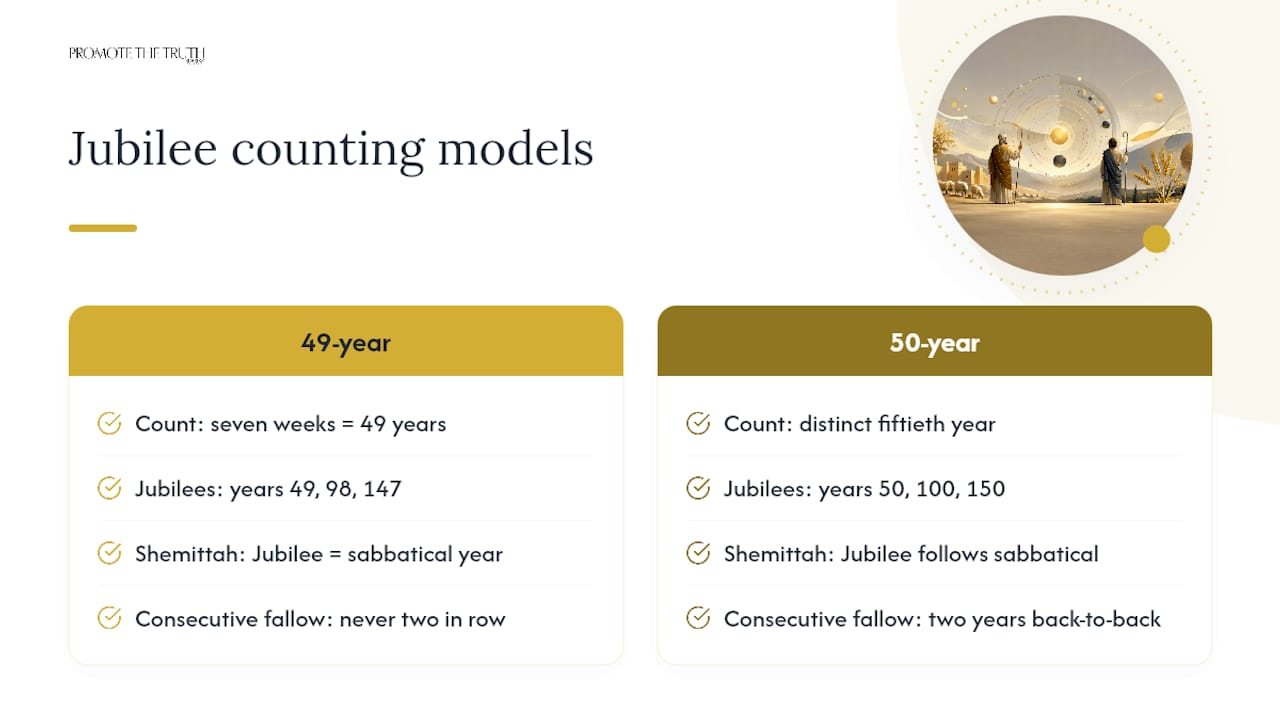
How Does the Abariy (Hebrew) Calendar Affect Yubal (Jubilee) Timing?
The Abariy (Hebrew) calendar’s lunisolar structure is one reason a proposed Yubal (Jubilee) Year cannot be reduced to a single Gregorian calendar year. Tishri, the seventh month in the Scriptural religious count but traditionally treated as the first month of the civil year, is especially important because the Yubal proclamation is connected with Yum Kapar (Day of Atonement) on the tenth day of the seventh month, as recorded in Uiyqara (Leviticus) 25:9.
Because this proclamation occurs in the autumn, a Yubal year expressed in the later Tishri-based civil calendar framework generally overlaps portions of two Gregorian calendar years rather than fitting neatly within one January-to-December year.
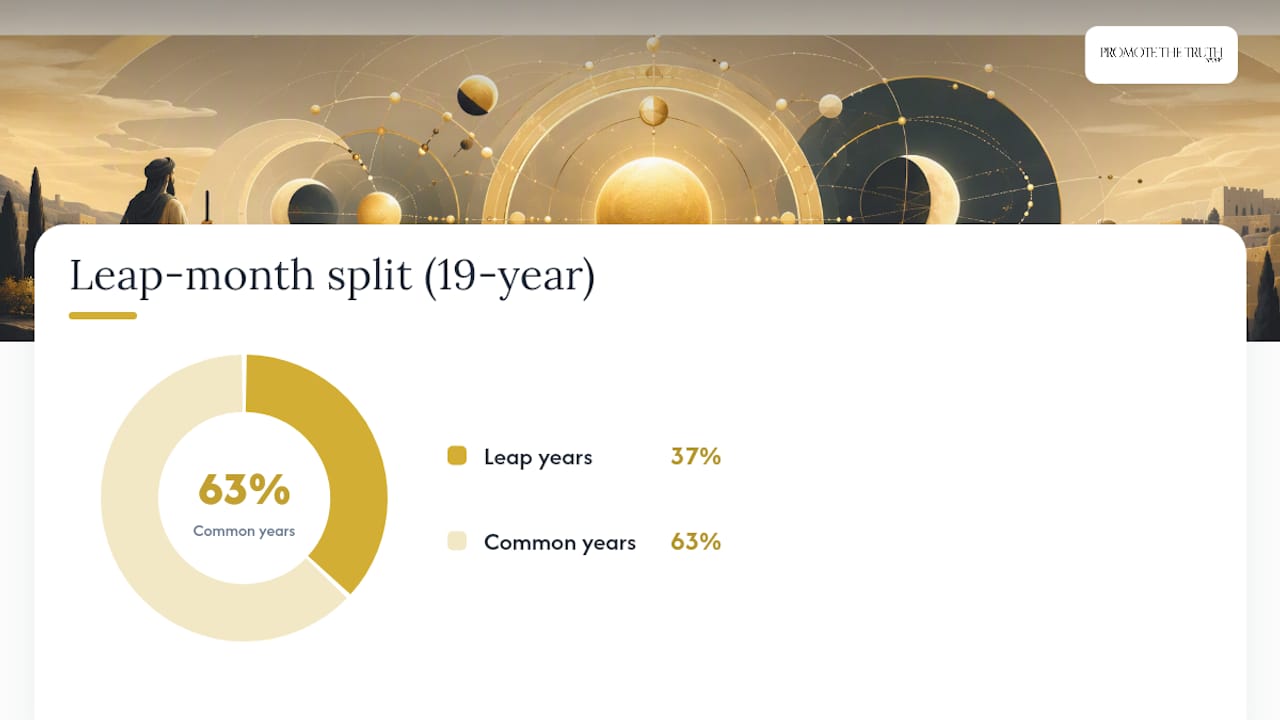
Leap months add another layer of complexity. The fixed Abariy (Hebrew) calendar uses a 19-year Metonic cycle and adds an extra month during seven of those nineteen years to keep the lunar months aligned with the solar year. In the later Hebrew lunisolar calendar, this additional month is commonly referred to as Adar II, helping keep the calendar aligned with the proper seasonal cycle.
A practical conversion method is to:
-
Identify the target Abariy (Hebrew) year produced by the Yubal calculation.
-
Find Tishri 1 of that year using a reliable Abariy calendar converter or almanac.
-
Determine its Gregorian equivalent.
-
Extend the range through the following Tishri 1 if the calculation is using a Tishri-based civil-year framework.
-
Cross-check the result with at least one independent calendar source, especially when leap years are involved.
Statistic Callout: The fixed Abariy (Hebrew) calendar follows a 19-year Metonic cycle with seven leap years, each containing an additional month. This keeps the lunar months aligned with the solar year and directly affects where Tishri 1 falls on the Gregorian calendar.
The most common error is to add 50 Gregorian years directly to an Abariy anchor year and treat that as a complete Yubal calculation. A more careful method is to count the required 49 or 50 Abariy (Hebrew) years first, according to the chosen model, and only then convert the resulting year into its Gregorian equivalent.
Any proposed Yubal (Jubilee) Year should clearly identify the calendar framework, counting method, treatment of leap months, and Gregorian conversion process being used. This is especially important when comparing different Scriptural Yubal (Biblical Jubilee) Year calculations, because later calendar systems and historical assumptions can produce different results. By stating each method openly, readers can examine the evidence, compare the calculations, and distinguish between the Scriptural instructions in Uiyqara (Leviticus) 25 and the later calendar systems used to interpret them…
What Historical Anchors Do Scholars Use for Yubal (Jubilee) Dates?
The choice of an anchor year is one of the most important variables in any Yubal (Jubilee) Year calculation. Different scholarly and traditional approaches propose different starting points, and none has achieved universal acceptance. This is one reason proposed dates for a past or future Scriptural Yubal (Biblical Jubilee) Year can vary significantly from one source to another.
-
Yihazaqal (Ezekiel)-based anchors. Some researchers look to Yihazaqal (Ezekiel) 40:1, which dates a vision to the fourteenth year after the city was struck and refers to the beginning of the year. Some interpreters connect this chronological statement with Yubal (Jubilee) counting. Calculating backward or forward from that reference produces one family of proposed anchor years, although the method depends on accepting the passage as evidence of a Jubilee-related date rather than simply a historical chronological marker.
-
Seder Olam and Rabbinic chronological counts. Later Rabbinic chronology provides its own framework for counting years from creation, the entry into Kana’an (Canaan), and events connected with the Ahiykal (Temple) periods. Some traditional calculations use these chronological systems to propose specific historical Shamittah (Sabbatical) and Yubal (Jubilee) years.
-
Hypothetical or working anchors. Because the historical anchor remains debated, some modern studies use a clearly identified hypothetical anchor year simply to demonstrate how a Yubal (Jubilee) calculation works. This approach can be useful for teaching the method, provided the example is clearly labeled as illustrative rather than historically established.
The table above uses three hypothetical anchors purely to demonstrate the arithmetic. It is not a claim that any one of those anchors is historically correct. Instead, it shows how sensitive a proposed Yubal (Jubilee) Year is to the assumptions used at the beginning of the calculation.
If the anchor year changes, the resulting Yubal (Jubilee) timeline changes with it. Likewise, switching between a 49-year cycle and a distinct 50-year model produces increasingly different results across successive cycles. For this reason, any claim that “the next Yubal (Jubilee) falls in a specific year” should be examined by asking three questions: What anchor year was used? What counting method was applied? What calendar system and conversion process were followed?
A reliable Yubal (Jubilee) chronology should therefore make its assumptions transparent. Clearly identifying the historical anchor, Shamittah cycle, 49-versus-50-year model, Abariy (Hebrew) calendar framework, and Gregorian conversion method allows readers to examine the calculation for themselves rather than accepting a proposed Jubilee date without seeing how it was produced.
Why Isn’t the Yubal (Jubilee) Observed Today?
The short answer is that the difficulty is institutional as well as calendrical. Uiyqara (Leviticus) 25 describes a national proclamation of the Yubal (Jubilee) throughout the land, together with the release of bondservants, the restoration of ancestral property, and agricultural rest. In later Jewish interpretation, carrying out these requirements depended on a functioning national religious and legal framework capable of proclaiming and administering the Jubilee.
Without that recognized authority and without the historical land-tenure system that the Yubal (Jubilee) regulated, there is no generally accepted mechanism today for making a calculated Yubal (Jubilee) Year legally binding on debts, servitude, or ancestral land restoration. Chabad’s overview of Jubilee timing likewise explains that the Yubal (Jubilee )is not currently designated or observed in the same way it was understood in the ancient Scriptural framework.
This also helps explain why the Shamittah (Sabbatical) Year continues to be observed in some forms within modern Yahudiy (Jewish) agricultural practice while the Yubal (Jubilee) does not follow the same pattern. The Shamittah operates on a recurring seven-year cycle, while the Yubal (Jubilee) involves broader national requirements concerning liberty, ancestral land, and the public proclamation commanded in Uiyqara 25.
For readers studying the Scriptural Yubal (Biblical Jubilee) Year today, several practical distinctions are important:
-
Treat any modern Yubal (Jubilee) date calculation as a matter of Scriptural study, historical chronology, or symbolic commemoration rather than as an automatically enforceable legal declaration.
-
Do not assume that a calculated Yubal (Jubilee) year cancels modern civil debts or legally requires the return of property.
-
When presenting a proposed Yubal (Jubilee) date, clearly disclose the anchor year, counting method, calendar framework, and Gregorian conversion process.
-
Recognize that full implementation of the Yubal (Jubilee) laws described in Uiyqara (Leviticus) 25 depended on social, legal, agricultural, and land-tenure conditions very different from those in most modern societies.
Pro Tip: When teaching the Yubal (Jubilee)**, begin with its Scriptural themes of liberty, restoration, return of ancestral property, agricultural rest, and obedience to YAHUAH*. Chronological calculations can be useful, but they should remain secondary to the purpose and requirements of the Jubilee described in the Scriptural text.*
How Promote the truth Supports Careful Yubal (Jubilee) Study
Promote The Truth (PTT) approaches the study of the Yubal (Jubilee) by returning readers to the language, calendar, and Scriptural context behind the command. Understanding a term such as Yubal begins with examining the underlying Abariy (Hebrew), and Promote The Truth’s Abariy (Hebrew) to English resource helps readers explore how words such as yōḇel can carry meanings and associations that may not be fully visible in a simple English translation.
Calendar study is also essential to any serious Yubal (Jubilee) Year calculation. Promote The Truth’s research into lunar-solar calendar mechanics helps readers understand the broader calendar framework behind Scriptural dates and how those dates may be compared with the modern Gregorian calendar. Readers who want to study the trumpet-sounding proclamation more closely can also explore the site’s article on Yum Tarua’ah and the Feast of Trumpets, which provides additional context for the seventh-month trumpet imagery connected with the proclamation of the Yubal.
The Truth Scriptures (TST) are designed to bring readers closer to the ancient Abariy (Hebrew) and Aramiyt (Aramaic) Scriptural context while preserving restored terminology and the Set-Apart Name, YAHUAH. Readers can examine the relevant Uiyqara (Leviticus) material through the free sample download, allowing them to study the Scriptural text itself before building a Yubal (Jubilee) calculation on top of later chronological assumptions.
Because the Yubal (Jubilee) is rooted in covenant law, its meaning extends beyond chronology. The Jubilee concerns liberty, restoration of ancestral property, agricultural rest, family inheritance, and obedience to YAHUAH’s commands. For that reason, careful Yubal study should examine not only when the Jubilee may have occurred, but also why it was established and how it fits within the broader covenant framework of the Scriptures.
An Editor’s Note on Calculating the Yubal (Jubilee) Honestly
One of the biggest problems with much of the Yubal (Jubilee) content online is not necessarily bad arithmetic, but unstated assumptions. Writers may choose an anchor year, apply a calculation, and then present a Gregorian date as though it were an established fact—without clearly identifying the historical anchor, counting method, calendar framework, or conversion process behind the result.
That approach can create a false sense of certainty.
For anyone calculating a proposed Yubal (Jubilee) Year—whether for personal study, a teaching timeline, or a Scriptural research group—the best practice is simple: show your work. State the anchor year. State whether you are using a 49-year cycle or a distinct 50-year model. Explain the calendar system being used, and show how the final Gregorian date was reached.
If a proposed Yubal (Jubilee) date could influence real legal, financial, or property decisions, extra caution is necessary. Modern calculations should not be presented as legally binding declarations, especially when there is no universally recognized institution today proclaiming an enforceable Yubal.
Where the Scriptural text, historical chronology, and later calendar traditions do not align perfectly, that uncertainty should be stated plainly rather than hidden behind a single confident date. Readers are better served by transparent research than by false precision.
The goal should not be to force the evidence into the cleanest answer, but to present the Scriptural text, Abariy (Hebrew) calendar framework, historical anchors, and competing calculation methods honestly enough that readers can examine the evidence for themselves.
— Maria
Study Resources for Going Deeper Into the Yubal (Jubilee)
If this study has encouraged you to examine the Yubal (Jubilee) passage in its full Scriptural context rather than relying on secondhand summaries, the Original Scriptures page from Promote The Truth is a strong place to begin.
The Truth Scriptures (TST) are designed to bring readers closer to the ancient Abariy (Hebrew) and Aramiyt (Aramaic) manuscript context while preserving restored Scriptural terminology and the Set-Apart Name, YAHUAH. This becomes especially important in a subject such as the Yubal (Jubilee) Year, where questions involving the 49th year, the distinct 50th year, the Shamittah cycle, and the wording of Uiyqara (Leviticus) 25 can significantly affect how a calculation is understood.
Rather than beginning with a modern Jubilee timeline and working backward, readers are encouraged to begin with the Scriptural text itself. Examine the wording, compare the calendar framework, identify the assumptions behind each counting method, and then evaluate proposed Scriptural Yubal (Biblical Jubilee) Year calculations for yourself.
If your goal is to understand the Yubal (Jubilee), Shamittah (Sabbatical) cycles, Leviticus 25, the Abariy (Hebrew) calendar, and the restoration of Scriptural terminology from a manuscript-focused perspective, the Original Scriptures provide a practical next step for deeper study.

Beyond the printed text, Promote The Truth’s Scripture Study Series on YouTube provides video-based teaching on Scriptural calendar principles, covenant law, and related passages. For readers who learn more easily by watching a passage explained step by step, these studies offer a practical way to follow the reasoning behind the text rather than relying only on written commentary.
Readers who want to examine the Truth Scriptures (TST) before going deeper can also begin with the free Abariym (Hebrews) 1 sample download. It provides a no-cost introduction to how the translation presents manuscript-based wording, restored Scriptural terminology, and the Set-Apart Name, YAHUAH.
These resources are not required to understand the Yubal (Jubilee), but they are especially useful for readers who want to move beyond secondhand summaries and examine the Scriptural text, calendar framework, and covenant context more directly. If your goal is to study the Scriptural Yubal (Biblical Jubilee) Year, Uiyqara (Leviticus) 25, Shamittah cycles, the Abariy (Hebrew) calendar, and the Truth Scriptures from a manuscript-focused perspective, these resources provide a strong next step.
Frequently Asked Questions
How Do You Calculate a Yubal (Jubilee) Year?
Choose a clearly defined Abariy (Hebrew) anchor year, decide whether you are using a 49-year cycle or a distinct 50th-year model, and then apply that counting method consistently. After identifying the resulting Abariy (Hebrew) year, convert it to the Gregorian calendar using the calendar framework stated in your calculation, such as a Tishri-based civil-year conversion.
Is 2026 a Scriptural Yubal (Biblical Jubilee) Year?
There is no universally accepted or institutionally proclaimed Yubal (Jubilee) Year for 2026. Proposed dates depend on the anchor year, 49-versus-50-year counting method, Abariy (Hebrew) calendar framework, and Gregorian conversion process being used. Because these assumptions differ, 2026 cannot be presented as an agreed Scriptural Jubilee year without first explaining the calculation behind that claim.
How Many Years Are in a Yubal (Jubilee) Cycle?
The Scriptural text in Uiyqara (Leviticus) 25:8–12 first counts seven cycles of seven years, totaling 49 years, and then refers to a Fiftieth Year as the Yubal. The main interpretive question is whether that fiftieth year forms a distinct additional year or overlaps with the continuing Shamittah (Sabbatical) cycle. This is why both 49-year and 50-year Jubilee models appear in historical and scholarly discussions.
What Is Every Seventh Year Called in the Scriptures?
Every seventh year is called a Shamittah (Sabbatical) Year. It is a year of agricultural rest for the land and is distinct from the Yubal (Jubilee). The Jubilee follows the completion of seven Shamittah cycles, although interpreters differ over whether the repeating Jubilee cycle should be calculated as 49 or 50 years.
Why Do the 49-Year and 50-Year Yubal Models Produce Different Results?
The 49-year model treats the Yubal as overlapping with, or being incorporated into, the recurring sabbatical cycle. The distinct 50th-year model understands Uiyqara (Leviticus) 25:8–12 as completing 49 years and then setting apart an additional Fiftieth Year as the Yubal. Because each model applies a different cycle length, the resulting proposed Jubilee dates diverge more and more across successive cycles.