
The Hanuk (Enoch) Calendar is a fixed 364-day solar calendar divided into four equal seasons of 91 days each. Each season contains three months of 30, 30, and 31 days, producing a total of 52 complete weeks every year. Because the calendar contains exactly 364 days, each calendar date returns to the same weekday within the fixed cycle, preserving a consistent weekly pattern for Shabats (Sabbaths) and the Appointed Times.
One important consideration, however, is that a 364-day year is shorter than the actual tropical solar year, which is approximately 365.2422 days. Without some form of correction or intercalation, a strictly continuous 364-day calendar would gradually drift away from the astronomical seasons. For this reason, modern reconstructions that seek to keep the calendar aligned with the spring equinox must define a clear method for correcting that difference.
Key Takeaways
-
The Hanuk (Enoch) Calendar follows a fixed 364-day solar year divided into four equal 91-day seasons, with each season containing months of 30, 30, and 31 days, for a total of 52 complete weeks.
-
Converting a Hanuk (Enoch) Calendar date to the Gregorian calendar requires a clearly defined starting point, often called an equinox anchor, followed by counting forward or backward through the 364-day calendar cycle.
-
Because the 364-day calendar is approximately 1.2422 days shorter than the tropical solar year, any long-term reconstruction must account for that difference through an intercalation or correction method if seasonal alignment is to be maintained.
-
The fixed 364-day structure preserves a consistent weekday pattern, which is one reason some believers use the Hanuk (Enoch) Calendar when determining Shabats (Sabbaths) and the Appointed Times.
-
One of the most common conversion errors is assuming that the Hanuk (Enoch) Calendar begins on January 1 or combining different reconstruction methods, equinox anchors, and correction systems. Doing so can produce different Gregorian dates, weekdays, Shabats, and Feast Day calculations.
Table of Contents
-
How Do You Convert Hanuk (Enoch) Calendar Dates to Gregorian Dates?
-
Why Does the Hanuk (Enoch) Calendar Drift From the Solar Year?
-
What Do Ancient Texts and Modern Scholars Say About the Hanuk (Enoch) Calendar?
-
How Do You Read a Specific Date on the Hanuk (Enoch) Calendar?
-
How Do You Read a Specific Date on the Hanuk (Enoch) Calendar?
-
What Mistakes Do People Make When Converting Hanuk (Enoch) and Gregorian Dates?
-
Why a Rule-Based Approach Matters More Than a History-Only Approach
What Is the Structure of the Hanuk (Enoch) Calendar?
The Hanuk (Enoch) Calendar is notable for its simplicity, symmetry, and mathematical precision. Once its basic structure is understood, readers can follow the monthly pattern without needing to depend on a separate reference chart.
Each of the four seasons contains 91 days and is divided into three months. The first two months contain 30 days each, while the third month contains 31 days. Together, the four seasons total 364 days. Because 52 weeks of seven days also equal 364 days, the calendar preserves a complete weekly cycle throughout the year.
This mathematical structure is one of the defining features of the Hanuk (Enoch) Calendar and distinguishes it from the Gregorian calendar used for modern civil timekeeping. Since 364 is evenly divisible by seven, the first day of the first month returns to the same weekday within the fixed annual cycle. This feature is central to the Hanukkah (also spelled Hanuk, Chanukah, or Chanukkah), an eight-day Jewish festival commemorating the rededication of the Second Temple in Jerusalem and the miracle of the oil that lasted eight days, celebrated with lighting the menorah, playing traditional games, and enjoying festive foods.Enoch Calendar structure documented on Wikipedia.
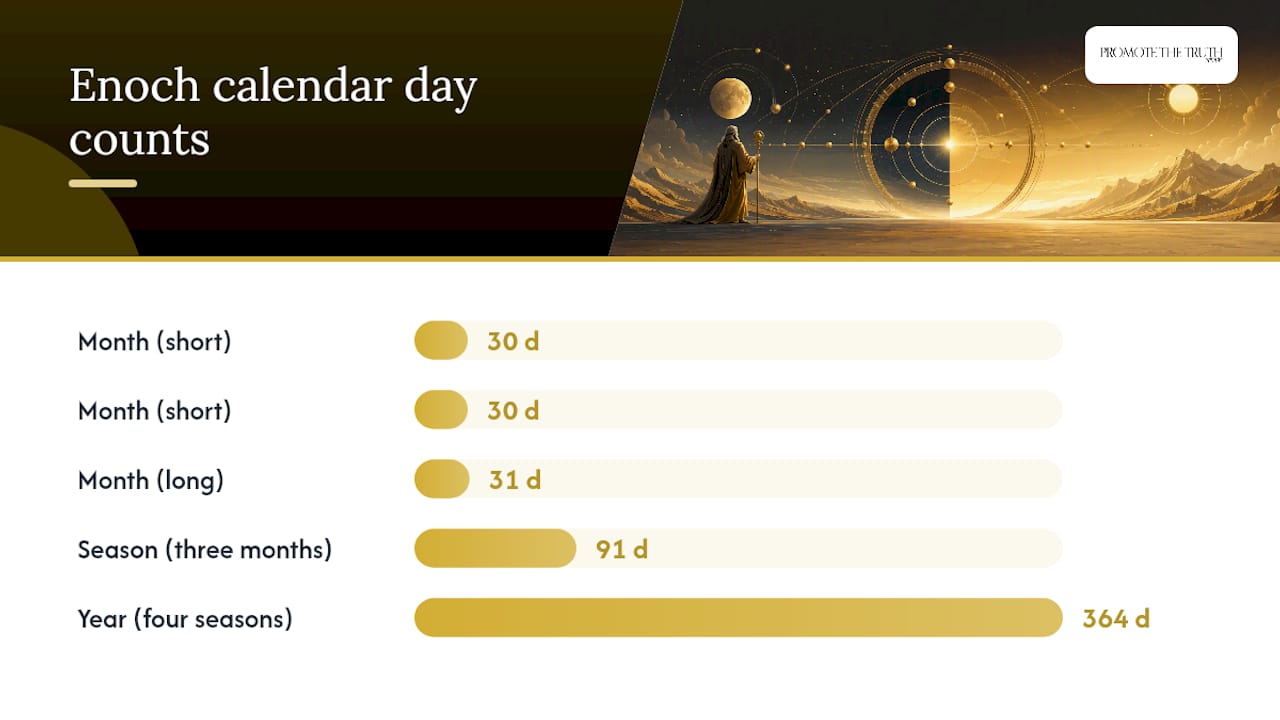
The additional day associated with the end of each 31-day third month has a special role within the 364-day Hanuk (Enoch) Calendar. These four seasonal or cardinal days mark the transitions between the calendar’s four equal seasons. Some modern reconstructions describe them as intercalary or seasonal marker days, although interpretations differ over exactly how they relate to the regular weekly count. Together, these four turning points give the year a structured rhythm connected with the annual movement of the sun and the changing seasons rather than with the phases of the moon.
Modern implementations of the Hanuk (Enoch) Calendar often use the following twelve month names, drawn from the Abariy (Hebrew) calendar tradition:
-
Abiyb (Aviv)
-
Zu (Ziv)
-
Siyun (Sivan)
-
Tamuz (Tammuz)
-
Ab
-
Alul (Elul)
-
Tishriy (Tishrei)
-
Hashuan (Cheshvan)
-
Kisliu (Kislev)
-
Tabat (Tevet)
-
Shabat [Shebat (Shevat)]
-
Adar
One detail often causes confusion for newcomers: different Hanuk (Enoch) Calendar reconstructions do not always agree on the exact weekday on which the year should begin. Some practitioners anchor the year to a Wednesday Taqufah (tekufah), connecting the starting point with their interpretation of the creation account in Barashiyt (Genesis), while others begin the calendar on Thursday.
This difference is significant. Choosing one starting day instead of the other shifts every corresponding calendar date by 24 hours, which helps explain why two sources using the label “Hanuk (Enoch) Calendar” can sometimes assign a Shabat (Sabbath), Appointed Time, or Feast Day to different Gregorian dates or weekdays.
Our own study of the Creator’s calendar mechanics explores in greater detail how the four 91-day seasons, the 364-day solar year, the seasonal turning points, and the repeating weekly pattern fit together.
How Do You Convert Hanuk (Enoch) Calendar Dates to Gregorian Dates?
Converting Hanuk (Enoch) Calendar dates to Gregorian calendar dates becomes much easier once you establish a clear and reliable reference point. The process begins with an astronomical anchor date, followed by counting forward or backward according to the calendar’s fixed 364-day structure.
Many modern reconstructions align the beginning of the year with the spring equinox, often referred to as the Taqufah in Abariy (Hebrew) calendrical terminology. This distinction is important because the Hanuk (Enoch) Calendar is a solar calendar, not a lunar calendar. Its annual cycle is tied to the movement of the sun and the changing seasons rather than to the phases of the moon.
To identify the timing of the spring equinox, some modern Hanuk (Enoch) Calendar projects use astronomical calculations and ephemeris data. According to the Hanuk (Enoch) Calendar project’s methodology, astronomical calculations are used as part of the process for calibrating the calendar to the solar year.
The following method provides a practical framework for converting Hanuk (Enoch) Calendar dates to Gregorian dates:
-
Choose a reliable anchor year. Select a year in which the spring equinox is well documented, then determine whether the reconstruction you are following begins the calendar year on Wednesday or Thursday.
-
Establish the equinox anchor. Identify the Gregorian date associated with the spring Taqufah and use that point as the reference for the first day of the Hanuk year according to your chosen calendar model.
-
Count forward using the 364-day cycle. Add complete 364-day years until you reach the target year. Because 364 days equal exactly 52 weeks, the calendar preserves the same weekday pattern unless an intercalation or correction method is introduced.
-
Locate the correct month and day. Within the target year, follow the repeating 30-30-31 monthly pattern for each of the four 91-day seasons to identify the exact Hanuk (Enoch) Calendar date.
-
Determine whether intercalation applies. Some modern reconstruction models introduce a leap week or another correction method at specific intervals to prevent the calendar from drifting away from the solar seasons. Verify the method used by your chosen model before completing the conversion.
-
Verify the result. Because different Hanuk (Enoch) Calendar reconstructions may use different equinox anchors, starting weekdays, and intercalation systems, compare your result with another calendar source or converter that clearly explains its methodology.
Several practical resources can assist with this process, including printable yearly calendars, monthly planning grids, and dual-calendar converters that display Gregorian and Hanuk (Enoch) dates side by side. Resources such as the Enochian Solar Calendar published by Halleluyah Prints illustrate the types of planning tools commonly available.
Before relying on any Enoch calendar converter, examine the method behind it. A reliable tool should explain its equinox anchor, astronomical calculations, starting weekday, and intercalation method rather than simply displaying dates without showing how they were determined.
Study Tip: For greater accuracy, verify the timing of the spring equinox using a recognized astronomical dataset, such as NASA JPL ephemeris data, before comparing the result with a Hanuk (Enoch) Calendar converter. Understanding the method behind the conversion is just as important as the final Gregorian date.
Why Does the Hanuk (Enoch) Calendar Drift From the Solar Year?
A 364-day year is approximately 1.2422 days shorter than the tropical solar year of about 365.2422 days. Although that difference may appear insignificant, it accumulates over time. Without a method of correction, the Hanuk (Enoch) Calendar gradually drifts away from the actual solar year, causing its seasonal markers—including the equinoxes, solstices, and the calendar’s cardinal days—to fall out of alignment with the observable heavens within only a few decades.
Because of this gradual drift, scholars and calendar researchers have proposed several methods for maintaining the calendar’s alignment with the solar year:
-
Leap-week insertion, in which an additional seven-day week is inserted at specific intervals to compensate for the accumulated drift while preserving the 364-day calendar structure.
-
John Pratt’s 27-year cycle, which proposes a repeatable schedule for inserting leap weeks to keep the calendar closely synchronized with the solar year over extended periods.
-
Academic reconstruction models, including longer chronological cycles that attempt to synchronize the 364-day calendar with both the Julian and Yahudiy (Jewish) lunar calendars, as discussed in this academic reconstruction of the Essene solar calendar.
The Drift in Practical Terms
At approximately 1.2422 days per year, an uncorrected 364-day calendar accumulates nearly one month of seasonal drift every twenty-four years. If left uncorrected, appointed times that were originally intended to occur during the spring season would eventually fall during what the heavens identify as autumn, making accurate seasonal observance increasingly difficult.
Each proposed solution presents its own strengths and challenges. Leap-week models preserve the simplicity and theological structure of the 364-day calendar but require agreement on precisely when the additional week should be inserted. John Pratt’s model offers a structured and repeatable correction cycle, although it introduces additional chronological calculations that researchers should evaluate carefully. Likewise, other academic reconstruction models provide alternative approaches but have not achieved universal acceptance among scholars or calendar researchers.
Ultimately, the question is not simply whether the calendar requires correction, but which method most faithfully preserves the original calendar while remaining aligned with the observable heavens. For that reason, the ongoing discussion continues to encourage careful examination of the historical, astronomical, and manuscript evidence rather than reliance on tradition or assumption alone.
What Do Ancient Texts and Modern Scholars Say About the Hanuk (Enoch) Calendar?
The 364-day Hanuk (Enoch) Calendar is not merely a modern reconstruction imposed on ancient writings. Its basic structure is described in early Jewish literature and is also reflected in manuscript evidence from the Second Ahiykal (Temple) period.
The Astronomical Book, preserved within 1 Hanuk (Enoch), presents an ordered system for tracking the movement of the heavenly luminaries through appointed “portals.” Hanuk (Enoch) 72 describes a year of 364 days, forming a structured pattern of months and seasons that is central to the calendar system associated with the text.
The Book of Yubal (Jubilees) also supports a 364-day calendar and presents it as a Set-Apart (Divinely) ordained framework for measuring appointed times. It contrasts this system with alternative methods of timekeeping and warns against calendrical practices that would cause the Appointed Times to shift from their proper seasons.
The Dead Sea Scrolls provide additional manuscript evidence that the 364-day calendar was known and used within some Second Ahiykal (Temple) Yahudiy (Jewish) communities. Calendrical texts discovered at Qumran, including 4Q317, 4Q503, and 4Q252, show that calendar calculation and the ordering of appointed times were important subjects within the community. At the same time, the wider manuscript record indicates that more than one calendrical tradition existed during the Second Ahiykal (Temple) period, meaning that calendar observance was an active area of interpretation and practice rather than a single universally accepted system.
Taken together, 1 Hanuk (Enoch), Yubal (Jubilees), and the Dead Sea Scrolls provide important historical and manuscript evidence for studying the origins, structure, development, and transmission of the 364-day Hanuk (Enoch) Calendar. They also help explain why this calendar continues to receive attention among readers interested in Scriptural chronology, Shabats (Sabbaths), the Appointed Times, Qumran calendrical texts, and ancient Yahudiy (Jewish) timekeeping traditions.

The most significant modern research on this subject includes a Tel Aviv University study examining whether the Qumran community actually practiced the 364-day calendar during its early history rather than treating it only as a theological ideal. According to the study, the calendar appears to have played an important role in the community’s religious identity and may have contributed to tensions with the priestly leadership in Yirushalam (Jerusalem). The researchers also suggest that the calendar’s gradual seasonal drift could have made long-term observance increasingly difficult. These findings shift the discussion from simply asking whether the 364-day calendar was ever used to examining how long such a system could realistically have been maintained in practice based on the available historical and manuscript evidence. See the full study from Tel Aviv University.
Scholars continue to debate the extent to which the calendrical systems preserved in the Dead Sea Scrolls reflect actual community practice, theological idealization, or a combination of both. Because many of the Qumran manuscripts survive only in fragmentary form, important questions remain open for continued manuscript research and historical reconstruction.
For readers who want to examine the primary manuscript evidence more closely rather than relying only on secondary summaries, explore the Dead Sea Scrolls through the Yisha’aiyahu (Isaiah) Dead Sea Scrolls. To study the broader diversity of calendrical systems during the Second Ahiykal (Temple) period, see our article on Calendrical Plurality in Second Temple Judaism
Study Resources for Learning the Hanuk (Enoch) Calendar
Reading about the Hanuk (Enoch) Calendar is one step. Understanding its manuscript foundation and learning how it is applied according to the Scriptures is another. At Promote The Truth, our studies draw from ancient Abariy (Hebrew) and Aramiyt (Aramaic) manuscript traditions, helping readers examine the Scriptural evidence behind the Creator’s Calendar rather than relying solely on later tradition or modern interpretation.
If you are ready to study the Hanuk (Enoch) Calendar more deeply, explore these resources:
-
Learn how the Creator’s Calendar is structured in our complete study of the Creator’s Calendar mechanics, which explains the four equal seasons, the weekly cycle, and the Scriptural framework of the calendar in clear, practical language.
-
Discover how the calendar is used to determine Yum Shabua’aut (Feast of Weeks) by reading our in-depth study of Yum Shabua’aut, including its timing, prophetic significance, and relationship to the annual Appointed Times.
-
Visit our Creator’s Calendar Resource Center, where you can explore our complete teaching series, study guides, downloadable resources, and additional materials designed to help you better understand and observe the Hanuk (Enoch) Calendar.
These resources offer more than a printable calendar. They are designed to lead readers back to the Scriptural and manuscript evidence behind the calendar’s structure, seasonal cycle, Shabats (Sabbaths), and Appointed Times.
If your goal is to understand YAHUAH’s Appointed Times as closely as possible to the earliest available Abariy (Hebrew) and Aramiyt (Aramaic) manuscript traditions, begin with the primary Scriptural evidence and continue your study through the manuscript-based resources available at Promote The Truth.
How Do You Read a Specific Date on the Hanuk (Enoch) Calendar?
Reading a specific date on the Hanuk (Enoch) Calendar begins with three questions: Which season is it? Which month within that season? And is the date a regular numbered day or one of the four cardinal days?
Because the calendar follows a fixed 364-day structure, once you know the starting weekday of a season, you can determine the weekday pattern for every date within it. Each season contains exactly 91 days, which is a multiple of seven. As a result, the first day of each season falls on the same weekday as the first day of every other season. In practical terms, once you know the weekday on which the spring season begins, you also know the starting weekday for summer, autumn, and winter.
The four cardinal days mark the seasonal turning points associated with the equinoxes and solstices. However, different Hanuk (Enoch) Calendar reconstructions do not always treat these days in exactly the same way. Some include them within the regular weekly count, while others describe them as seasonal marker days that stand outside the normal weekly sequence. This difference is one reason calendar reconstructions can disagree over whether the annual cycle should begin on Wednesday or Thursday.
The Appointed Times and Feast Days follow fixed positions within the calendar rather than shifting according to lunar phases. This is one of the main reasons the 364-day Hanuk (Enoch) Calendar appeals to many practitioners. A Feast Day assigned to a specific calendar date returns to the same weekday within the uninterrupted 364-day cycle.
The main complication appears over longer periods of time. Because 364 days are shorter than the tropical solar year, an uncorrected calendar would gradually drift away from the astronomical seasons. For that reason, any long-term reconstruction must explain how it handles solar drift, intercalation, and seasonal alignment.
How Do You Read a Specific Date on the Hanuk (Enoch) Calendar?
Reading a specific date on the Hanuk (Enoch) Calendar begins with three questions: Which season is it? Which month within that season? And is the date a regular numbered day or one of the four cardinal days?
Because the calendar follows a fixed 364-day structure, once you know the starting weekday of a season, you can determine the weekday pattern for every date within it. Each season contains exactly 91 days, which is a multiple of seven. As a result, the first day of each season falls on the same weekday as the first day of every other season. In practical terms, once you know the weekday on which the spring season begins, you also know the starting weekday for summer, autumn, and winter.
The four cardinal days mark the seasonal turning points associated with the equinoxes and solstices. However, different Hanuk (Enoch) Calendar reconstructions do not always treat these days in exactly the same way. Some include them within the regular weekly count, while others describe them as seasonal marker days that stand outside the normal weekly sequence. This difference is one reason calendar reconstructions can disagree over whether the annual cycle should begin on Wednesday or Thursday.
The Appointed Times and Feast Days follow fixed positions within the calendar rather than shifting according to lunar phases. This is one of the main reasons the 364-day Hanuk (Enoch) Calendar appeals to many practitioners. A Feast Day assigned to a specific calendar date returns to the same weekday within the uninterrupted 364-day cycle.
The main complication appears over longer periods of time. Because 364 days are shorter than the tropical solar year, an uncorrected calendar would gradually drift away from the astronomical seasons. For that reason, any long-term reconstruction must explain how it handles solar drift, intercalation, and seasonal alignment.
What Mistakes Do People Make When Converting Hanuk (Enoch) and Gregorian Dates?
One of the most common mistakes is assuming that the Hanuk (Enoch) Calendar begins on January 1, like the Gregorian calendar. It does not. In many modern reconstructions, the Hanuk (Enoch) New Year is anchored to the spring equinox. Any conversion that starts from January 1 will therefore produce incorrect results because it is based on the wrong calendar framework.
Another common mistake is combining different Hanuk (Enoch) Calendar traditions without recognizing how their methods differ. For example, someone may calculate the beginning of the year using a Wednesday Taqufah method while following a Thursday-start calendar for the monthly layout. This mismatch can shift the entire calendar by one day and may change the weekday assigned to certain Appointed Times. Before comparing or combining calendars, always confirm that both sources use the same calculation method, year-start convention, and treatment of seasonal marker days.
A third mistake is overlooking intercalation. Because a fixed 364-day calendar is shorter than the tropical solar year, a calendar without a correction method will gradually drift away from the astronomical seasons. Over time, this can move the Appointed Times farther from the agricultural and seasonal framework they are intended to follow. When evaluating a Hanuk (Enoch) Calendar, check whether its creators clearly explain how they maintain alignment with the spring equinox. If no correction method is provided, its long-term seasonal accuracy should be examined carefully.
Finally, many readers assume that every Hanuk (Enoch) Calendar available online follows the same reconstruction. In reality, researchers and restoration communities may use different month names, calculate the placement of the cardinal days differently, or follow different methods for determining the beginning of the year. These variations can affect weekday calculations, Gregorian conversions, and the dating of the Appointed Times.
Before relying on any Hanuk (Enoch) Calendar converter, take time to understand the methodology behind it and compare its calculations with the available historical, astronomical, and manuscript evidence. A reliable conversion method should clearly explain its equinox anchor, starting weekday, intercalation system, and treatment of the 364-day cycle.
Who Uses the Hanuk (Enoch) Calendar Today?
The 364-day Hanuk (Enoch) Calendar is not merely a historical system preserved in ancient manuscripts. Today, a growing number of believers and Scripture-focused communities use this calendar to determine the Shabat (Sabbath), the Appointed Times, and other Scriptural observances. Many believe that its fixed 364-day structure more closely reflects the calendrical framework described in Hanuk (Enoch), Yubal (Jubilees), and the Dead Sea Scrolls than the modern Gregorian calendar.
These communities often include Turah (Torah)-observant assemblies, Set-Apart (Sacred) Name believers, and various Abariy (Hebrew) Roots groups seeking to restore what they understand to be the original Scriptural calendar rather than relying solely on later rabbinic or civil calendar systems. Although they do not follow a single governing authority or one universally accepted reconstruction, many share the conviction that the fixed weekly Shabat (Sabbath) pattern associated with the Hanuk (Enoch) Calendar preserves an important element of the Creator’s appointed order.
Interest in the Hanuk (Enoch) Calendar has grown alongside renewed attention to Abariy (Hebrew) Roots, Set-Apart (Sacred) Name studies, and ongoing Dead Sea Scrolls research. Greater access to manuscript studies, digital archives, astronomical data, and online educational resources has enabled more readers to examine the historical and Scriptural evidence for themselves.
For comparison, other ancient civilizations also preserved sacred calendrical systems, such as the Mayan Tzolk’in 260-day calendar. However, what distinguishes the Hanuk (Enoch) Calendar for many believers is its connection to Hanuk (Enoch), Yubal (Jubilees), and related manuscript traditions, together with its emphasis on preserving a consistent weekly cycle for the Shabat (Sabbath) and the Appointed Times.
Why a Rule-Based Approach Matters More Than a History-Only Approach
Many discussions of the Hanuk (Enoch) Calendar devote extensive attention to the history of Qumran while giving readers very little practical guidance on how the calendar actually works. For anyone seeking to understand or apply the calendar, learning its underlying rules is just as important as studying its historical background.
Historical and manuscript research indicates that the 364-day calendar was more than an abstract theological idea for some ancient communities. This perspective encourages readers to move beyond historical discussion and examine the calendar’s structure, calculations, seasonal framework, and Scriptural foundations for themselves.
If there is one principle to remember, begin with the 30–30–31 monthly pattern and the spring equinox as the calendar’s foundational reference point. Once those basic principles are understood, the different theories surrounding intercalation, leap weeks, and calendar correction become much easier to evaluate.
A clear understanding of the 364-day Hanuk (Enoch) Calendar structure provides a stronger foundation than beginning with the more complex debates over long-term adjustment methods. Learn the rules first, then evaluate the competing reconstruction models from that foundation.
— Maria
Continue Your Search for the Truth
Every manuscript, restored name, and historical source ultimately points to one question: What do the original Scriptures actually say? Don’t stop with secondary sources or scholarly discussion alone. Examine the manuscript evidence for yourself through the Truth Scriptures, translated directly from the earliest available Abariy (Hebrew) and Aramiyt (Aramaic) sources. Whether you’re researching the Set-Apart Name, YAHUAH, restoring the original Scriptural names, studying the YAHUAH Calendar, or seeking a deeper understanding of salvation, Promote The Truth provides resources designed to help sincere truth seekers return to the foundation of the Scriptures.
Begin Your Study
-
Explore Promote The Truth — Discover manuscript research, Scripture studies, restoration resources, and articles that help you examine the evidence for yourself.
https://www.promotethetruth.com/ -
Read the Truth Scriptures — Experience the Scriptures with restored Abariy (Hebrew) and Aramiyt (Aramaic) names, titles, and terminology based on manuscript research.
https://www.promotethetruth.com/truthscriptures -
Study the YAHUAH Calendar — Learn about the Creator’s appointed times through manuscript evidence and historical research.
https://www.promotethetruth.com/yahuah-calendar -
Understand True Salvation — Explore what the Scriptures teach about repentance, obedience, faith, and eternal life through the original Scriptural record.
https://www.promotethetruth.com/true-salvation