
Who are the Alahiym (Elohim) mentioned in Tahliym (Psalm) 82, and what does the Set-Apart (Divine) Council reveal about YAHUAH’s authority and righteous judgment? This remarkable passage presents a heavenly courtroom scene in which Aluah (God) stands in judgment among the Alahiym (Elohim), holding them accountable for injustice and their failure to defend the poor, oppressed, and needy.
One influential scholarly interpretation identifies these Alahiym (Elohim) as heavenly or Set-Apart (divine) beings associated with the governance of the nations and subject to the authority of Yisharal’s Aluah (Israel’s God). This interpretation is commonly known as the Set-Apart (Divine) Council view. Other interpretations identify the Alahiym as human judges, rulers, or heavenly messengers. Understanding these perspectives requires examining the original Abariy (Hebrew) language, historical context, and related Scriptural passages.
In this study, we will examine Tahliym (Psalm) 82 verse by verse, explore the meaning of Alahiym (Elohim), compare four major interpretations of the Set-Apart (Divine) Council, and consider what the passage reveals about YAHUAH’s supreme authority, justice, and judgment over the nations.
The Truth Scriptures™ Translation presents Tahliym (Psalm) 82:1–8 as follows:
Tahliym (Psalm) 82:1–8 — Truth Scriptures™ Translation
1 Aluah stands up in Heaven’s Court. He pronounces judgment on the alahiym.
2 “How long will you continue to judge unfairly, and favor wicked people?
3 Judge the poor and the orphans fairly. Defend the oppressed and those in need.
4 Rescue those in need and the abused out of the hand of the wicked.
5 The wicked do not understand a thing. They live in darkness while the foundations of the world tremble.”
6 Then I declared, “I have called you good alahiym, children of the Most High.
7 Nevertheless, your human form shall die, and all of the powerful rulers shall die as well.”
8 Arise, Oh, Aluah, judge the earth, because they belong to You!
The central question is who these Alahiym are and why they are being judged. By examining the original Abariy (Hebrew) wording and related Scriptural passages, we can better understand the heavenly courtroom scene and its message about righteous judgment.
Key Takeaways
-
Tahliym (Psalm) 82 presents a heavenly courtroom scene in which Aluah judges the Alahiym for injustice and their failure to protect the vulnerable. The judgment includes a declaration that they will die like mortals.
-
Alahiym (Elohim) is grammatically plural in form*, but its meaning depends on context. It can refer to the Creator or to other beings. In verse 1, the first occurrence refers to the supreme Judge, while the second identifies those standing before Him.*
-
Four major interpretations exist: the people of Yisharal (Israel) at Siyniy (Sinai), human judges or rulers, heavenly beings, and a Set-Apart (Divine) Council associated with the nations. The heavenly council interpretation has substantial scholarly support, although other readings remain debated.
-
Other passages describe heavenly assemblies under YAHUAH’s authority*, including Tahliym (Psalms) 29 and 89, Aiyub (Job) 1–2, and 1 Malakiym (1 Kings) 22.*
-
Understanding the Set-Apart (Divine) Council requires examining the original Abariy (Hebrew) wording*, including the distinction between Aluah and Alahiym, grammatical context, and the relationship between Scriptural titles and the Set-Apart (Divine) Name YAHUAH (יהוה).*
Table of Contents
What Tahliym (Psalm) 82 describes, verse by verse
Tahliym (Psalm) 82 contains eight verses that unfold as a heavenly courtroom scene, moving from the appearance of the Judge to the accusation, sentence, and final appeal for judgment over the earth.
Verse 1: Aluah Stands in Heaven’s Court
The opening verse presents Aluah standing in judgment among the Alahiym.
The original Abariy (Hebrew) wording distinguishes the One presiding over the assembly from those receiving judgment. This distinction forms the foundation of the Set-Apart (Divine) Council interpretation.
Verses 2–4: The Charge Against Unjust Judgment
The Alahiym are accused of judging unfairly and favoring wicked people rather than protecting the poor, orphans, oppressed, and needy.
The Working Preacher commentary on Tahliym (Psalm) 82 emphasizes that the passage confronts injustice, particularly the failure to defend vulnerable people.
The message is clear: those entrusted with authority are accountable for how they exercise judgment.
Verse 5: Injustice Shakes the Foundations
Verse 5 describes ignorance, darkness, and the trembling foundations of the world.
The imagery connects unjust judgment with disorder. When those responsible for justice fail in their duties, the consequences extend beyond individual wrongdoing.
Verses 6–7: The Judgment Against the Alahiym
The passage identifies those being addressed as Alahiym and children of the Most High, yet declares that they will die.
Under the heavenly council interpretation, this judgment expresses the loss of their privileged status or authority. Under the human-ruler interpretation, the warning emphasizes that earthly authority cannot protect anyone from death and judgment.
Either reading underscores the supremacy of Aluah over those who exercise delegated authority.
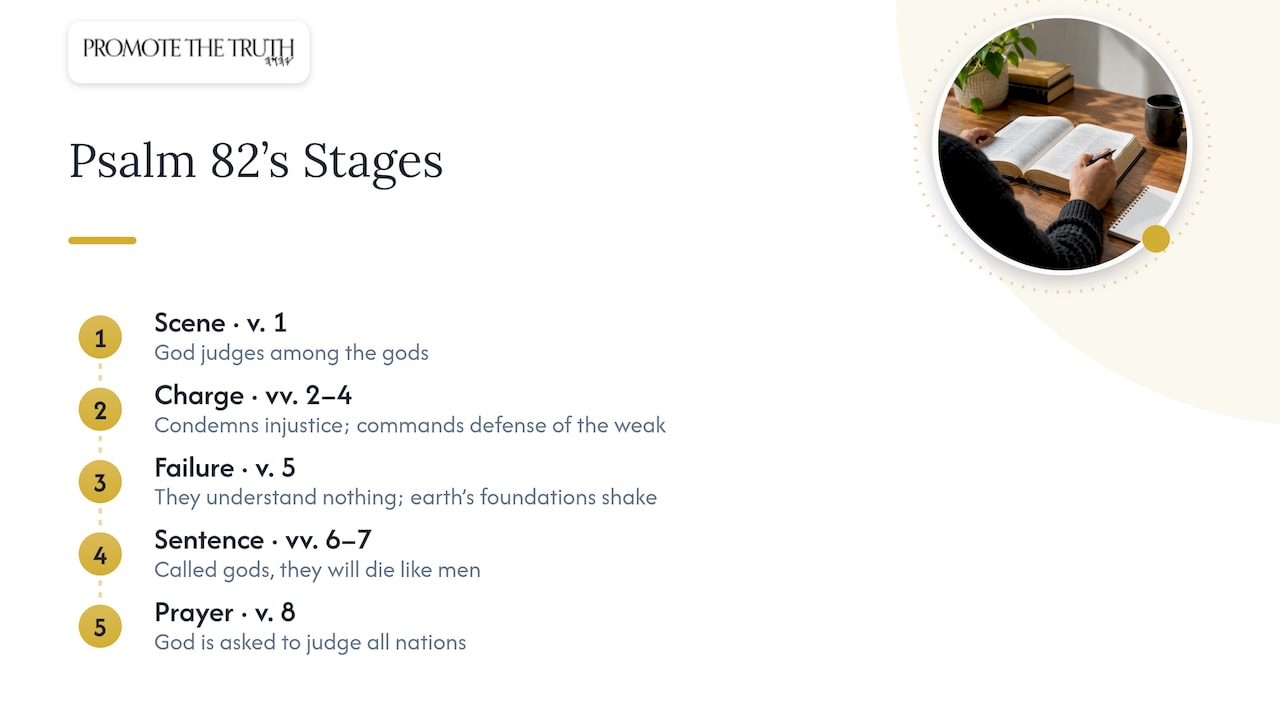
Verse 8: A Call for Aluah to Judge the Earth
The final verse calls upon Aluah to arise and judge the earth, affirming that the nations belong to Him.
A 1986 academic study of Tahliym (Psalm) 82 discusses how the passage transforms set-apart (divine) assembly imagery into a judicial setting where the accused beings are judged.
Importantly, the passage does not identify rival deities by name or describe a battle between competing powers.
The central message is not that YAHUAH faces an equal opponent, but that all authority remains subject to His righteous judgment.
What Alahiym (elohim) Means in Tahliym (Psalm) 82
Understanding Alahiym (Elohim) is essential to interpreting Tahliym (Psalm) 82.
The original Abariy (Hebrew) word אלהים (Elohim) has a plural grammatical form. However, its meaning depends on how it functions within a particular sentence.
In different Scriptural contexts, the term may refer to the Creator, other set-apart (divine) beings, or figures associated with divine authority.
Why Does Verse 1 Use Elohim Twice?
In Tahliym (Psalm) 82:1, the first occurrence of Alahiym (Elohim) is accompanied by a singular verbal form, identifying one supreme Judge.
The second occurrence appears within a plural context, referring to those standing before Him.
This grammatical distinction helps explain why the same Abariy (Hebrew) word can appear twice in one verse without necessarily referring to the same subject.
Verse 6 further addresses the accused as Alahiym and children of the Most High, using plural language.
However, grammar alone does not settle whether these figures are heavenly beings or human representatives of divine authority. The surrounding passage must also be considered.
What Does the Assembly of El Mean?
An important expression in verse 1 is עֲדַת־אֵל (ʿAdat El), commonly understood as the assembly of Al (El) or set-apart (divine) assembly.
An academic reference entry on the Set-Apart (Divine) Council discusses parallels between this expression and ancient Ugaritic descriptions of assemblies associated with Al (El) and other set-apart (divine) beings.
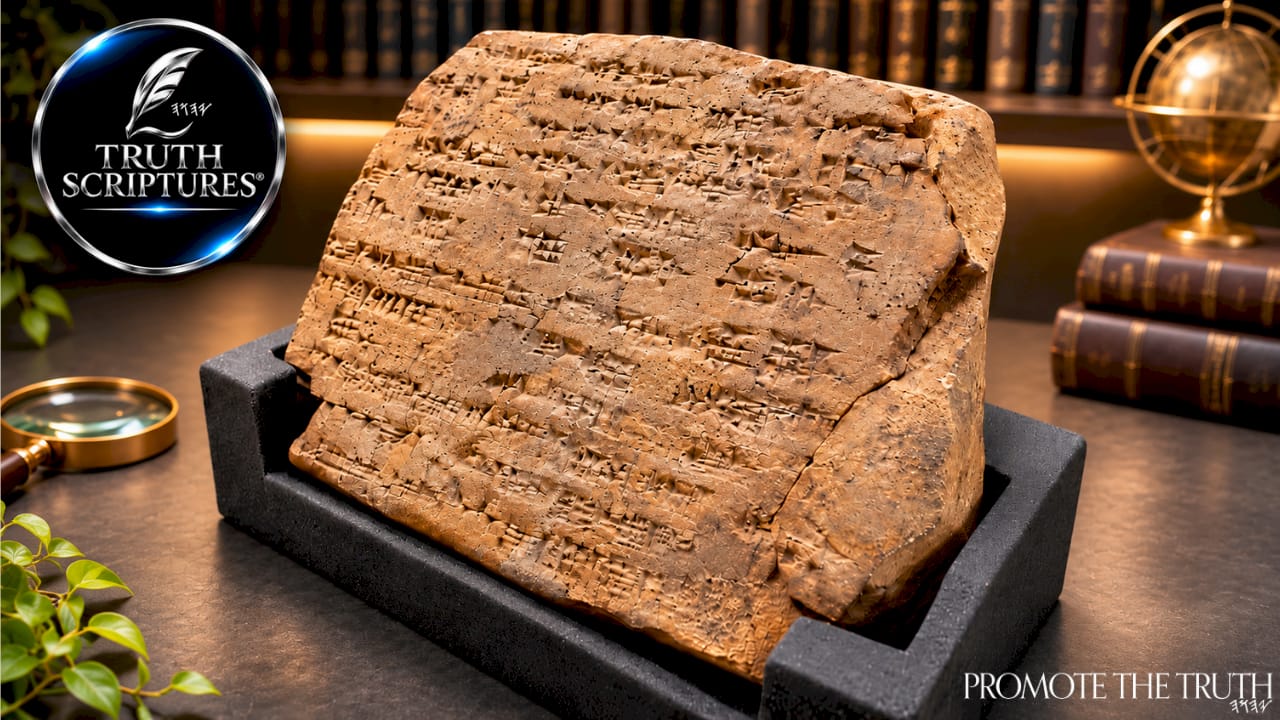
Ugarit was an ancient city whose surviving clay tablets preserve religious and literary traditions from the wider Kana’aniy (Canaanite) world.
These linguistic parallels help scholars examine the historical background of the Scriptural passage. They do not, by themselves, establish that the Scriptural writers endorsed every belief found in neighboring cultures.
For a deeper examination of the distinction between Scriptural titles and the Creator’s Set-Apart Name, explore our study on the Names of the Creator in Abariy (Hebrew).
The distinction between Aluah and Alahiym is central to understanding the authority and judgment described in Tahliym (Psalm) 82.
Four Ways Readers Have Understood the “Alahiym (gods)”
The identity of the Alahiym (Elohim) in Tahliym (Psalm) 82 has been interpreted in several ways throughout Scriptural history.
Each interpretation draws upon particular linguistic, historical, or theological considerations.
Four Major Interpretations of the Alahiym in Tahliym (Psalm) 82
| Interpretation | Who Are the Alahiym? | Main Supporting Evidence | Main Question or Difficulty |
|---|---|---|---|
| Yisharal (Israel) at Siyniy (Sinai) | People who received the Law | Traditions connecting set-apart (divine) address and the giving of the Law | How does this interpretation explain the heavenly assembly imagery? |
| Human judges and rulers | Authorities responsible for justice | Shamut (Exodus) 21:6 and 22:8, together with the emphasis on fair judgment | How should “children of the Most High” and “die like men” be understood? |
| Heavenly beings | Spiritual beings under set-apart (divine) authority | “Children of the Most High” and comparisons with Aiyub (Job) 1:6 and 38:7 | Does the passage assign these beings authority over the nations? |
| Set-Apart (Divine) Council over the nations | Heavenly beings held accountable for unjust governance | The assembly scene, judgment, and closing appeal concerning the nations | How should their responsibilities and judgment be understood within the broader Scriptural context? |
The 2016 study published in the Journal of the Adventist Theological Society discusses the competing interpretations, including the human-judge and heavenly-being readings.
The Working Preacher commentary also examines these perspectives and presents the set-apart (divine) assembly interpretation as a persuasive reading within the passage’s ancient setting.
Why the Set-Apart (Divine) Council Interpretation Has Strong Support
Three features are particularly important.
1. The heavenly assembly setting
The passage opens with Aluah standing in an assembly described using language associated with set-apart (divine) beings. This setting invites comparison with other heavenly council passages in the Ta’anak.
2. The judgment that the Alahiym will die
The statement that these figures will die like mortals creates a striking contrast if they are understood as heavenly beings.
However, interpreters who identify them as human judges understand the warning as emphasizing the mortality of those who misuse authority.
3. The final judgment of the nations
Verse 8 calls upon Aluah to judge the entire earth, connecting the courtroom scene with universal authority.
This has led some scholars to associate the accused Alahiym with the governance of nations.
Taken together, these features make the heavenly council interpretation a substantial and influential scholarly reading. Nevertheless, the human-judge and other interpretations remain important for understanding the passage’s reception and theological history.
Other Passages that Show the Same Assembly
The imagery of a Set-Apart (Divine) Council is not limited to Tahliym (Psalm) 82.
Several passages in the Ta’anak (Old Testament) describe heavenly beings appearing before YAHUAH, worshiping Him, or participating in scenes where His authority is supreme.
Tahliym (Psalm) 29:1–2
1 Acknowledge YAHUAH, you Heavenly Beings! Acknowledge YAHUAH’s power and esteem!
2 Give YAHUAH the esteem His Name deserves. Worship YAHUAH in Set-Apart Attire.
This passage calls upon the Heavenly Beings to acknowledge and worship YAHUAH.
The emphasis is on YAHUAH’s authority, power, esteem, and worthiness of worship, not on any independent authority belonging to the heavenly beings gathered before Him. Their role is to recognize His supremacy and give YAHUAH the esteem His Name deserves.
Tahliym (Psalm) 89:5–7
5 The heavens will praise Your wonders, oh, YAHUAH. Your faithfulness is also in the assembly of the Set-Apart Ones.
6 Who in the heavens can be compared to YAHUAH? Who among the mighty ones is like YAHUAH? (Salah)
7 Aluah is highly respected among the council of the Set-Apart Ones. Aluah is to be feared above all them who are around Him.
This passage describes an assembly of the Set-Apart Ones and asks who among the mighty ones in the heavens can be compared to YAHUAH.
The language emphasizes YAHUAH’s incomparable authority, greatness, and supremacy. Even within the council of the Set-Apart Ones, none can be compared to Him. He alone is to be highly respected and feared above all those who are around Him.
Aiyub (Job) 1:6–12
6 One day, the Messengers of Aluah came to present themselves before YAHUAH*, and Shatan also came with them.*
7 YAHUAH said to Shatan, “Where have you come from?” Shatan answered, “From roaming across the earth, walking up and down and all around it.”
8 YAHUAH said to Shatan, “Have you noticed My servant Aiyub? There is no one like him on earth, a man who is blameless and upright, who fears Aluah and stays away from evil.”
9 However, Shatan answered YAHUAH, saying, “Aiyub honors Aluah for a good reason.
10 Have You not placed a hedge of protection around him, his household, and everything he owns? You have baruk the work of his hands, and his possessions have spread throughout the land.
11 However, if You stretch out Your Hand and strike everything he owns, surely, he will curse You to Your Face.”
12 YAHUAH replied to Shatan, “Very well, everything he owns is in your power. However, you are not allowed to lay a hand on Aiyub himself.” Then Shatan left the presence of YAHUAH.
Aiyub (Job) 2:1–8
1 At another time, the Messengers of Aluah came to present themselves before YAHUAH, and Shatan also came among them again to stand before YAHUAH.
2 YAHUAH said to Shatan, “Where have you come from?” Shatan answered, “From roaming across the earth and walking back and forth on it.”
3 YAHUAH said to Shatan, “Have you noticed My servant Aiyub? There is no one like him on earth, blameless, upright, fearing Aluah and avoiding evil. He still holds firmly to his integrity, even though you urged Me to ruin him without cause.”
4 Shatan replied to YAHUAH, “Skin for skin! A man will give up everything he owns to save his own life.
5 However, if You stretch out Your Hand and strike Aiyub’s body, his flesh and bones, he will surely curse You to Your Face.”
6 YAHUAH said to Shatan, “Very well, he is in your power, just do not kill him.”
7 So Shatan left the presence of YAHUAH and afflicted Aiyub with painful boils, from the bottom of his feet to the top of his head.
8 Aiyub took a piece of broken pottery to scrape himself while he sat among the ashes.
These passages portray the Messengers of Aluah assembling before YAHUAH, with Shatan appearing among them. The scenes emphasize that YAHUAH remains the supreme authority, while the other heavenly beings appear before Him and operate within the limits He establishes.
A study of the Set-apart (Divine) Council in the Abariy Scriptures (Hebrew Bible) discusses how passages such as these contribute to the broader understanding of heavenly assembly and Set-apart (Divine) Council imagery in the Ta’anak.
A related passage appears in Aiyub (Job) 38:7:
7 While the morning stars sang together and all the Messengers of Aluah shouted with joy?”
This verse also refers to heavenly beings in connection with creation, further contributing to the Scriptural picture of a heavenly assembly under the authority of YAHUAH.
1 Malakiym (1 Kings) 22:19–23
19 Miykiyahu said, “Then listen to the Word of YAHUAH! I saw YAHUAH sitting on His Throne, with all the Armies of Heaven standing around Him, some on His right, and some on His left.
20 YAHUAH asked, ‘Who shall deceive Ahab so that he goes to attack Ramat Gala’ad and dies there?’ One suggested this idea, and another suggested something else.
21 Then a Spirit stepped forward and stood before YAHUAH and said, ‘I will deceive him.’
22 YAHUAH asked the Spirit, ‘How shall you do it?’ He answered, ‘I will go and become a lying spirit in the mouths of all his prophets.’ YAHUAH said, ‘You shall deceive him, and you shall succeed. Go and do it.’
23 Now, look, YAHUAH has put a lying spirit in the mouth of all your prophets, and YAHUAH has spoken evil against you.
In this prophetic vision, YAHUAH is seen sitting on His Throne, with all the Armies of Heaven standing around Him. The scene presents a heavenly assembly in which different proposals are brought forward concerning King Ahab.
The passage emphasizes YAHUAH’s supreme authority over the heavenly assembly. Although the heavenly beings participate in the scene and one Spirit steps forward with a proposal, the final decision and permission come from YAHUAH.
The Andrews University study also examines this passage in connection with Set-apart (Divine) Council and heavenly assembly imagery in the Ta’anak.
Other Related Scriptural Passages
Scholarly discussions of heavenly beings and Set-aprt (Divine) Council imagery sometimes also include Barashiyt (Genesis) 6:2, 4:
2 that the sons of Aluah saw the daughters of humans, and that they were attractive, so they took wives from any of them whom they chose.
4 The Napiyliym were on the earth in those days, and also after that. Then the sons of Aluah slept with the daughters of men, and they gave birth to children. These children became the mighty men of old, the men of renown."
They may also examine Dabariym (Deuteronomy) 32:8–9:
8 When the Most High divided the nations and spread out the people, He assigned land borders based on the number of the children of Yisharal.
9 YAHUAH chose His people as His special portion. Ya’aqab is the part He claimed for Himself."
These passages are especially relevant when comparing manuscript traditions and interpretations concerning heavenly beings, the nations, and YAHUAH’s authority.
Each passage should be examined individually, since the wording of certain verses and their interpretation may differ among manuscript witnesses and textual traditions.
Taken together, these passages provide a broader Scriptural context for understanding heavenly assemblies, subordinate beings, the nations, and the supreme authority of YAHUAH.
The Set-Apart (Divine) Council Worldview and the Ancient Near East
The Set-Apart (Divine) Council worldview describes a heavenly order in which the supreme Creator exercises authority over subordinate spiritual beings.
Ancient Near Eastern literature contains related imagery, including assemblies of divine beings described in Ugaritic texts.
The academic reference entry on the Set-Apart (Divine) Council discusses these linguistic and cultural parallels.
For modern readers, this historical background can help explain the vocabulary and imagery that ancient audiences may have recognized.
However, similar language does not automatically mean that the beliefs were identical.
The Scriptural passages must be examined according to their own wording and context, especially where they emphasize YAHUAH’s supremacy, judgment, and authority over creation.
In Tahliym (Psalm) 82, the focus is not on exalting the Alahiym. Instead, the passage presents their accountability before the supreme Judge.
Understanding the ancient historical setting can help us recognize the meaning of the imagery without allowing surrounding religious traditions to replace or redefine the message communicated by the Scriptures themselves.
How to Study Tahliym (Psalm) 82 for Yourself
A careful study of Tahliym (Psalm) 82 begins with examining the complete passage, its original language, and related Scriptural passages.
The following six steps provide a practical method for studying the chapter.
-
Read the complete chapter. Examine all eight verses together, paying attention to the courtroom setting, the accusations, the judgment, and the concluding appeal.
-
Identify the speaker and audience. Distinguish between Aluah as Judge, those receiving His judgment, and the concluding appeal in verse 8.
-
Examine the Abariy (Hebrew) word Alahiym. Compare its grammatical usage in verses 1 and 6, including its singular and plural constructions. Our guide to Scriptural Abariy (Hebrew) Grammar provides additional guidance for studying these grammatical distinctions.
-
Compare related Scriptural passages. Study Tahliym (Psalms) 29 and 89, Aiyub (Job) 1–2, and 1 Malakiym (1 Kings) 22 to identify similarities and differences in their descriptions of heavenly assemblies and subordinate beings.
-
Study Scriptural Names and titles. Examine how the original manuscripts distinguish titles such as Al (El) and Alahiym (Elohim) from the Creator’s Set-Apart Name, YAHUAH (יהוה). Our studies on the Meaning of the Tetragrammaton and Ketiv and Qere in the Abariy Scriptures explain these important manuscript traditions. Although יהוה does not explicitly occur in the Abariy (Hebrew) text of Tahliym 82, it appears elsewhere in related Scriptural passages.
-
Compare the four interpretations. Examine the evidence supporting each interpretation and distinguish between what the passage explicitly states and the theological conclusions that have been drawn from it.
For another practical example of original-language study, explore our guide to Tahliym (Psalm) 23 in Abariy (Hebrew).
By examining the original wording, grammatical context, Scriptural Names and titles, and related passages, readers can develop a clearer understanding of the Set-Apart (Divine) Council while avoiding reliance solely on later theological interpretations.
Where Promote The Truth Can Help Your Study
Go Deeper With the Truth Scriptures™ Translation and Original Scriptural Names
Understanding Tahliym (Psalm) 82 requires more than reading a single passage in isolation. It calls for careful attention to ancient manuscript traditions, original Scriptural terminology, historical context, and the distinction between the Creator’s Set-Apart Name and the titles used throughout the Scriptures.
The Truth Scriptures™ Translation is designed to help readers examine these questions more closely by restoring original Scriptural Names and terminology throughout the Ta’anak (Old Testament) and Bariyt Hadash (New Testament), with attention to ancient Abariy (Hebrew) and Aramiyt (Aramaic) manuscript traditions.
At the center of this study is the Creator’s Set-Apart Name, YAHUAH (יהוה). Rather than simply accepting inherited terminology, readers are encouraged to return to the Scriptural text, examine the manuscript evidence, and test what they have been taught against the Word.
Continue your study directly through Promote The Truth:
-
Explore the Truth Scriptures™ Translation — Discover the printed Truth Scriptures™ and its approach to restoring original Scriptural Names and terminology.
-
Access the Truth Scriptures™ Digital Collection — Take your study further with digital access to the Scriptures and restored Scriptural terminology.
-
Discover the PTT Virtual Retreats — Go beyond surface-level study and examine Scriptural Names, historical context, manuscript evidence, and foundational teachings in greater depth. The listed retreats are priced at £197 each.
-
Download the Truth Scriptures Names and Places Resource — Start examining restored Scriptural Names and places through this free study resource.
Do not stop with a discussion about the Set-Apart (Divine) Council. Go directly to the Scriptures. Examine the original wording. Compare the manuscript evidence. Study the Names and titles for yourself. Then continue your research through the resources available at Promote The Truth.
Visit Promote The Truth, open the Truth Scriptures™, and continue seeking a deeper understanding of YAHUAH’s authority, His righteous judgment, and the message preserved in His Word.
Perspective
Tahliym (Psalm) 82 is a passage we return to because it emphasizes an essential Scriptural Truth: YAHUAH alone is supreme, and all who exercise authority remain accountable to Him. Whether the Alahiym are understood as heavenly beings or representatives of set-apart (divine) authority, the passage declares that unjust judgment cannot stand before the Most High.
We believe the original message of the Scriptures is best understood by returning to the earliest available Abariy (Hebrew) and Aramiyt (Aramaic) manuscript traditions, examining their language, Names, and historical setting.
This is why our study emphasizes original Scriptural wording and the restoration of Names and meanings. Through the Truth Scriptures™ Translation, we seek to help readers examine the Ta’anak and Bariyt Hadash with greater attention to their ancient linguistic foundations, including the Creator’s Set-Apart (Divine) Name, YAHUAH (יהוה).
We encourage readers to examine Tahliym (Psalm) 82 carefully, compare the related passages, and allow the Scriptures to guide their understanding.
The heavenly court stands before its supreme Judge. Those who failed to uphold justice face judgment, and the closing appeal calls upon Aluah to judge the entire earth.
The message remains powerful: YAHUAH’s authority is supreme, His judgment is righteous, and justice for the vulnerable matters before Him.
Maria
Frequently Asked Questions
1. Who Are the Alahiym (Elohim) in Tahliym (Psalm) 82?
The Alahiym (Elohim) are the figures addressed and judged by Aluah in the heavenly courtroom scene.
One influential scholarly interpretation identifies them as heavenly or Set-Apart (divine) beings associated with the governance of nations. Other interpretations identify them as human judges, rulers, heavenly messengers, or the people of Yisharal (Israel) receiving set-apart (divine) instruction.
The passage emphasizes their accountability before the supreme Judge.
2. What Does Alahiym (Elohim) Mean in Tahliym (Psalm) 82?
Alahiym (Elohim) is an Abariy (Hebrew) word with a plural grammatical form that can refer to the Creator or other beings, depending on context.
In Tahliym (Psalm) 82:1, the first occurrence identifies the supreme Judge through a singular verbal construction, while the second refers to the figures standing before Him.
Verse 6 further addresses these figures as Alahiym and children of the Most High.
3. What Is the Set-Apart (Divine) Council in the Scriptures (Bible)?
The Set-Apart (Divine) Council is a scholarly term describing heavenly assembly scenes in which spiritual beings appear before the supreme Creator.
Relevant passages include Tahliym (Psalms) 29, 82, and 89; Iyub (Job) 1–2; and 1 Malakiym (1 Kings) 22.
These passages portray heavenly beings in settings involving worship, divine authority, judgment, or deliberation.
4. Is the Set-Apart (Divine) Council Connected to Ancient Kana’aniy (Canaanite) Beliefs?
Ancient Kana’aniy (Canaanite) and Ugaritic literature contains vocabulary and imagery resembling the heavenly assembly described in Tahliym (Psalm) 82.
For example, the Abariy phrase associated with the assembly of Al (El ) has parallels in ancient Ugaritic texts.
However, similar language does not necessarily mean identical theology. The Scriptural passage must be examined within its own context, particularly its emphasis on the supreme Judge’s authority over the assembly.
5. Did Yahusha, Who Is YAHUAH, Quote Tahliym (Psalm) 82:6?
Yes. Yahusha, who is YAHUAH, refers to Tahliym (Psalm) 82:6 in Yahuhanan (John) 10:34–36, where He responds to an accusation of blasphemy by citing the passage in which certain figures are called Alahiym (gods).
This connection is important because it shows that Tahliym (Psalm) 82 remained relevant in discussions about Scriptural authority, set-apart (divine) titles, and the identity of the Alahiym.
However, scholars and interpreters differ on how Yahusha’s use of Tahliym 82:6 should be understood in relation to the identity of the Alahiym in the original psalm.
To understand the passage properly, readers should study Tahliym (Psalm) 82:1–8 alongside Yahuhanan (John) 10:34–36, paying close attention to the wording, context, and purpose of each passage.
For PTT readers, this comparison is especially important because it helps clarify how Yahusha, who is YAHUAH, used the Scriptures when addressing questions about authority, identity, and the use of divine titles.
Sources
The following references provide historical, linguistic, and scholarly discussions relevant to the interpretation of Tahliym (Psalm) 82:
Recommended Further Reading
Continue exploring the original Scriptural language, historical context, and YAHUAH’s authority through these related studies: