
Scriptural (Biblical) monotheism is the conviction that YAHUAH alone possesses supreme, sovereign Set-Apartness (Divinity) and holds the exclusive right to receive worship—a right that no spiritual being, idol, or rival power can share.
The English word “monotheism” is a modern coinage. It did not exist when Mashah (Moses), Duiyd (David), or the Nabiyaiym (Prophets) wrote, and the ancient world had no equivalent technical term for it. Instead, the Scriptures present something far more relational and compelling: a repeated covenantal declaration that YAHUAH’s uniqueness is qualitative, not merely numerical.
This distinction between numerical oneness and qualitative uniqueness shapes everything that follows in this article. A numerical claim simply states that “there is exactly one.” A qualitative claim declares that YAHUAH is categorically unlike anyone or anything else, and that every so-called alahiym (gods) is powerless, subordinate, or nonexistent in comparison with Him.
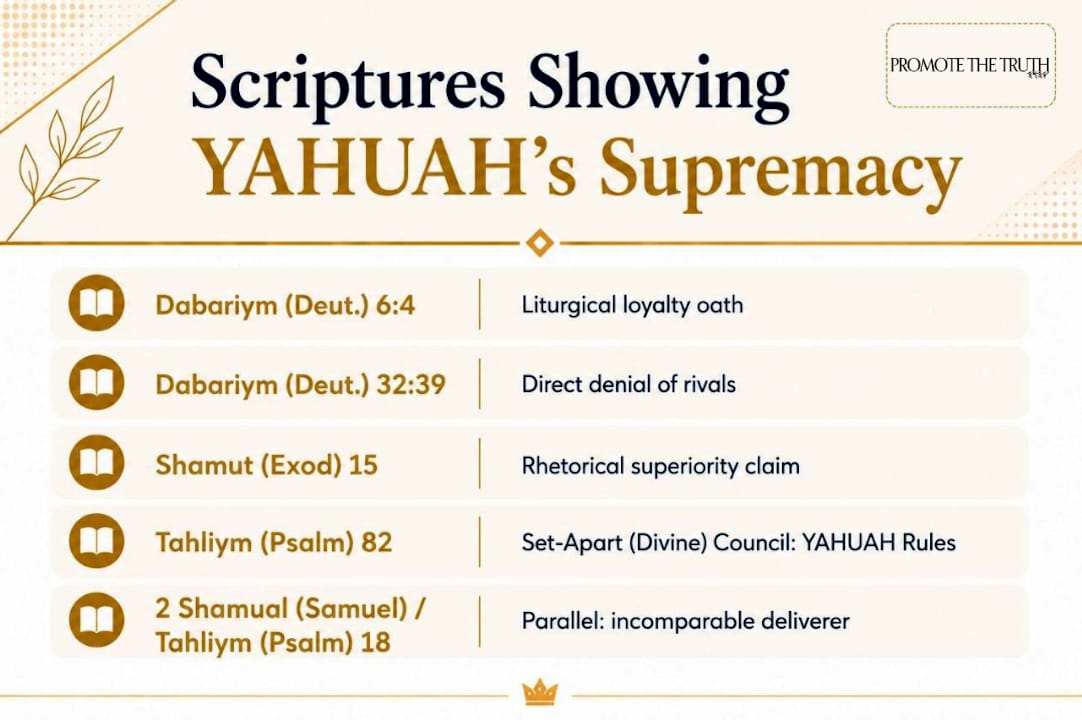
The Scriptures (Bible) consistently emphasize this second truth. Passages such as Dabariym (Deuteronomy) 6:4—the Shema—the Song of the Sea in Shamut (Exodus) 15, and Dabariym (Deuteronomy) 32:39 proclaim YAHUAH’s incomparable supremacy in language that predates modern philosophical terminology by well over a thousand years. Rather than presenting a technical definition of “monotheism,” the Scriptures repeatedly affirm that YAHUAH alone is without equal, unrivaled in His Set-Apartness (Divinity), sovereign authority, and exclusive worthiness to receive worship.
The Scriptural Foundation
The following passages establish this claim directly from the text:
-
Dabariym (Deuteronomy) 6:4 — "Oh, Yisharal, listen! YAHUAH*, our Aluah, is One!" This declaration, known as the Shema, has served as the public confession of faith recited by observant Yisharaliym (Israelites) for millennia.
-
Shamut (Exodus) 15:11 — "Who is like You among the mighty ones, oh, YAHUAH*? Who is like You, great in esteem, awesome in praises, and working wonders?" This rhetorical question declares YAHUAH’s incomparable greatness, assuming the obvious answer: no one.
-
Dabariym (Deuteronomy) 32:39 — “Now you shall see that ‘Aniy, Aniy, Ahua,’ meaning, ‘I Am That I Am, the Living Aluah. I Am He.’ There is no Aluah besides Me. I give life, and I send death. I can hurt, and I can heal. There is no one who can escape from Me.” Rather than simply counting deities, this passage presents YAHUAH’s own declaration of His unrivaled sovereignty over life, death, judgment, and healing.
Together, these passages reveal that the Scriptures define YAHUAH’s uniqueness not merely by number, but by His absolute supremacy, sovereign authority, incomparable Set-Apartness (Divinity), and exclusive worthiness to receive worship.
Promote The Truth’s manuscript research into the Ta’anak and Bariyt Hadash invites readers to examine these foundational passages within their original Abariy (Hebrew) and Aramiyt (Aramaic) context, allowing the Scriptures themselves—not later theological terminology—to explain what is commonly called Scriptural (Biblical) monotheism.
Key Takeaways
Scriptural (Biblical) monotheism affirms that YAHUAH alone possesses unrivaled Set-Apartness (Divinity), sovereign authority, and the exclusive right to receive worship. Rather than presenting a merely numerical claim, the Scriptures consistently proclaim YAHUAH’s qualitative uniqueness through declarations of His incomparability, denial of rival deities, rhetorical questions, and the subordination of every other spiritual being.
| Key Point | Summary |
|---|---|
| Qualitative Uniqueness Over Numerical Oneness | The Scriptures emphasize that YAHUAH is incomparable and without equal, focusing on His unique nature and supreme authority rather than simply stating that only one deity exists. |
| Alahiym (Elohim) Is a Title, Not a Number | The term alahiym (elohim) is applied to YAHUAH as well as to lesser spiritual beings, depending on the context. The title itself does not determine equality with YAHUAH. |
| The Earliest Scriptural Witnesses Proclaim YAHUAH’s Supremacy | Foundational passages such as Dabariym (Deuteronomy) 6:4, Shamut (Exodus) 15:11, and Dabariym (Deuteronomy) 32:39 contain some of the earliest declarations of YAHUAH’s unrivaled supremacy and exclusive sovereignty. |
| The Set-Apart (Divine) Council Is Subordinate to YAHUAH | Passages such as Tahliym (Psalm) 82 portray the members of the Set-Apart (Divine) Council as subject to YAHUAH’s judgment and authority. They are never presented as His equals or rivals. |
| The Scriptural Pattern Is Consistent | From the Ta’anak through the Bariyt Hadash, the Scriptures consistently affirm that YAHUAH alone is supreme, sovereign, and uniquely worthy of worship. |
| Scholarly Discussion Is More Nuanced Than Popular Claims | Many peer-reviewed studies recognize that the development of Yisharal’s (Israel’s) understanding of YAHUAH cannot be reduced to the simplistic claims that Israel was either “always philosophically monotheistic” or that “monotheism appeared only in a late period.” The Scriptural emphasis remains YAHUAH’s incomparable supremacy. |
Table of Contents
-
What Is Scriptural (Biblical) Monotheism According to Key Scripture Passages?
-
Monotheism, Monolatry, and Henotheism: Understanding the Differences
-
When Did Scriptural (Biblical) Monotheism Actually Develop in Ancient Israel?
-
How Does Trinitarian Doctrine Relate to Scriptural (Biblical) Monotheism?
-
Does the Scriptures (Bible) Really Mention Other Alahiym (Gods)?
-
Where Promote The Truth’s Manuscript Research Helps You Study More Deeper
-
An Editorial Perspective on Reading Scriptural (Biblical) Monotheism Faithfully
What Is Scriptural (Biblical) Monotheism According to Key Scripture Passages?
The strongest evidence for Scriptural (Biblical) monotheism does not rest on a single verse. Instead, it emerges from a consistent pattern throughout the Ta’anak, where the Turah (Law), set-apart (sacred) poetry, and prophetic writings all proclaim the same truth: YAHUAH alone is incomparable in His Set-Apartness (Divinity), sovereign authority, and exclusive worthiness to receive worship. Although each passage expresses this truth in its own literary style, they all converge on the same foundational declaration—YAHUAH has no equal.
1. Dabariym (Deuteronomy) 6:4 — The Shema
“Oh, Yisharal, listen! YAHUAH, our Aluah, is One!”
The Shema is Yisharal’s foundational confession of covenant faithfulness. Rather than presenting a philosophical definition of monotheism, it functions as a public declaration of loyalty, calling Yisharal to acknowledge YAHUAH alone as their Aluah. For generations, it has been recited as the central confession of the covenant community, affirming His unique and unrivaled position.
2. Dabariym (Deuteronomy) 32:39
“Now you shall see that ‘Aniy, Aniy, Ahua,’ meaning, ‘I Am That I Am, the Living Aluah. I Am He.’ There is no Aluah besides Me.”
This declaration intensifies YAHUAH’s exclusive sovereignty. The repeated expression “Aniy, Aniy” emphasizes His personal authority, while the statement “There is no Aluah besides Me” is an unmistakable declaration of His unrivaled supremacy. The passage goes on to affirm that YAHUAH alone possesses authority over life, death, healing, and judgment—powers that no rival can claim independently.
3. Shamut (Exodus) 15:11 — The Song of the Sea
“Who is like You among the mighty ones, oh, YAHUAH? Who is like You, great in esteem, awesome in praises, and working wonders?”
The Song of the Sea, one of the oldest poetic celebrations preserved in the Scriptures, proclaims YAHUAH’s incomparability through a rhetorical question whose answer is self-evident: no one is like Him. Rather than elevating other so-called alahiym (gods) to His level, the song magnifies YAHUAH’s unmatched greatness, Set-Apartness (Divinity), and mighty works.
Together, these foundational passages present a unified Scriptural witness. Whether expressed through covenant confession, set-apart (divine) proclamation, or sacred poetry, they consistently affirm that YAHUAH alone is supreme, sovereign, and without equal. This is the heart of Scriptural (Biblical) monotheism.
Study Tip: When reading passages that mention “other alahiym (gods)” or “the mighty ones,” pay close attention to the literary context. Ask whether the passage is a covenant declaration, a legal command, a poetic celebration, a prophetic oracle, or a historical narrative. Understanding the genre helps reveal what the text is actually affirming about YAHUAH’s unrivaled supremacy rather than relying on isolated wording.
4. Tahliym (Psalm) 82 — YAHUAH Rules the Set-Apart (Divine) Council
1 Aluah stands up in Heaven’s Court. He pronounces judgment on the alahiym.
2 "How long will you continue to judge unfairly, and favor wicked people?
3 Judge the poor and the orphans fairly. Defend the oppressed and those in need.
4 Rescue those in need and the abused out of the hand of the wicked.
5 The wicked do not understand a thing. They live in darkness while the foundations of the world tremble."
6 Then I declared, "I have called you good alahiym, children of the Most High.
7 Nevertheless, your human form shall die, and all of the powerful rulers shall die as well."
8 Arise, Oh, Aluah, judge the earth, because they belong to You!
Among the passages commonly discussed in relation to Scriptural (Biblical) monotheism, Tahliym (Psalm) 82 is one of the most significant—and one of the most debated. The Tahliym (psalm) portrays Aluah standing in Heaven’s Court, pronouncing judgment upon the alahiym (gods). At first glance, some readers conclude that the passage describes a pantheon of equal deities. A closer reading, however, reveals a very different picture.
Scholars generally understand the alahiym (gods) in one of two ways. Some interpret them as corrupt human judges or rulers who are addressed metaphorically because they exercise delegated authority. Others understand them as members of the Set-Apart (Divine) Council—subordinate heavenly beings who serve under YAHUAH’s sovereign rule. Although these interpretations differ regarding the identity of the alahiym (gods), both maintain the same central conclusion: YAHUAH alone remains supreme.
The Tahliym (psalm) never presents the alahiym (gods) as equals of YAHUAH. Instead, they are judged, rebuked, and ultimately stripped of their authority and status. Whether understood as earthly rulers or heavenly beings, they remain accountable to YAHUAH, who alone presides over the Court, executes judgment, and inherits authority over all the nations.
Rather than weakening Scriptural (Biblical) monotheism, Tahliym (Psalm) 82 reinforces it. The existence of subordinate spiritual beings does not diminish YAHUAH’s unique Set-Apartness (Divinity) or sovereign authority. On the contrary, the psalm magnifies His supremacy by portraying Him as the One who governs, judges, and rules over every earthly and heavenly authority.
Study Tip: When reading passages about the Set-Apart (Divine) Council, ask who holds ultimate authority. In Tahliym (Psalm) 82, the answer is unmistakable: YAHUAH alone stands as Judge over the entire assembly, while every other authority remains subject to His righteous judgment.
Comparable language also appears in 2 Shamual (Samuel) 22 and its parallel passage, Tahliym (Psalm) 18, where YAHUAH is repeatedly described as the Rock, Shield, Deliverer, and Savior of His people. These titles emphasize His unrivaled strength, faithfulness, and sovereign protection, leaving no room for a co-equal or competing authority.
When these passages are read alongside Dabariym (Deuteronomy) 6:4, Dabariym (Deuteronomy) 32:39, Shamut (Exodus) 15:11, and Tahliym (Psalm) 82, they reveal a consistent Scriptural pattern: YAHUAH alone is supreme, while every other earthly or heavenly authority remains subordinate to Him.
Scholarly studies on Scriptural (Bible) monotheism recognize that the coexistence of YAHUAH’s exclusive supremacy and references to the Set-Apart (Divine) Council has generated ongoing discussion rather than a single universal interpretation. Rather than creating a contradiction, these passages consistently portray YAHUAH as the supreme ruler who governs both heaven and earth, while every other spiritual being remains subject to His authority and judgment.
Monotheism, Monolatry, and Henotheism: Understanding the Differences
Understanding these terms is important because much of the discussion surrounding Scriptural (Biblical) monotheism begins with how they are defined. Although they are sometimes used interchangeably in popular discussions, they describe distinct theological concepts.
-
Monotheism affirms that YAHUAH alone is the supreme and sovereign Aluah. Some define this in a strictly numerical sense, while others understand it as emphasizing YAHUAH’s qualitative uniqueness, acknowledging that other spiritual beings may exist but that none share His Set-Apartness (Divinity), sovereign authority, or rightful claim to worship.
-
Monolatry acknowledges the existence of other so-called alahiym (gods) but insists that worship belongs exclusively to one Aluah. It primarily describes exclusive worship, not necessarily a complete explanation of the nature of spiritual beings.
-
Henotheism recognizes one deity as supreme while accepting that other deities possess independent legitimacy and authority. This differs significantly from the Scriptural portrayal of YAHUAH, whose supremacy is never presented as merely greater than His rivals but as categorically unique and unrivaled.
The language of the Ta’anak can initially appear similar to henotheism because it refers to other alahiym (gods), the Set-Apart (Divine) Council, and the sons of Aluah. However, a careful reading of passages such as Dabariym (Deuteronomy) 6:4, Shamut (Exodus) 15:11, Dabariym (Deuteronomy) 32:39, Tahliym (Psalm) 82, and 2 Shamual (Samuel) 22 / Tahliym (Psalm) 18 reveals a consistent pattern: every other earthly or heavenly being remains subordinate to YAHUAH’s sovereign authority.
This is a crucial distinction between the Scriptural worldview and the religious systems of the ancient Near East. In the Kana’aniy (Canaanite) pantheon, figures such as El, Ba’al (Baal), and Asharah (Asherah) were understood as independent centers of authority. By contrast, the Scriptures consistently portray YAHUAH alone as the supreme ruler, while every other spiritual being derives its authority from Him and remains subject to His judgment.
The Abariy (Hebrew) term alahiym (elohim) contributes to much of the confusion. Although elohim is plural in grammatical form, it functions primarily as a title rather than a numerical count. Depending on the context, it may refer to YAHUAH, subordinate spiritual beings, or, in certain passages, human rulers or judges exercising delegated authority. The word identifies the category of being, not equality with YAHUAH.
Likewise, the Set-Apart (Divine) Council describes the heavenly assembly surrounding YAHUAH’s throne. These spiritual beings function as His servants, messengers, or members of His heavenly court. They are never portrayed as independent sovereigns or rivals. Throughout the Scriptures, they remain accountable to YAHUAH, receive authority from Him, and are subject to His righteous judgment. This reinforces, rather than weakens, the Scriptural declaration that YAHUAH alone is supreme.
Study Tip: When the Scriptures mention other alahiym (gods), the Set-Apart (Divine) Council, or the sons of Aluah, ask whether the passage presents them as equal to YAHUAH or subject to His authority. Throughout the Ta’anak, the answer consistently points to YAHUAH’s unrivaled supremacy, making the context—not merely the terminology—the key to understanding Scriptural (Biblical) monotheism.

When Did Scriptural (Biblical) Monotheism Develop in Ancient Yisharal (Israel)?
One of the most debated questions in Scriptural studies is when Scriptural (Biblical) monotheism emerged in ancient Yisharal (Israel). Scholars generally recognize three major interpretive models, and the available evidence presents a more nuanced picture than any single theory fully explains.
1. The Evolutionary Model
The evolutionary model proposes that Yisharal’s religion developed gradually from polytheism through monolatry or henotheism, eventually arriving at Scriptural (Biblical) monotheism during or after the Babaliy (Babylonian) Exile in the sixth century BC. This interpretation draws upon archaeological discoveries, comparative studies of ancient Near Eastern religions, and observations that some pre-exilic passages acknowledge the existence of other spiritual beings without explicitly denying them.
2. The Early Monotheism Model
The early monotheism model points to some of the oldest poetic passages preserved in the Ta’anak. Texts such as Shamut (Exodus) 15, Dabariym (Deuteronomy) 32, and 2 Shamual (Samuel) 22 / Tahliym (Psalm) 18 contain linguistic features that many scholars identify as highly archaic, suggesting they originated centuries before the Babaliy (Babylonian) Exile. If this dating is correct, declarations of YAHUAH’s incomparable supremacy were present from Yisharal’s earliest Scriptural traditions rather than being later theological developments.
3. The Qualitative Uniqueness Model
A third perspective shifts the discussion away from counting deities altogether. Rather than asking, “How many set-apart (divine) beings exist?”, this approach asks, “What does the Scripture declare about YAHUAH’s nature?” According to this view, the central claim of the Ta’anak is not numerical but qualitative: YAHUAH alone possesses unrivaled Set-Apartness (Divinity), sovereign authority, and the exclusive right to receive worship.
Summary of the Three Models
-
Evolutionary Model: Yisharal’s religion gradually developed from polytheism toward Scriptural (Biblical) monotheism over many centuries.
-
Early Monotheism Model: The earliest Scriptural traditions already proclaim YAHUAH’s exclusive supremacy.
-
Qualitative Uniqueness Model: The primary Scriptural claim concerns YAHUAH’s incomparable nature, not simply the numerical existence of divine beings.
This third perspective deserves particular attention because it reframes the entire discussion. Twentieth-century scholars such as Hermann Cohen and Yehezkel Kaufmann argued that the Scriptures were never primarily attempting to answer the philosophical question, “How many alahiym (gods) exist?” Instead, they maintained that the scriptural (biblical) writers consistently proclaimed who YAHUAH is—the One who is without equal, incomparable in His Set-Apartness (Divinity), and sovereign over every earthly and heavenly authority.
Under this framework, passages such as Tahliym (Psalm) 82, with its description of the Set-Apart (Divine) Council, and Shamut (Exodus) 15:11, with its rhetorical question, “Who is like You among the mighty ones?”, do not contradict one another. Instead, they express the same foundational truth through different literary forms: nothing and no one compares to YAHUAH.
Pro Tip: Don’t expect scholarship to produce a single, unanimous conclusion on this question. Peer-reviewed studies on set-apart (divine) plurality in the Abariy (Hebrew) Scriptures generally reject both the claim that Yisharal was always philosophically monotheistic and the claim that monotheism emerged only during the Babaliy (Babylonian) Exile*. Instead, they present a more nuanced picture shaped by the Scriptural text, its historical setting, and its literary genres.* Academic assessments of set-part (divine) plurality generally conclude that the Scriptural evidence resists a single, simplistic storyline. Rather, it reflects a covenant document written across centuries that consistently affirms YAHUAH alone as supreme, sovereign, and without equal.
How Does Trinitarian Doctrine Relate to Scriptural (Biblical) Monotheism?
One of the central theological questions surrounding Scriptural (Biblical) monotheism is how Trinitarian doctrine understands the relationship between the Father, the Son, and the Set-Apart Spirit while maintaining the confession that YAHUAH alone is supreme.
Classical Trinitarian theology teaches that the Father, Son, and Set-Apart Spirit share one undivided Set-Apart (Divine) nature rather than existing as three separate sovereign beings. Within this framework, the three persons are understood to possess one essence, one will, and one authority, preserving the belief in one Aluah rather than three competing deities.
Supporters of this doctrine point to passages such as Yahuhanan (John) 1:1, where “…the Word was Aluah,” and Yahuhanan (John) 10:30, where Yahusha, who is YAHUAH, declares, “The Father and I are one.” They also observe that the Bariyt Hadash (New Testament) applies language associated with YAHUAH in the Ta’anak to Yahusha, such as comparing Yisha’aiyahu (Isaiah) 45:23, “I have sworn to Myself, and the Word that came out of My Mouth is true, and it shall not change. Every knee shall bow before Me, and every tongue shall confess to Me,” with Philippians 2:10–11, “That at the Name of YAHUAH Mashiyha, every knee shall bow, in Heaven and on earth and under the earth, and every tongue shall confess that YAHUAH Mashiyha is the Masta, to the Esteem of Aluah the Father.” During the first several centuries of Mashiyha’n (Christian) history, councils such as Nicaea and Constantinople formulated doctrinal language intended to preserve belief in one Aluah while affirming the full Set-Apartness (Divinity) of the Son and the Set-Apart Spirit.
Key Features of Classical Trinitarian Doctrine
-
One Set-Apart (Divine) nature shared by the Father, Son, and Set-Apart Spirit, not three separate deities.
-
Bariyt Hadash (New Testament) passages apply language associated with YAHUAH in the Ta’anak to Yahusha, supporting the doctrine’s understanding of His Set-Apartness (Divinity).
-
The early Mashiyha’n (Christian) councils, including Nicaea and Constantinople, sought to preserve Scriptural (Biblical) monotheism while defining the relationship between the Father, Son, and Set-Apart Spirit.
A common misunderstanding portrays the Trinity as dividing YAHUAH’s sovereignty among three independent beings. Classical Trinitarian theology rejects that conclusion. Instead, it maintains that the three persons share one undivided Set-Apart (Divine) essence and sovereign authority, preserving belief in one Aluah rather than three rival powers.
From the perspective of Scriptural (Biblical) monotheism, the discussion ultimately turns on how the Scriptural texts themselves should be interpreted. The debate is not simply about the number of set-apart (divine) persons, but about how the Ta’anak and the Bariyt Hadash describe YAHUAH’s unique identity, the relationship of Yahusha, who is YAHUAH, to the Father, and the work of the Set-Apart Spirit. For this reason, careful study of the original Abariy (Hebrew) and Aramiyt (Aramaic) manuscripts, together with the Yuuniy (Greek) text of the Bariyt Hadash, remains essential before reaching theological conclusions.
Does the Scriptures (Bible) Really Mention Other Alahiym (Gods)?
One of the most common questions about Scriptural (Biblical) monotheism is why the Scriptures sometimes mention other alahiym (gods). A careful reading shows that these passages do not weaken YAHUAH’s supremacy. Instead, they consistently reinforce His unrivaled authority and expose the limitations of every so-called rival.
1. “The Scriptures mention other alahiym (gods), so how can they teach Scriptural (Biblical) monotheism?”
Many references to other alahiym (gods) are rhetorical, polemical, or descriptive, acknowledging the deities worshipped by surrounding nations while denying them any authority equal to YAHUAH. For example, Shamut (Exodus) 15:11 asks:
“Who is like You among the mighty ones, oh, YAHUAH?”
The question is rhetorical. Its obvious answer is no one. Rather than affirming a pantheon of equal deities, the passage proclaims YAHUAH’s incomparable supremacy.
2. “Alahiym (Elohim) Is Grammatically Plural. Doesn’t That Mean Many Gods?”
No. The Abariy (Hebrew) word alahiym (elohim) is plural in grammatical form but functions primarily as a title, not a numerical count. Depending on the context, it may refer to YAHUAH, subordinate spiritual beings, or, in some passages, human rulers exercising delegated authority. Context—not grammar alone—determines how the word should be understood.
3. “Doesn’t Tahliym (Psalm) 82 Prove the Scriptures Are Polytheistic?”
No. Tahliym (Psalm) 82 portrays the alahiym as being judged by YAHUAH, rebuked for injustice, and ultimately told that they will die like men. Whether these figures are understood as corrupt human judges or members of the Set-Apart (Divine) Council, the passage never presents them as equals of YAHUAH. Instead, it demonstrates that every earthly and heavenly authority remains accountable to Him.
Taken together, these passages consistently point to the same conclusion: YAHUAH alone possesses supreme Set-Apartness (Divinity), sovereign authority, and the exclusive right to receive worship. References to other alahiym (gods) do not diminish Scriptural (Biblical) monotheism. Rather, they reinforce the Scriptural declaration that YAHUAH is without equal, while every other power remains subordinate to His rule.
Where Promote The Truth’s Manuscript Research Helps You Study More Deeply
Studying passages such as Tahliym (Psalm) 82, the Shema in Dabariym (Deuteronomy) 6:4, or the declarations of YAHUAH’s supremacy in Shamut (Exodus) 15 and Dabariym (Deuteronomy) 32 requires more than relying on translations alone. Promote The Truth’s manuscript research examines the original Abariy (Hebrew) and Aramiyt (Aramaic) sources behind the Ta’anak and Bariyt Hadash, enabling readers to study these foundational passages more closely and evaluate important translation choices for themselves.
The Truth Scriptures restoration places particular emphasis on preserving the Set-Apart Name, YAHUAH, and restoring original manuscript terminology where later translations often substitute generic titles such as “LORD.” Examining these passages within their original linguistic and historical context helps readers better understand why YAHUAH alone is consistently presented as supreme, sovereign, and without equal throughout the Scriptures.For readers who want to continue their manuscript-based study:
-
Learn about the Set-Apart Name, YAHUAH, and why its restoration is significant for understanding Scriptural (Biblical) monotheism.
-
Explore the documented occurrences of YAHUAH’s Name throughout the Scriptures for additional manuscript context and Scriptural study.
-
Compare key passages in the original Abariy (Hebrew) and Aramiyt (Aramaic) with the Truth Scriptures translation to examine how manuscript evidence informs translation decisions.
-
For additional background on related topics such as the Set-Apart (Divine) Council, BibleManna’s topical resource provide a helpful introductory overview before returning to the primary Scriptural texts.
The Bottom Line on Scriptural (Biblical) Monotheism
Scriptural (Biblical) monotheism centers on YAHUAH’s sovereign, qualitative uniqueness rather than on a merely numerical claim. As the Scriptural evidence demonstrates, the Shema in Dabariym (Deuteronomy) 6:4, the Song of the Sea in Shamut (Exodus) 15, and Dabariym (Deuteronomy) 32:39 all proclaim the same foundational truth: YAHUAH alone is supreme, incomparable, and uniquely worthy of worship. At the same time, passages describing the Set-Apart (Divine) Council, such as Tahliym (Psalm) 82, invite careful study without diminishing YAHUAH’s unrivaled sovereignty.
The practical takeaway is straightforward: whenever the Scriptures mention other alahiym (gods) or heavenly beings, read those passages in light of who judges, who is judged, who possesses delegated authority, and who alone is without equal. Throughout the Ta’anak and the Bariyt Hadash, YAHUAH is never portrayed as one among equals but as the supreme ruler over every earthly and heavenly authority.
For readers who want to examine these passages through manuscript evidence rather than relying solely on later translations, Promote The Truth’s Original Scriptures restoration provides a manuscript-based approach grounded in the original Abariy (Hebrew) and Aramiyt (Aramaic) texts.
When the Scriptures are read on their own terms, YAHUAH’s sovereignty is never the central point of dispute. Rather, the discussion concerns how the surrounding language, literary context, and manuscript evidence should be understood. Careful study of the original text helps readers distinguish between translation traditions, theological interpretation, and what the Scriptural authors themselves wrote.
If you would like to explore these passages in a translation that preserves the Set-Apart Name, YAHUAH, rather than replacing it with a generic title, Promote The Truth’s Original Scriptures offers a manuscript-based restoration of the original Abariy (Hebrew) and Aramiyt (Aramaic) wording. Readers who prefer to begin with a sample can download Abariym (Hebrews) 1 free through the Truth Scriptures Abariym (Hebrews) 1 download, or explore the complete Truth Scriptures Digital Scriptures Collection for convenient online study.
An Editorial Perspective on Reading Scriptural (Biblical) Monotheism Faithfully
Many popular discussions of Scriptural (Biblical) monotheism become preoccupied with counting divine beings, but the Scriptural emphasis points in a different direction. The qualitative uniqueness of YAHUAH, highlighted by scholars such as Yehezkel Kaufmann and Hermann Cohen, reminds readers that the central question is not simply how many spiritual beings exist, but who alone possesses unrivaled Set-Apartness (Divinity), sovereign authority, and the exclusive right to receive worship.
Discussions often present a false choice: either the Scriptures teach a form of monotheism that leaves no room for language about the Set-Apart (Divine) Council, or they preserve remnants of polytheism that later writers attempted to suppress. A careful reading of the Scriptural text supports neither extreme. From its earliest poetic and covenantal passages, the Ta’anak consistently proclaims YAHUAH’s incomparable supremacy while also acknowledging a heavenly assembly that remains entirely subordinate to His authority.
If there is one practical lesson to take from this study, it is this: begin with the Scriptural text itself. Read passages such as Dabariym (Deuteronomy) 6:4, Shamut (Exodus) 15:11, Dabariym (Deuteronomy) 32:39, and Tahliym (Psalm) 82 in a translation that preserves the Set-Apart Name, YAHUAH, rather than replacing it with a generic title. Seeing the Set-Apart Name consistently throughout these passages brings the Scriptural declarations of YAHUAH’s unrivaled supremacy into even sharper focus and allows readers to evaluate the manuscript evidence with greater clarity.
Frequently Asked Questions
What is Scriptural (Biblical) monotheism in simple terms?
Scriptural (Biblical) monotheism is the belief that YAHUAH alone possesses supreme, sovereign Set-Apartness (Divinity) and the exclusive right to receive worship. The Scriptures emphasize YAHUAH’s unique and incomparable nature rather than merely making a numerical statement about the existence of spiritual beings.
How does Scriptural (Biblical) monotheism differ from monolatry and henotheism?
Scriptural (Biblical) monotheism affirms that YAHUAH alone possesses unrivaled Set-Apartness (Divinity) and sovereign authority. Monolatry acknowledges the existence of other so-called alahiym (gods) but reserves worship exclusively for one. Henotheism recognizes one deity as supreme while accepting the legitimacy and independent authority of other deities.
Why do the Scriptures mention “other alahiym (gods)” if they teach Scriptural (Biblical) monotheism?
Many references to other alahiym (gods) are rhetorical, polemical, or descriptive, identifying the deities worshipped by surrounding nations while denying them any authority equal to YAHUAH. Passages such as Shamut (Exodus) 15:11 proclaim YAHUAH’s incomparable supremacy rather than affirming a pantheon of equal deities.
Does Trinitarian doctrine contradict Scriptural (Biblical) monotheism?
Classical Trinitarian doctrine teaches that the Father, Son, and Set-Apart Spirit share one undivided Set-Apart (Divine) nature rather than existing as three separate sovereign beings. Supporters therefore understand the doctrine as preserving Scriptural (Biblical) monotheism while affirming the full Set-Apartness (Divinity) of the Father, the Son, and the Set-Apart Spirit.
What does alahiym (elohim) actually mean?
The Abariy (Hebrew) word alahiym (elohim) is a title, not a fixed numerical count. Depending on the context, it can refer to YAHUAH, subordinate spiritual beings, or, in some passages, human rulers exercising delegated authority. The surrounding context determines how the word should be understood…