
Prayer in ancient scripture is defined as a commanded, continuous spiritual practice designed to align human will with Set-apart (divine) purpose and transform the one who prays. Across the Scriptural (Biblical) texts, the Vedic Rig Veda, and the Abariy Tahliym (Hebrew Psalms), prayer functions as far more than a request mechanism. Theological scholars like John Calvin described it as the primary channel through which believers receive what YAHUAH has promised. Understanding prayer and its role in ancient scripture reveals a practice that is simultaneously communal, cosmological, and deeply personal. This article explores those dimensions with historical precision and theological depth.
What does ancient scripture say about prayer’s role?
Prayer is a command in scripture, not an optional spiritual exercise. Tashalaniyqiym Alaf (First Thessalonians) 5:17 instructs believers to “pray without ceasing,” and Qulasaiym (Colossians) 4:2 calls them to be set-apart (devoted) to prayer with watchfulness and thanksgiving. These are not suggestions. They frame prayer as the primary tool for alignment with the will of YAHUAH.
The Emissary (Apostle) Shaul (Paul) expands this in Apasiyiym (Ephesians) 6:18, describing prayer as a spiritual weapon to be used “at all times in the Ruha (Spirit).” Matatiyahu (Matthew) 6 records Yahusha’s own model prayer, which structures petition around submission to Set-apart (divine) will before personal need. That ordering is deliberate and theologically significant.

The Tahliym (Psalms) function as the prayer book of the Abariy (Hebrew) scriptures. They were not composed as texts to read silently. Tahliym (Psalms) were oral prayers sung, chanted, and memorized within communal worship settings to foster lamentation, praise, and trust in YAHUAH. This oral dimension gave prayer a living, embodied quality that modern reading practices often miss.
Theologians across centuries have identified a deeper purpose beneath the petitionary surface. Prayer reorients human desires from self-centeredness toward Aluah (God)-centeredness. Yahusha’s prayer in Gat Shamaniy (Gethsemane), “Not my will, but yours,” models this reorientation precisely. Prayer, in this view, does not change YAHUAH’s mind. It changes the one praying.
Key scriptural commands that frame prayer’s function include:
-
Tashalaniyqiym Alaf (First Thessalonians) 5:17: Pray without ceasing, establishing continuity as a spiritual posture
-
Apasiyiym (Ephesians) 6:18: Pray at all times in the Ruha (Spirit), framing prayer as active spiritual defense
-
Matatiyahu (Matthew) 6:9–13: The model prayer prioritizes Set-apart (divine) will before human petition
-
Qulasaiym (Colossians) 4:2: Set-apart (Devote) yourselves to prayer, watchful and thankful
Pro Tip: When studying prayer in the Scriptural (Biblical) texts, read the Tahliym (Psalms) aloud rather than silently. Their original function as chanted oral prayers becomes far more apparent when you hear the rhythm and emotional weight of the language.
How do vedic scriptures define prayer as sonic practice?
The Vedic tradition presents prayer in a form that surprises many readers trained in Abarahm related (Abrahamic) frameworks. Prayer here is not primarily verbal petition. It is sonic alignment with cosmic order.
The Gayatri Mantra from the Rig Veda (3.62.10) is composed of a 24-syllable rhythmic meter and has been chanted at dawn and dusk for over 3,000 years. That timing is not arbitrary. Chanting at sunrise and sunset aligns the practitioner’s consciousness with solar rhythms, a practice called Sandhya. The goal is not to request a favor from a deity. It is to awaken the intellect and focus the mind through vibrational frequency.
Vedic scholars describe mantras as sonic tools designed to steady the mind and awaken higher consciousness using ancient language vibrational frequencies. The Sanskrit language itself was considered sacred because its phonetic structure was believed to carry inherent spiritual power. Chanting was therefore a precise, disciplined act, not an emotional outpouring.
This contrasts meaningfully with Abarahm related (Abrahamic) prayer forms. The table below captures the core distinctions:
| Dimension | Scriptural (Biblical) Prayer | Vedic Mantra Practice |
|---|---|---|
| Primary form | Verbal petition and praise | Rhythmic sonic chanting |
| Timing | Continuous, commanded daily | Specific cosmic intervals (Sandhya) |
| Language | Abariy (Hebrew), Aramiyt (Aramaic), Yuuniy (Greek) | Sanskrit, fixed phonetic structure |
| Core purpose | Align will with YAHUAH’s purpose | Awaken intellect, align with cosmic order |
| Communal vs. personal | Both, with strong communal emphasis | Meditative, often solitary |
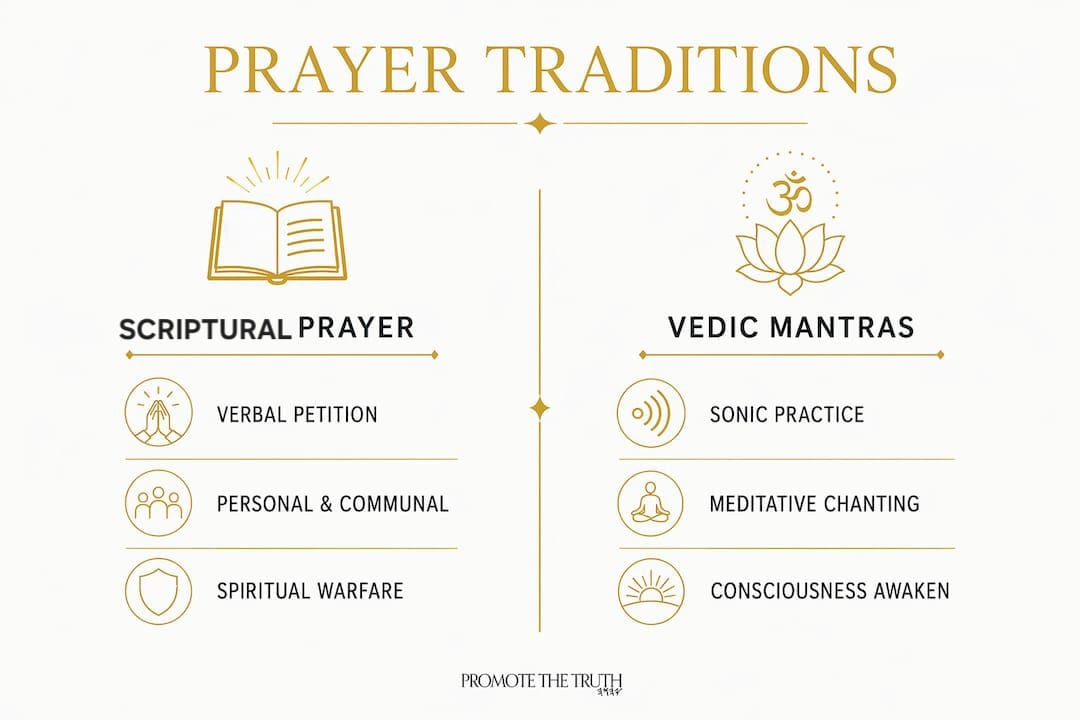
Both traditions share a conviction that prayer is not passive. It demands discipline, repetition, and a willingness to be changed by the practice itself.
What does science reveal about prayer’s effects on the body?
Empirical research confirms what ancient scripture assumed. Prayer produces measurable physiological changes in the one who prays.
Studies involving 7,646 patients across 10 randomized trials show that intercessory prayer affects metabolic and brain activity in the person praying. This means the act of prayer itself generates neurological and physiological responses, independent of any supernatural outcome. The body responds to the practice.
Prayer’s universal biological function predates formal religion and appears across all major civilizations. Researchers identify prayer as ritualized action that manages uncertainty and regulates emotional states. This is not a reductive claim. It actually strengthens the case that prayer is wired into human experience at a foundational level.
The neurological effects are specific. Prayer reduces anxiety and muscle tension through rhythmic language and focused attention. These are the same mechanisms activated by meditation, which explains why Scriptural (Biblical) prayer both produce states of calm and clarity. You can read more about prayer’s role in calming anxiety in practical spiritual wellness contexts.
Key findings from the scientific literature include:
-
Rhythmic prayer language activates the parasympathetic nervous system, reducing cortisol levels
-
Focused prayer produces neurological states similar to deep meditation
-
Communal prayer amplifies emotional regulation effects beyond solitary practice
-
Prayer predates organized religion, suggesting it fulfills a biological and psychological need
These findings do not reduce prayer to mere psychology. They reveal that YAHUAH designed human beings with a capacity for prayer that is built into their physiology. The ancient scriptures commanded what the body was already built to receive.
How do ritualistic and personal prayer forms differ in ancient texts?
Ancient prayer was communal and ritualized, serving covenantal and cosmological purposes rather than being primarily private or therapeutic. This is the most common misconception modern readers bring to ancient prayer texts. We assume prayer is an individual, silent, internal act. The ancient world assumed the opposite.
In the Ta’anak (Old Testament), communal prayer was embedded in the covenant relationship between YAHUAH and Yisharal (Israel). The Tahliym (Psalms) were performed in the Ahiykal (Temple) with instruments, specific melodic frameworks, and congregational participation. They were not set-apartness (devotional)reading material. They were liturgical scripts for a worshiping community.
The Vedic tradition mirrors this structure. Mantras were transmitted orally within teacher-student lineages called guru-shishya parampara. The precise phonetic accuracy of transmission was considered sacred. A single mispronounced syllable was understood to alter the mantra’s effect. Both traditions treated prayer as a craft requiring serious formation and communal accountability.
Personal prayer, however, is also present in both traditions. The Tahliym (Psalms) include deeply intimate laments where individual voices cry out to YAHUAH in raw, unfiltered anguish. Tahliym (Psalms) 22, which begins “Aliy Aliy Lamah Azabataniy” (My Aluah, My Aluah, how long will You alow Me to endure) is one of the most personal prayer texts in all of ancient scripture. It is also one of the most communally significant, quoted by Yahusha from the stake (cross).
The distinction between ritualistic and personal prayer is not a contradiction. It is a spectrum. Ancient scripture holds both in tension, recognizing that prayer shapes ancient beliefs through both the corporate covenant and the individual heart. Reading scripture in its original historical context makes this tension far more visible and meaningful.
Key takeaways
Prayer in ancient scripture is a commanded, transformative spiritual discipline that functions simultaneously as communal covenant, personal reorientation, and physiologically grounded human practice across Scriptural (Biblical) and Vedic traditions.
| Point | Details |
|---|---|
| Prayer is commanded, not optional | Tashalaniyqiym Alaf (First Thessalonians) 5:17 and Apasiyiym (Ephesians) 6:18 frame prayer as a continuous spiritual posture, not a periodic ritual. |
| Tahliym (Psalms) were oral, communal prayer | The Tahliym (Psalms) functioned as chanted liturgical scripts in Ahiykal (Temple) worship, not silent set-apartness (devotional) reading material. |
| Vedic prayer aligns mind with cosmos | The Gayatri Mantra’s 24-syllable meter, chanted at Sandhya timings, was designed to awaken intellect and focus attention. |
| Science confirms physiological effects | Research across 10 randomized trials shows prayer affects metabolic and brain activity in the one praying. |
| Ancient prayer was primarily communal | Modern readers misread ancient prayer as private; its original function was covenantal, communal, and cosmological. |
Why prayer’s ancient roots still matter to us
We have spent years studying prayer across both Scriptural (Biblical) and Vedic traditions, and the single most disorienting discovery was this: almost everything modern culture teaches about prayer gets the direction wrong. We treat prayer as a tool we use to get things from YAHUAH. Ancient scripture treats it as a discipline that gets things out of us.
The Tahliym (Psalms) shook us first. Reading them as a scholar rather than a follower (devotee), we kept encountering raw, almost uncomfortable honesty directed at YAHUAH. These were not polished petitions. They were arguments, laments, and desperate cries from people who believed YAHUAH was present enough to hear them and strong enough to respond. That kind of prayer requires a relationship, not a formula.
The Vedic tradition added a different dimension. The Gayatri Mantra is not asking for anything. It is aligning the practitioner with something larger than personal desire. That reorientation is precisely what John Calvin described in the Scriptural (Biblical) tradition. The language differs. The underlying movement is identical.
What we find most valuable for anyone exploring healing scriptures and prayer is this: prayer in ancient scripture was never designed to be efficient. It was designed to be formative. The person who prays without ceasing, as Shaul (Paul) commands, is not the person who gets more answers. They are the person who becomes more aligned with the will of YAHUAH. That is the ancient understanding, and it is the one worth recovering.
— Maria
Deepen your study of prayer with Promote The Truth
Promote The Truth exists to help you engage with the ancient scriptural texts in their original depth and context. If this article has opened questions about how prayer functions across the Ta’anak and Bariyt Hadash, the resources below are your next step.
The Scripture Study Series on Promote The truth’s YouTube channel provides in-depth video teachings on prayer, covenant, and the original Abariy (Hebrew) and Aramiyt (Aramaic) manuscript sources. These are not surface-level overviews. They are scholarly, reverent explorations designed for people who want to understand the true Word of YAHUAH. For direct access to the texts themselves, the original scriptures collection and the Truth Scriptures downloads give you the most accurate English restoration available, translated from ancient Abariy (Hebrew) and Aramiyt (Aramaic) sources. Start there.
FAQ
What is prayer’s role in ancient scripture?
Prayer in ancient scripture is a commanded spiritual discipline designed to align human will with divine purpose. Across Scriptural (Biblical) texts, it functions as both communal covenant practice and personal transformation.
How did the Tahliym (Psalms) function as prayer in ancient Yisharal (Israel)?
The Tahliym (Psalms) were oral prayers chanted and sung in communal worship settings, not silent set-apartness (devotional)texts. They served as living liturgical scripts for lamentation, praise, and covenant renewal within the Ahiykal (Temple).
What does science say about prayer’s effects?
Research across 10 randomized trials involving 7,646 patients shows prayer affects metabolic and brain activity in the one praying. Rhythmic prayer language also reduces anxiety and muscle tension through neurological mechanisms similar to meditation.
How does vedic mantra prayer differ from Scriptural (biblical) prayer?
Vedic mantra practice, such as the Gayatri Mantra from the Rig Veda, uses fixed 24-syllable rhythmic chanting at specific cosmic intervals to awaken intellect and align consciousness. Scriptural (Biblical) prayer emphasizes verbal petition and praise directed toward a personal covenant relationship with YAHUAH.
Was ancient prayer primarily private or communal?
Ancient prayer was primarily communal and ritualized, embedded in covenantal and cosmological frameworks. The modern assumption that prayer is a private, silent, individual act reflects a significant departure from how ancient scriptural communities actually practiced it.