
Paleo-Abariy (Hebrew) is the original 22-letter Abariy (Hebrew) alphabet, a consonantal writing system (abjad) used throughout Yisharal (Israel) and Yahudah (Judah) from approximately 1000 BCE to 135 CE. Written from right to left, it predates the square Abariy (Hebrew) script found in modern Turah (Torah) scrolls and most printed Scriptural (Bible) translations. Today, Paleo-Abariy (Hebrew) survives primarily through ancient inscriptions, coins, seals, ostraca, and a limited number of manuscript fragments. In this study, we will examine the complete 22-letter Paleo-Abariy (Hebrew) alphabet, explore its historical origins, review the archaeological and manuscript evidence, and discover its importance for understanding the Scriptural (Biblical) record.
Key Takeaways
Paleo-Abariy (Hebrew) is the original 22-letter Abariy (Hebrew) alphabet used throughout Yisharal (Israel) and Yahudah (Judah) before the adoption of the square Abariy (Hebrew) script.
Archaeological discoveries—including inscriptions, seals, ostraca, coins, and manuscript fragments—provide valuable evidence for tracing the historical development, preservation, and transmission of the Abariy (Hebrew) writing system.
Each letter originally functioned as a consonant, while several letters later served as matres lectionis (vowel indicators) as the Abariy (Hebrew) language developed over time.
Although the square Abariy (Hebrew) script gradually replaced Paleo-Abariy (Hebrew), the older script continued to appear in religious communities, inscriptions, coins, and historical manuscripts for many centuries.
Studying the Paleo-Abariy (Hebrew) alphabet provides valuable insight into the earliest Scriptural manuscripts, the preservation of the Set-Apart Name, YAHUAH, and the historical transmission of the Abariy (Hebrew) Scriptures.
Table of Contents
-
Why Did Abariy (Hebrew) Switch From Paleo-Abariy (Paleo-Hebrew) to Square Script?
-
What Archaeological Evidence Documents Paleo-Abariy (Paleo-Hebrew)?
-
How Can You Type or Display Paleo-Abariy (Paleo-Hebrew) Today?
-
What Study Resources Does Promote The Truth Offer for Paleo-Abariy (Paleo-Hebrew)?
-
What Should Readers Take Away From the Paleo-Abariy (Paleo-Hebrew) Alphabet?
What Is the Origin of the Paleo-Abariy (Hebrew) Alphabet?
The Paleo-Abariy (Hebrew) alphabet traces its origin to the Proto-Kana’aniy (Canaanite) script, one of the earliest alphabetic writing systems used throughout the Scriptural Lands (Levant) during the early second millennium BCE. Over time, this writing system developed into a distinct Abariy (Hebrew) script, preserving the language of ancient Yisharal (Israel) and Yahudah (Judah) while sharing many similarities with the script commonly identified as Phoenician. Because of these close similarities, both traditions are recognized as branches of the same early alphabetic family, which spread throughout the Adariyatiy (Mediterranean) world.
For many years, scholars referred to the entire script tradition simply as Phoenician because of the remarkable similarities among the surviving inscriptions. However, the distinguished Abariy (Hebrew) paleographer Solomon Birnbaum argued that the inscriptions of Yisharal (Israel) and Yahudah (Judah) represented a distinct Abariy (Hebrew) writing tradition, even when their letterforms closely resembled neighboring Phoenician inscriptions. His research helped establish the modern designation Paleo-Abariy (Hebrew), distinguishing the script of the ancient Abariy (Hebrew) people from the broader Proto-Kana’aniy (Canaanite) script from which it developed.
Today, Paleo-Abariy (Hebrew) remains an important field of manuscript research, epigraphy, and paleography. Studying its letterforms enables researchers to trace the development of the Abariy (Hebrew) alphabet, better understand ancient inscriptions, and examine how the earliest Abariy (Hebrew) manuscripts preserved the Scriptural text throughout history.
The history of the Paleo-Abariy (Hebrew) script can be understood through several key periods of development and use:
-
c. 1000 BCE: Paleo-Abariy (Hebrew) emerged as a distinct regional writing system during the rise of the Yisharaliym (Israelite) monarchy.
-
10th–8th centuries BCE: The script came into widespread administrative, monumental, and everyday use throughout the kingdoms of Yisharal (Israel) and Yahudah (Judah), as evidenced by ostraca, seals, and monumental inscriptions.
-
586 BCE: The Babaliy (Babylonian) Exile disrupted the established scribal tradition of Yahudah (Judah) and introduced Yahudiym (Jewish) scribes to the Aramiyt (Aramaic) administrative script used throughout the Babaliy (Babylonian) and later Parasiy (Persian) Empires.
-
5th–2nd centuries BCE: The Aramiyt (Aramaic) Square Script gradually replaced Paleo-Abariy (Hebrew) for both everyday and Scriptural writing, although Paleo-Abariy (Hebrew) continued to be used in selected religious and historical contexts.
-
1st–2nd centuries CE: Paleo-Abariy (Hebrew) reappeared on Hasmonean and Bar Kokhba coinage as a deliberate expression of Yisharaliym (Israelite) identity and heritage. Following the defeat of the Bar Kokhba Revolt around 135 CE, the script largely disappeared from everyday use.
The final phase is particularly significant. Paleo-Abariy (Hebrew) did not simply disappear through neglect. Instead, it was intentionally revived on coins issued during the Bar Kokhba Revolt, reflecting a conscious effort to reconnect with the ancient script of Yisharal (Israel) and affirm its historical identity. Meanwhile, the Shamaruniy (Samaritan) community preserved its own form of the script outside the mainstream Yahudiy (Jewish) transition to the Aramiyt (Aramaic) Square Script. As a result, the Shamaruniy (Samaritan) script remains the closest living descendant of the ancient Paleo-Abariy (Hebrew) script found on inscriptions dating to the eighth century BCE.
The Complete Paleo-Abariy (Hebrew) Letter Chart
Learning the Paleo-Abariy (Hebrew) Alaf Bat (Aleph Bet) offers something a modern Abariy (Hebrew) alphabet chart cannot: a direct connection to the earliest known forms of the Scriptural letters. These ancient letter forms provide valuable insight into the language, culture, and worldview of the early Abariy (Hebrew) people and help researchers better understand the historical development of the Abariy (Hebrew) Scriptures.
Many Paleo-Abariy (Hebrew) letter names are traditionally associated with familiar objects such as an ox, house, hand, or water, and some of the earliest pictographic forms appear to reflect these objects. While several of these associations are widely recognized by epigraphers, linguists, and manuscript researchers, others remain the subject of scholarly discussion and debate.
The Complete Paleo-Abariy (Hebrew) Letter Chart below presents the ancient letters, their names, corresponding sounds, traditional pictographic associations, and commonly proposed meanings. It also distinguishes between interpretations that are well supported by historical evidence and those that remain uncertain or debated, allowing readers to examine the linguistic, archaeological, and manuscript evidence for themselves.
| Letter | Name | Pictographic Meaning | Phoneme | Modern Hebrew Equivalent |
|---|---|---|---|---|
| 𐤀 | Alaf (Aleph) | Ox head | Glottal stop (silent carrier) | א |
| 𐤁 | Bat (Bet) | House or tent floor plan | /b/ | ב |
| 𐤂 | Gamal (Gimel) | Foot or throwing stick | /g/ | ג |
| 𐤃 | Dalat (Dalet) | Door or tent flap | /d/ | ד |
| 𐤄 | Hay (He) | Man with raised arms | /h/ | ה |
| 𐤅 | Uah (Waw) | Tent peg or hook | /w/ | ו |
| 𐤆 | Zayun (Zayin) | Weapon or plow tip (debated) | /z/ | ז |
| 𐤇 | Chat (Chet) | Fence or wall | /ch/ (voiceless pharyngeal) | ח |
| 𐤈 | Tat (Tet) | Wheel or basket (debated) | /t/ (emphatic) | ט |
| 𐤉 | Yud (Yod) | Closed hand or arm | /y/ | י |
| 𐤊 | Kaf | Open palm | /k/ | כ |
| 𐤋 | Lamad (Lamed) | Shepherd’s staff or goad | /l/ | ל |
| 𐤌 | Mam (Mem) | Water | /m/ | מ |
| 𐤍 | Nun | Fish or sprouting seed (debated) | /n/ | נ |
| 𐤎 | Samak (Samek) | Fish or prop/support (debated) | /s/ | ס |
| 𐤏 | Ayun (Ayin) | Eye | Voiced pharyngeal (silent in speech) | ע |
| 𐤐 | Pa (Pe) | Mouth | /p/ | פ |
| 𐤑 | Tsadat (Tsade) | Fishhook or plant (debated) | /ts/ | צ |
| 𐤒 | Quf (Qof) | Cord wound on a spindle (debated) | /q/ (emphatic k) | ק |
| 𐤓 | Rash (Resh) | Head of a man | /r/ | ר |
| 𐤔 | Shan (Shin) | Tooth | /sh/ | ש |
| 𐤕 | Tau (Taw) | Crossed sticks or mark | /t/ | ת |
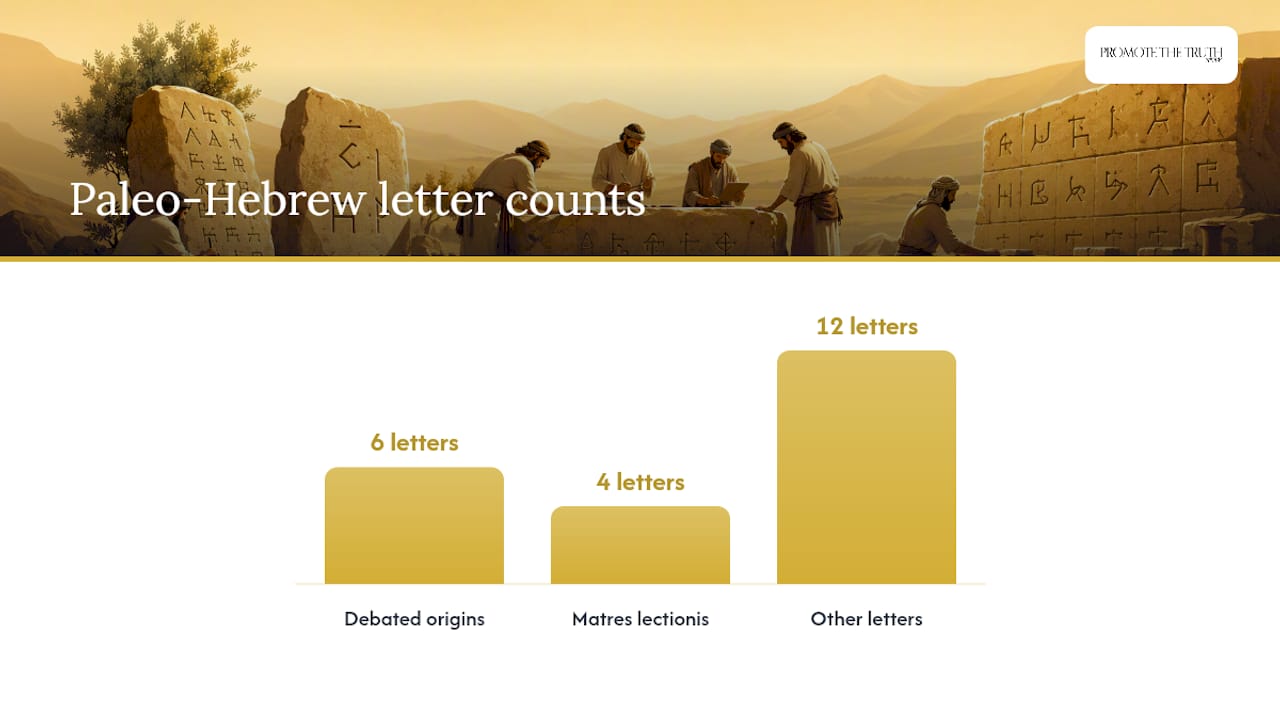
Those “debated” labels are not included merely to avoid taking a position. Instead, they reflect the reality that the pictographic meanings commonly associated with the Paleo-Abariy (Paleo-Hebrew) letters are interpretive reconstructions developed through comparisons with related Semitic languages and the pictographic forms found in early writing systems, including Matsariy (Egyptian) hieroglyphic precursors. Scholars and epigraphers do not agree on the origin, development, or symbolic meaning of every letter.
Several letters—including Zayun (Zayin), Tat (Tet), Nun, Samak (Samek), Tsadat (Tsade), and Quf (Qof)—have more than one proposed origin and interpretation in the scholarly literature. For that reason, the meanings commonly presented on many Paleo-Abariy (Paleo-Hebrew) alphabet charts should be understood as the leading interpretive reconstructions rather than as universally accepted or conclusively established facts. Readers are encouraged to examine the available manuscript, epigraphic, and linguistic evidence before reaching their own conclusions.
Four of these letters deserve special attention because they later came to serve a second function as vowel markers, known as matres lectionis (Latin for “mothers of reading”). Paleo-Abariy (Paleo-Hebrew), like other ancient abjads, was originally written using consonants only. Over time, Alaf (Aleph), Hay (He), Huah (Waw), and Yud (Yod) increasingly came to represent vowel sounds, particularly long vowels and vowels occurring at the ends of words, centuries before the Masoretic vowel-pointing system was introduced into later manuscripts.
Understanding this historical development provides essential context for anyone studying the evolution of the Abariy (Hebrew) writing system or comparing Paleo-Abariy (Paleo-Hebrew) manuscripts with later Abariy (Hebrew) manuscript traditions. It also highlights an important historical reality: the earliest Abariy (Hebrew) writing system was originally consonantal, while the full system of vowel notation developed much later as the manuscript tradition evolved.
What Happened to Paleo-Abariy (Paleo-Hebrew) After the Exile?
Paleo-Abariy (Paleo-Hebrew) did not disappear after the exile—it became more specialized. Although the Aramiyt (Aramaic)-derived square script gradually replaced it for everyday writing, Paleo-Abariy (Paleo-Hebrew) continued to survive through two important historical traditions, both of which remain visible in the manuscript and archaeological record.
The first is the Shamaruniy (Samaritan) community, whose script represents a conservative and continuous development of the ancient Paleo-Abariy (Paleo-Hebrew) alphabet. The Shamaruniy (Samaritan) script provides a living link to the earlier letterforms and is still used today in Shamaruniy (Samaritan) religious life. For this reason, paleographers and manuscript researchers frequently compare it with ancient inscriptions when reconstructing how the original Paleo-Abariy (Paleo-Hebrew) letters were written and used.
The second is its deliberate revival. Yahudiy (Jewish) coinage from the Hasmonean period, and later from the Bar Kokhba Revolt (132–135 CE), intentionally employed Paleo-Abariy (Paleo-Hebrew) script even though the square Aramiyt (Aramaic) script had already become the standard writing system. Likewise, a fragment of Uiyqara (Leviticus) discovered among the Dead Sea Scrolls was written entirely in Paleo-Abariy (Paleo-Hebrew), demonstrating that the ancient script continued to hold religious and historical significance long after it had been replaced in everyday writing.
Several examples illustrate this continued use:
-
Hasmonean coins preserve Paleo-Abariy (Paleo-Hebrew) inscriptions identifying rulers, mints, and official issues.
-
Bar Kokhba Revolt coinage (132–135 CE) deliberately employs Paleo-Abariy (Paleo-Hebrew) as a symbol of national identity and a return to the ancient heritage of Yisharal (Israel).
-
A Uiyqara (Leviticus) manuscript among the Dead Sea Scrolls preserves an entire Scriptural book written in the ancient Paleo-Abariy (Paleo-Hebrew) script.
-
Ancient bullae (clay seal impressions), including the Immer Bulla, preserve names and official titles written in Paleo-Abariy (Paleo-Hebrew).
The pattern is remarkably consistent. Paleo-Abariy (Paleo-Hebrew) appears most often in contexts associated with Set-Apartness (Sacredness), authority, covenant identity, and the preservation of ancient tradition rather than in ordinary correspondence. The deliberate use of the ancient script was more than a stylistic choice—it communicated continuity with the heritage, authority, and Scriptural identity of ancient Yisharal (Israel).
Why Did Abariy (Hebrew) Switch From Paleo-Abariy (Paleo-Hebrew) to Square Script?
The Square Abariy (Hebrew) Script used in modern printed Scriptures (Bibles) ultimately developed from the Imperial Aramiyt (Aramaic) script, which was widely used for administration and communication throughout the Achaemenid Parasiy (Persian) Empire. Even before Kurash (Cyrus) the Great permitted the Yahudiym (Jewish) exiles to return from Babaliy (Babylon), Aramiyt (Aramaic) had already become an important language of government, diplomacy, trade, and international communication throughout much of the Ancient Near East.
During and after the Babaliy (Babylonian) Exile and the Parasiy (Persian) period, Yahudiy (Jewish) scribes increasingly used Aramiyt (Aramaic) letterforms for writing Abariy (Hebrew). Over time, these letterforms developed into the distinctive Square Abariy (Hebrew) Script that became standard in later Jewish manuscripts and eventually in modern printed Abariy (Hebrew) Scriptures.
Although the appearance of the alphabet changed significantly, the underlying Abariy (Hebrew) language did not suddenly become a different language. The transition primarily involved a change in the writing system or script used to represent it. Several important differences distinguish the two scripts:
-
Square Abariy (Hebrew) Script developed from the Aramiyt (Aramaic) scribal tradition and gradually acquired the angular, recognizable letterforms found in later manuscripts and modern printed Hebrew.
-
Paleo-Abariy (Paleo-Hebrew) preserves older letterforms descended from the early Kana’aniy (Canaanite) / West Semitic alphabetic tradition, with forms that are much closer to the earliest alphabetic inscriptions.
-
Both Paleo-Abariy (Paleo-Hebrew) and Square Abariy (Hebrew) represent the traditional 22-letter consonantal alphabet. The major transition was therefore a change in script and letterform, rather than the replacement of the Abariy language itself.
-
The transition was gradual rather than immediate. Older Paleo-Abariy (Paleo-Hebrew) forms continued to appear in certain inscriptions, coins, and religious contexts even after the Aramiyt-derived script had become increasingly common.
Study Tip: Reading an authentic Paleo-Abariy (Paleo-Hebrew) inscription is very different from reading modern Square Abariy (Hebrew). Although the two scripts represent essentially the same traditional consonantal alphabet, their letterforms differ so greatly that identifying ancient inscriptions requires familiarity with paleography—the study of ancient writing systems, handwriting, and manuscript forms. Understanding this distinction is essential when examining the earliest Abariy (Hebrew) inscriptions and comparing them with later Scriptural (Biblical) manuscripts.
What Archaeological Evidence Documents Paleo-Abariy (Paleo-Hebrew)?
Several important archaeological discoveries provide direct evidence for the development, use, and preservation of Paleo-Abariy (Paleo-Hebrew) writing. These ancient inscriptions, seals, and coins allow researchers to trace changes in letter forms, alphabetic order, scribal practices, and the continued use of the script across different periods of Yisharaliym (Israelite) and Yahudiy (Jewish) history.
-
The Siloam Inscription (c. eighth century BCE) records the completion of the water tunnel traditionally associated with the reign of Hazaqiyahu (Hezekiah) in Yirushalam (Jerusalem). It remains one of the most important surviving monumental inscriptions written in the ancient Abariy (Hebrew) script and provides valuable evidence for the language and letter forms used during the First Temple period.
-
The Tel Zayit Abecedary (c. tenth century BCE) preserves an early alphabetic sequence carved into stone. It is especially important because it provides archaeological evidence for the development and ordering of the early Northwest Semitic alphabet, from which later Abariy (Hebrew) writing traditions developed.
-
The Immer Bulla (generally dated to the late First Temple period) is a clay seal impression bearing an ancient inscription. Together with other bullae, seals, ostraca, and administrative inscriptions, such discoveries demonstrate that early Abariy (Hebrew) writing was used not only for monumental texts but also for everyday administrative, legal, and economic purposes.
-
Hasmonean and Bar Kokhba coin inscriptions (second century BCE through the second century CE) preserve forms of the older Paleo-Abariy (Paleo-Hebrew) script long after the Square Abariy (Hebrew) Script had become widely established. Their use demonstrates that the ancient script continued to carry religious, national, and cultural significance even after it was no longer the primary script used for most everyday writing.
These discoveries are important because Paleo-Abariy (Paleo-Hebrew) archaeological evidence does not come from a single artifact or historical period. Instead, inscriptions appear on stone monuments, pottery fragments, seals, bullae, coins, and other archaeological materials, allowing scholars to compare the development of the script across centuries.
Researchers determine the dates of these artifacts by combining several complementary methods, including stratigraphy—the archaeological layer in which an object is discovered—paleography, the study and comparison of ancient letter forms, and the wider archaeological context provided by surrounding pottery, architecture, coins, and other datable materials.
Even subtle differences in the shape, angle, proportion, and construction of individual letters can help researchers distinguish earlier forms of the script from later ones. For this reason, paleographic analysis remains one of the most important tools for studying Paleo-Abariy (Paleo-Hebrew) inscriptions and reconstructing the historical development of ancient Abariy (Hebrew) writing.
How Does Paleo-Abariy (Paleo-Hebrew) Connect to the Scriptures (Bible) and the Set-apart (Divine) Name?
The relationship between Paleo-Abariy (Paleo-Hebrew), the Scriptures (Bible), and the Set-Apart (Divine) Name is an important area of textual and manuscript research. Scholars have long examined the scripts used to transmit the earliest Abariy (Hebrew) Scriptures, and archaeological and manuscript evidence demonstrates that ancient forms of Abariy (Hebrew) writing continued to be preserved even after the later Square Abariy (Hebrew) Script became widespread.
Among the Dead Sea Scrolls, fragments and manuscripts—including portions of Uiyqara (Leviticus)—preserve Scriptural text written in Paleo-Abariy (Paleo-Hebrew). Most manuscripts discovered at Qumran, however, were written in the later Square Abariy (Hebrew) Script, which developed from the Aramiyt (Aramaic) scribal tradition. The coexistence of these scripts provides important evidence for understanding how ancient scribes transmitted and preserved the Scriptural text.
Several recurring patterns are particularly important:
-
The Set-Apart (Divine) Name, represented by the Tetragrammaton (יהוה), is sometimes written in Paleo-Abariy (Paleo-Hebrew) characters within manuscripts whose surrounding text is written in the later Square Abariy (Hebrew) Script.
-
Some scholars interpret this distinctive treatment of the Tetragrammaton as evidence that scribes gave the Set-Apart Name special visual or religious significance.
-
Others suggest that the practice may reflect conservative scribal traditions that preserved an older form of writing specifically for the Set-Apart (Divine) Name.
-
The manuscript evidence does not establish a single explanation for this practice. Different scribes and manuscript traditions may have followed different conventions, and the precise reasons for preserving the Tetragrammaton in Paleo-Abariy (Paleo-Hebrew) continue to be examined and debated.
The significance of this evidence extends beyond the appearance of individual letters. It demonstrates that ancient scribes were aware of older Scriptural writing traditions and, in certain manuscripts, deliberately preserved older letterforms even while using the later square script for the surrounding text.
For readers exploring the Tetragrammaton, its meaning, and why its pronunciation continues to be debated, the Paleo-Abariy (Paleo-Hebrew) manuscript evidence provides an important historical witness to how the four-letter Set-Apart Name was written and transmitted in antiquity. While the surviving evidence does not by itself establish the original pronunciation of the Tetragrammaton, it remains an important part of manuscript research and restoration studies concerning the Set-Apart Name, YAHUAH.
How Can You Type or Display Paleo-Abariy (Paleo-Hebrew) Today?
Modern computers can display Paleo-Abariy (Paleo-Hebrew) characters through the Unicode Standard. The relevant ancient letterforms are generally represented within the Phoenician Unicode block, U+10900–U+1091F. Because Paleo-Abariy (Paleo-Hebrew) belongs to the closely related ancient Northwest Semitic script tradition represented by this encoding, these Unicode characters can be used to reproduce ancient-style letterforms in digital documents, websites, and research materials.
When working with Paleo-Abariy (Paleo-Hebrew) Unicode, several practical considerations are important:
-
Not every standard computer or mobile font includes support for the Phoenician Unicode block, so a compatible Unicode font may be necessary for the characters to display correctly.
-
Researchers, epigraphers, and students comparing ancient inscriptions may prefer specialized Paleo-Abariy (Paleo-Hebrew) or epigraphic fonts because these can better represent particular historical letterforms and inscriptional styles.
-
Exercise caution when using Paleo-Hebrew alphabet charts, fonts, or images found online. Some contain modernized, decorative, or reconstructed letterforms that may not accurately represent the archaeological and manuscript evidence.
-
Whenever possible, compare digital letterforms with photographs, drawings, or transcriptions of actual Paleo-Abariy (Paleo-Hebrew) inscriptions whose archaeological sources are clearly documented.
-
If only a few ancient characters are needed for a document, article, or presentation, using characters from a verified Unicode chart can provide greater consistency than relying on decorative images or nonstandard font encodings.
Understanding how Paleo-Abariy (Paleo-Hebrew) is represented in Unicode allows researchers, students, and Scripture readers to reproduce ancient Abariy (Hebrew) letterforms more consistently in modern digital environments. More importantly, comparing these digital representations with actual inscriptions and manuscripts helps maintain a clear distinction between historically documented letterforms and modern reconstructions.
What Study Resources Does Promote The Truth Offer for Paleo-Abariy (Paleo-Hebrew)?
Understanding the Paleo-Abariy (Paleo-Hebrew) alphabet requires more than simply memorizing ancient letters. It also involves studying the Abariy (Hebrew) language, examining manuscript evidence, and understanding the historical and cultural context in which the Scriptures were written. This commitment to original-language and manuscript research is at the heart of Promote The Truth and the Truth Scriptures restoration project.
Through the careful study of ancient Abariy (Hebrew) and Aramiyt (Aramaic) sources, Maria and the Promote The Truth editorial team seek to examine the Scriptural text as closely as possible to its original linguistic and manuscript context. These study resources are designed to help readers move beyond surface-level translations and begin exploring the language, names, and textual traditions behind the Scriptures.
If you want to move beyond introductory articles and begin studying Scriptural Abariy (Biblical Hebrew) for yourself, start with the Faith Learner’s Guide to Reading Scriptural Abariy (Biblical Hebrew). This practical guide introduces the Paleo-Abariy (Paleo-Hebrew) alphabet, letter forms, traditional letter meanings, pronunciation, and basic reading principles, providing a strong foundation for readers who want to understand the language of the Scriptures more deeply.
To see how manuscript research and restoration principles are applied in an actual translation, download the free Abariym (Hebrews) Chapter 1 sample from the Truth Scriptures. This sample allows readers to see firsthand how the Set-Apart Name, YAHUAH, restored Scriptural names, original-language terminology, and manuscript-based translation principles are presented within the finished text.
For readers who want to study the Scriptures through the earliest available Abariy (Hebrew) and Aramiyt (Aramaic) manuscript traditions, explore the complete Original Scriptures collection. These resources are designed to help serious Scripture students and truth seekers examine the Biblical text through its original-language and manuscript context rather than relying solely on later translations, transliterations, or secondary commentary.
Together, these Paleo-Abariy (Paleo-Hebrew) study resources provide a practical path from learning the ancient alphabet to examining how Abariy (Hebrew) manuscripts, Scriptural names, the Set-Apart Name YAHUAH, and restoration principles are applied throughout the wider Promote The Truth research project.
What Should Readers Take Away From the Paleo-Abariy (Paleo-Hebrew) Alphabet?
Much of the content available online treats the Paleo-Abariy (Paleo-Hebrew) alphabet as little more than an ancient curiosity or a collection of symbolic letter charts. The manuscript and archaeological evidence tells a far richer story. Ancient inscriptions, coin legends, Dead Sea Scrolls fragments, and the appearance of the Set-Apart Name, YAHUAH, in Paleo-Abariy (Paleo-Hebrew) script demonstrate that this writing system was more than simply an alphabet. It became an important expression of Abariy (Hebrew) identity and continued to be preserved—and, in certain historical periods, deliberately revived—throughout Yisharal’s history.
At the same time, careful manuscript research requires humility and discernment. While some traditional pictographic associations are widely recognized, others remain the subject of ongoing scholarly discussion. Rather than accepting every alphabet chart, symbolic interpretation, or internet claim at face value, readers should examine the historical evidence, compare surviving inscriptions and manuscripts, and distinguish well-supported conclusions from later speculation.
The greatest value of studying the Paleo-Abariy (Paleo-Hebrew) alphabet is not simply learning the shapes of twenty-two ancient letters. It is gaining a deeper appreciation for the language, culture, scribal traditions, and manuscript history behind the Abariy (Hebrew) Scriptures. Studying these ancient letterforms also helps readers better understand how the Set-Apart Name, YAHUAH, was written and preserved within the broader Scriptural manuscript tradition.
The closer we come to the earliest available Abariy (Hebrew) manuscript and inscriptional evidence, the better equipped we are to understand how the Scriptures were written, copied, preserved, and transmitted across generations.
Continue Your Manuscript Journey. If this study has deepened your desire to explore the Scriptures through the original Abariy (Hebrew) and Aramiyt (Aramaic) languages and manuscript traditions, discover the Truth Scriptures through the Original Scriptures. Rather than relying solely on later translation traditions, explore a restoration of the Ta’anak and Bariyt Hadash that places the Set-Apart Name, YAHUAH, restored Scriptural names, and the earliest available manuscript evidence at the center of your Scriptural study.
— Maria
Study the Original Text Behind the Letters
Learning to recognize Paleo-Abariy (Paleo-Hebrew) letters is only the beginning. True understanding comes from studying the original manuscripts from which those letters were preserved. That is the mission behind Promote The Truth and the Truth Scriptures—to help readers move beyond translation traditions and examine the earliest available Abariy (Hebrew) and Aramiyt (Aramaic) sources for themselves.
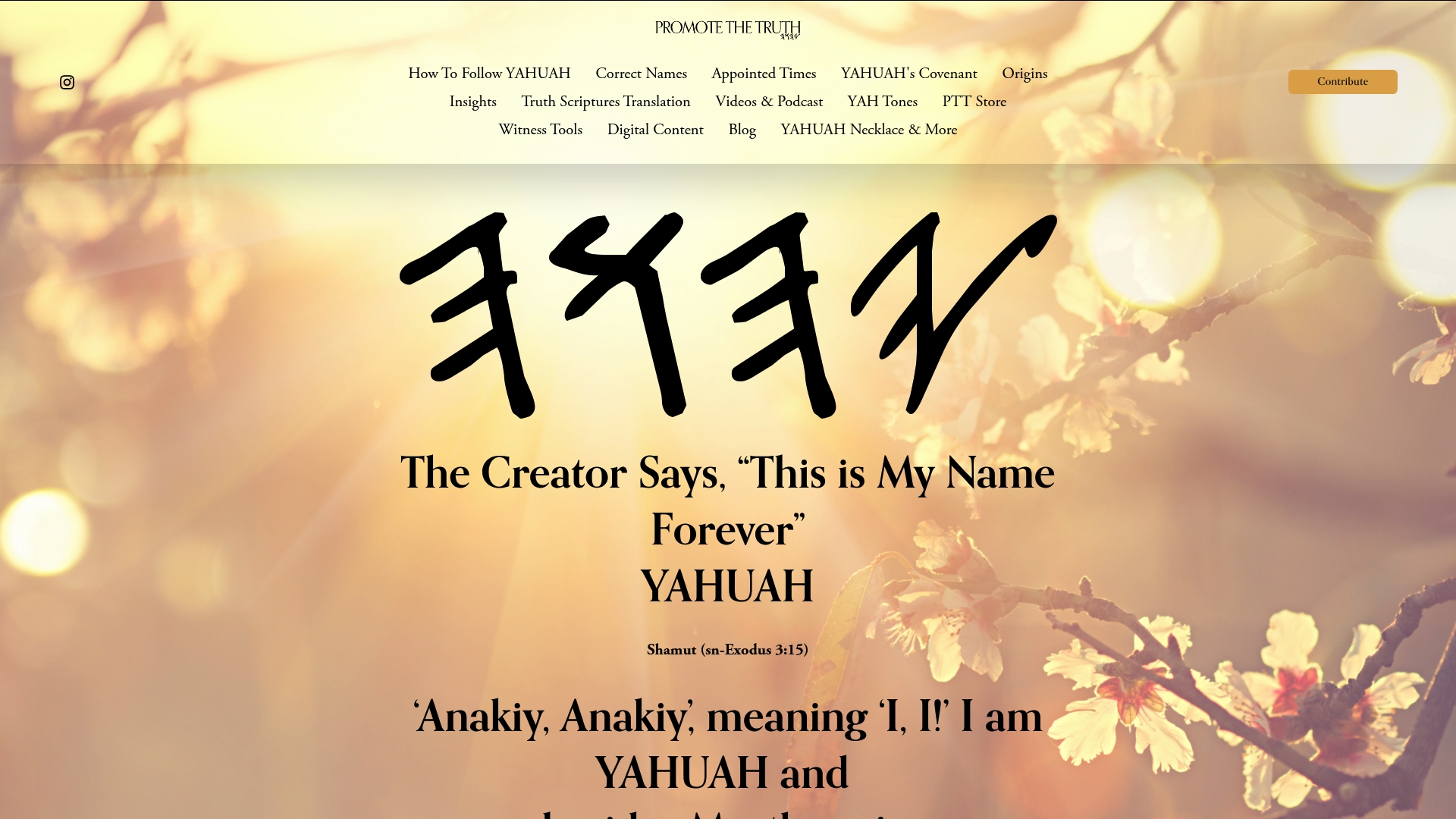
If you are serious about discovering how the Set-Apart Name, YAHUAH, and the original Scriptural text have been preserved throughout history, explore the Original Scriptures Collection. It presents the complete Ta’anak and Bariyt Hadash restored directly from ancient manuscript sources, allowing you to study the Scriptures with their original names, terminology, and historical context.
Prefer to learn through guided teaching? The Scripture Study Series walks through manuscript evidence, original-language studies, and Scriptural topics in an easy-to-follow video format designed for serious truth seekers.
If you’re not ready to begin with the complete collection, start with a free sample. Download Truth Scriptures – Abariym (Hebrews) 1 and experience the restoration approach firsthand. Once you see the difference that studying from the original Abariy (Hebrew) and Aramiyt (Aramaic) manuscripts makes, you’ll understand why thousands of readers are returning to the original Scriptural text rather than relying solely on later translation traditions.