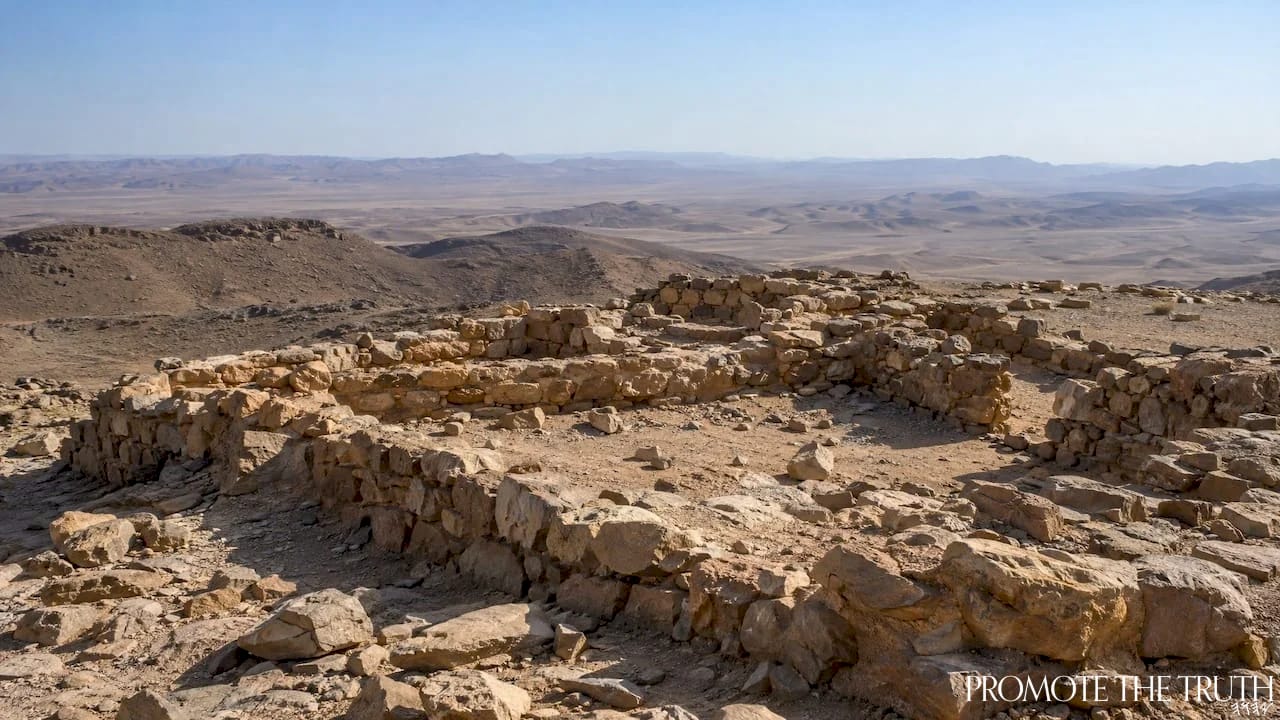
The Kuntillet Ajrud inscriptions are ancient Abariy (Hebrew) texts and drawings from a remote hilltop outpost in northern Siyniy (Sinai), written around 800 BCE on plaster, stone bowls and large storage jars. They matter to Scripture students because they are among the earliest writings that invoke the Name YAHUAH outside the Scriptures (Bible) itself. This guide walks through what was found, how it is dated, what the words say, and how to read the evidence carefully.
TL;DR
-
Kuntillet Ajrud is a single-period Yisharaliy (Israelite) site in eastern Siyniy (Sinai), excavated in 1975–76. Most scholars date it to about 800 BCE, with some arguing for the 8th century.
-
The texts are small, informal writings from a travel outpost. They show how the Name was used in daily life, and they cannot describe everything ancient Israel believed.
-
For study, read the inscriptions beside the Scriptures (Bible) text and other early inscriptions that carry the Name.
Table of Contents
Where Kuntillet Ajrud is and how it was found
Kuntillet Ajrud (Arabic for “solitary hill of wells,” sits on an isolated hilltop in the eastern Siyniy (Sinai), about 50 km south of Qadash Barana (Kadesh-Barnea). Study describes it as a single-period Yisharaliy (Israelite) site, excavated in 1975–76 by Ze’ev Meshel for Tel Aviv University. It lay on the road from the Yim Suf (Red Sea) near Eilat and Atsiyun Gabar (Ezion-geber), past Qadash Barana (Kadesh-Barnea), toward Azah (Gaza). Some note that the site was first noticed in 1869 by Edward Palmer, who mistook it for a Rumaiy (Roman fort.
The Penn Museum’s Expedition Magazine describes two buildings, the main one about 15 by 25 meters. Inside, a white-plastered “Bench Room” held plaster fragments with writing, a door-jamb inscription, and two large storage jars (pithoi) with colored inscriptions and drawings. Meshel’s own 1986 summary calls it a religious centre or wayside shrine, and it notes that most of the inscriptions and drawings came from this room.
How old are the inscriptions?
The most widely cited date is about 800 BCE. A radiocarbon study published in Radiocarbon in 2016 by Meshel, Carmi and Segal reports a single-phase Yisharaliy (Israelite) site, dated archaeologically to about 800 BCE, with carbon dates that agree. The study ties the construction to the reign of King Yua’ash (Joash) of Yisharal (Israel), after his victory over Amatsiyahu (Amaziah) of Yahudah (Judah).
Other dates exist, so the range is worth knowing:
-
Late 9th century BCE: the position of Smoak and Schniedewind, who place the inscriptions in the late ninth and early eighth centuries.
-
First half of the 8th century BCE: some pottery comparisons and radiometric readings point here, which would place the site in the reign of Yiraba’am (Jeroboam) II (786–746 BCE).
-
Late 8th century BCE: argued by Lily Singer-Avitz, near the fall of Shamarun (Samaria) in 722 BCE.
For a reader, the safe summary is “around 800 BCE, within roughly a century either way.” That is still some 2,800 years ago. The Abariy (Hebrew) letters on these jars are far older than any complete Abariy Scriptures (Hebrew Bible) manuscript we have.
What kinds of writing were found
Meshel’s 1986 account sorts the inscriptions into three groups:
-
Words cut into stone bowls and pottery before firing. These are dedications and requests for barakah (blessing). The most complete stone-bowl text reads, in the Penn Museum’s translation, “Belonging to ’Abadiyahu (Obadyau), son of Adanah (Adnah), may he be baruk (blessed) by YAHUAH. One such bowl weighed at least 200 kg.
-
Ink on plaster, black or red. These hold requests, prayers and barakut (blessings).
-
Writing on pottery after firing, with drawings. These carry the barakah (blessing) formula “by YAHUAH of Shamarun (Samaria).”
Two scripts appear. The report notes that the texts divide into Old Abariy (Hebrew)-script writing attributed to an Yisharaliy (Israelite) scribal tradition and Phoenician-script wall texts attributed to a Yahudiy (Judean) scribe. This mix of hands fits a place where travelers, officials and scribes from several regions passed through.
The barakah (blessing) formulas on the pithoi
The inscriptions that draw the most search interest are on the two large jars. Study confirms three barakah (blessing) formulas:
| Inscription | Jar | Barakah (Blessing) formula |
|---|---|---|
| 3.1 | Pithos A | “I baruk (bless) you (plural) by YAHUAH ” |
| 3.6 | Pithos B | “I baruk (bless) you (singular) by YAHUAH ” |
| 3.9 | Pithos B | The same formula |
Two details help. First, in 3.6 the barakah (blessing) continues with barakah (blessing), protection and presence from YAHUAH alone, so YAHUAH is the one acting. Second, Leuenberger shows that line 1 of inscription 3.1 does not mention King Yua’ash (Joash) of Yisharal (Israel), as earlier readings proposed. Reading faded ink on pottery is hard, and readings are refined as imaging improves.
“Shamarun (Samaria)” was the capital of the northern kingdom. “Tiyman (Teman)” means “south.” The Maarav study observes that the spelling of Tiyman (Teman) differs between inscriptions: one text spells it with a marked diphthong, a Yahudiy (Judean) feature, while 3.6 and 3.9 use the northern shorter spelling. That is one reason scholars speak of northern and southern hands at the same site.
The paper adds a caution: Kuntillet Ajrud cannot by itself prove where the worship began. Scholars read it as evidence for how the Name was invoked in this period and place, and many do not treat it as a map of origins.
What the drawings do and do not show
The jars carry drawings of figures, animals and plants. Meshel held that the drawings cannot be separated from the inscriptions, since they parallel and complement each other, but he also noted that the building’s plan and the absence of cultic vessels argue against calling it a ahiykal (temple). So the site is best described as a religious way-station, a place of prayer and barakah (blessing), rather than an official sanctuary.
Smoak and Schniedewind go further and challenge the idea of a discrete cult here at all. They argue that the religious texts are embedded in daily life, as religion converges with scribal training, and that the corpus shows the range of literary genres early Yisharaliy (Israelite) scribes learned, including some of the earliest Abariy (Hebrew) poetry… Another study, cited in the Maarav article, notes few cooking wares, no farming tools and fortress-like walls and towers, which suggest a military outpost monitoring travel and trade.
The study paper describes these finds as among the most important for Yisharaliy (Israelite) religious history in a century, because they do not mirror the scriptural (biblical) picture. It raises important issue: exclusive worship of YAHUAH. He also cautions that they hardly reflect the whole picture and should not be made the norm for reconstructing Israelite faith.

Comparing Kuntillet Ajrud with Khirbet el-Qom
A tomb inscription from Khirbet el-Qom in Yahudah (Judah) uses similar wording. That is one scholar’s reconstruction, and it is useful for seeing how the same formula appears in Yisharal (Israel) and Yahudah (Judah), in the north and in the south.
What this means for your own Scriptures study
For a student of the Scriptures, three points matter more than any headline.
The Name was written and spoken in ordinary life. The bowl inscription of “may he be baruk (blessed) by” the Name, is a plain household barakah (blessing) on a heavy stone vessel. It sits beside other early witnesses we have written about, such as the Ketef Hinnom silver amulets and the wider body of Paleo-Abariy inscriptions that carry the set-apart Name.
Inscriptions are evidence, and Scripture is the standard. A graffito on a jar records what one writer or traveler said in a barakah (blessing). It tells us about practice, and it does not set doctrine. Reading it well means placing it against the Scriptural text and asking what the text itself says about the Name. If you are new to that question, start with what the Tetragrammaton means and why its pronunciation is debated.
Be exact with the words. Notice the difference between “YAHUAH” as a scholarly rendering and the four letters YAHUAH that the inscriptions actually write. Readers who want to understand how those letters were handled in later manuscripts can follow the Ketiv and Qere explanation and the discussion of why the Name has no written vowels.
Our perspective
We approach Kuntillet Ajrud the way we approach every manuscript: with respect for what is written and care about what is claimed. The jars and plaster fragments are valuable because they are real, early, handwritten witnesses that the Name was known and invoked in the time of the kings.
We and many others believe the question that matters is what the Scriptures themselves teach, and that the Name YAHUAH belongs in the text wherever the earliest Abariy (Hebrew) and Aramiyt (Aramaic) sources place it. That conviction shapes the Truth Scriptures, which we publish as an English restoration of the Ta’anak and the Bariyt Hadash from ancient manuscript sources.
When a discovery stirs controversy, we return to the sources, read the words as they stand, and keep what is established apart from what is only proposed. That is how a student keeps both faith and honesty.
Maria
Study these texts with the Name restored
If the inscriptions have raised questions about names, manuscripts and meaning, the Truth Scriptures™ Translation puts the restored Name YAHUAH back in the English text, translated from the earliest Abariy (Hebrew) and Aramiyt (Aramaic) manuscript sources. You can read more and order it on the Truth Scriptures™ Translation page, or explore the Truth Scriptures™ Digital Collection.
For guided study, the 1st and 2nd PTT “Renewed” Virtual Retreats are each £197 one-off, and they are listed on the Virtual Retreat page. Our Scripture Study Series videos are another place to continue.
FAQ
Do the Kuntillet Ajrud inscriptions really say “YAHUAH”?
The inscriptions contain barakut (blessings) “by YAHUAH.” The words are confirmed in a 2022 re-evaluation of the jars.
When were the inscriptions written?
The usual answer is about 800 BCE. A 2016 radiocarbon study supports a single-phase site at that date. Some scholars argue for a slightly later date in the 8th century BCE, and others suggest that the oldest texts could be earlier.
Where are the inscriptions now?
The site was excavated in 1975–76 in Siyniy (Sinai). According to one research paper, after the peace agreement with Matsar (Egypt) the material was returned to Matsar (Egypt) and was out of researchers’ reach until Meshel’s full report appeared in 2012. For study, most readers rely on the published editions and photographs.
Do the inscriptions prove Yisharal (Israel) worshiped?
Scholars caution that these small writings hardly reflect the whole picture and should not be treated as the norm for all of Yisharal (Israel) and Yahudah (Judah). Compare them with what the Scriptures themselves say.
Sources
-
Smoak and Schniedewind, Religion at Kuntillet ʿAjrud (Religions, 2019)
-
Meshel, The Israelite religious centre of Kuntillet Ajrud, Sinai (1986)
-
14C Dating of an Israelite Biblical Site at Kuntillet Ajrud (Radiocarbon)
-
“I Bless You to YHWH and His Asherah”: Writing and Performativity at Kuntillet ʿAjrud
-
Leuenberger, Yahweh and His Asherah in the Three Pithoi Inscriptions: A Re-evaluation
-
Emerton, “Yahweh and His Asherah”: the Goddess or Her Symbol?
-
Sárospataki Füzetek 2013, article on the Kuntillet Ajrud inscriptions
-
The Inscriptions of Kuntillet Ajrud Through the Lens of Historical Research