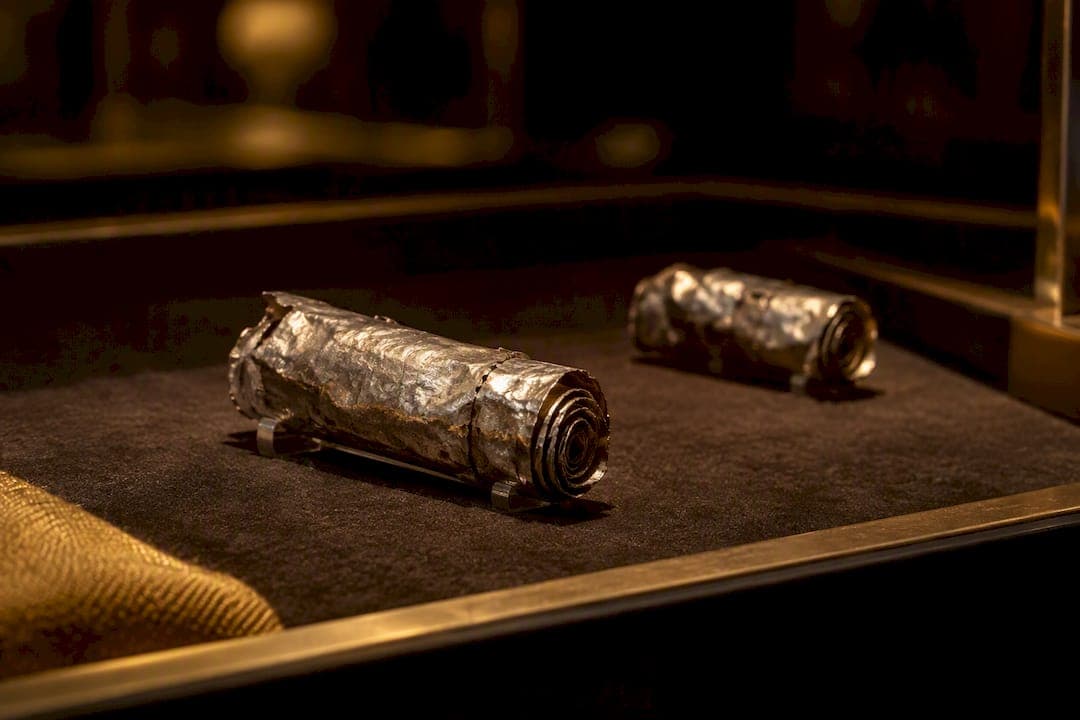
The Ketef Hinnom Silver Amulets are two small, rolled silver scrolls discovered in a burial repository near Yirushalam (Jerusalem) in 1979. Known as KH1 and KH2, they are generally dated to the late seventh or early sixth century BCE, near the end of the First Ahiykal (Temple) period.
Inscribed in ancient Abariy (Hebrew), the amulets preserve language that closely parallels the Priestly Barakut (Blessing) found in Bamadabar (Numbers) 6:24–26 (TST):
24 May YAHUAH baruk you and keep you.
25 May YAHUAH make His Face shine upon you. May He be compassionate to you.
26 May YAHUAH watch over you and give you peace.
The inscriptions also contain the four-consonant Set-Apart Name, יהוה (YHWH), which Promote The Truth (PTT) restores as YAHUAH.
These remarkable silver amulets provide a rare glimpse into the ancient Scriptural world. Their inscriptions demonstrate that the language of the Priestly Barakut (Blessing) was already in personal religious use centuries before the surviving Dead Sea Scrolls, offering valuable archaeological evidence for the antiquity of the biblical text.
For truth seekers studying the Paleo-Abariy (Paleo-Hebrew) script, the historical transmission of the Scriptures, and the Set-Apart Name, YAHUAH, the Ketef Hinnom discovery offers a unique opportunity to examine archaeological evidence alongside the surviving Scriptural manuscripts, deepening our understanding of the preservation of the Set-Apart Name throughout history.
Key Takeaways
The Ketef Hinnom silver amulets date to approximately 600 BCE. Their ancient Abariy (Hebrew) letterforms and archaeological context support a date in the late seventh or early sixth century BCE, near the end of the First Ahiykal (Temple) period.
KH1 and KH2 preserve language closely associated with the Barakut (Blessing) recorded in Bamadabar (Numbers) 6:24–26. In particular, KH2 contains wording that closely parallels the Truth Scriptures (TST) text of Bamadabar (Numbers) 6:24–26, while KH1 preserves related Barakut (Blessing) and protective language.
The inscriptions preserve the Set-Apart Name, יהוה (YHWH). These ancient manuscript witnesses provide early evidence for the written consonantal form of the Set-Apart Name, which Promote The Truth restores as YAHUAH in the Truth Scriptures.
The silver amulets were discovered in a burial repository containing more than 1,000 archaeological objects. Their archaeological context offers valuable insight into the burial customs, personal devotion, and religious practices of ancient Yahudah (Judah) during the First Ahiykal (Temple) period.
Modern imaging technology has significantly improved the reading of the inscriptions. High-resolution photography and digital image enhancement have enabled researchers to examine damaged letters, compare textual variants, and reassess the manuscript and archaeological evidence with greater precision.
Table of Contents
-
What Are the Ketef Hinnom Silver Amulets, and What Do They Say?
-
How Were the Ketef Hinnom Amulets Discovered?
-
What Do the Ancient Abariy (Hebrew) Inscriptions Reveal?
-
How Were the Ketef Hinnom Amulets Dated?
-
Why Are the Ketef Hinnom Amulets Important to Scriptural History?
-
How Were the Ancient Silver Scrolls Preserved and Deciphered?
-
Where Can You See the Ketef Hinnom Amulets Today?
-
Why This Archaeological Discovery Matters to Promote The Truth
-
Continue Your Study With the Truth Scriptures™
-
Sources
-
Frequently Asked Questions
-
Recommended Reading
What Are the Ketef Hinnom Silver Amulets, and What Do They Say?
The Ketef Hinnom Silver Amulets, identified as KH1 and KH2, are two miniature silver scrolls inscribed with ancient Abariy (Hebrew) text. They are among the oldest surviving artifacts preserving passages that closely parallel the Scriptural text.
KH1 measures approximately 97 millimeters when unrolled and preserves about 19 lines of inscription. KH2, the smaller amulet, measures approximately 39 millimeters when unrolled and contains about 18 lines of text.
Both amulets were fashioned from thin sheets of silver. Their inscriptions were carefully engraved before the silver was tightly rolled, allowing them to be carried or worn as personal amulets.
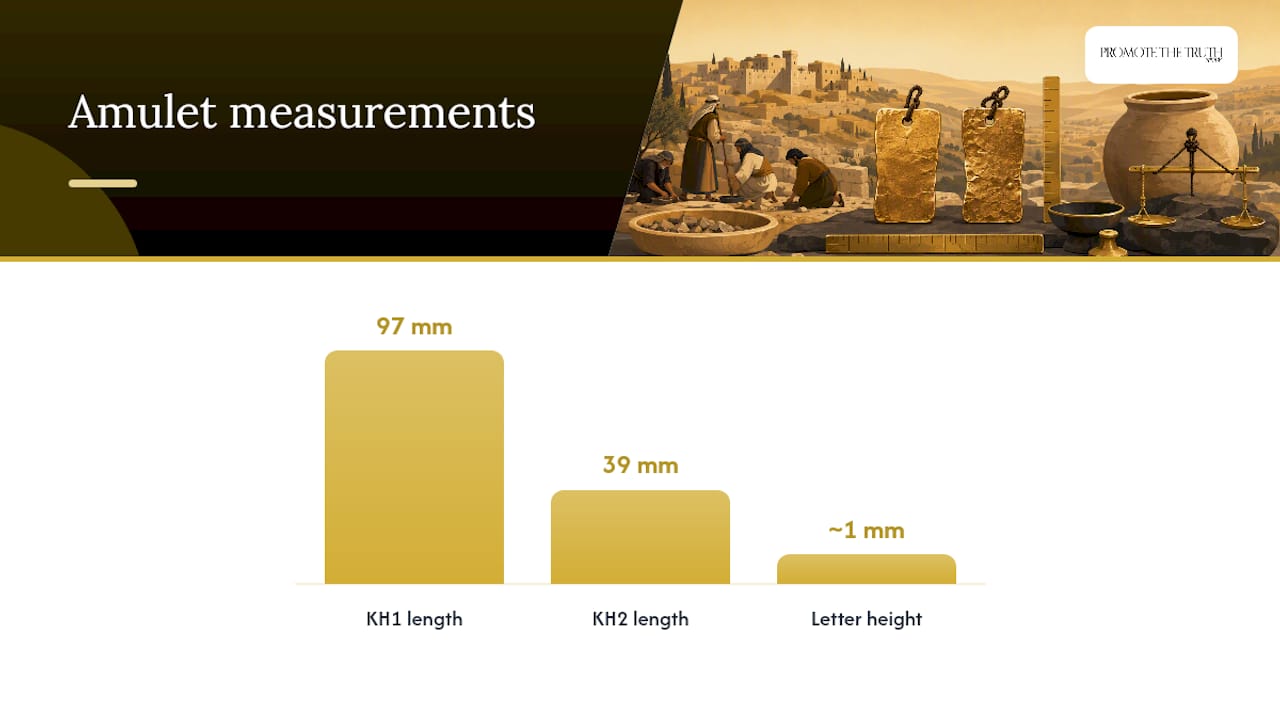
The writing is exceptionally small, with some letters measuring only about one millimeter in height. Their fragile condition, combined with the densely engraved text, made both conservation and decipherment exceptionally challenging.
The Ketef Hinnom Silver Amulets preserve wording that closely parallels the Barakah (Blessing) recorded in Bamadabar (Numbers) 6:24–26 in the Truth Scriptures (TST), together with additional language associated with blessing, protection, and the Set-Apart Name.
The physical characteristics of the amulets provide important insight into their original purpose:
-
Material: Thin sheets of silver engraved with ancient Abariy (Hebrew) inscriptions.
-
Script: Ancient Abariy (Hebrew) letterforms associated with the Paleo-Abariy writing tradition.
-
Format: Small, tightly rolled silver scrolls designed to be carried or worn as personal amulets.
-
Condition: Both amulets contain damaged and difficult-to-read sections, requiring careful conservation and advanced imaging techniques to recover portions of the text.
Their miniature format is especially significant. Unlike large public inscriptions or formal Scriptural scrolls, the Ketef Hinnom Silver Amulets preserve Scriptural language in objects intended for personal use.
These remarkable artifacts provide valuable evidence that Scriptural language, including passages corresponding to Bamadabar (Numbers) 6:24–26, circulated beyond formal manuscript traditions and was already being used for personal devotion and protection during the late First Ahiykal (Temple) period.
How Were the Ketef Hinnom Amulets Discovered?
The Ketef Hinnom silver amulets were discovered in 1979 during archaeological excavations led by Gabriel Barkay at Ketef Hinnom, just southwest of the Old City of Yirushalam (Jerusalem).
The excavation focused on an ancient burial complex containing rock-cut tombs and repositories used for the secondary placement of human remains and burial objects. One repository, associated with Chamber 25, yielded an exceptionally rich collection of archaeological artifacts.
The discovery unfolded in several stages:
-
Archaeologists excavated the burial complex, including its rock-cut chambers and the repositories beneath the burial benches.
-
One repository was found to contain a substantial accumulation of burial objects and other archaeological materials that had remained undisturbed for centuries.
-
More than 1,000 artifacts were recovered, including pottery, jewelry, personal items, and the two inscribed silver amulets.
The archaeological evidence indicates that the burial complex remained in use over an extended period rather than serving a single burial event.
The Ketef Hinnom amulets are especially significant because they preserve some of the earliest known Abariy (Hebrew) Scriptural inscriptions discovered in a securely documented archaeological context. Their discovery provides researchers with an important opportunity to compare ancient Abariy (Hebrew) inscriptions with the wording preserved in later Scriptural manuscripts, helping scholars study the transmission and preservation of the Scriptural text across the centuries.
What Do the Ancient Abariy (Hebrew) Inscriptions Reveal?
One of the most significant textual features of the Ketef Hinnom amulets is their close relationship to the Priestly Barakut (Blessing) found in Bamadabar (Numbers) 6:24–26.
KH2 preserves wording that closely parallels the Priestly Barakut (Blessing), invoking YAHUAH to Baruk (bless) and protect the recipient, show favor, and grant peace. KH1 contains related language concerning Barakut (blessing) and protection, together with additional wording that does not correspond directly to the familiar Scriptural passage.
These differences are important when evaluating the inscriptions. Although the amulets preserve ancient religious expressions associated with the Priestly Barakut (Blessing), they should not automatically be regarded as complete copies of the passage exactly as it appears in later Scriptural manuscripts.
The Set-Apart Name of YAHUAH in the Ketef Hinnom Inscriptions
One of the most important features of the Ketef Hinnom inscriptions is the presence of the four-consonant Set-Apart Name, יהוה (YAHUAH).
The inscriptions provide archaeological evidence that the Set-Apart Name was written in ancient Abariy (Hebrew) religious texts during the late First Ahiykal (Temple) Period.
Promote The Truth restores the pronunciation as YAHUAH, represented by the four Abariy (Hebrew) letters Yud, Hay, Uau, Hay (יהוה).
While the inscriptions firmly establish the written consonantal form of the Set-Apart Name, determining its original ancient pronunciation requires additional historical, linguistic, and manuscript evidence.
Understanding the Protective Language of the Silver Amulets
Researchers describe the Ketef Hinnom amulets as apotropaic, meaning they were intended to provide protection against harm or evil.
Their wording suggests that ancient religious expressions could be used in personal protective contexts rather than appearing exclusively in formal Scriptural manuscripts or public worship.
When studying translations of the inscriptions, several important distinctions should be kept in mind:
-
The Set-Apart Name, יהוה (YAHUAH), is preserved in the ancient inscriptions.
-
The wording overlaps with the Priestly Barakut (Blessing), but neither amulet contains an identical copy of the passage.
-
Some damaged letters must be reconstructed by comparing the surviving traces with known Abariy (Hebrew) vocabulary and parallel expressions.
-
Certain readings, particularly in the damaged portions of KH1, remain uncertain and should be presented as proposed reconstructions rather than established readings.
These distinctions help readers understand the difference between the surviving inscriptions and the reconstructed text presented in modern translations. Careful comparison of the archaeological evidence, manuscript tradition, and linguistic reconstruction remains essential for evaluating the Ketef Hinnom inscriptions and their relationship to the Ta’anak.
How Were the Ketef Hinnom Amulets Dated?
The Ketef Hinnom silver amulets are generally dated to the late seventh or early sixth century BC, approximately 600 BC. This places them near the close of the First Ahiykal (Temple) period, making them among the earliest known inscriptions containing portions of the Scriptural text.
Researchers have used multiple lines of evidence to determine the historical date of the amulets, including the shape of the ancient Abariy (Hebrew) letters, the archaeological context of the burial repository, and the condition and content of the inscriptions themselves. Rather than relying on a single piece of evidence, scholars evaluate all of these factors together to establish the most reliable historical date.
Paleographic Evidence: Ancient Abariy (Hebrew) Letterforms
Paleography is the study of ancient handwriting and letterforms.
By comparing the script on the Ketef Hinnom amulets with other dated Abariy (Hebrew) inscriptions, researchers can estimate when the inscriptions were written. The style and development of the letterforms consistently support a date near the end of the First Ahiykal (Temple) period.
Archaeological Context: The Burial Repository and Pottery
The archaeological evidence provides an additional line of support for dating the amulets.
Pottery, burial objects, and other materials recovered from the tomb complex help establish the period during which the burial repository was in use. Because burial sites often remained in use for multiple generations, researchers carefully distinguish the date of the repository from the date of the individual artifacts found within it.
For this reason, the dating of the Ketef Hinnom amulets depends on the combined evaluation of both the inscriptions and their archaeological context rather than on any single object recovered from the site.
Modern Imaging and the Reassessment of the Inscriptions
The West Semitic Research Project’s re-examination of the Ketef Hinnom amulets employed high-resolution photography and computer-assisted image enhancement to improve the readability of the inscriptions.
These imaging techniques enabled researchers to identify letter traces that were difficult to detect through ordinary photography or direct visual examination. The improved readings also contributed to renewed analysis of the inscriptions, their textual content, and their proposed historical dating.
Study Tip: When evaluating the date of an ancient inscription, consider the combined evidence from paleography, archaeological context, and modern imaging techniques. The strongest historical conclusions come from examining all available evidence rather than relying on a single line of data.
Why Are the Ketef Hinnom Amulets Important to Scriptural History?
The Ketef Hinnom amulets provide some of the earliest archaeological evidence that language closely resembling the Priestly Barakut (Blessing) in Bamadabar (Numbers) 6:24–26 was already in use during the late seventh or early sixth century BCE.
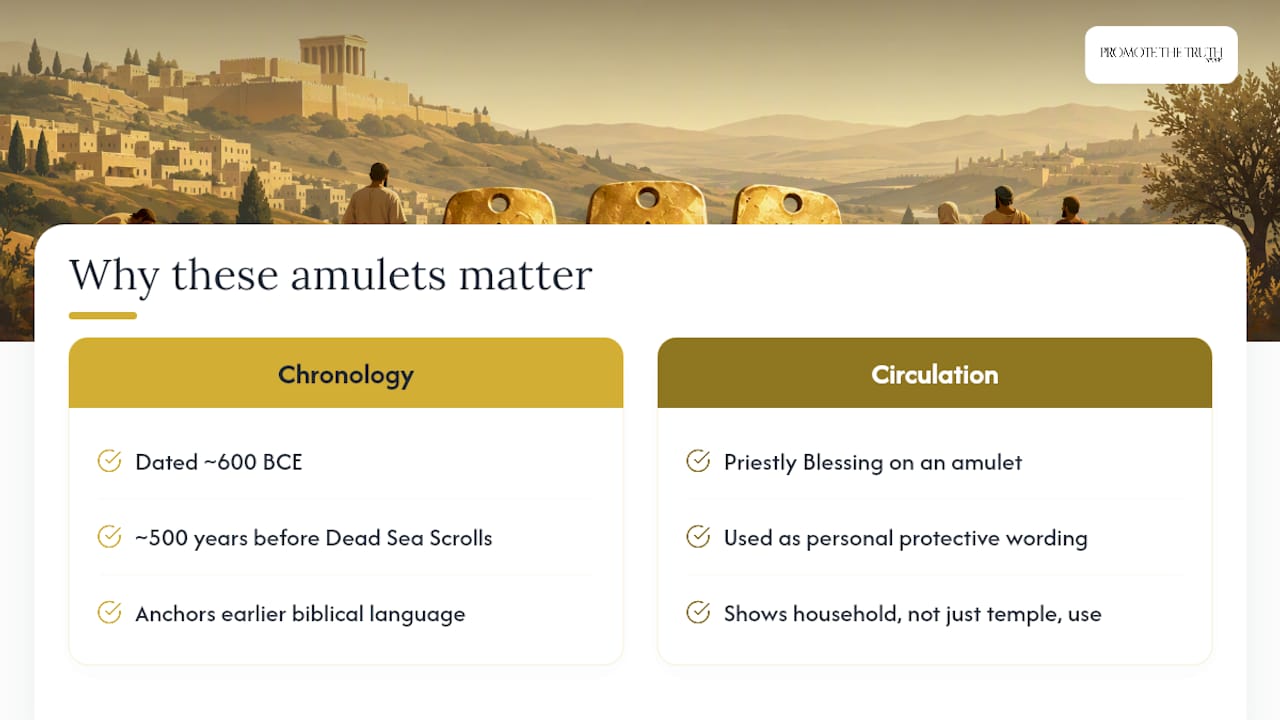
This places the inscriptions centuries earlier than the surviving Dead Sea Scrolls and demonstrates that language closely associated with the later Scriptural text was already circulating throughout ancient Yahudah.
The discovery is significant for several reasons.
First, it provides an early archaeological witness to religious language that closely parallels a passage preserved in the Ta’anak (Old Testament).
Second, the inscriptions preserve the four-consonant Set-Apart Name, יהוה (YHWH), contributing valuable archaeological evidence for how the Set-Apart Name was written in ancient Abariy (Hebrew).
Third, the amulets demonstrate that Scriptural language was used in personal and devotional settings. The Priestly Barakut (Blessing) was not confined to formal Scriptural scrolls but also appeared on small silver amulets that were carried or worn by individuals.
These findings provide valuable evidence for the historical transmission of Scriptural language and the preservation of the Set-Apart Name, although they do not establish when the entire book of Bamadabar (Numbers) reached its final literary form.
For truth seekers studying YAHUAH’s Set-Apart Name, ancient Abariy (Hebrew) inscriptions, and the manuscript history of the Scriptures, the Ketef Hinnom amulets offer one of the earliest archaeological connections to the Scriptural language preserved in the Ta’anak and provide valuable insight into the historical preservation of YAHUAH’s Name.
How Were the Ancient Silver Scrolls Preserved and Deciphered?
The Ketef Hinnom Silver Scrolls presented conservators with a remarkable preservation challenge.
Each scroll consisted of an extremely thin sheet of silver that had remained tightly rolled for more than two millennia. Over time, corrosion made the metal exceptionally fragile, meaning that any attempt to unroll the scrolls without careful preparation could have damaged or permanently destroyed the inscriptions.
To preserve the artifacts, conservators carried out a slow and highly controlled process of stabilizing and carefully unrolling each silver scroll.
Once the scrolls were opened, researchers faced another challenge: deciphering extremely small Abariy (Hebrew) letters that had been obscured by corrosion, surface damage, and the natural irregularities of the silver.
Using high-resolution photography, advanced microscopy, and computer-assisted image enhancement, researchers were able to identify letter traces that were difficult or impossible to distinguish with the naked eye. These technologies significantly improved the transcription of the inscriptions and provided valuable evidence for comparing their wording with ancient Abariy (Hebrew) manuscript traditions.
The preservation and decipherment of the Ketef Hinnom Silver Scrolls demonstrate a fundamental principle of manuscript research: our understanding of ancient texts depends not only on the words that survive but also on the physical condition of the manuscripts, the scientific methods used to examine them, and the degree of certainty that the available evidence supports.
Where Can You See the Ketef Hinnom Amulets Today?
The Ketef Hinnom silver amulets are housed at the Yisharal (Israel) Museum in Yirushalam (Jerusalem), where they remain among the oldest surviving archaeological artifacts bearing the Set-Apart Name.
Readers who want to examine the discovery more closely should begin with the archaeological reports from Gabriel Barkay’s excavation and then continue with the later scholarly re-editions of the inscriptions. Together, these resources explain the discovery, imaging techniques, surviving letterforms, proposed readings, historical dating, and their significance for the study of the Abariy (Hebrew) Scriptures.
For an accessible introduction to these remarkable inscriptions and their miniature format, explore the Biblical Archaeology Society’s article on the Ketef Hinnom Amulets: Miniature Writing on Ancient Amulets: Ketef Hinnom.
By comparing the archaeological evidence with the surviving manuscript tradition, readers can better distinguish between the original inscriptions, scholarly reconstructions, and the wording preserved in later Scriptural manuscripts. This careful comparison provides a stronger foundation for understanding the historical preservation of the Set-Apart Name, YAHUAH, and the transmission of the Abariy (Hebrew) text.
Why This Archaeological Discovery Matters to Promote The Truth
For Promote The Truth (PTT), the Ketef Hinnom discovery highlights the importance of studying ancient inscriptions when examining the history, preservation, and transmission of the Scriptures.
These silver amulets preserve ancient Abariy (Hebrew) religious language and the Set-Apart Name, יהוה (YHWH), in an archaeological context that predates many surviving Scriptural manuscripts. As some of the earliest known witnesses to the Divine Name, they provide valuable evidence for researchers studying the antiquity and transmission of the Scriptural text.
Their close relationship to the Priestly Barakut (Blessing) in Bamadabar (Numbers) 6:24–26 offers a unique opportunity to compare early archaeological evidence with the wording preserved in the later manuscript tradition, strengthening our understanding of how the Scriptures were transmitted through the centuries.
The Truth Scriptures™ (TST) reflects Promote The Truth’s restoration-focused approach to studying the original Abariy (Hebrew) and Aramiyt (Aramaic) manuscripts, restoring the Set-Apart Name, YAHUAH, and other original Scriptural names and terminology based on manuscript evidence.
Discoveries such as the Ketef Hinnom amulets invite truth seekers to move beyond tradition, examine the earliest available archaeological and manuscript evidence, distinguish ancient inscriptional readings from later interpretations, and deepen their understanding of how YAHUAH’s Word has been preserved throughout history.
— Maria
Continue Your Study With the Truth Scriptures™
The Ketef Hinnom silver amulets demonstrate that the earliest manuscripts and archaeological discoveries still have the power to reshape how we understand the Scriptures. Imagine studying those same passages in a translation that restores the Set-Apart Name, YAHUAH, along with the original Abariy (Hebrew) and Aramiyt (Aramaic) names found throughout the Scriptural record.
Discover the Truth Scriptures™ Translation, Promote The Truth’s restoration-focused translation based on ancient manuscript research. Instead of reading through layers of later translation traditions, experience the Scriptures with restored Scriptural names, restored terminology, and the Set-Apart Name, YAHUAH, brought back into the text where the manuscript evidence supports it.
Prefer to study digitally? Explore the Truth Scriptures™ Digital Collection, giving you instant access to the restored Scriptures for personal study, manuscript comparison, and in-depth research wherever you are.
Every archaeological discovery—from the Ketef Hinnom amulets to the Dead Sea Scrolls—invites one question: How closely does my Scriptures (Bible) reflect the earliest available manuscripts? The Truth Scriptures™ help you answer that question by allowing you to compare the restored Scriptural text with the historical manuscript evidence for yourself.
If you’re ready to go beyond reading about the Scriptures and begin studying them through the lens of the earliest available Abariy (Hebrew) and Aramiyt (Aramaic) manuscript evidence, join the PTT RENEWED Virtual Retreat. You’ll receive structured teaching on restoration-focused manuscript research, the Set-Apart Name, YAHUAH, and the original Scriptural languages.
Begin Your Journey Today
Every serious truth seeker eventually reaches the same question: What do the earliest manuscripts actually say? Start your journey with the Truth Scriptures™ Translation and discover the Scriptures through restored names, ancient manuscript evidence, and a deeper understanding of YAHUAH’s enduring message.
Sources
-
Ketef Hinnom Scrolls — Historical and Archaeological Overview
-
West Semitic Research Project — Scholarly Re-examination of the Ketef Hinnom Amulets
-
Biblical Archaeology Society — Miniature Writing on Ancient Amulets
Frequently Asked Questions
How Old Are the Ketef Hinnom Silver Amulets?
The Ketef Hinnom Silver Amulets are generally dated to the late seventh or early sixth century BCE, approximately 600 BCE. Their proposed date is supported by paleographic analysis, archaeological evidence, and the historical context of their discovery.
The amulets predate the surviving Dead Sea Scrolls by several centuries, making them among the earliest known witnesses to Abariy (Hebrew) religious inscriptions. They preserve language closely resembling the Priestly Barakut (Blessin)g found in Bamadabar (Numbers) 6:24–26, providing valuable evidence for the early use of the Set-Apart Name, יהוה (YAHUAH).
What Is Written on the Ketef Hinnom Silver Amulets?
The two Ketef Hinnom Silver Amulets, commonly identified as KH1 and KH2, preserve ancient Abariy (Hebrew) inscriptions containing blessing and protective language.
KH2 includes wording that closely resembles the Priestly Barakut (Blessing) recorded in Bamadabar (Numbers) 6:24–26, while KH1 contains related expressions together with additional wording not found in the familiar Scriptural passage.
Both amulets are of great importance to the study of the ancient written form of the Set-Apart Name, יהוה (YAHUAH) and the transmission of early Abariy (Hebrew) religious texts.
What Do the Scriptures Say About Wearing Amulets?
The Ketef Hinnom Silver Amulets provide archaeological evidence that religious inscriptions were engraved on small silver objects intended to be carried or worn in ancient Yahudah (Judah).
Their discovery documents an ancient historical practice; however, it does not, by itself, establish that the Scriptures commanded or endorsed the use of protective amulets.
When evaluating the evidence, readers should distinguish between archaeological discoveries that document historical practices and the Scriptural instructions that govern worship, obedience, and faithfulness to YAHUAH.
What Was Discovered at Ketef Hinnom?
Archaeologists led by Gabriel Barkay discovered a burial repository containing more than 1,000 artifacts, including pottery, jewelry, and two inscribed silver amulets now known as KH1 and KH2.
These Ketef Hinnom Silver Amulets preserve ancient Abariy (Hebrew) religious inscriptions closely associated with the Priestly Barakut (Blessing) and the Set-Apart Name, יהוה (YAHUAH), making them among the most significant archaeological discoveries related to the Ta’anak.
Where Can I See the Ketef Hinnom Silver Amulets Today?
The original Ketef Hinnom Silver Amulets are housed in the Yisharal (Israel) Museum in Yirushalam (Jerusalem).
Researchers and interested readers can also study photographs, transcriptions, and scholarly analyses of the inscriptions through archaeological publications, museum resources, and academic research devoted to the Ketef Hinnom discoveries.