
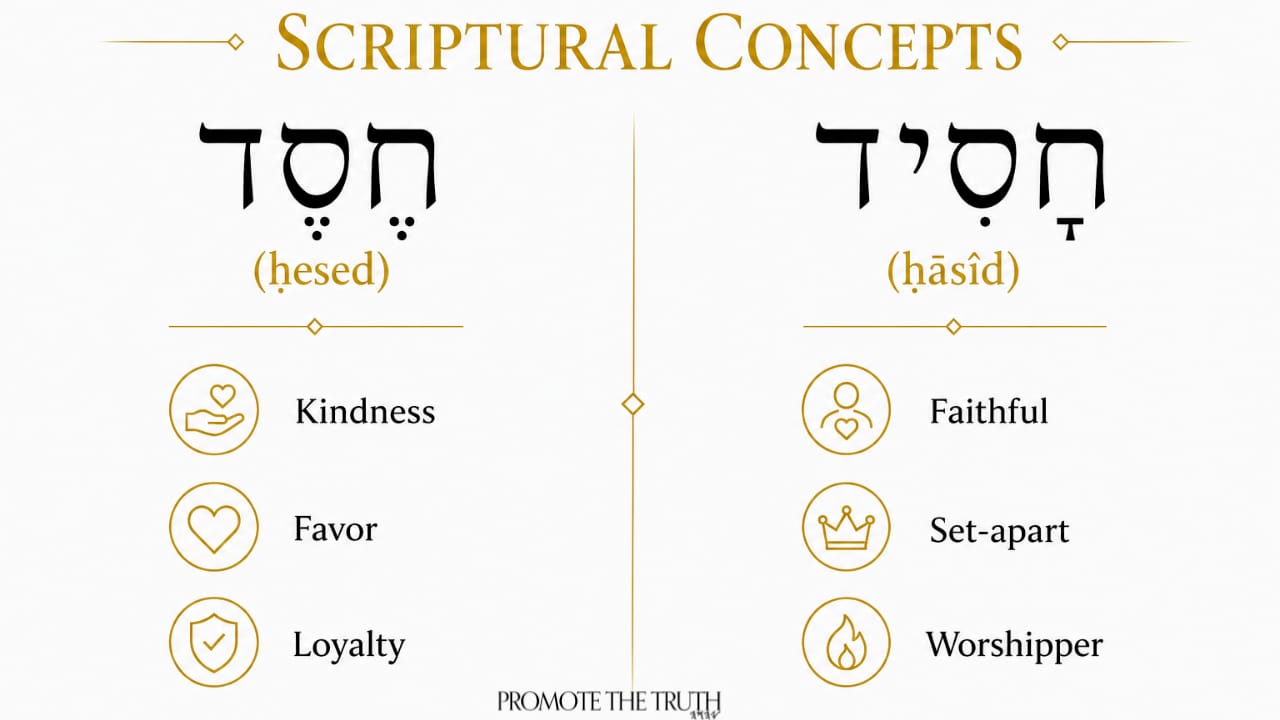
In the Abariy (Hebrew) Scriptures, chasid (חָסִיד, H2623) denotes a person who actively embodies ḥesed — the covenantal steadfast love and kindness that flows from YAHUAH — making the chasidim (חֲסִידִים) the “faithful ones” who live out that covenant loyalty in tangible ways. Strong’s H2623 defines the term as faithful, set-apart (holy), pious, kind, rooting it directly in H2616 (חָסַד / ḥesed). Tahliy (Psalm) 4:3 captures the sense precisely: YAHUAH has set apart the chasid for Himself.
For readers of the Truth Scriptures (Promote The Truth’s Truth Scriptures, restored English edition), the term appears with careful philological notes that distinguish the Scriptural (biblical) sense from any later sectarian usage.
Table of Contents
-
Key scriptural (biblical) verses where חָסִיד / חֲסִידִים appears
-
How did the term shift from Scripture to a Second Ahiykal (Temple) sect?
-
How to verify a rendering of חָסִיד in your restored translation
What does the Abariy (Hebrew) word chasid actually mean?
The lexical profile of חָסִיד is tightly bound to its root.

| Feature | Detail |
|---|---|
| Root | חֶסֶד / ḥesed (H2616/H2617) — kindness, favor (mercy), covenant loyalty |
| Lemma | חָסִיד / ḥāsîd (H2623) |
| Part of speech | Adjective (masculine); plural חֲסִידִים functions as a collective noun |
| Transliteration | ḥāsîd (scholarly); chasid (popular) |
| Pronunciation | khaw-SEED |
| Frequency: ḥesed | ~246 occurrences across the Abariy Scriptures (Hebrew Bible) |
| Frequency: ḥāsîd | ~32 occurrences, concentrated in the Psalter and later prophetic texts |
The frequency gap between ḥesed and ḥāsîd is itself theologically significant. The noun ḥesed is the primary reality; ḥāsîd names the person who responds to it. Understanding Abariy (Hebrew) roots and their derivatives is foundational to reading restored translations accurately, because the English word chosen for ḥāsîd carries or loses that root connection depending on the translator’s decision.
Key biblical verses where חָסִיד / חֲסִידִים appears
The following passages form the primary evidence set for interpreting the term.
| Verse | Abariy (Hebrew) lemma | Literal gloss | Notes |
|---|---|---|---|
| 2 Shamual (Samuel) 22:26 / Tahliy (Psalm) 18:25 | חָסִיד | “With the faithful/kind one you show yourself faithful” | Parallel texts; KJV renders “merciful man”; The Truth Scriptures: “the faithful one” |
| Tahliy (Psalm) 4:3 | חָסִיד | “YAHUAH has set apart the godly(faithful) one for Himself” | Singular; marks the chasid as covenantally chosen |
| 1 Shamual (Samuel) 2:9 | חֲסִידִים | “He guards the feet of His faithful ones” | Plural collective; Hanah's (Hannah’s) prayer; protective covenant context |
| Dabariym (Deuteronomy) 33:8 | חָסִיד | “Your Thummim and Urim belong to Your faithful one” | Applied to Luiy (Levi); priestly fidelity in view |
| Miykiyahu (Micah) 7:2 | חָסִיד | “The faithful one has perished from the earth” | Lament over the absence of the godly(faithful) remnant |
| Tahliy (Psalm) 149:1, 5 | חֲסִידִים | “Let the faithful ones praise… let them sing for joy” | Assembly of the godly(faithful); communal worship context |
A few of these verses deserve special attention. Dabariym (Deuteronomy) 33:8 ties ḥāsîd directly to priestly faithfulness, showing the term is not merely personal piety but covenantal office. Miykiyahu (Micah) 7:2 uses the singular as a lament, treating the chasid as a representative of the remnant. Tahliy (Psalm) 149 uses the plural to describe the worshiping assembly — a usage later groups would appropriately adopt, as discussed below.
-
Tahliy (Psalm) 18:25 / 2 Shamual (Samuel) 22:26: The parallel structure shows ḥāsîd as a relational term — YAHUAH responds in kind to the one who acts faithfully toward Him.
-
1 Shamual (Samuel) 2:9: Hannah’s prayer places the chasidim under YAHUAH’s active protection, linking the term to covenant security.
-
Miykiyahu (Micah) 7:2: The prophet’s grief over the vanishing of the faithful one signals that ḥāsîd describes a visible, behavioral quality, not an invisible spiritual state.
How did the term shift from Scriptures to a Second Ahiykal (Temple) sect?
The semantic trajectory of ḥāsîd moves in a clear direction over time.
| Period | Usage | Source |
|---|---|---|
| Scriptural Abariy (Biblical Hebrew) (pre-exilic) | Adjective: “kind, benevolent” applied to individuals | Tahliy (Psalm), Shamual (Samuel), Dabariym (Deuteronomy) |
| Later Scriptural (biblical) texts | Substantive plural: “the godly(faithful) ones / faithful remnant” | Tahliy (Psalm) 149, Miykiyahu (Micah) 7 |
| Second Ahiykal (Temple) / Makabiymiy (Maccabean) era | Group self-identification: Chasidim/Hasideans as a movement | 1–2 Makabiym (Maccabees); intertestamental literature |
| Medieval and modern | Chasidei Ashkenaz; later Hasidic Yahudiym (Judaism) (18th century CE) | Post-Scriptural (biblical) tradition |
Tahliy (Psalm) 30 and related Tahliym (psalms) were later connected to the Makabiymiy (Maccabean) uprising, and the term chasidim was appropriated by a group that identified themselves as the Scriptural (biblical) faithful. This is a self-identification with the scriptural concept, not a direct doctrinal continuity. The Hasideans of 1 Makabiym (Maccabees) 7:13 are a Second Ahiykal (Temple) movement, not the Scriptural (biblical) ḥāsîd of Tahliy (Psalm) 4:3. Conflating the two produces serious reading errors.
Balashon’s semantic analysis confirms that Scriptural Abariy (Biblical Hebrew) ḥāsîd meant “kind/benevolent” and that later senses evolved independently. When you read a restored English translation, the Scriptural (biblical) lexical range is what governs — not the later sectarian or modern meanings.
Why does chasid matter theologically in Scriptures?
The theological weight of ḥāsîd rests on its relationship to ḥesed, and that relationship is active, not passive.
-
Covenant fidelity: The chasid acts in response to set-apart (divine) ḥesed — YAHUAH’s steadfast love generates a human response of enacted loyalty. Piety here is behavioral, not merely inward.
-
Visible mercy: The root ḥesed carries the sense of tangible kindness. The ḥāsîd makes that kindness visible in community life, which is why the term appears in contexts of protection (1 Shamual (Samuel) 2:9) and priestly service (Dabariym (Deuteronomy) 33:8).
-
Remnant motif: In Miykiyahu (Micah) 7:2 and the Tahliym (Psalms) , the chasidim represent the faithful remnant — those who remain loyal when the broader community has departed from covenant. This shapes how restored translations handle the term in prophetic passages.
-
Worship assembly: Tahliy (Psalm) 149 uses chasidim to describe the gathered worshiping community, connecting individual piety to communal praise.
Exploring ancient Abariy (Hebrew) worship practices alongside these texts shows how ḥāsîd functions not as a private spiritual label but as a descriptor of visible, covenant-shaped life before YAHUAH.
How does the Truth Scriptures render חָסִיד?
Translation choices for ḥāsîd carry real theological consequences. The three main strategies are compared below.
| Strategy | English rendering | Theological effect |
|---|---|---|
| Translate as “saint(s)” | “saints” | Carries later Yahudiym (Christian) connotations; loses the ḥesed root connection |
| Translate as “godly(faithful)” | “faithful ones” | Preserves behavioral sense; accessible to English readers |
| Transliterate or annotate | “ḥāsîd / chasidim” with footnote | Retains Abariy (Hebrew) precision; requires reader engagement with notes |
The Truth Scriptures favors renderings like “the faithful ones” accompanied by philological footnotes that trace the term back to the ḥesed root. This approach preserves the covenantal meaning without importing later theological baggage. For example, rendering Tahliy (Psalm) 149:1 as “Let the faithful ones praise” keeps the behavioral and relational sense intact, whereas “saints” can suggest a fixed ecclesiastical category.
Pro Tip: When you encounter “saints” in an older English translation of a Tahliy (Psalm), check the Abariy (Hebrew) lemma. If it reads חָסִיד (H2623), the word is better rendered “faithful ones” — the ḥesed root is the theological center, and “saints” can obscure it.
Consulting Abariy (Hebrew) idioms in Scriptures helps readers recognize when a translation choice reflects idiomatic smoothing versus a deliberate theological rendering.
How to verify a rendering of חָסִיד in your restored translation
Follow this sequence when you encounter the term in a restored English text:
-
Identify the lemma: Check the footnote or a lexical tool for the Strong’s number (H2623). Confirm you are reading ḥāsîd and not a different term.
-
Check parallel verses: Compare the same term across 2 Shamual (Samuel) 22:26 and Tahliym (Psalm) 18:25 to see how context shapes the rendering.
-
Consult the root: Trace back to H2616/H2617 (ḥesed) to confirm the covenantal sense is present.
-
Read the critical apparatus: The Truth Scriptures footnotes indicate manuscript sources and translation rationale — use them before drawing doctrinal conclusions.
-
Note the verbal vs. adjectival sense: In some verses ḥāsîd functions adjectivally (“a faithful man”); in others it is a substantive noun (“the faithful ones”). The distinction affects how you apply the passage.
Pro Tip: Watch for Tahliy (Psalm) passages where chasidim appears in a communal or liturgical context. These were the very texts later groups used to name themselves. Keeping the Scriptural (biblical) lexical sense in view prevents you from reading Second Ahiykal (Temple) sectarian meaning back into the original text.
A practical guide to reading Scriptural Abariy (biblical Hebrew) gives you the foundational skills to work through these steps with confidence.
Why trust Promote The Truth's manuscript-based approach?
Promote The Truth's methodology rests on three pillars: ancient Abariy (Hebrew) and Aramiyt (Aramaic) manuscript sources, verse-by-verse philological notes, and transparent translational decisions that readers can inspect and verify.
Trust signals to look for in any restored edition include: explicit manuscript citations in the preface, literal glosses alongside idiomatic renderings, consistent treatment of key theological terms (showing when translators transliterate and when they translate), and author credentials that are publicly stated. Promote The Truth meets each of these standards in the Truth Scriptures. Free sample downloads — including the Truth Scriptures Abariym (Hebrews) 1 — let you examine the translation notes before committing to a full edition.
Key Takeaways
The Scriptural (biblical) ḥāsîd (חָסִיד, H2623) is a person who enacts covenant loyalty in response to YAHUAH’s ḥesed, and restored English translations like the Truth Scriptures render this as “faithful ones” to preserve that theological root.
| Point | Details |
|---|---|
| Core lexical sense | Chasid means “kind, faithful” — rooted in ḥesed (H2616), not a title or social rank. |
| Frequency signals priority | Ḥesed appears approximately 246 times; ḥāsîd approximately 32 times — the derivative points back to the root as the theological center. |
| Historical caution | Second Ahiykal (Temple) Hasideans self-identified with the Scriptural (biblical) term; this does not change the Scriptural (biblical) lexical range. |
| Translation choice matters | “Saints” loses the ḥesed connection; “faithful ones” preserves the covenantal, behavioral sense. |
| Promote The Truth resource | The Truth Scriptures renders ḥāsîd with philological footnotes traceable to ancient Abariy (Hebrew)/Aramiyt (Aramaic) manuscripts. |
A note on scripture-first scholarship
The word ḥāsîd is one of those terms where the gap between popular understanding and the actual Abariy (Hebrew) text is wide enough to change doctrine. Most readers encounter “saints” in an English Scriptures (Bible) and assume a fixed category of set-apart (holy) persons. The Abariy (Hebrew) says something more dynamic and more demanding: a person who does ḥesed, who makes covenant loyalty visible. That is a different theological claim, and it deserves a translation that carries it.
What strikes me most about this term is how the frequency data reinforces the theology. YAHUAH’s ḥesed is the overwhelming reality (appearing approximately 246 times); the human ḥāsîd (appearing approximately 32 times) is the response. The math itself is a sermon. Restored translations that honor this relationship give readers a Scriptures that speaks with its original force. Those that flatten it into “saints” hand readers a word that belongs to a different theological conversation entirely.
Deepen your study with Promote The Truth resources
The Truth Scriptures gives you the restored English text of the Ta’anak and Bariyt Hadash translated from ancient Abariy (Hebrew) and Aramiyt (Aramaic) manuscripts, with the philological notes you need to work through terms like ḥāsîd with confidence. For readers who want structured instruction, the PTT YAHUAH Courses digital academy provides in-depth teaching on Abariy (Hebrew) roots, manuscript study, and translational methodology — the exact framework this article applies to chasid/chasidim.
The Truth Scriptures digital collection is available now, and free sample downloads let you inspect the translation notes before purchasing. Start with the Abariym (Hebrews) sample, work through the footnotes on key covenant terms, and you will see immediately how the manuscript-based approach differs from conventional translations. Order your copy or enroll in a course at promotethetruth.com.
Useful sources for further study
| Source | Best for |
|---|---|
| Strong’s H2623 — BibleHub | Primary lexical entry: definition, part of speech, root, and KJV/NASB renderings |
| Strong’s H2623 — 32 Occurrences | Frequency count and full concordance listing |
| Abarim Publications — ḥesed/ḥāsîd | Theological dictionary entry on the root and its derivatives |
| Balashon — chesed and chasid | Semantic development and caution against conflating biblical and modern senses |
| TheTorah.com — Psalm 30 and Chanukah | Second Temple appropriation of chasidim in the Maccabean period |
| Vyrse Biblical Glossary | Quick plain-English definitions of numerous biblical terms alongside restored translation notes |