
When Shaul (Paul) wrote that he became “all things to all men,” he was not describing a spineless desire to please everyone. He was articulating a deliberate, Bashurah (gospel)-driven strategy of cultural and relational adaptability, one rooted in humility and self-sacrifice, not doctrinal flexibility. The phrase comes from 1 Qaranatiym (Corinthians) 9:19–23, where Shaul (Paul) writes: “To the weak I became weak, to win the weak. I have become all things to all people, so that by all means I might save some.” Promote The Truth, as a publisher dedicated to restoring the original Scriptural message, offers this guide to help you study and teach this passage with precision and confidence.
Three immediate implications worth holding from the start:
-
Shaul’s (Paul’s) adaptability was Bashurah (gospel)-focused, not self-serving: every adjustment served the single aim of removing barriers to hearing the message.
-
It required genuine humility, the willingness to set aside personal rights and cultural preferences for the sake of others.
-
It was an act of self-sacrifice, not compromise: Shaul (Paul) surrendered comfort and status, never truth.
Key Takeaways
Shaul’s (Paul’s) phrase “all things to all men” describes Bashurah (gospel)-driven adaptability in conduct and communication, bounded by the Bashurah (gospel) itself and governed entirely by the motive of saving others.
| Point | Details |
|---|---|
| Bashurah (gospel) contextualization, not compromise | Shaul (Paul) adapted cultural behavior and relational style while keeping the Bashurah (gospel) message and personal set-apartness (holiness) intact. |
| Ginomai signals active, ongoing choice | The Yuuniy (Greek) verb means repeated, deliberate adjustment, not a one-time identity shift or passive conformity. |
| Hard doctrinal limits apply | Shaul (Paul) refused to alter Bashurah (gospel) content; Galatiym (Galatians) 1:8–9 and 1 Qaranatiym (Corinthians) 9:21 together mark the non-negotiable boundary. |
| Modern idiom inverts the meaning | Today the phrase often implies spineless people-pleasing; Shaul’s (Paul’s) original intent was sacrificial, mission-driven service. |
| Promote The Truth resources support deeper study | The Truth Scriptures translation and Scriptures Study Series video lessons offer manuscript-grounded tools for teaching this passage. |
Table of Contents
-
What the Yuuniy (Greek) text reveals about Shaul’s (Paul’s) meaning
-
How to teach this passage: outlines, questions, and illustrations
What does 1 Qaranatiym (Corinthians) 9:19–23 actually say?
Chapter 9 of 1 Qaranatiym (Corinthians) is Shaul’s (Paul’s) defense of his emissary (apostolic) conduct. He opens by establishing his freedom: as an emissary (apostle), he had every right to financial support, to bring a believing wife on his travels, and to live from the Bashurah (gospel). Yet he waived those rights. Why? Because he was “a slave to everyone, to win as many as possible” (v. 19).
Verses 19–23 then map out four audience categories and what Shaul’s (Paul’s) identification with each looked like:
-
To the Yahudiym (Jews) (v. 20): Shaul (Paul) lived as a Yahudiym (Jew), observing customs he was not technically bound by, so that Yahudiym (Jew) hearers would not be alienated before the Bashurah (gospel) had a chance to land.
-
To those under the law (v. 20): He submitted to legal observance when among those who measured faithfulness by Turah (Torah) compliance, not because the law saves, but to remove a stumbling block.
-
To those outside the law (v. 21): Among Guiym (Gentiles), he did not impose Yahudiymiy (Jewish) customs, though he was careful to note he was “not free from Aluah’s (God’s) law but under the law of Mashiyha (Christ).”
-
To the weak (v. 22): He restricted his own freedoms, including food choices addressed in 1 Qaranatiym (Corinthians) 8, to protect the conscience of believers who were still fragile in faith.
Cross-references that anchor this argument: Rumaiym (Romans) 14 (bearing with the weak), 1 Qaranatiym (Corinthians) 8 (food offered to idols), and Ma’ashiym (Acts) 10 (Kapa’s (Peter’s) vision preparing him to enter a Guiy (Gentile) household) all show the same pattern: the Bashurah (gospel) crosses cultural lines when its messengers are willing to cross them first. Idescribes Shaul’s (Paul’s) posture here as a model of missionary flexibility that keeps the message intact while removing unnecessary cultural offense.
How Shaul’s (Paul’s) missionary strategy worked in practice
Shaul’s (Paul’s) approach was not theoretical. He circumcised Tiymutiy (Timothy) before a mission to Yahudiymiy (Jewish) communities (Ma’ashiym (Acts) 16:3) but refused to circumcise Tiytus (Titus) when the issue was doctrinal pressure from Early Yahudiymiy (Judaizers) (Galatiym (Galatians) 2:3–5). The difference was motive: one removed a cultural obstacle, the other would have conceded a Bashurah (gospel) truth.

His stated aim appears twice in the passage: “that I might by all means save some” and “for the sake of the Bashurah (gospel).” Both phrases reveal that the driving force was not social comfort or personal reputation. It was a missional urgency grounded in love. Adaptive communication increases persuasiveness and trust, and Shaul (Paul) understood this intuitively, but he layered onto it something secular communication theory cannot supply: self-denial and a willingness to be misunderstood for the sake of another person’s eternal good. It consistently frames Shaul’s (Paul’s) flexibility as Bashurah (gospel)-centered humility rather than pragmatic accommodation, a distinction that matters enormously for how you teach this text.
Pro Tip: When teaching this passage, use a simple two-question test to distinguish identification from compromise: (1) Is the Bashurah (gospel) message still clear and unaltered? (2) Is personal set-apartness (holiness) still intact? If both answers are yes, the adaptation is likely Shauliy (Pauline). If either answer is no, it has crossed into compromise.
Where the limits are, and how the phrase gets misused today
Shaul’s (Paul’s) adaptability had hard boundaries. He named them explicitly.
-
The Bashurah (gospel) content was non-negotiable. He adapted style, not substance. Galatiym (Galatians) 1:8–9 makes clear that any alteration to the Bashurah (gospel) message itself falls under a severe warning.
-
Personal set-apartness (holiness) was preserved. “Becoming like” a group never meant adopting their sin. Shaul (Paul) was “not outside the law of Aluah (God) but under the law of Mashiyha (Christ)” (1 Qaranatiym (Corinthians). 9:21).
-
Love governed every adjustment. The motive was always the other person’s salvation, never Shaul’s (Paul’s) comfort, popularity, or social standing.
The modern idiomatic meaning of the phrase has drifted far from Shaul’s (Paul’s) intent. Dictionary that today the expression often carries a pejorative sense, describing someone who tries to please everyone and ends up standing for nothing. The Cambridge Dictionary similarly defines it as attempting to satisfy everyone, often with an implied criticism of inconsistency. Idioms by The Free Dictionary gives examples where the phrase signals weakness or insincerity.
That secular drift is worth addressing directly in any teaching context. Here is a short corrective Q&A:
Q: Doesn’t “becoming all things to all men” mean we should become like the world to win the world? A: No. Shaul’s (Paul’s) boundary is explicit: he remained “under the law of Mashiyha (Christ)” throughout. Becoming like the world in its sin is not contextualization; it is compromise. The goal is removing cultural barriers, not moral ones.
Q: Is this just a sophisticated form of people-pleasing? A: Shaul’s (Paul’s)own letters show the opposite. He rebuked Kapa (Peter) publicly (Galatiym (Galatians) 2:11), confronted the Qaranatiym (Corinthians) sharply (2 Qaranatiym (Corinthians) 10–13), and accepted rejection rather than water down his message. People-pleasers do not behave that way.
Q: Can a qahal (church) use this verse to justify adopting any cultural trend? A: Only if the trend does not compromise Bashurah (gospel) clarity or personal set-apartness (holiness) . It consistently teaches that contextualization is legitimate when it serves communication, not when it serves cultural approval. The test is always motive and outcome, not method alone.
What the Yuuniy (Greek) text reveals about Shaul’s (Paul’s) meaning
The key verb in 1 Qaranatiym (Corinthians) 9:19–23 is ginomai (γίνομαι), translated “became” or “become.” Unlike eimi (to be, a static state), ginomai carries the sense of active, ongoing transformation. Shaul (Paul) was not claiming a fixed identity shift; he was describing a repeated, deliberate adjustment of social posture and relational approach. The present-tense and aorist forms used across the passage reinforce that this was a practiced habit of ministry, not a one-time decision.
The phrase “all things” (panta) is equally significant. It is comprehensive in scope but bounded by context: Shaul (Paul) lists specific audience categories immediately after, which shows that “all things” means “whatever is appropriate to each group,” not “literally everything without limit.”
Every English rendering is defensible from the Yuuniy (Greek), but the active voice most closely reflects the ginomai sense of deliberate, repeated becoming. The Truth Scriptures translation, translated from ancient Abariy (Hebrew) and Aramiyt (Aramaic) manuscript sources by Promote The Truth, approaches such passages with close attention to the active, volitional force of the original verbs, a detail that shapes how readers understand Shaul’s (Paul’s) agency in this passage.
Key terms worth noting in any word study:
-
Eleutheros (free, v. 19): Shaul (Paul) begins from a position of genuine freedom, making his self-limitation all the more deliberate.
-
Edoulōsa (I enslaved myself, v. 19): The verb is strong. Shaul (Paul) did not merely accommodate; he voluntarily took on the posture of a servant.
-
Kerdainō (to win/gain, vv. 19–22): Used five times in four verses, this commercial term for profit frames souls as the only currency Shaul (Paul) was pursuing.
How to teach this passage: outlines, questions, and illustrations
A three-point teaching outline
Point 1: The Freedom Shaul (Paul) Started With (v. 19a) Shaul (Paul) had rights he chose not to use. Establish that his adaptability was a free choice, not a necessity. This prevents the passage from being read as weakness.
Point 2: The Method Shaul (Paul) Employed (vv. 19b–22) Walk through each audience category. Show that “becoming like” meant relational and cultural identification, not doctrinal surrender. Use the Tiymutiy (Timothy)/Tiytus (Titus) contrast as a concrete illustration.
Point 3: The Motive and the Limit (vv. 22b–23) “That I might save some” and “for the sake of the Bashurah (gospel)” are the governing phrases. The limit is the gospel itself. Anything that serves it is permitted; anything that dilutes it is forbidden.
Study questions for group discussion
-
What rights or freedoms did Shaul (Paul) voluntarily set aside, and what does that cost him in terms of comfort or status?
-
How does Shaul (Paul) distinguish between being “under the law” and being “outside the law of Aluah (God)”?
-
Can you think of a modern example where a believer might legitimately adapt their communication style without changing the message?
-
What is the difference between removing a cultural barrier and removing a moral boundary?
-
How does the repeated use of kerdainō (to win/gain) shape your understanding of Shaul’s (Paul’s) motivation?
-
Where does this passage connect to Rumaiym (Romans) 14 and 1 Qaranatiym (Corinthians) 8? What consistent principle runs through all three?
-
How would you respond to someone who uses this verse to justify adopting practices that compromise personal set-apartness (holiness)?
-
What does it look like practically to become “weak with the weak” in a local congregation today?
Audience categories and teaching approaches
| Audience | Shaul’s (Paul’s) Approach | Teaching Prompt |
|---|---|---|
| Yahudiym (Jew) | Observed Yahudiymiy (Jewish) customs voluntarily | How do we honor someone’s background without implying it saves them? |
| Those under the law | Submitted to legal observance | When is rule-keeping a bridge rather than a barrier? |
| Guiym (Gentiles) (outside the law) | Dropped Yahudiymiy (Jewish) cultural requirements | What cultural assumptions do we impose that the Bashurah (gospel) does not require? |
| The weak | Restricted personal freedoms | How does protecting another’s conscience reflect love rather than weakness? |
Pro Tip: When preparing this lesson for a mixed audience, open by asking participants to name one cultural habit they hold that is not a Bashurah (gospel) requirement. That exercise surfaces the exact tension Shaul (Paul) navigated and makes the passage immediately personal.
For a practical guide to designing the full study session, Promote The Truth's resource on topical Scripture study walks through the planning process step by step.
A publisher’s perspective on why this passage still matters
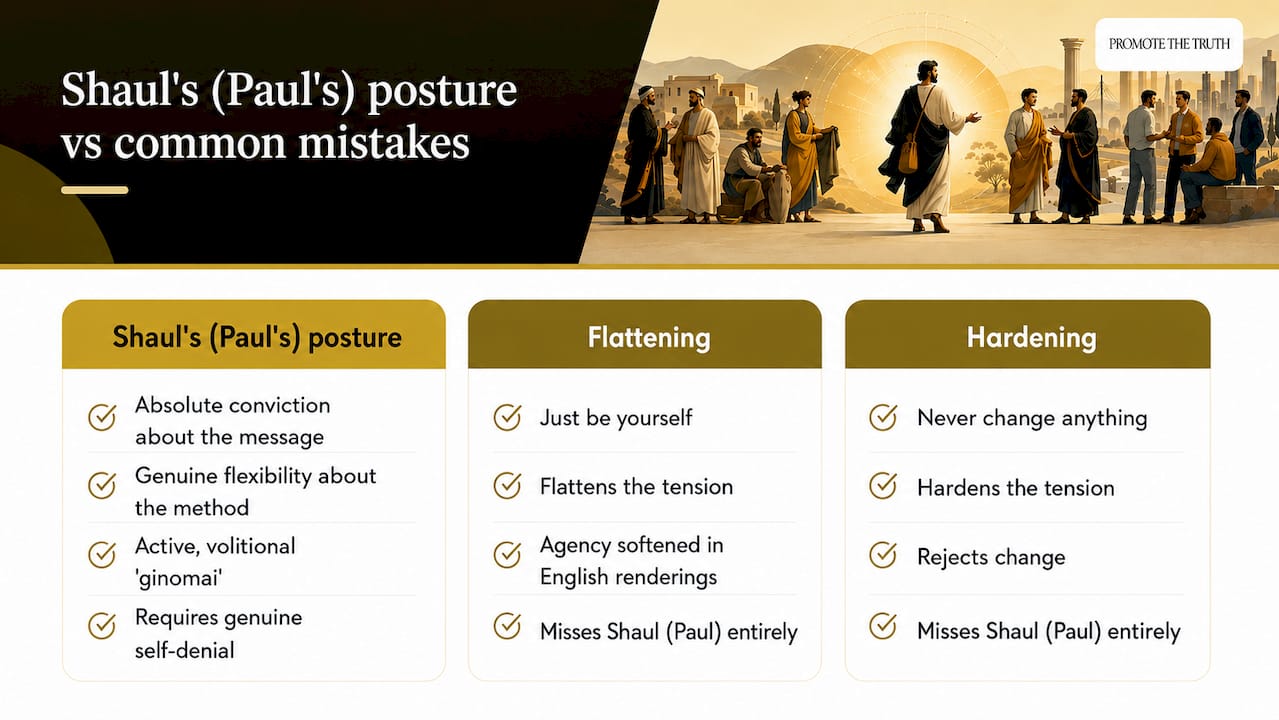
Shaul’s (Paul’s) phrase has outlasted every cultural moment it was first spoken into, and that staying power is not accidental. The passage survives because it holds two things in tension that most people instinctively pull apart: absolute conviction about the message and genuine flexibility about the method. Most teachers I encounter either flatten the tension into “just be yourself” or harden it into “never change anything.” Both miss Shaul (Paul) entirely.
What strikes us most in the manuscript work behind the Truth Scriptures translation is how the active, volitional force of ginomai gets softened in passive English renderings. When you read “I am made all things,” the agency disappears. Shaul (Paul) was not passively shaped by his audiences; he was actively, repeatedly choosing to step into their world. That is a harder and more demanding posture than most modern contextualization conversations acknowledge. It requires not just cultural awareness but genuine self-denial, the kind Shaul (Paul) describes elsewhere as counting others more significant than yourself (Piyliypiyniym (Philippians) 2:3).
Promote The Truth study resources for going deeper
The passage in 1 Qaranatiym (Corinthians) 9 rewards careful, unhurried study, and Promote The Truth has built a set of resources specifically for readers and teachers who want that depth. The Scripture Study Series video channel offers structured video lessons that walk through passages like this one with close attention to manuscript background and original-language nuance. For a more structured course experience, the Digital Video Academy provides in-depth teaching modules suited to both individual learners and group leaders. If you want the text itself in a translation grounded in ancient Abariy (Hebrew) and Aramiyt (Aramaic) sources, the Truth Scriptures digital collection gives you the full Ta’anak and Bariyt Hadash with the precision this kind of word study demands.

Start with the Scripture Study Series if you are preparing a lesson on 1 Qaranatiym (Corinthians) 9. The video format makes it straightforward to preview material, pull teaching clips, or assign pre-session viewing to a study group.
Sources
Recommended
-
How to Study the Truth Scriptures: A Complete Guide to Manuscript-Based Scriptural Study
-
Scripture Study Series YouTube Video Channel - Promote The Truth
-
What Is a Topical Scriptures (Bible) Study? A Practical Guide to Studying Scripture by Topic
-
Study Scriptural (Biblical) Community Living Principles: A Practical Study Guide