
“For Aluah has not given us a Spirit of fear. He has given us a Spirit of power, love, and discipline.” — Tiymutiy Bat (2 Timothy) (TST) 1:7
A sound mind is one of the greatest gifts YAHUAH gives to His people. According to Tiymutiy Bat (2 Timothy) 1:7, it is not merely positive thinking or emotional resilience. Rather, it is the Spirit-produced ability to think soberly, exercise self-control, and make wise decisions without being controlled by fear or irrational thinking.
The Greek word translated as “discipline” or “sound mind” is sōphronismos, a term that appears only once in the entire Bariyt Hadash (New Testament). It conveys the idea of sound judgment, self-discipline, and sober-minded discernment that flows from the work of the Set-Apart Spirit (Holy Spirit) rather than from human willpower alone. As noted by Gotquestions, English translations render sōphronismos as “sound mind,” “self-control,” “discipline,” or “sound judgment,” each highlighting a different aspect of the same Spirit-given gift.
Before reading further, pause for a moment. Consider memorizing Tiymutiy Bat (2 Timothy)1:7 and praying this simple prayer:
“YAHUAH, I receive the sound mind You have given me through Your Set-Apart Spirit.”
That simple act of faith is where cultivating genuine Scriptural mental clarity begins.
Key Takeaways
A sound mind is a Spirit-given gift of sober, self-controlled discernment rooted in Tiymutiy Bat (2 Timothy) 1:7. It is cultivated through daily submission to the Set-Apart Spirit, renewed by the Word of YAHUAH, and strengthened through consistent engagement with Scripture.
| Point | Details |
|---|---|
| Scriptural (Biblical) definition | Sōphronismos describes Spirit-produced soundness of mind, sober judgment, and self-discipline rather than mere emotional calm or human willpower. |
| Core Scripture | Tiymutiy Bat (2 Timothy) 1:7 contains the only occurrence of sōphronismos in the Bariyt Hadash (New Testament). Memorizing this verse is an excellent first step toward cultivating a sound mind. |
| Daily application | A practical pattern of Scripture meditation, prayer, and wise decision-making helps guard against fear-driven thinking and encourages Spirit-led discernment. |
| When additional help is needed | Persistent emotional distress, symptoms lasting two weeks or longer, or thoughts of self-harm should be taken seriously. Seek immediate support from a qualified healthcare professional or your local emergency or crisis services. |
| Promote the Truth resources | The Truth Scriptures restoration translation and the Scripture Study Series provide manuscript-grounded resources for deeper Scriptural study and spiritual growth. |
Table of Contents
-
What does 2 Timothy 1:7 really mean? A word study on sophronismos
-
How to Cultivate a Sound Mind Through Faith-Based Daily Practice
-
When Spiritual Practice Is Not Enough: Recognizing When to Seek Professional Help
-
How Promotethetruth’s restoration translation clarifies “a sound mind”
-
A pastoral perspective on what “sound mind” actually costs you
-
Deepen your study with Promotethetruth’s Scripture resources
What Does Tiymutiy Bat (2 Timothy) 1:7 Really Mean? A Word Study of Sōphronismos
Shaul (Paul) wrote Tiymutiy Bat (2 Timothy) while imprisoned in Rum (Rome), most likely during his second imprisonment under Nero. At the time, Tiymutiy (Timothy), his young coworker and trusted emissary, was overseeing the congregation in Apasiy (Ephesus) and appears to have been struggling with timidity and discouragement. Shaul’s (Paul’s) purpose was not to present abstract theology but to encourage Tiymutiy (Timothy) to stop shrinking back and to faithfully exercise the Spirit-given gifts YAHUAH had already entrusted to him.
At the heart of that encouragement is the Yuuniy (Greek) word sōphronismos. It appears only once in the entire Bariyt Hadash (New Testament), in Tiymutiy Bat (2 Timothy) 1:7, making it a uniquely significant word for understanding the Scriptural meaning of a sound mind. The term conveys the ideas of sound judgment, self-discipline, sober-mindedness, and mental wholeness produced by the Set-Apart Spirit, rather than by human willpower alone.
The word is related to other Yuuniy (Greek) terms that reinforce the same theme. Enkrateia (“self-control”) is listed among the fruit of the Set-Apart Spirit in Galatiym (Galatians) 5:22–23, while sōphrosynē describes sobriety, sound judgment, and a disciplined mind. Together, these related terms portray a mind that is stable, well ordered, and governed by the Set-Apart Spirit, rather than one controlled by fear, anxiety, or unchecked emotions.
| Translation | Rendering of sōphronismos | Nuance |
|---|---|---|
| NKJV | Sound mind | Emphasizes soundness, wholeness, and sober judgment. |
| NIV | Self-discipline | Highlights disciplined living empowered by the Set-Apart Spirit. |
| ESV | Self-control | Emphasizes self-restraint and disciplined thinking guided by Scripture. |
| NASB | Sound judgment | Focuses on wise discernment and thoughtful decision-making. |
| NLT | Good judgment | Stresses practical wisdom in everyday choices. |
The role of the Set-Apart Spirit (Holy Spirit) is central to Tiymutiy Bat (2 Timothy) 1:7. Shaul’s (Paul’s) threefold expression—“power, love, and discipline”—describes complementary aspects of the Spirit’s work in the life of a believer: the power to act courageously, the love to act selflessly, and the discipline, or soundness of mind, to act wisely. A sound mind is not merely a personality trait that Tiymutiy (Timothy) was expected to develop through his own efforts. Rather, it is a Spirit-given gift to be received, cultivated, and faithfully exercised through the work of the Set-Apart Spirit.
Key Observations
-
Sōphronismos appears only once in the Bariyt Hadash (New Testament), making Tiymutiy Bat (2 Timothy) 1:7 its only occurrence.
-
The term conveys the ideas of sound judgment, self-discipline, sober-mindedness, and mental soundness, rather than merely emotional calm or emotional stability.
-
Shaul’s (Paul’s) exhortation is essential for understanding the passage. The answer to Tiymutiy’s (Timothy’s) fear was not courage alone, but Spirit-produced discernment expressed through power, love, and a sound mind.
Key Scriptures That Reveal What a Healthy Mind Looks Like
The Scriptures do not leave the concept of a sound mind undefined. Throughout the Bariyt Hadash (New Testament), several passages provide a clear picture of what it means to think with wisdom, self-control, and Spirit-produced discernment. Each Scripture below is followed by a brief explanation and a practical application you can begin today.
-
Rumaiym (Romans) (TST) 12:2 — “Do not be conformed to the ways of this world. Instead, be transformed by the renewing of your mind, so that you may prove those things that are good, acceptable, and the perfect will of Aluah.”
Interpretation: A sound mind is not fixed or unchangeable. Through the transforming work of the Set-Apart Spirit and continual renewal by the Word of YAHUAH, the mind can be reshaped to discern and embrace Aluah’s good, acceptable, and perfect will.
Application: Replace one passive media habit this week with ten minutes of reading and meditating on the Scriptures, allowing the Word of YAHUAH to renew your mind each day. -
Galatiym (Galatians) (TST) 5:22–23 — “But the fruit of the Spirit is love, joy, peace, patience, kindness, goodness, faithfulness, humility, and self-control. There is no Law against these things.”
Interpretation: Self-Control is a fruit by the Set-Apart Spirit, not something we can achieve through human effort alone. As noted by Gotquestions, Spirit-produced self-control flows from YAHUAH’s work within the believer rather than from self-reliance.
Application: When you feel tempted to react in fear, anger, or frustration, pause and pray: “YAHUAH, through Your Set-Apart Spirit, produce Your fruit in me today.” -
Qaranatiym Alaf (1 Corinthians) (TST) 2:16 — “The Scriptures say, ‘Who has the mind of the Master that can instruct Him?’ But we have the mind of the Mashiyah.”
Interpretation: Through the Mashiyah, believers have been given access to a way of thinking that is shaped by the wisdom and purposes of Aluah, rather than by the wisdom of this world. Having the mind of the Mashiyah means learning to view people, circumstances, and decisions through the truth of YAHUAH’s Word as the Set-Apart Spirit transforms and renews the mind.
Application: Before making an important decision or entering a difficult conversation, pause and ask, "How would the mind of the Mashiyah respond in a way that honors YAHUAH?"Then seek guidance through prayer and the Scriptures before you act. -
Apasiyiym (Ephesians) (TST) 4:22–24 — “You were taught to put away your former life and strip away the corrupt ways of lust and deceit. You are to be renewed in your mind. You have now clothed yourself as a new person, whose nature was created according to Aluah’s image in righteousness and set-apart in truth.”
Interpretation: A renewed mind is not a one-time experience but an ongoing work of transformation. Shaul (Paul) teaches that believers are to continually put away their former patterns of thinking and living, allow their minds to be renewed, and live according to the new nature that Aluah has created in righteousness and truth. As the Set-Apart Spirit (Holy Spirit) renews the mind through the Scriptures, old habits of deceit, sinful desires, and worldly thinking are replaced with thoughts that reflect Aluah’s character and will.
Application: Identify one recurring fearful, anxious, or sinful thought pattern this week. Then find a Scripture that directly speaks to that struggle, meditate on it daily, and ask YAHUAH, through His Set-Apart Spirit, to renew your mind according to His truth. -
Tiytus (Titus) (TST) 2:11–12 — “The free gift of eternal life is now being offered by Aluah to everyone. It instructs us to deny all wickedness and worldly lusts so we will live ethically, righteously, and set-apart in this present world.”
Interpretation: The compassion of Aluah is not merely the means by which we receive salvation; it is also the teacher that continually trains believers to reject wickedness, resist worldly desires, and develop a sound mind that reflects righteous, disciplined, and set-apart living. Rather than relying on human willpower alone, believers are shaped by Aluah’s compassion as the Set-Apart Spirit (Holy Spirit) transforms their thinking and daily conduct.
Application: Thank YAHUAH today for Your compassion, which not only saves but also teaches, corrects, and transforms. Ask Him to help you reject worldly thinking and cultivate a sound mind that honors Him in your daily decisions.
-
Kapa Alaf (1 Peter) (TST) 1:13 — “Therefore, strongly prepare your minds, keep a clear head, and set your hope completely on the favor that is to be given to you when YAHUAH Mashiyha returns and is revealed.”
Interpretation: Kapa (Peter) calls believers to prepare their minds for faithful living by remaining spiritually alert, sober-minded, and fully focused on the hope promised through the return of YAHUAH Mashiyha. A sound mind is not merely a healthy way of thinking; it is a Spirit-shaped mindset that remains disciplined, watchful, and anchored in the promises of YAHUAH, even amid life’s trials and distractions.
Application: Begin each morning by dedicating your thoughts to YAHUAH before checking your phone or engaging with the day’s distractions. Pray a simple declaration such as, *“*YAHUAH, prepare my mind today, keep me clear-headed, and help me place my hope completely in You.”
-
Piyliypiyniym (Philippians) (TST) 4:6–8 — “Do not be anxious about anything. Instead, bring all your requests through prayer to Aluah, and always be thankful. Then the peace of Aluah, which surpasses all understanding, will guard your hearts and your thoughts through YAHUAH Mashiyha. Finally, brothers and sisters, whatever things are true, whatever things are honorable, whatever things are just, whatever things are pure, whatever things are lovely, whatever things are commendable, whatever things are virtuous, and everything that is praiseworthy, think on these things.”
Interpretation: Shaul (Paul) teaches that a sound mind is cultivated through prayer, thankfulness, and intentional meditation on what is true, honorable, just, pure, lovely, commendable, virtuous, and praiseworthy. Rather than allowing anxiety to control the mind, believers are invited to bring every concern before Aluah in prayer. As they do, the peace of Aluah guards both the heart and the mind through YAHUAH Mashiyha, enabling them to think according to His truth rather than their fears.
Application: When anxiety begins to rise, pause and bring your concerns to YAHUAH in prayer with thanksgiving. Then read or recite a few Scriptural truths that remind you of His faithfulness, allowing your thoughts to rest on what is true, honorable, and praiseworthy.
-
Yisha’aiyahu (Isaiah) (TST) 26:3 — “You will give perfect peace to those who keep their minds on You and trust You.”
Interpretation: YAHUAH promises perfect peace to those whose minds remain steadfast because they trust in Him. A sound mind is not merely the absence of anxious thoughts but the result of continually fixing the mind on YAHUAH and placing unwavering confidence in His faithfulness. As trust in YAHUAH grows, His peace guards and steadies the mind, even in the midst of uncertainty and trials.
Application: When your thoughts become anxious or overwhelmed, pause and intentionally refocus your mind on YAHUAH. Pray, YAHUAH, I choose to fix my mind on You and trust in Your faithfulness.” Then meditate on His promises until your thoughts are anchored in His peace.
How to Cultivate a Sound Mind Through Faith-Based Daily Practice
Knowing the truth is only the beginning. A sound mind is cultivated through consistent, daily obedience to YAHUAH and the transforming work of the Set-Apart Spirit (Holy Spirit). The following plan will help you put these Scriptural truths into practice through a realistic weekly routine. Start small. The goal is faithful consistency, not perfection.
1.Morning Anchor (Daily – 5 Minutes)
Begin each day by reading one Scripture from the passages above. Read it aloud, then pray a simple prayer, asking the Set-Apart Spirit to apply its truth to your heart and mind throughout the day. This is a practical example of habit stacking: connect this daily practice to something you already do, such as preparing your first cup of coffee or tea each morning.

2. Midday Reset (Daily – 2 Minutes)
When stress or anxiety begins to rise, follow the pattern found in Piyliypiyniym (Philippians) 4:6–8. First, identify what is causing your anxiety. Next, bring it before YAHUAH in prayer with thanksgiving. Then intentionally redirect your thoughts to what is true, honorable, just, pure, lovely, commendable, virtuous, and praiseworthy. If it helps, write a key Scriptural truth on a sticky note or save it on your phone as a reminder throughout the day.
3.The Sound Mind Decision Method (As Needed)
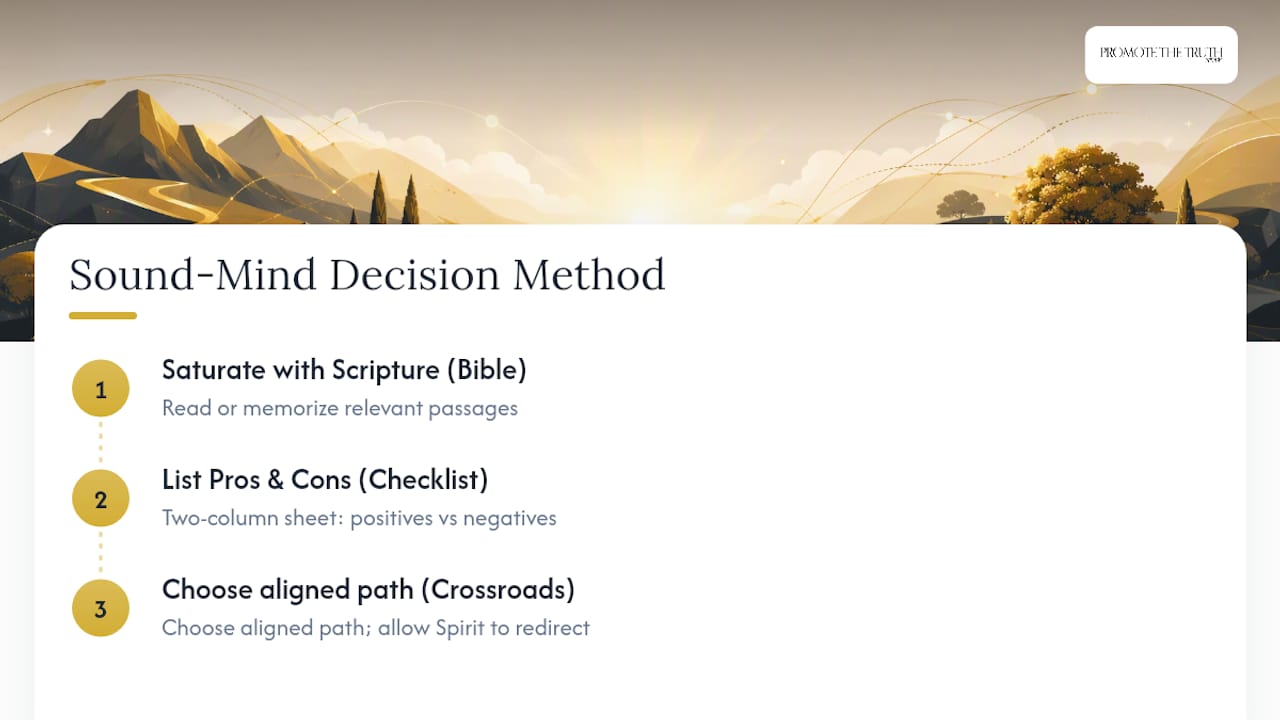
When facing an important decision, seek to cultivate a sound mind by grounding your thinking in the Scriptures rather than your emotions. A practical framework, similar to the Cru “Sound Mind Principle,” begins by filling your mind with relevant Scriptural passages. Next, create a simple two-column list of the potential benefits and concerns. Finally, choose the course of action that most closely aligns with Scriptural (Biblical) truth, while remaining prayerful and sensitive to the leading of the Set-Apart Spirit (Holy Spirit). This approach helps prevent fear, impulse, or emotion from replacing Spirit-guided wisdom and sound judgment.
4. Evening Reflection (Daily – 5 Minutes)
At the end of each day, reflect on one moment when fear, anxiety, or impulsive reactions surfaced. Ask yourself, “How would a sound mind have responded differently?” Write one sentence describing what you learned and how you will respond next time. This is not an exercise in self-condemnation but an opportunity for Spirit-guided reflection, correction, and spiritual growth.
5. Weekly Community Encouragement
Share one struggle and one Scripture with a trusted believer each week. Encourage one another, pray together, and hold each other accountable for applying YAHUAH’s Word. Scriptural fellowship strengthens faith, build spiritual maturity, and cultivates a sound mind in ways that isolated spiritual practice cannot.
6. Support Your Mind Through Wise Stewardship
The Scriptures teach that we are to be faithful stewards of every area of life, including our bodies.Research consistently shows that sleep deprivation, dehydration, and chronic stress can contribute to reduced mental clarity and impaired decision-making. Prioritizing seven to eight hours of sleep, staying properly hydrated, and managing stress wisely help create the physical conditions that support prayer, Scripture meditation, and sound, Spirit-led decision-making. Caring for your physical well-being does not compete with your spiritual life; it supports your ability to serve YAHUAH with a clear, disciplined, and sound mind.

7. 30-Day Starter Commitment.
Choose one Scripture to memorize each week for four weeks. Pair each verse with one of the daily practices outlined above. By the end of 30 days, you will have memorized four foundational Scriptures and established a daily rhythm that relies less on willpower and more on faithful consistency.
Pro Tip: Start with the smallest possible version of each practice. Two minutes of consistent Scripture reading will accomplish far more than a 30-minute plan that is abandoned after only a few days. The Set-Apart Spirit (Holy Spirit) works through faithful obedience and consistency, not through the amount of time you spend.
A Scriptural Encouragement
One truth is worth remembering throughout this journey: relying on human self-discipline alone often leads to discouragement and burnout. YAHUAH never intended you to carry the burden of transformation by your own strength. The goal is not merely to appear spiritually healthy but to be continually transformed by the work of the Set-Apart Spirit.
As Tiytus (Titus) (TST) 2:11–12 reminds us, the compassion of Aluah not only brings salvation but also teaches, corrects, and transforms those who receive it. Your responsibility is not to manufacture spiritual growth through human effort but to remain faithful, available, and responsive to the work of YAHUAH in your life each day.
When Spiritual Practice Is Not Enough: Recognizing When to Seek Professional Help
Faith and professional mental health care are not rivals. Scripture calls us to wisdom, and wisdom sometimes means seeking medical care. The National Institute of Mental Health (NIMH) recommends consulting a primary care provider or a qualified mental health professional when symptoms are severe, persistent, or significantly interfere with daily functioning.
Watch for These Signs That May Warrant Professional Attention
-
Persistent sadness, hopelessness, or a depressed mood lasting two weeks or longer.
-
Significant changes in sleep or appetite that do not improve over time.
-
Difficulty performing everyday responsibilities, such as work, personal hygiene, or maintaining healthy relationships.
-
Thoughts of harming yourself or others.
-
Hallucinations, paranoia, or severe confusion.
-
Anxiety or panic that remains severe, worsens, or continues despite personal coping efforts, spiritual support, and appropriate self-care.
These are not signs of weak faith. They are symptoms that deserve appropriate attention, just as chest pain is a symptom that should be evaluated by a medical professional.
Practical Next Steps If You Recognize These Signs
-
Speak with your primary care provider first. They can evaluate possible physical causes, provide initial treatment, or refer you to an appropriate mental health specialist.
-
If you or someone you know is in immediate danger or experiencing thoughts of suicide, contact your local emergency services or a crisis hotline immediately.
-
Ask your Overseer, Guardian Keeper, or faith community if they can recommend a licensed mental health professional who respects and supports your faith.
-
Explore spiritually supportive practices as a complement to —not a replacement for—evidence-based mental health care.
Faith-informed counseling approaches, including cognitive behavioral therapy (CBT) provided by a qualified mental health professional who respects your beliefs, can complement Scriptural reflection with evidence-based therapeutic techniques. These approaches are not mutually exclusive. A counselor who respects your faith should not ask you to abandon your convictions, and seeking professional care should never be viewed as a lack of faith or trust in YAHUAH.
Pro Tip: If you are looking for a faith-informed counselor, ask directly: “Do you have experience working with clients who want to integrate their faith into the counseling process?” Most licensed mental health professionals will answer this question openly and honestly.
Combining consistent spiritual disciplines with appropriate professional care can provide comprehensive support for mental and emotional well-being. Professional treatment can address clinical symptoms, while prayer, Scripture study, fellowship, and other spiritual disciplines can strengthen faith and encourage spiritual growth alongside that care.
How Promote The Truth’s Restoration Translation Clarifies “a Sound Mind”
Translation choices are not neutral. When a translator renders sōphronismos as “self-discipline,” the emphasis often falls on disciplined conduct. When the same word is rendered as “sound mind” or “sound judgment,” the emphasis highlights the Spirit-given quality of discernment and sound thinking. These translation choices can influence how readers understand the passage and their relationship to it: Are they relying primarily on human effort, or are they learning to receive and cultivate what the Set-Apart Spirit provides?
Promote The Truth approaches this question through meticulous manuscript research, translating the Ta’anak and Bariyt Hadash from ancient Abariy (Hebrew) and Aramiyt (Aramaic) manuscripts. The organization’s Truth Scriptures restoration translation seeks to preserve the original meaning of the text, including the covenantal significance of the Name YAHUAH, which many English translations render with generic titles.
Consider one example. Where some English translations render Tiymutiy Bat (2 Timothy) 1:7 with “self-discipline” or “self-control,” the restoration rendering “sound mind” emphasizes the fuller sense conveyed by sōphronismos. One rendering may lead readers to focus primarily on personal discipline, while another highlights the Spirit-produced soundness of mind that believers are called to receive and cultivate through YAHUAH’s Set-Apart Spirit.
-
Promote The Truth’s Truth Scriptures Digital collection provides access to this restoration translation for personal Scripture study.
-
The organization’s courses and teachings offer structured, manuscript-grounded instruction for readers who desire a deeper understanding of the Scriptures.
-
Every translation decision is guided by careful historical, linguistic, and manuscript research, with the goal of remaining as faithful as possible to the ancient text.
A Scriptural Reflection on What a Sound Mind Truly Requires
Much of the conventional wisdom about mental well-being in Mashiyha (Christian) circles tends to fall into one of two unhelpful extremes: either “just pray more” or “therapy fixes everything.” Neither fully reflects what Shaul (Paul) actually wrote to Tiymutiy (Timothy).
Shaul (Paul) was writing from prison. Tiymutiy (Timothy) was facing fear and discouragement. This letter was not a self-help guide or a motivational framework. It was a faithful servant of YAHUAH encouraging a younger leader, reminding him that the Set-Apart Spirit already dwelling within him was sufficient for the challenges before him. The sound mind that Shaul (Paul) described was not the absence of hardship. It was a Spirit-produced way of thinking that enabled believers to face difficulties without being overcome by them.
What does this mean in everyday life? Cultivating a sound mind is less about achieving a constant state of emotional calm and more about training your mind to remain fixed on the truth of YAHUAH’s Word. When fear arises, where does your mind go? Does it continually rehearse fear, or does it return to the promises of YAHUAH? That is the daily discipline—not dramatic transformation overnight, but the quiet and consistent decision to bring your thoughts back to what is true, honorable, just, pure, lovely, commendable, virtuous, and praiseworthy, just as Piyliypiyniym (Philippians) 4:8 teaches.
A 7-Day Sound Mind Challenge
-
Day 1: Memorize Tiymutiy Bat (2 Timothy) 1:7. Recite it aloud three times before going to bed.
-
Day 2: Write Piyliypiyniym (Philippians) 4:8 on a card or save it on your phone. Read it several times throughout the day.
-
Day 3: Apply the Sound Mind Decision Method to one important decision you are currently facing.
-
Day 4: Share one Scriptural truth that you are thankful for with another believer.
-
Day 5: Identify one fear you have repeatedly entertained this week. Write down a Scripture that directly speaks to that fear, and meditate on it.
-
Day 6: Rest before YAHUAH. Shabat (Sabbath) is not laziness; it is an expression of trust in His provision and care.
-
Day 7: Review the week prayerfully. What has YAHUAH been teaching you? Write one honest sentence about how your thinking has begun to change.
One final encouragement: YAHUAH’s compassion is greater than your failures. If you miss a day, begin again. Developing a sound mind is not about flawless performance but about faithfully returning to YAHUAH each day. Spiritual maturity is built through consistent faithfulness, not perfection.
Deepen Your Study with Promote The Truth’s Scripture Resources
The article you have just read is only the beginning. The deeper work of applying the Scriptures to daily life takes time, faithful study, reliable resources, and a translation you can trust. Whether you are seeking a clearer understanding of a sound mind, the work of the Set-Apart Spirit, or the original meaning of the Scriptures, building a strong Scriptural foundation begins with carefully studying YAHUAH’s Word.

Promote the truth’s Scripture Study Series offers video-based teachings grounded in careful manuscript research and the Truth Scriptures restoration translation, providing guided, media-rich study that goes beyond surface-level devotional content. Each lesson draws from the original Abariy (Hebrew) and Aramiyt (Aramaic) manuscripts, helping readers better understand the Scriptural meaning of important words and concepts, such as sōphronismos, within their broader covenantal context.
For those seeking a more structured learning experience, the Digital Video Academy offers systematic courses covering Scripture, manuscript research, Scriptural history, and foundational faith concepts. These resources are excellent starting points for deepening your understanding of YAHUAH’s Word through careful study of the ancient manuscripts. While many study resources are available, the ultimate goal is to grow in the knowledge of the true Word of YAHUAH and to apply it faithfully in everyday life.
Begin your journey today by exploring the Promote The Truth Scripture Study Series and continue building a stronger, Scripture-centered foundation for your faith.
Sources
A brief note before the list: The sources below represent a range of perspectives, from exegetical reference works to clinical mental health guidance. Promote The Truth’s own resources are listed first as the primary study resources.
-
The Sound Mind Principle | Today’s Promise - January 26 | Cru
-
How to Improve Mental Clarity: The Science-Backed Guide for Knowledge Workers | 10000Hours Blog
This article is intended for general informational purposes only and is not a substitute for advice from a qualified healthcare professional. Consult a qualified healthcare professional about your individual circumstances before acting on any information provided in this article.