
The Clementine Homilies are a pseudonymous, late-antique Mashiyha (Christian) theological narrative preserved in twenty books of theological and philosophical dialogue. They represent one of two principal recensions used to reconstruct an earlier lost work that scholars refer to as the Grundschrift or Periodoi Petrou (“Circuits of Peter”). Together with the Clementine Recognitions, the Homilies use Clement of Rome as a literary framework rather than as a claim of genuine authorship. They are among the most theologically layered texts in early Mashiyha (Christian) literature, and understanding them requires careful attention to pseudonymity, redaction, and their complex manuscript tradition.
Three facts orient every serious researcher from the outset:
-
Date and provenance: Scholarly consensus places the final redaction in the mid-fourth century CE, with an Aramiy (Syrian) or Antiyukiyah (Antiochene) origin widely supported by linguistic, literary, and theological evidence.
-
Literary structure: The work consists of twenty numbered books arranged as homilies and theological dialogues. It is prefaced by the Letter (Epistle) of Kapa (Peter) to Ya’aqab (James) and the Adjuration (Contestation), which frame Clement’s account of Kapa’s (Peter’s) missionary journeys.
-
Primary research value: The Clementine Homilies preserve important evidence of Yahudiym-Mashiyha (Jewish-Christian) theological currents, anti-Sha’ul’s Letters (Pauline) tendencies, and prophetic traditions and speculation, providing valuable insight into late-antique theological and doctrinal debates rather than serving as reliable evidence for reconstructing first-century emissary history.
For primary study, the most accessible English translation remains Thomas Smith’s rendering in the Ante-Nicene Fathers, available through New Advent. Although Rufinus of Aquileia’s Latin translation (c. 406 CE) covers the Clementine Recognitions rather than the Homilies themselves, it remains indispensable for comparative textual study. Early Aramiy (Syriac) witnesses—particularly British Library Add. 12150—also provide valuable manuscript evidence that predates many of the surviving Yuuniy (Greek) copies.
Key Takeaways
The Clementine Homilies are a pseudonymous Mashiyha (Christian) romance, most likely finalized in the mid-fourth century CE. They are best studied as witnesses to late-antique theological and doctrinal developments rather than as reliable sources for reconstructing the history of the first-century emissaries.
| Point | Details |
|---|---|
| Pseudonymous Genre | The Clementine Homilies use Clement of Rome’s name as a literary framework rather than as a genuine claim of authorship… |
| Manuscript Tradition | Early Aramiy (Syriac) witnesses, including British Library Add. 12150 (411 CE), predate many surviving Yuuniy (Greek) manuscripts and are essential for comparative textual study. |
| Two Recensions, One Lost Source | The Homilies (H) and Recognitions (H) are independent reworkings of a lost Grundschrift. Reading both side by side provides the best opportunity to reconstruct the earlier source. |
| Theological Discernment Required | Anti-Sha’ul’s Letters (Pauline) tendencies, prophetological Mashiyha (Christology), and cosmological speculation reflect later editorial and theological perspectives rather than firsthand apostolic testimony… |
| Recommended Starting Edition | Thomas Smith’s translation in the Ante-Nicene Fathers (available through New Advent and CCEL) remains the most accessible English-language starting point for studying the Clementine Homilies. |
Table of Contents
-
What Are the Clementine Homilies, and How Do Scholars Classify Them?
-
What does the manuscript tradition tell us about the Homilies?
-
How Were the Homilies Received, and Why Do They Still Matter to Scholars?
-
Where Can You Read the Homilies in Reliable Editions and Translations?
What Are the Clementine Homilies, and How Do Scholars Classify Them?
The Clementine Homilies belong to a literary genre that scholars describe as a pseudepigraphical Tendenzroman—a theological narrative that adopts the name of a well-known figure, Clement of Rome, to advance specific doctrinal arguments.The Clementine literature is entirely distinct from the authentic First Letter of Clement and should not be read as genuine first-century correspondence. Its pseudonymous character is not merely incidental; it is a deliberate literary device through which the author(s) sought to invest their theological arguments with the authority of the early emissaries.
The internal structure follows a clear pattern:
-
Letter (Epistle) of Kapa (Peter) to Ya’aqab (James): A prefatory letter urging Ya’aqab (James), the Master’s (Lord’s) brother, to guard Kapa’s (Peter’s) teachings from misuse, expressing explicit concern about false interpretations associated with Sha’ul (Paul).
-
Adjuration (Contestation): A formal oath requiring recipients of Kapa’s (Peter’s) teachings to preserve them faithfully and maintain their confidentiality, establishing the text’s esoteric literary framework.
-
Twenty Numbered Books: Presented as homilies delivered by Kapa (Peter) during his missionary journey from Qiysariyah (Caesarea) to Antiyukiyah (Antioch), they function primarily as extended theological dialogues and doctrinal discourses rather than as narrative travel accounts.
Historically, the Homilies served community identity formation within Yahudiym-Mashiyha (Jewish-Christian) circles that preserved distinct ritual practices and theological commitments. For researchers, their greatest value lies not in reconstructing what Kapa (Peter) actually said or did, but in tracing the doctrinal currents that shaped specific late-antique communities. Scholars treat them as a layered, redacted collection whose study is most productive for understanding how the Mashiyah (Messiah) was understood, how the Nabiyaiym (prophets) were interpreted, and how ritual practices developed within mid-to-late antique Yahudiym-Mashiyha (Jewish-Christian) communities.
What Does the Manuscript Tradition Tell Us About the Clementine Homilies?
The textual history of the Clementine Homilies is genuinely complex, and understanding its manuscript tradition is the first task of any serious researcher. Rufinus of Aquileia’s Latin translation (c. 406 CE) and the early Aramiy (Syriac) witnesses occupy central places in the manuscript tradition. Most scholars regard the Homilies (H) and the Recognitions (H) as two independent recensions of an earlier, longer source, with a mid-fourth-century CE final redaction representing the prevailing scholarly view.
Major Manuscript Witnesses
| Witness | Language | Date/Period | Significance |
|---|---|---|---|
| Yuuniy (Greek) Manuscripts (H) | Yuuniy (Greek) | Medieval copies | The primary textual witnesses to the Clementine Homilies; no early Yuuniy (Greek) papyri have survived. |
| British Library Add. 12150 | Aramiy (Syriac) | Portions dated to 411 CE | Among the earliest datable manuscript witnesses to the Clementine corpus. |
| British Library Add. 14609 | Aramiy (Syriac) | 5th–6th century CE | An additional Aramiy (Syriac) witness preserving material from both the Homilies (H) and the Recognitions ®. |
| Rufinus of Aquileia’s Latin Translation | Latin | c. 406 CE | Translates the Recognitions® and is indispensable for comparative textual reconstruction. |
| Medieval Epitomes | Aramiy (Arabic), Armenian, Slavonic | Medieval period | Later derivative witnesses that are valuable for tracing the reception and transmission of the Clementine tradition rather than reconstructing its earliest text. |
The Aramiy (Syriac) manuscript tradition deserves special attention. Because British Library Add. 12150 contains portions dated to 411 CE, it predates many surviving Yuuniy (Greek) manuscripts of the Clementine Homilies, making the Aramiy (Syriac) evidence especially valuable for reconstructing earlier textual layers. These Aramiy (Syriac) witnesses also preserve material drawn from both the Homilies (H) and the Recognitions (H). Although this complicates efforts to distinguish the two recensions with precision, it also provides richer evidence for reconstructing the development, transmission, and textual history of the Clementine tradition.
Transmission Timeline of the Clementine Homilies
The transmission of the Clementine Homilies can be summarized as follows:
-
Possible 2nd-century CE source traditions — Yahudiym-Mashiyha (Jewish-Christian) community documents, including the Periodoi Petrou (“Circuits of Peter”), which may preserve traditions incorporated into the later Clementine literature.
-
Mid-4th-century CE final redaction — The Homilies (H) and Recognitions (R) emerge as the two principal recensions known today.
-
c. 406 CE — Rufinus of Aquileia completes his Latin translation of the Recognitions(R), providing an important witness for comparative textual study.
-
Early 5th-century CE Aramiy (Syriac) manuscripts — British Library Add. 12150 (dated to 411 CE) and related witnesses preserve some of the earliest surviving evidence of the Clementine tradition.
-
Medieval period — Yuuniy (Greek) manuscript copies become more numerous, while epitomes and translations appear in Aramiy (Arabic), Armenian, and Slavonic.
-
19th century — Critical printed editions and the Ante-Nicene Fathers translation make the Clementine Homilies more widely accessible to English-speaking scholars and researchers.
The Catholic Encyclopedia’s overview describes the Clementine Homilies as a “curious religious romance” preserved in Yuuniy (Greek), Latin, and Aramiy (Syriac) forms. Its summary of the manuscript tradition and editorial history remains a valuable point of orientation for readers beginning serious research into the Clementine literature.
What Do the Twenty Homilies Actually Cover?
The twenty books of the Clementine Homilies do not divide neatly into thematic sections, but several clear narrative and theological clusters emerge through a close reading of the text.
Books 1–3 establish the narrative framework. They introduce Clement’s background in Rum (Rome), his search for truth, his encounter with Baranaba (Barnabas), and his journey to Qiysariyah (Caesarea) to meet Kapa (Peter). The opening also includes the Letter (Epistle) of Kapa (Peter) to Ya’aqab (James), which serves as a literary framework and signals the text’s concern with preserving authentic teaching.
Books 4–6 record Kapa’s (Peter’s) first major disputations with Shama’aun Magusha (Simon Magus) in Tripolis. These dialogues form the theological core of the Clementine Homilies, presenting debates about the nature of Aluah (God), the reliability of Scripture, and the identity of the True Nabiya (Prophet).
Books 7–11 continue the missionary journey and the debates with Shama’aun Magusha (Simon Magus) while incorporating extended discourses on the True Nabiya (Prophet), creation, and the order of the universe. Kapa’s (Peter’s) teaching concerning the True Nabiya (Prophet) reaches its fullest development in these books.
Books 12–19 follow Kapa’s (Peter’s) journey toward Antiyukiyah (Antioch), combining additional debates with the well-known family reunion narrative involving Faustinianus (Faustus), Clement’s father. These books also contain extended doctrinal discussions on immersion (baptism), ritual purity, and faithful living.
Book 20 survives only in a fragmentary form within the existing manuscript tradition.
The Faustinianus (Faustus) narrative, in which Clement’s father appears in disguise before eventually being recognized, may have influenced later medieval Faust traditions. Whether directly or indirectly, this episode illustrates the broader literary influence of the Clementine Homilies beyond their theological setting.
A passage from the Letter (Epistle) of Kapa (Peter) to Ya’aqab (James), which serves as the preface to the Clementine Homilies, illustrates the work’s concern with preserving authentic teaching:
Some from among the Guiym (Gentiles) have rejected my lawful preaching and have accepted a lawless and absurd doctrine of the man who is my enemy.
Many scholars interpret this statement as an indirect or veiled reference to Sha’ul (Paul), although the text never identifies him by name. Whether or not that interpretation is accepted, the passage has contributed significantly to scholarly discussions of the Clementine Homilies, Yahudiym-Mashiyha (Jewish-Christian) theology, and the relationship between early Yahudiym-Mashiyha (Jewish-Christian) communities and the emerging Guiy Mashiyha (Gentile Christian) movement.
When Were the Homilies Written, and Who Wrote Them?
No single theory of authorship commands universal scholarly agreement, but the range of proposed dates has narrowed considerably. Dates ranging from the 2nd to the 4th century CE have all been proposed. However, the mid-4th century CE remains the most widely accepted period for the final redaction of both the Homilies (H) and the Recognitions ®. An Aramiy (Syrian) provenance is widely supported by the Aramiy (Syriac) manuscript tradition, as well as by the text’s linguistic and theological characteristics.
Major Scholarly Positions on Dating and Redaction
| Position | Date Range | Key Argument |
|---|---|---|
| Early Source Traditions | 2nd century CE | Yahudiym-Mashiyha (Jewish-Christian) community documents likely underlie both the Homilies (H) and the Recognitions ® |
| Grundschrift Composition | Late 2nd–early 3rd century CE | A unified Periodoi Petrou (“Circuits of Peter”) is thought to have preceded both recensions. |
| Final Redaction of the Homilies (H) | Mid-4th century CE | The theological concerns align closely with fourth-century debates, while the early Aramiy (Syriac) witnesses demonstrate that the work was already circulating by the early fifth century. |
| Rufinus of Aquileia’s Latin Translation | c. 406 CE | Covers the Recognitions ® only and confirms that this recension was in circulation by the early fifth century. |
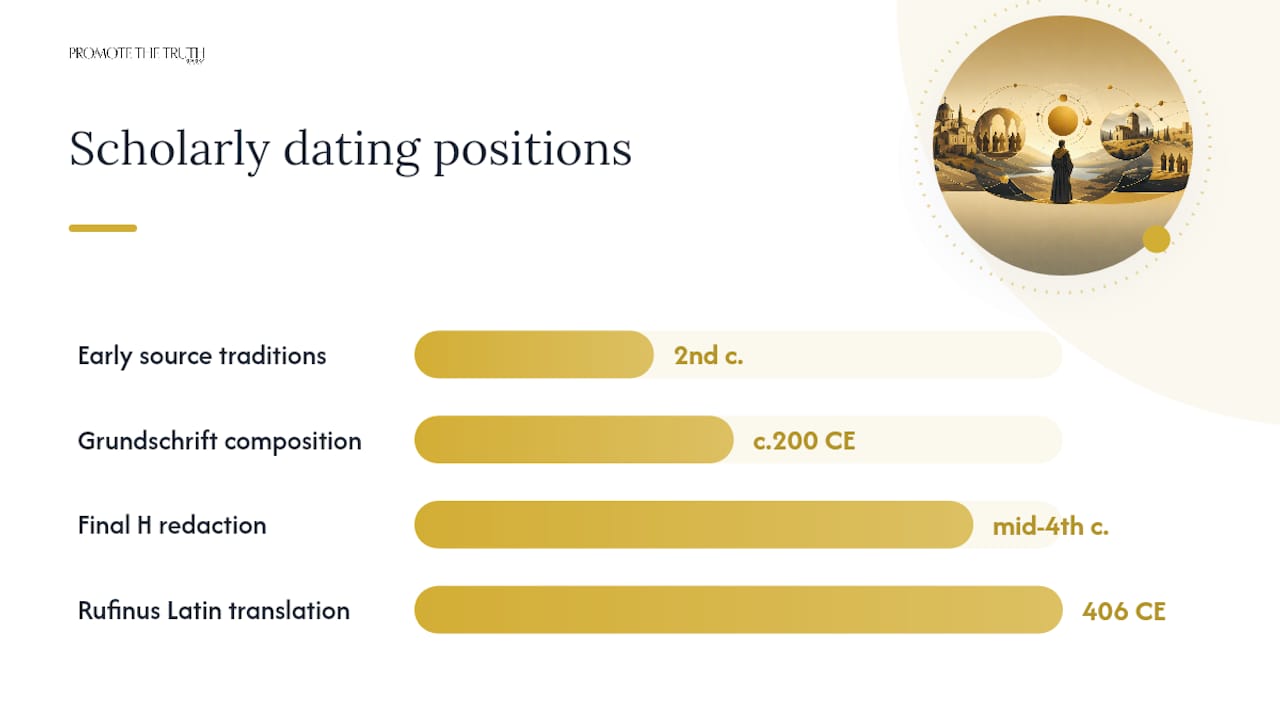
The redaction model accepted by most scholars proposes that an earlier Grundschrift—commonly identified with the Periodoi Petrou (“Circuits of Peter”)—was independently reworked into the Homilies (H) and the Recognitions (R) by editors with differing theological agendas. Researchers attempt to reconstruct the Grundschrift by identifying verbatim agreements between H and R, tracing shared narrative structures, and examining passages where one recension expands the text with doctrinal material absent from the other.
Georg Strecker’s analysis argues that the Recognitions ® and the Homilies (H) were composed as independent recensions with distinct theological programs. According to Strecker, the Recognitions reflect a more orthodox catholic editorial tendency, whereas the Homilies preserve more of the underlying heterodox material. The nineteenth-century Tübingen School, led by F. C. Baur, interpreted the Clementine literature as direct evidence of conflict between Yahudiym-Mashiyha (Jewish-Christian) communities and Sha’ulin Guiy Mashiyha (Pauline Gentile Christianity). Most modern scholars no longer accept that interpretation as direct historical evidence. Nevertheless, many conclude that the Clementine Homilies preserve authentic traces of Yahudiym-Mashiyha (Jewish-Christian) theological traditions and doctrinal developments.
The pseudonymous attribution to Clement of Rum (Rome) adds another layer of complexity. The Clementine Homilies conflate the historical Clement of Rum (Rome) with later figures, including Flavius Clemens, reflecting the development of later traditions rather than historical memory. As a result, modern scholarship regards any attempt to attribute the work to a first-century author as historically untenable.
What Theological Themes Run Through the Homilies?
The Clementine Homilies present a distinctive theological agenda that sets them apart from mainstream patristic literature. Researchers should approach each theme with the understanding that later editorial revisions may have softened, expanded, or reframed earlier theological traditions.
Teachings About the Mashiyha (Messiah) and the True Nabiya (Prophet)
The Clementine Homilies present the Mashiyha (Messiah) as the True Nabiya (Prophet), the final manifestation of a set-apart (divine) prophetic spirit that has appeared in various human figures throughout history. This understanding differs significantly from later Nicene formulations and suggests that the text preserves earlier, possibly Yahudiym-Mashiyha (Jewish-Christian), theological traditions. In this context, Yahudiym-Mashiyha (Jewish-Christian) refers to followers of Yahusah, who is YAHUAH’s Mashiyha (Jesus Christ), who identified with both Yahudiym (Jewish) heritage and Mashiyha (Christian) faith, emphasizing their roots in Yahudiym (Judaism) while embracing the teachings of the Mashiyha (Messiah). These communities often observed traditional Yahudiym (Jewish) customs, such as celebrating Pasaha (Passover) and keeping kosher, alongside their belief that Yahusah is YAHUAH’s Mashiyha (Jesus Christ), the promised Mashiyha (Savior). This dual identity reflects the cultural and religious heritage that shaped their theological outlook, communal identity, and spiritual life.
Anti-Sha’ul’s Letters (Pauline) Tendencies
The Letter (Epistle) of Kapa (Peter) to Ya’aqab (James) frames the entire collection with a warning against a “lawless” teacher whose doctrine corrupts Kapa’s (Peter’s) authentic message. Many scholars interpret this as a polemic against Sha’ulin Guiy Mashiyha (Pauline Gentile Christianity), making the Clementine Homilies an important source for studying Yahudiym-Mashiyha (Jewish-Christian) responses to emerging Guiy Mashiyha (Gentile Christian) theological developments.
Immersion (Baptism) and Ritual Purity
Kapa’s (Peter’s) discourses emphasize immersion (baptism) as the central rite of initiation, while also stressing ongoing ritual purity as a condition for receiving authentic teaching. These emphases broadly correspond with practices attested in other Yahudiym-Mashiyha (Jewish-Christian) sources.
Cosmological Speculation and Gnostic Parallels
The Clementine Homilies include discussions of syzygies (paired opposites within the cosmic order) and other speculative cosmological concepts that share terminology with Gnostic literature, although the precise relationship remains debated. The Ante-Nicene Fathers (ANF) editorial notes place these themes within broader discussions of Ebionite affinities and possible Gnostic parallels.
Shama’aun Magusha (Simon Magus) as a Theological Foil
Shama’aun Magusha (Simon Magus) functions not merely as the principal narrative opponent but also as a literary representative of theological positions rejected by the author(s), including false prophecy, speculative cosmology, and distorted interpretations of Scripture.
Pro Tip: When evaluating a doctrinal claim in the Clementine Homilies, first determine whether the passage appears in both the Homilies (H) and the Recognitions®, which may indicate that it derives from the earlier Grundschrift, or whether it appears only in the Homilies (H). Passages unique to the Homilies (H) are more likely to reflect the theological perspective of the Homilies’ editor(s) rather than inherited source material and should therefore be weighed accordingly in doctrinal analysis.
How Do the Homilies and Recognitions Overlap and Differ?
Understanding the relationship between the Homilies (H) and the Recognitions® is essential for serious Clementine research. It provides the methodological foundation for evaluating what these texts preserve and how they developed through the manuscript tradition.
The two recensions share a substantial narrative framework. Clement’s journey, Kapa’s (Peter’s) missionary travels, the disputes with Shama’aun Magusha (Simon Magus), and the family reunion narrative all appear in both works. Large portions of the text overlap closely enough to allow for meaningful and productive verbatim comparison.
Key Differences
-
Doctrinal Discourses: The Homilies (H) preserve extended theological discussions—particularly on the True Nabiya (Prophet), cosmology, and related doctrinal themes—more fully than the Recognitions®. If your research focuses on the distinctive theological program of the Homilies, H is the primary witness.
-
Narrative Structure: The Recognitions ® sometimes preserve a more coherent narrative sequence, suggesting either that they reflect an earlier organizational arrangement in certain sections or that their editor prioritized narrative continuity over theological expansion.
-
Rufinus’s Editorial Choices: Rufinus of Aquileia translated the Recognitions ® into Latin around 406 CE, but he was not merely a neutral translator. He omitted passages he considered theologically problematic and occasionally softened doctrinal expressions. Researchers should therefore read Rufinus’s translation critically, comparing it with the surviving Yuuniy (Greek) tradition wherever possible.
-
Unique Material: Each recension contains passages with no parallel in the other. These unique sections provide some of the strongest evidence for identifying the distinctive editorial interests and theological emphases of each recension.
For practical research, the best approach depends on your objective. If your goal is to reconstruct the Grundschrift, read the Homilies (H) and the Recognitions ® side by side, using their shared passages as anchor points for comparison. If your goal is to understand the distinctive theological program of the Homilies, H should serve as your primary text, with R functioning as a comparative control. When studying the Aramiy (Syriac) manuscript tradition, consult both recensions together, since the surviving Aramiy (Syriac) witnesses often preserve mixed material that does not correspond neatly to either Yuuniy (Greek) recension.
Reading the Clementine Homilies alongside principles for reading Scripture in its historical context also strengthens the analytical discipline needed to distinguish between what a text claims and what it can historically demonstrate.
How Were the Homilies Received, and Why Do They Still Matter to Scholars?
The reception history of the Clementine writings can be divided into three distinct phases, each with different implications for how researchers should evaluate and use these texts.
Late Antique and Medieval Reception
The Recognitions, in Rufinus of Aquileia’s Latin translation, circulated widely throughout the medieval West and gained considerable popularity as a pious narrative. The Homilies, preserved primarily in Yuuniy (Greek), circulated more narrowly but remained influential within the Eastern Assembly (Church). Ephrem the Aramiy (Syrian) demonstrates familiarity with Clementine material, providing evidence of early Aramiy (Syriac) engagement with the corpus. The Catholic Encyclopedia’s description of the Clementine writings as a “curious religious romance” reflects the longstanding ambivalence surrounding their reception: they were widely read but were never fully accepted as reliable historical accounts.
Nineteenth-Century Scholarly Debates
The Tübingen School, led by F. C. Baur and his students, regarded the Clementine literature as a primary source for reconstructing early Yahudiym-Mashiyha (Jewish-Christian) communities in conflict with Sha’ulin Guiy Mashiyha (Pauline Gentile Christianity). This interpretation made the Clementine Homilies a central test case for broader theories concerning the development of early Mashiyha (Christian) thought. Although later scholarship largely rejected the Tübingen School’s confidence in the texts as direct historical evidence, the debates it generated led to the publication of the first major critical editions and scholarly translations.
Modern Scholarly Perspective
Contemporary scholars generally treat the Clementine Homilies as layered literary works that are most valuable for tracing theological and doctrinal developments within late-antique Yahudiym-Mashiyha (Jewish-Christian) communities. Georg Strecker’s work distinguishing the editorial agendas of the Homilies (H) and the Recognitions ® remains foundational. Other influential scholars include F. Stanley Jones, whose research on the Aramiy (Syriac) manuscript tradition has significantly advanced Clementine studies, and Annette Yoshiko Reed, whose work on the boundaries between Yahudiym (Judaism) and Mashiyha (Christianity) engages extensively with the Clementine corpus.
For researchers interested in the relationship between pseudonymous literature and the historical development of early Mashiyha (Christian) thought, the Clementine Homilies remain an especially valuable case study.
Where Can You Read the Homilies in Reliable Editions and Translations?
Access to the primary text is straightforward for English-language researchers, with several reliable open-access resources available.
Primary English Translations:
-
Ante-Nicene Fathers (Thomas Smith translation): The standard English translation, available through New Advent and the Christian Classics Ethereal Library (CCEL). It is accessible, well organized, and suitable for primary-text reading and academic citation.
-
Roberts & Donaldson (ANF series): Also available through CCEL, this edition includes editorial introductions and contextual notes that help orient new researchers.
-
19th-century printed edition (Archive.org): A scanned historical edition is freely available as a PDF, making it useful for comparing earlier editorial notes, apparatus, and footnotes.
Latin and Aramiy (Syriac) Witnesses
-
Rufinus’s Latin translation (c. 406 CE): Covers the Recognitions rather than the Homilies. It is available in Migne’s Patrologia Latina and through various academic library databases. It remains essential for comparative study of the Recognitions .
-
British Library Add. 12150 and Add. 14609: Important Aramiy (Syriac) manuscript witnesses. Digital images are available through the British Library’s Digitised Manuscripts portal. These resources require familiarity with Aramiy (Syriac).
Modern Critical Editions:
-
Bernhard Rehm’s critical Yuuniy (Greek) edition, Die Pseudoklementinen (GCS series), remains the standard scholarly edition of the Homilies (H). It is primarily available through academic libraries rather than as an open-access resource.
-
F. Stanley Jones’s research on the Aramiy (Syriac) tradition provides one of the most important modern scholarly treatments of the manuscript witnesses.
Reading recommendation: For doctrinal study, begin with the Ante-Nicene Fathers translation of the Clementine Homilies (available through New Advent or CCEL) and read the Letter (Epistle) of Kapa (Peter) to Ya’aqab (James) first. For textual comparison and Grundschrift reconstruction, consult Bernhard Rehm’s GCS edition alongside Rufinus’s Latin translation of the Recognitions . For research on the Aramiy (Syriac) tradition, examine British Library Add. 12150 through the British Library’s Digitised Manuscripts portal and supplement your study with the scholarship of F. Stanley Jones.
Researchers selecting editions will also benefit from the guidance Provided in Promote The Truth’s reliable scripture study resources guide for evaluating translation quality and editorial reliability across ancient texts.
How Do You Conduct Reliable Scholarship on the Homilies?
A disciplined research methodology helps prevent the most common errors when studying the Clementine Homilies—such as treating the text as straightforward historical evidence, overlooking the differences between the Homilies (H) and the Recognitions, or citing Rufinus’s Latin translation as though it were a direct witness to the Homilies (H).
Step-by-Step Textual Comparison Checklist
-
Assemble both recensions.
Obtain the Yuuniy (Greek) text of the Homilies (H) (Bernhard Rehm’s GCS edition or the Ante-Nicene Fathers translation) together with the Recognitions in both Yuuniy (Greek) (where available) and Rufinus’s Latin translation. Never base your conclusions on a single recension alone. -
Identify overlapping passages.
Use a synopsis or a parallel-column comparison to identify verbatim agreements and close narrative correspondences between H and R. These shared passages provide the strongest evidence for reconstructing the Grundschrift. -
Annotate unique passages.
Mark passages that appear only in H or only in R. These sections are the most likely locations of recension-specific editorial activity and theological development. -
Compare the Aramiy (Syriac) and Latin witnesses.
For passages of theological or textual significance, consult the Aramiy (Syriac) witnesses (British Library Add. 12150 and Add. 14609) together with Rufinus’s Latin translation to identify omissions, additions, harmonizations, or theological revisions. -
Evaluate probable redactional activity.
Apply Georg Strecker’s analytical framework. Passages in the Homilies (H) that expand heterodox theological themes without parallels in the Recognitions may reflect later editorial development within H. Likewise, passages in the Recognitions that soften or moderate doctrinal expressions may reflect the editorial tendencies of either the Recognitions tradition or Rufinus’s Latin translation.
Research Tips for Manuscript Work
-
Treat Rufinus as an interpreter rather than a neutral translator. His omissions are often just as significant as his inclusions and should be evaluated accordingly.
-
Medieval epitomes (Arabic, Armenian, and Slavonic) primarily reflect the reception history of the Clementine tradition rather than its earliest textual form. Use them to trace the transmission and influence of the text, not to establish original readings.
-
When citing Aramiy (Syriac) manuscripts, use the British Library shelfmark format (for example, BL Add. 12150, fol. [x]) and include the date of the relevant manuscript portion whenever possible.
Citation Best Practices:
-
For ANF/CCEL citations: Cite passages as “Clementine Homilies, Book [X], Chapter [Y], in Ante-Nicene Fathers, vol. 8, ed. Alexander Roberts and James Donaldson.”
-
For Aramiy (Syriac) witnesses: Cite the British Library shelfmark, the relevant folio number, and the corresponding scholarly edition or catalogue entry whenever available.
-
For secondary scholarship: Cite authorities such as Georg Strecker, F. Stanley Jones, or Annette Yoshiko Reed with complete publication details. Avoid relying solely on encyclopedia articles when making theological or doctrinal arguments.
Pro Tip: The most productive starting point for Grundschrift reconstruction is often not the most theologically striking passage, but the most narratively ordinary one. Verbatim agreements in transitional narrative sections—such as travel notices and brief scene-setting passages—are less likely to have been independently revised and therefore provide stronger evidence for reconstructing shared source material.
Researchers seeking to build a broader methodological foundation will also benefit from Promote the Truth’s guide to Types of Scriptural Historical Evidence which provides a practical framework for evaluating textual, patristic, manuscript, and historical sources when conducting manuscript-based research.
An Editorial Perspective on Reading the Homilies Honestly
The Clementine Homilies have a way of tempting researchers into overreach. The anti-Sha’ul’s Letters (Pauline) passages feel urgent and specific. The teachings about the True Nabiya (Prophet) appear ancient and unfiltered. The disputes with Shama’aun Magusha (Simon Magus) read like a window into real historical debates. That vividness is precisely what makes these texts dangerous to use carelessly.
What the Clementine Homilies actually preserve is a mid-fourth-century editor’s vision of what emissary teaching should have looked like, filtered through the concerns of the community in which the text was transmitted. The Tübingen School’s mistake was not that it took the texts seriously, but that it took them too literally. The Homilies are not a transcript of early Mashiyha (Christian) history. They are a theological argument presented in narrative form.
The more productive question is not, “What did Kapa (Peter) actually teach?” but rather, “What did this community believe Kapa (Peter) should have taught, and why?” That shift in perspective does not diminish the historical value of the Homilies. Instead, it enhances it. A text that reveals a community’s theological concerns, communal boundaries, and self-understanding often provides greater historical insight than one that simply reports events.
For researchers committed to a faithful yet rigorous approach to ancient texts, the Clementine Homilies reward careful and patient study. They invite readers to hold pseudonymity and theological seriousness together, to view redaction as historical evidence rather than merely an obstacle, and to treat the manuscript tradition as a living witness to how communities preserved, interpreted, and transmitted their beliefs. This is not a limitation of the Clementine writings. It is one of their greatest contributions to historical and manuscript research.
Promote the Truth’s commitment to manuscript research textual criticism and historical analysis reflects this same disciplined and faithful approach to ancient textual traditions—following the manuscript evidence wherever it leads rather than forcing it to fit predetermined conclusions.
Deepen Your Study with Promote the Truth
If the Clementine Homilies have sparked a deeper interest in ancient Scriptural history, manuscript research, and the transmission of early texts, Promote the Truth offers resources designed to help you explore those subjects with confidence and depth.
The Truth Scriptures Digital Scriptures Collection provides carefully restored English translations based on ancient Abariy (Hebrew) and Aramiyt (Aramaic) manuscript sources. Rather than relying solely on traditional English translations, these resources allow you to study the Scriptures with greater awareness of the underlying manuscript evidence, linguistic details, and historical context that shaped their transmission.
If you want to move beyond reading and begin studying systematically, the PTT YAHUAH Courses and Video Academy offer in-depth teaching on manuscript research, Scriptural history, restoration-English translation principles, and the original Scriptural worldview. Each course is designed to help you evaluate historical claims, compare manuscript traditions, and develop the skills needed to study ancient texts with greater confidence and discernment.
The Clementine Homilies remind us that understanding ancient writings requires more than reading a translation—it requires examining the manuscripts, the historical context, and the transmission of the text itself. The same careful approach is at the heart of everything we do at Promote the Truth.
If your desire is not merely to read about Scripture but to examine the evidence for yourself, we invite you to explore the Truth Scriptures Digital Scriptures Collection, the PTT YAHUAH Courses, and the Video Academy. Equip yourself with resources that encourage careful manuscript study, honest historical inquiry, and a lifelong pursuit of the truth revealed in the Scriptures.
Sources
Primary texts and translations:
Secondary literature and reference works:
Practical note: The ANF/New Advent translation, CCEL edition, Britannica entry, Catholic Encyclopedia, and Archive.org PDF are all freely available online. Rehm’s GCS edition, Jones, and Reed require university library access or purchase through academic publishers.