
The original Abariy (Hebrew) name of the Mashiyha (Messiah) has been discussed for generations, with the names Yeshua, Yahshua, and Yahusha each finding supporters in different religious communities. Mainstream philological research identifies Yeshua as the historically attested Second Ahiykal (Temple) Abariy (Hebrew) form preserved in Abariy (Hebrew) manuscripts, inscriptions, and other ancient sources. By contrast, the form “Yahshua” has not been identified in currently known pre-modern Abariy (Hebrew) manuscripts, inscriptions, rabbinic literature, or the Dead Sea Scrolls, leading most historical linguists to regard it as a later reconstruction rather than an ancient attested form.
That conclusion addresses the linguistic evidence, but it does not answer every question surrounding the name of the Mashiyha. Many believers ask whether the shortened set-apart (divine) element YAH should be reflected in the Mashiyha’s name for theological reasons rather than purely historical or linguistic ones. Distinguishing between manuscript evidence and theological interpretation is therefore essential.
This discussion rests on two different kinds of evidence, each answering a different question. The first is philological: What do the surviving manuscripts actually preserve? The second is theological: What should the Mashiyha’s (Messiah’s) name communicate about His identity and mission? Although these questions are related, they should not be confused.
To understand the philological evidence, it is helpful to examine the manuscript record directly rather than relying solely on later tradition or modern opinion.
A survey of the Truth Scriptures (TST) translation of the Ta’anak, which follows ancient Abariy (Hebrew) and Aramiyt (Aramaic) manuscript traditions, reveals an interesting pattern. Across 1 Dabariy ah Yimiym (1 Chronicles), 2 Dabariy ah Yimiym (2 Chronicles), Azara (Ezra), and Nahamiyahu (Nehemiah), the personal name is consistently rendered Yishua in 29 occurrences, referring to priests, Luiym (Levites), leaders, family lines, and Yishua son of Yutsadaq, the High Priest. By contrast, Nahamiyahu (Nehemiah) 8:17 preserves Yahusha son of Nun, distinguishing the successor of Mashah (Moses) from the later priestly figures.
This distinction does not, by itself, determine the original name of the Mashiyha. However, it demonstrates that the manuscript tradition preserves more than one related name form and that careful study of the textual evidence is necessary before drawing historical or theological conclusions.
In the sections that follow, we will examine:
-
the Abariy (Hebrew) manuscript occurrences of Yishua in 1–2 Dabariy ah Yimiym (Chronicles), Azara (Ezra), and Nahamiyahu (Nehemiah);
-
the Yuuniy (Greek) transliteration patterns preserved in the Septuagint and the Bariyt Hadash (New Testament);
-
the manuscript evidence for Yahusha son of Nun;
-
the historical evidence regarding the fact that “Yahshua” has not been identified in presently known pre-modern Abariy (Hebrew) manuscripts, inscriptions, rabbinic literature, or the Dead Sea Scrolls;
-
what leading scholars conclude from this evidence.
Key Takeaways
The surviving Abariy (Hebrew) manuscript evidence consistently preserves the name Yishua in the post-exilic Ta’anak, while mainstream philological scholarship generally identifies the corresponding Second Ahiykal (Temple) form as Yeshua. The form “Yahshua” has not been identified in currently known pre-modern Abariy (Hebrew) manuscripts, inscriptions, rabbinic literature, or the Dead Sea Scrolls, making it the subject of theological reconstruction rather than manuscript attestation.
| Point | Details |
|---|---|
| Yishua (Yeshua) is manuscript-attested | The name Yishua appears repeatedly in 1–2 Dabariy ah Yimiym (Chronicles), Azara (Ezra), and Nahamiyahu (Nehemiah) and is attested in Second Ahiykal (Temple) manuscript traditions. |
| Yahshua is not currently manuscript-attested | The form “Yahshua” has not been identified in currently known pre-modern Abariy (Hebrew) manuscripts, inscriptions, rabbinic literature, or the Dead Sea Scrolls. |
| Yuuniy (Greek) phonology explains the transliteration | Koine Yuuniy (Greek) lacked both the “sh” (ש) sound and a final ayin (ע), resulting in Ἰησοῦς (Iēsous) as the natural Yuuniy (Greek) rendering of Yishua (Yeshua). |
| Philology and theology address different questions | Philological research asks what the manuscripts preserve, while theological reflection considers what the Mashiyha’s (Messiah’s) name communicates. These approaches should be distinguished rather than conflated. |
| Promote the Truth begins with the manuscripts | The Truth Scriptures (TST) translation and Promote the Truth study resources emphasize careful examination of ancient Abariy (Hebrew) and Aramiyt (Aramaic) manuscript evidence before drawing theological conclusions. |
Table of Contents
-
What Abariy (Hebrew) Manuscripts and Ancient Translations Reveal
-
How Yahudiym (Jewish), Mashiyha’n (Christian), and Set-apart (Sacred) Name Communities Use the Name
How Yehoshua Became Yishua (Yeshua), and Then Jesus
The Mashiyha's (Messiah's) Name did not arrive in English by accident. It passed through several languages over many centuries, and at each stage its written form reflected the phonology and writing conventions of that language. The historically reconstructed full Abariy (Hebrew) form is Yehoshua (יְהוֹשֻׁעַ), a theophoric name built from the Yahu element of the set-apart (divine) Name and the Abariy (Hebrew) verb root ישע (yasha), meaning "to save," "to deliver," or "to bring salvation."
During the late Scriptural (biblical) period, many Abariy (Hebrew) theophoric names underwent natural linguistic contraction as part of the language's historical development. For example, Yehochanan became Yochanan, and Yehoshua became Yeshua (יֵשׁוּעַ). These shortened forms became the ordinary usage during the post-exilic period and appear consistently throughout Azara (Ezra), Nahamiyahu (Nehemiah), and 1–2 Dabariy ah Yimiym (Chronicles).
Within the Truth Scriptures (TST), these historically contracted forms are represented as Yahuhanan and Yishua, corresponding to the historical forms Yehochanan and Yeshua, while the restored forms Yahuhanan and Yahusha preserve the translation's Abariy (Hebrew) naming convention. This contraction was not a devotional innovation but a normal feature of the historical development of the Abariy (Hebrew) language.
In the Scriptural understanding, however, a name (sham) is far more than a spoken label. It represents a person's identity, character, authority, and often the purpose to which YAHUAH has called them. Although the pronunciation or transliteration of a name may change as it passes from one language to another, the identity and meaning of the original Abariy (Hebrew) name remain the same. For this reason, the Truth Scriptures (TST) seeks to help readers understand both the historical manuscript forms and the restored Abariy (Hebrew) forms, enabling them to appreciate more fully the Scriptural significance of names such as Yahusha, whose Name is directly connected with YAHUAH and the message of salvation.
The transition from the Abariy (Hebrew) form Yeshua to the Yuuniy (Greek) form Iēsous (Ἰησοῦς) was not a mistranslation. Rather, it was the natural result of representing an Abariy (Hebrew) name in a language that lacked several of its original sounds.
The historical development can be summarized as follows:
-
Pre-exilic period: the full form Yehoshua was in common use, as seen in Yahusha son of Nun.
-
Second Ahiykal (Temple) period: the contracted form Yeshua became increasingly common among the Yahudiym (Jews) of Yahudah.
-
First century CE: the writers of the Bariyt Hadash (New Testament) rendered the name as Iēsous (Ἰησοῦς) in Yuuniy (Greek).
-
Latin Mashiyha’n (Christian) tradition: Iesus became the standard Latin form used throughout the Western Assembly (Church).
-
Middle English to the present: the English form Jesus gradually became the standard rendering.
Comparing these forms side by side makes the pattern easy to recognize:
Abariy (Hebrew): Yihushua (Yehoshua) → Yishua (Yeshua)
Yuuniy (Greek): Iēsous (Ἰησοῦς)
Latin: Iesus
English: Jesus
Each stage reflects well-established linguistic principles governing pronunciation and transliteration between languages. The progression does not require the invention of an otherwise unattested intermediate form.
What Abariy (Hebrew) Manuscripts and Ancient Translations Reveal
Ask any specialist in Second Ahiykal (Temple) Abariy (Hebrew), and they will point to the same sources: the post-exilic books of the Ta’anak, the Qumran manuscripts, and the ancient Yuuniy (Greek) translations that predate Mashiyha’n (Christianity) by centuries. Together, these sources preserve the historical development of the name. None contains the form “Yahshua.”
The contracted form Yishua (Yeshua) appears repeatedly in the later books of the Ta’anak. In the Truth Scriptures (TST), these occurrences are consistently rendered as Yishua throughout Azara (Ezra), Nahamiyahu (Nehemiah), and 1–2 Dabariy ah Yimiym (Chronicles). The name refers primarily to priests, Luiym (Levites), leaders, and Yishua son of Yutsadaq, the High Priest, all within the same post-exilic Yahudiym (Jewish) setting in which the contracted form became common.
The Dead Sea Scrolls, which preserve Abariy (Hebrew) and Aramiyt (Aramaic) manuscripts dating from approximately the third century BCE to the first century CE, reflect this same naming pattern rather than introducing an alternative form. Likewise, no presently known pre-modern Abariy (Hebrew) inscription, rabbinic text, or Qumran manuscript has been identified as containing the form “Yahshua.” For this reason, most historical linguists regard “Yahshua” as a later reconstruction rather than an ancient manuscript-attested form.
The Yuuniy (Greek) manuscript evidence tells a consistent story as well:
-
Ἰησοῦς (Iēsous) appears as the standard Koine Yuuniy (Greek) rendering throughout the Bariyt Hadash (New Testament) manuscripts, reflecting the expected transliteration of the underlying Semitic name in Yahudiym (Jewish) and early Mashiyha’n (Christian) usage.
-
Koine Yuuniy (Greek) did not contain the “sh” (ש) sound or a final ayin (ע), explaining why the Yuuniy (Greek) form differs phonetically from the original Abariy (Hebrew) pronunciation without implying a theological substitution.
-
In Matatiyahu (Matthew) 1:21 (TST), "She shall give birth to a Son, and you shall call His Name Yahusha, which means YAHUAH is Salvation, because He shall save His people from their sins." This explanation reflects the underlying Abariy (Hebrew) verb meaning “to save.” Although the Yuuniy (Greek) form Ἰησοῦς (Iēsous), and later the English form Jesus, represent the historical Abariy (Hebrew) name, the meaning “YAHUAH is Salvation” is no longer evident from those later forms alone and must be explained by the underlying Abariy (Hebrew) name.
How Yahudiym (Jewish), Mashiyha’n (Christian), and Srt-apart (Sacred) Name Communities Use the Name
Walk into a Yahudiym (Jewish) synagogue, a Mashiyha’n (Christian) assembly, or a Sacred Name fellowship, and you will likely hear different names used for the Mashiyha (Messiah). Each community’s preferred form reflects its understanding of Scripture, history, language, and theology.

Standard Yahudiym (Jewish) usage recognizes Yahusha (Yehoshua) as the full Scriptural (Biblical) form (as seen in Yahusha son of Nun) and Yishua (Yeshua) as its common Second Ahiykal (Temple) contraction, the everyday form borne by many Yahudiym (Jews) during the post-exilic period. Early Mashiyha’n (Christian) communities writing in Aramiy (Syriac), the Aramiyt (Aramaic) dialect preserved in the Peshitta, used a related form commonly rendered “Isho” in the Western Aramiy (Syriac) tradition, reflecting the same Semitic root through a different phonological development.
Contemporary usage often reflects theological tradition as much as historical or linguistic preference:
-
Messianic Yahudiym (Judaism) generally prefers Yishua (Yeshua), recognizing it as the historically attested Second Ahiykal (Temple) form and the name commonly used within its Yahudiym (Jewish) cultural setting.
-
Sacred Name movements, along with many Hebrew Roots communities, prefer Yahshua or Yahusha, seeking to preserve the YAH element within the Mashiyha’s (Messiah’s) name as an expression of their theological convictions.
-
Mainstream Mashiyha’n (Christian) scholarship, films, and media—including The Passion of the Christ—generally use Yishua (Yeshua), reflecting the prevailing historical and linguistic consensus rather than a particular devotional position.
TThe choice between Yishua (Yeshua), Yahshua, and Yahusha rarely stems from disagreement over the historical evidence. More often, it reflects a difference in what a community considers most important: historical manuscript attestation, linguistic reconstruction, or theological restoration…
The Case for Yahshua and Why Most Scholars Reject It
Advocates of the Sacred Name movement generally present a theological argument rather than a manuscript-based one. Recognizing that distinction is essential for evaluating the discussion fairly.
The argument is commonly presented as follows: if the Father’s Name contains the element YAH or Yahu, then the Son’s Name should also visibly preserve that same element, since many Abariy (Hebrew) theophoric names do. Some also point to Yahuhanan (John) 5:43, where the Mashiyha (Messiah) declares:
“I have come in My Father’s Name, and you do not receive Me. If another shall come in his own name, you will receive him.” (Yahuhanan (John) 5:43, TST)
They understand this passage as supporting the restoration of the YAH element in the pronunciation of the Mashiyha’s (Messiah’s) Name. From this perspective, preserving the set-apart (divine) Name within the Mashiyha’s Name reflects both the identity and mission of the One who was sent by YAHUAH.
This approach is primarily theological rather than philological. It begins with the theological significance of the set-apart (divine) Name and seeks to preserve that significance in the pronunciation of the Mashiyha’s Name, rather than reconstructing the pronunciation solely from the surviving Abariy (Hebrew) and Aramiyt (Aramaic) manuscript evidence.
Most historical linguists, however, begin with the manuscript record itself. Their conclusions are based on what the presently known evidence contains—and what it does not.
-
No presently known pre-modern Abariy (Hebrew) inscription, manuscript, Qumran scroll, or rabbinic text has been identified as containing the form “Yahshua.”
-
Historical Abariy (Hebrew) phonology does not naturally derive the form “Yahshua” from the attested name Yehoshua through the contraction patterns preserved in the manuscript tradition.
-
Historical linguistic reconstruction normally begins with the earliest available evidence—including the Abariy (Hebrew) manuscripts, the Septuagint, and the Yuuniy (Greek) Bariyt Hadash (New Testament)—and reconstructs the underlying Semitic form according to established principles of historical linguistics rather than beginning with a theological conclusion and working backward.
Pro Tip: When a theological claim and a manuscript-based claim appear to differ, ask which one can be tested against the surviving primary sources. For example, the occurrence of Yishua in Azara (Ezra) 2:2 can be verified directly in the manuscript tradition. By contrast, the claim that the Mashiyha’s (Messiah’s) Name should preserve the YAH element is a theological interpretation rather than a conclusion derived from the presently known manuscript evidence. Distinguishing between those two approaches is an important part of careful Scriptural study.
What “YAHUAH Is Salvation” Means Within the Name
The Abariy (Hebrew) verb root ישע (yasha), meaning “to save,” “to deliver,” or “to bring salvation,” forms the verbal element of both Yehoshua and its contracted form Yeshua. The related noun yeshuah (יְשׁוּעָה), meaning “salvation” or “deliverance,” comes from the same root, creating a clear linguistic connection between the Mashiyha’s (Messiah’s) Name and the Scriptural theme of salvation.
The theophoric element—the Yahu- or Yah- component associated with the set-apart (divine) Name—has become one of the central points of discussion. Within the Truth Scriptures (TST), this element is restored as YAH, emphasizing the understanding that the name Yahusha proclaims “YAHUAH is Salvation.” Those who favor Yahshua or Yahusha generally seek to preserve this visible connection to the set-apart (divine) Name.
Mainstream historical linguists, however, explain that the contraction from Yehoshua to Yeshua reflects the ordinary development of the Abariy (Hebrew) language during the Second Ahiykal (Temple) period. They note that many Abariy (Hebrew) theophoric names underwent similar contractions over time without changing the identity of the person or the underlying meaning of the name.
From a Scriptural perspective, a name is more than a label. It represents a person’s identity, character, authority, and often their calling or mission. While the same individual may be known by different pronunciations or transliterations in different languages, the original Abariy (Hebrew) form most clearly preserves the name’s linguistic structure and theological significance. For this reason, careful study of the manuscript tradition helps readers better appreciate why the name Yahusha is understood within the Truth Scriptures as proclaiming "YAHUAH is Salvation."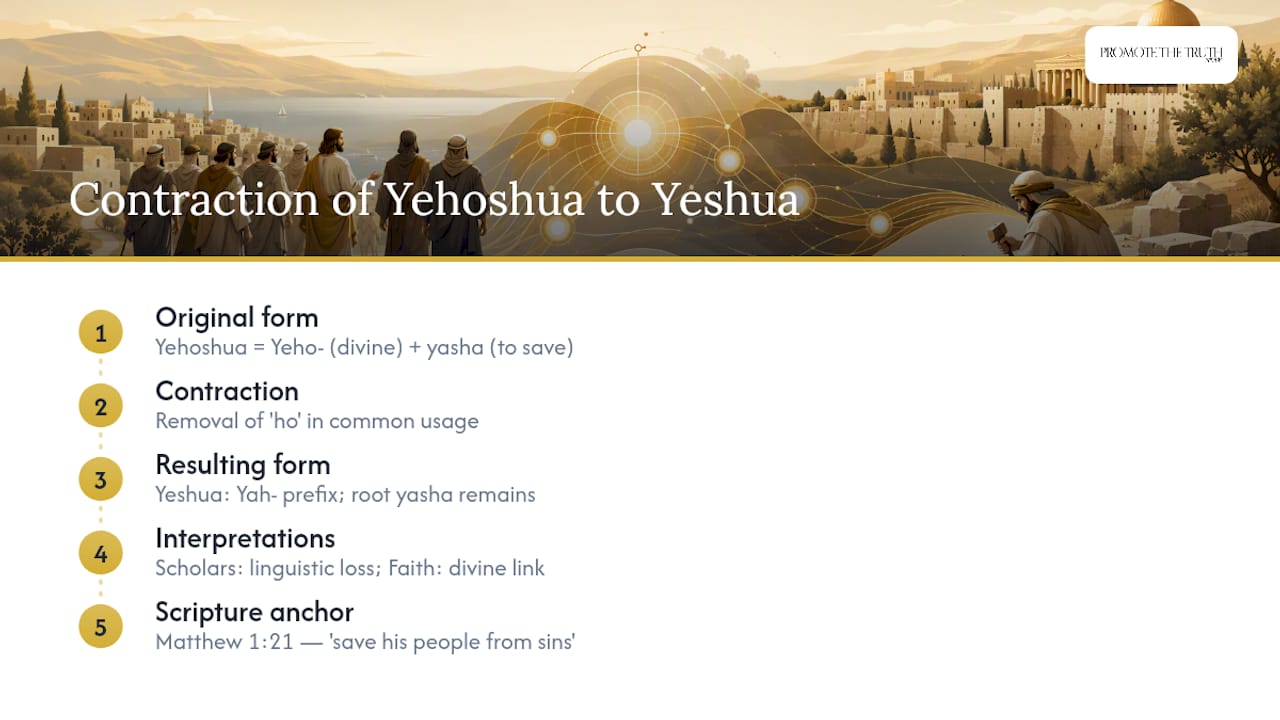
One passage forms the foundation of this theological understanding: Matatiyahu (Matthew) 1:21 (TST) directly connects the Mashiyha’s (Messiah’s) Name with His mission: "She shall give birth to a Son, and you shall call His Name Yahusha, which means YAHUAH is Salvation, because He shall save His people from their sins." For this reason, the Abariy (Hebrew) meaning of the Name remains significant, even for readers who have never studied Abariy (Hebrew) grammar or historical linguistics.
Choosing a Name for Study, Worship, or Publishing
The name you use should be guided by your purpose, audience, and the manuscript tradition you are discussing rather than by habit alone.
-
Historical and academic discussion: Use the historically attested forms Yahusha (Yehoshua) and Yishua (Yeshua) when referring to the manuscript evidence, since these are the forms recognized in mainstream philological research.
-
Truth Scriptures (TST) studies: Use Yahusha and Yishua, following the Truth Scriptures restoration and transliteration philosophy while clearly explaining their relationship to the historically attested forms.
-
Congregational worship: Use the form adopted by your assembly or community, while recognizing that sincere believers may use different names based on their linguistic, historical, or theological convictions.
-
Devotional publishing: when discussing Set-apart (Sacred) Name perspectives, present Yahshua as a proposed reconstruction, not an attested historical form
-
Comparative or devotional writing: When discussing Set-apart (Sacred) Name perspectives, present Yahshua as a theological reconstruction rather than a historically attested manuscript form, allowing readers to distinguish between devotional interpretation and manuscript evidence.
A helpful way to present the historical development is:
Yehoshua (historical full form) → Yeshua (historically attested contracted form; rendered as Yishua in the Truth Scriptures) → Iēsous (Yuuniy/Greek) → Iesus (Latin) → Jesus (English).
When referring specifically to the Truth Scriptures (TST), it is also helpful to distinguish between the historical forms and the translation’s restored renderings:
Yahusha (the Truth Scriptures’ restored form corresponding to the historical Yehoshua) and Yishua (the Truth Scriptures’ rendering corresponding to the historically attested Yeshua).
How Manuscript Research Shapes This Discussion
Promote The Truth approaches questions such as the original name of the Mashiyha (Messiah) by beginning with the earliest available Abariy (Hebrew) and Aramiyt (Aramaic) manuscripts rather than with later theological traditions or inherited English translations. This manuscript-first approach seeks to understand what the surviving textual evidence preserves before considering later linguistic developments or theological interpretations.
That same methodology is reflected in Promote The Truth’s ongoing study of the Yisha’aiyahu (Isaiah) Dead Sea Scrolls, where the earliest manuscript witnesses are examined before translation decisions are made. The same principle applies to the discussion surrounding the Mashiyha’s (Messiah’s) Name: first examine the Abariy (Hebrew) manuscript evidence, then consider how the name developed through Yuuniy (Greek), Latin, and English according to established principles of historical linguistics.
The surviving manuscript evidence points to Yehoshua as the historical full form and Yeshua as its historically attested contracted form. Within the Truth Scriptures (TST), these forms are represented as Yahusha and Yishua, reflecting the translation’s restoration philosophy while remaining grounded in the manuscript tradition. By contrast, forms such as Yahshua are understood primarily as later theological reconstructions rather than names attested in the presently known pre-modern manuscript record.
The goal of the Truth Scriptures is not to preserve tradition for its own sake but to preserve the original message of the Scriptures by following the earliest available manuscript evidence as faithfully as possible. Every translation decision begins with the text itself and proceeds from there
Readers who wish to examine the evidence firsthand are encouraged to compare the Yahusha, Yeshua, and Yehoshua manuscript study together with the Truth Scriptures’ manuscript methodology and the Yisha’yahu (Isaiah) Dead Sea Scrolls study. Examining the manuscript evidence directly allows readers to distinguish between historical attestation, translation philosophy, and theological interpretation, enabling them to evaluate the evidence before drawing their own conclusions.
The Short Answer, Restated
The surviving manuscript evidence consistently points to Yehoshua as the historical full form and Yeshua as its historically attested contracted form. Within the Truth Scriptures (TST), these names are represented as Yahusha and Yishua, reflecting the translation’s restoration philosophy while remaining grounded in the manuscript tradition. By contrast, Yahshua has not been identified in presently known pre-modern Abariy (Hebrew) manuscripts, inscriptions, rabbinic literature, or the Dead Sea Scrolls, and is therefore best understood as a later theological reconstruction rather than a historically attested manuscript form.
-
For historical and academic study: use Yehoshua and Yeshua when discussing the manuscript evidence, noting that Jesus is the standard English rendering.
-
For Truth Scriptures (TST) study: use Yahusha and Yishua, understanding how these restored forms correspond to the historically attested Yehoshua and Yeshua.
-
For worship and personal devotion: use the form adopted by your assembly or community, recognizing that sincere believers may differ in pronunciation while sharing the same desire to honor the Mashiyha (Messiah).
-
When discussing Sacred Name perspectives: present Yahshua respectfully as a theological reconstruction rather than a historically attested manuscript form, allowing readers to distinguish between manuscript evidence and theological interpretation.
Why Getting the Name Right Matters
At Promote The Truth, restoring Scriptural names begins with the earliest available Abariy (Hebrew) and Aramiyt (Aramaic) manuscripts. Our goal is not simply to preserve tradition or promote a preferred pronunciation but to help readers understand how the names found in the manuscripts developed through history and how the Truth Scriptures (TST) represents those names in English.
We believe that careful manuscript study and theological reflection should work together rather than compete with one another. By distinguishing between historical manuscript evidence, the Truth Scriptures’ restoration philosophy, and later theological reconstructions, readers are better equipped to evaluate the evidence for themselves and develop a deeper appreciation for the original message of the Scriptures.
Continue Studying with Promote The Truth’s Resources
Understanding the original name of the Mashiyha (Messiah) is only one part of a much broader journey into the Scriptures. At Promote The Truth, every study begins with the earliest available Abariy (Hebrew) and Aramiyt (Aramaic) manuscripts, allowing the manuscript evidence to guide the translation before later traditions or theological interpretations are considered.
If this study has helped you understand the relationship between Yehoshua, Yeshua, Yahusha, Yishua, and Yahshua, the next step is to explore how the same manuscript-first approach shapes the Truth Scriptures (TST) as a whole. From restored Scriptural names and manuscript comparisons to historical chronology and prophecy, every resource is designed to help readers examine the original text more carefully and understand how translation decisions influence interpretation.
Whether you are beginning your study or deepening years of research, the goal remains the same: start with the manuscripts, understand the language, evaluate the evidence, and let the Scriptures speak for themselves.
The Truth Scriptures Digital Collection allows you to study the Scriptures at your own pace using the Truth Scriptures (TST) translation, where restored names such as YAHUAH, Yahusha, and Yishua are presented consistently according to the translation’s manuscript-based restoration philosophy. Rather than relying solely on later English transliterations, the Truth Scriptures encourages readers to examine the original Abariy (Hebrew) and Aramiyt (Aramaic) forms alongside the manuscript evidence.
Prefer video study? The Scripture Study Series walks through passages such as Matatiyahu (Matthew) 1:21 within their historical, linguistic, and manuscript context. For more in-depth learning, the Digital Video Academy offers structured courses on Scriptural manuscript history, Abariy (Hebrew) and Aramiyt (Aramaic) studies, restored Scriptural names, and the translation philosophy behind the Truth Scriptures.
Begin with the Truth Scriptures Digital Collection, compare the manuscript evidence for yourself, and follow the development of the text verse by verse as you explore the original message preserved in the Scriptures.