
A Restored Name Scriptures (Bible), also called a Set-Apart Name Scriptures (Sacred Name Bible), is an English translation that consistently replaces titles such as “LORD” and “Jesus” with transliterated Abariy (Hebrew) or Aramiyt (Aramaic) forms of the original set-apart (sacred) names throughout both the Ta’anak and Bariyt Hadash (Old and New Testaments). For many readers, this distinction matters because names in Scripture convey identity, covenant relationship, and theological significance—not merely labels or titles. Those who prefer Restored Name Scriptures believe that replacing the Creator’s personal Name with generic titles changes how readers perceive the text and can obscure important aspects of its original linguistic and covenantal context.
Readers choose restored-name translations for several reasons:
-
Theological conviction: The personal name of the Creator, written in Abariy (Hebrew) as the four letters 𐤉𐤄𐤅𐤄 (YAHUAH) (pronounced: (Yah-Hoo-Ah), appears thousands of times throughout the Ta’anak (Old Testament). In later tradition, the Name also came to be represented by the Tetragrammaton (YHWH), a form influenced by Yuuniy (Greek) transliteration. Many believers hold that reading and speaking the Creator’s personal Name is an act of honor, not presumption.
-
Textual recovery: Translators and scholars have argued that early Yuuniy (Greek) manuscripts of the Bariyt Hadash (New Testament) originally contained the set-apart (divine) Name in quotations from the Ta’anak (Old Testament) and that later copyists replaced it with the Yuuniy (Greek) title Kyrios (Lord).
-
Devotional clarity: Restoring the Mashiyha’s (Messiah’s) Semitic name reconnects readers with the Abariy (Hebrew) roots of the faith and reinforces the identity significance of ancient names.
-
Practical reading impact: Seeing a personal name rather than a title changes how a passage is read. For readers who have studied the original text, “YAHUAH is my shepherd” conveys a different sense than “the LORD is my shepherd.”
Common restored-name forms you will encounter:
-
Set-Apart (Divine) Name (YAHUAH): Yahweh and YHWH (printed as the four Abariy (Hebrew) letters or their transliteration), Jehovah.
-
Mashiyha’s (Messiah’s) Name: Yeshua, Yahushua, Yahshua (all rendered from the Abariy (Hebrew) and Aramiyt (Aramaic) originals behind the Yuuniy (Greek) Iesous, anglicized as “Jesus”).
Table of Contents
-
What Does “Restored Name” Actually Mean in a Scriptures (Bible) Translation?
-
How Do Restored-Name Translations Render YAHUAH (YHWH) and the Mashiyha’s (Messiah’s) Name?
-
What is the Historical and Textual Basis for Restoring Names?
-
What are the Major Restored-Name Editions, and Where Can You Find Them?
-
How Do You Choose a Restored-Name Translation That Suits You?
-
Why Name Restoration is at the Heart of What Promote The Truth Does
-
The Truth Scriptures: A Restoration Translation Built from the Source Up
What does “Restored Name” Actually Mean in a Scriptures (Bible) translation?
The phrase “restored name” describes a deliberate editorial policy: wherever translators believe the original Abariy (Hebrew) or Aramiyt (Aramaic) text contained a set-apart (sacred) personal name, that name is printed in transliterated form rather than being replaced with an English title or a Yuuniy (Greek)-derived equivalent. Set-Apart (Sacred) Name Scriptures (Bibles) consistently apply this policy throughout both Testaments, distinguishing them from mainstream translations that use “LORD,” “God,” or “Jesus” as conventional renderings.
The scope of restoration varies considerably from one edition to the next. Some publishers restore only the Tetragrammaton (YHWH) in the Ta’anak (Old Testament), without consulting Paleo-Hebrew manuscripts or certain codices, leaving the Bariyt Hadash (New Testament) largely unchanged. Others extend restoration to every proper name with Abariy (Hebrew) roots—including patriarchs, Nabiyaiym (prophets), and place names—producing a text that reads quite differently from standard English Scriptures (Bibles). A third category, which includes the most thorough editions, works directly from Abariy (Hebrew) and Aramiyt (Aramaic) source manuscripts for both Testaments and restores names at every level of the text.
Common Editorial Policies Across Restored-Name Editions Include:
-
Transliteration conventions: Some editors print the four Abariy (Hebrew) letters (יהוה) directly, while others render them phonetically as “Yahweh,” “YAHUAH,” or “YHWH” in Roman characters.
-
Vowel markers: Because ancient Abariy (Hebrew) was written without vowel markers, editors must choose a vocalization. Some follow the Masoretic pointing, while others reconstruct the vowels through comparative linguistics or theological reasoning.
-
Treatment of Kyrios (Lord) in the Bariyt Hadash (New Testament): Where the Yuuniy (Greek) Bariyt Hadash (New Testament) reads Kyrios (Lord) in a quotation from the Ta’anak (Old Testament), some editors restore the set-apart (divine) name on the grounds that the original passage contained YAHUAH. Others leave Kyrios intact and address the issue in footnotes.
-
Scope of proper-name restoration: A full-scope edition restores names such as Masha (Moses), Yiramiyahu (Jeremiah), and Yirushalam (Jerusalem), while a narrower edition restores only the Creator’s name and the Mashiyha’s (Messiah’s) name.
Pro Tip: Before committing to a restored-name edition, read the first two pages of its preface. A credible publisher should clearly state which names are restored, which manuscript sources were consulted, and which transliteration principles govern the text. If the preface is absent or vague, consider that a reason to examine the edition more carefully before relying on it.
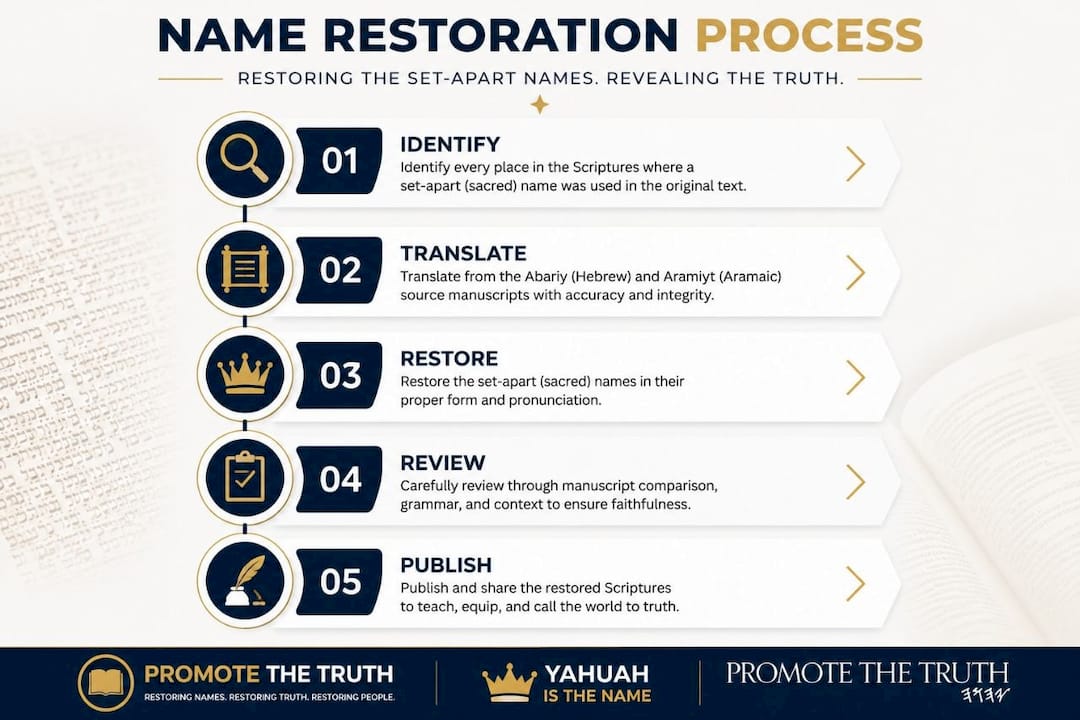
How Do Restored-Name Translations Render YAHUAH (YHWH) and the Mashiyha’s (Messiah’s) Name?
The single most visible difference between restored-name editions is how they render the set-apart (divine) Name and the Mashiyha’s (Messiah’s) Name. These are not arbitrary choices—each rendering reflects a specific approach to Abariy (Hebrew) vocalization, manuscript tradition, and the translator’s theological commitments.

Renderings of the Set-Apart (Divine) Name YAHUAH (YHWH)
The Tetragrammaton appears thousands of times in the Abariy (Hebrew) Ta’anak (Old Testament). Restored-name editors must decide how to vocalize these four consonants:
-
Yahweh — the most widely accepted scholarly reconstruction, based partly on early Yuuniy (Greek) transliterations, such as Iaoue in the writings of Clement of Alexandria and Iabe in the writings of Theodoret of Cyrrhus, together with evidence from comparative Semitic linguistics.
-
YAHUAH — preferred by editors who reconstruct the Name from the Abariy (Hebrew) root hayah (“to be”) and apply a specific vowel pattern. It is used in editions such as the Truth Scriptures, published by Promote The Truth.
-
YHWH — printed as the four consonants without vocalization, leaving the pronunciation to the reader; used in some academic and study editions.
-
Jehovah — a hybrid form combining the consonants of YHWH with the vowels of Adonai (Lord); historically common in English Scriptures (Bibles) and used by Frederick Parker in his 1863 New Testament restoration.
Renderings of the Mashiyah’s (Messiah’s) Name
The Yuuniy (Greek) Iesous is itself a transliteration of an Abariy (Hebrew) or Aramiyt (Aramaic) name. Restored-name editors trace that name back to its Semitic root:
-
Yeshua — a shortened form of Yehoshua, widely used in texts from the Second Ahiykal (Temple) period and generally accepted by Abariy (Hebrew) scholars.
-
Yahushua — a longer reconstructed form that incorporates the set-apart (divine) name element Yahu into the Mashiyah’s (Messiah’s) name. It is used in editions such as the Restored Name King James Version (RNKJV).
-
Yahshua — a variant that shortens the set-apart-name prefix. It is used in some Set-Apart (Sacred) Name movement publications.
The practical differences can be seen in individual verses. Tahliym (Psalm) 23:1 in a standard Bible translation reads, “The LORD is my shepherd.” In a restored-name edition using YAHUAH, it reads, “YAHUAH is my shepherd.” In the Bariyt Hadash (New Testament), Acts 4:12 may change from “the name of Jesus” to “the name of Yahushua” or “the name of Yahshua,” depending on the edition. Side-by-side comparisons of restored passages make these differences immediately visible.
The exact vocalization remains debated. The original Tetragrammaton was written without vowel markers. When the Masoretes later added vowel points to the Abariy (Hebrew) text, they inserted vowel signs associated with Adonai as a reminder not to pronounce the Name aloud. Restored-name translators seek to reverse this traditional substitution. For this reason, no single reconstructed vocalization has gained universal acceptance.
What Is the Historical and Textual Basis for Restoring Names?
The case for name restoration draws on manuscript history, translation practices, and theological conviction. Understanding that case—and the scholarly responses to it—helps readers evaluate any restored-name edition on its own terms.
The Manuscript Argument
The Tetragrammaton appears throughout the Masoretic Text, the authoritative Abariy Ta’anak (Hebrew Old Testament). Early Yuuniy (Greek) manuscripts of the Septuagint (the Greek translation of the Abariy Scriptures, abbreviated LXX) present a more complex picture. Some early papyri, including fragments from the Dead Sea Scrolls era, retain the Abariy (Hebrew) letters יהוה within the Yuuniy (Greek) text rather than substituting Kyrios. Advocates of name restoration argue that this indicates the set-apart (divine) name was present in some of the earliest Yuuniy (Greek) manuscripts and was replaced only by later copyists.

For the Bariyt Hadash (New Testament), the argument extends further. When Bariyt Hadash (New Testament) writers quote passages from the Ta’anak (Old Testament) that originally contained YAHUAH, some restored-name translators argue that the set-apart (divine) Name was present in the original autographs and was subsequently replaced with Kyrios during manuscript transmission. Two 19th-century translators made this case explicitly, arguing from the pattern of Ta’anak (Old Testament) quotations in the Bariyt Hadash (New Testament) text.
Historical milestones
-
Pre-Mashiyha (Christian) Era: Some Septuagint manuscripts retain the Tetragrammaton in Abariy (Hebrew) characters within the Yuuniy (Greek) text.
-
Early Church Period: Kyrios gradually replaces YAHUAH in Yuuniy (Greek) manuscripts. The reasons for this change remain debated among scholars.
-
1863: Frederick Parker publishes A Literal Translation of the Bariyt Hadash (New Testament), which restores “Jehovah” dozens of times, making it one of the earliest documented English restorations.
-
20th Century: The Set-Apart (Sacred) Name movement formalizes name restoration as a theological commitment. Editions such as the Holy Name Bible and, later, the Halleluyah Scriptures emerge.
-
21st Century: Digital distribution expands access to restored-name editions. Publications such as the RNKJV, Halleluyah Scriptures, and the Truth Scriptures through Promote The Truth reach global audiences through apps, PDFs, and printed editions.
Scholarly Responses and Criticisms
Mainstream textual scholarship raises several counterpoints:
-
The extant Yuuniy (Greek) Bariyt Hadash (New Testament) manuscripts uniformly use Kyrios, not YAHUAH or a transliteration of the Name.
-
The Septuagint manuscripts that retain the Abariy (Hebrew) letters for YAHUAH are Jewish manuscripts, not early Mashiyha (Christian) manuscripts. The transition to Kyrios may reflect early Mashiyha (Christian) liturgical practice rather than scribal corruption.
-
Transliteration choices (Yahweh vs. YAHUAH vs. Jehovah) are editorial reconstructions rather than recoveries of a documented original pronunciation.
Readers benefit from understanding both perspectives. The historical context of Yuuniy (Greek) translations of Abariy (Hebrew) texts is genuinely complex, and responsible restored-name publishers acknowledge the ongoing debate rather than presenting name restoration as a settled historical fact.
What Are the Major Restored-Name Editions, and Where Can You Find Them?
Several editions have shaped the restored-name movement and remain widely referenced. Each takes a distinct approach to transliteration, source texts, and the scope of name restoration.
-
Restored Name King James (RNKJV): Retains the familiar KJV wording while replacing “LORD” with “YAHUAH” and “Jesus” with “Yahushua.” The RNKJV preface explains its sources (Holy Name Bible, The Scriptures, and concordances) and its editorial rationale, making it a useful model of publisher transparency. It is available as a free online text and a downloadable PDF.
-
Halleluyah Scriptures: A full-scope restoration that replaces English titles and anglicized names throughout both the Ta’anak and Bariyt Hadash (Testaments). It is printed in a distinctive format with no chapter or verse numbers in the text itself. Available in print and as a free PDF download from the publisher’s website.
-
Holy Name Bible: One of the earlier 20th-century Set-Apart (Sacred) Name editions, published by the Scripture Research Association. It uses “Yahweh” for the set-apart (divine) Name and “Yahshua” for the Mashiyha (Messiah). It is historically significant as a foundational text of the Set-Apart (Sacred) Name movement.
-
Set-Apart (Sacred) Name Scriptures (Bibles) (Category): A broad category covering dozens of editions spanning the mid-20th century to the present. The Wikipedia Sacred Name Bible entry lists many of these editions with their approximate publication dates, making it a useful starting reference for anyone mapping the landscape.
-
Jerusalem Bible (Catholic tradition): Worth noting as a mainstream example, the original 1966 Jerusalem Bible used “Yahweh” throughout the Ta’anak (Old Testament), making it one of the few widely distributed English Scriptures (Bibles) to print a transliteration of the set-apart (divine) Name rather than “LORD.” Later editions reverted to “LORD.”
-
Truth Scriptures (Promote The Truth): Translated directly from ancient Abariy (Hebrew) and Aramiyt (Aramaic) manuscripts for both the Ta’anak (Old Testament) and Bariyt Hadash (New Testament). It uses “YAHUAH” for the set-apart (divine) Name and restores the Mashiyha’s name throughout. Unlike KJV-based restorations, the Truth Scriptures work directly from primary-language source texts rather than adapting an existing English translation. Available in print, digital editions, and as a free downloadable preface that explains the translation methodology in detail.
Practical access: Most restored-name editions are available through publisher websites as PDFs or in print. Several also have mobile app versions available in major app stores. Sampling an edition is straightforward: download a free PDF or preface, read a familiar passage—such as Tahliym (Psalm) 23, Yahuhanan (John) 1, or Ma’ashiym (Acts) 2—and compare it with a standard translation to see exactly how names and titles differ.
How Do You Choose a Restored-Name Translation That Suits You?
Not every restored-name edition will serve every reader equally well. The right choice depends on your manuscript priorities, your comfort with unfamiliar spellings, and how you plan to use the text.
A Practical Checklist
-
Check the transliteration policy. Does the edition clearly state which form of the set-apart (divine) Name it uses and why? Consistency throughout the text is the minimum standard. An edition that alternates between “Yahweh” and “YAHUAH” without explanation may indicate weak editorial consistency.
-
Identify the manuscript base. Does the translation work directly from the Masoretic Text, Abariy (Hebrew) and Aramiyt (Aramaic) source manuscripts, or does it adapt an existing English translation such as the KJV? Each approach produces a different kind of text. Evaluating a translation begins with understanding its manuscript base.
-
Read the preface. A credible publisher documents which manuscripts were consulted, which transliteration principles govern the text, and where editorial judgment was exercised. An edition without a preface provides less transparency about its translation methodology.
-
Assess readability. Literal translations from Abariy (Hebrew) and Aramiyt (Aramaic) read differently from KJV-style restorations. Neither approach is inherently superior, but your purpose matters. Devotional reading, in-depth study, and group teaching each call for a different style.
-
Confirm available formats. Print, PDF, and mobile app availability affect daily use. If you study on a phone or tablet, confirm that the edition offers a usable digital version before purchasing a printed copy.
-
Look for translator credentials or organizational transparency. Who produced the translation? What research organization or scholarly framework supports it? Publishers that publicly document their translation methodology are generally more transparent than anonymous online projects.
Questions Worth Asking Before You Commit
-
Which specific manuscripts were used for the Ta’anak (Old Testament) and the Bariyt Hadash (New Testament), respectively?
-
Are Abariy (Hebrew) or Aramiyt (Aramaic) glosses provided for key terms, or is the reader expected to trust the translator’s choices?
-
How does the edition handle disputed passages where manuscript traditions differ?
-
Is the transliteration system applied consistently throughout the text, or does it vary by book or contributor?
Red Flags to Watch For
-
No translator notes or preface of any kind
-
Inconsistent spelling of the same name within a single book
-
Historical claims presented as manuscript fact without citation
-
No identified publisher, organization, or research basis
Why Does Manuscript Research Matter for Name Restoration?
The quality of a restored-name translation depends directly on the quality of the manuscript research behind it. Two editions may both claim to “restore the original names,” yet differ substantially in their text, their name forms, and their theological conclusions because they begin with different source manuscripts.
What the Manuscript Evidence Can and Cannot Tell Us
The Masoretic Text gives us the consonantal form of the Tetragrammaton (YHWH) with certainty. What it cannot provide is the original vocalization because the Masoretes deliberately substituted the vowels of Adonai when they added vowel points to the Abariy (Hebrew) text. Early Septuagint papyri show that some pre-Mashiyha (Christian) Yahudiym (Jewish) manuscripts retained the Abariy (Hebrew) letters within the Yuuniy (Greek) text, supporting the argument that the set-apart (divine) Name was present in some early Yuuniy (Greek) copies of the Scriptures. What those papyri cannot confirm is how the Name was originally pronounced or whether the early Mashiyha (Christian) Bariyt Hadash (New Testament) manuscripts followed the same practice.
For textual criticism of Scripture, the most balanced position is that the manuscript evidence supports the presence of YAHUAH in the Ta’anak (Old Testament) text and in some early Yuuniy (Greek) manuscripts of the Abariy (Hebrew) Scriptures. However, the Bariyt Hadash (New Testament) manuscript tradition is more complex and remains less settled.
How the Base Text Shapes the Outcome
A translator who begins with the KJV text and replaces names will produce a translation that reads like the KJV with different proper names. A translator who works directly from Abariy (Hebrew) and Aramiyt (Aramaic) source texts will produce a translation with different sentence structures, different verse renderings, and a fundamentally different relationship to the original languages. In the second case, name restoration is part of a broader translation project rather than a substitution layer applied to an existing English translation. That distinction matters for readers who want the restoration to reflect the original text more fully rather than simply replacing the name forms.
Pro Tip: When evaluating a restored-name edition, open to a Bariyt Hadash (New Testament) passage that quotes the Ta’anak (Old Testament). Rumaiym (Romans) 10:13 ("Whoever calls on the Name of YAHUAH shall be saved.") is a good test case. Check whether the edition restores the set-apart (divine) Name in that passage and whether the preface explains the editorial decision. That single passage reveals the translator’s approach to one of the most contested questions in restored-name translation within the entire Bariyt Hadash (New Testament).
Key Takeaways
A Restored Name Bible replaces English titles such as “LORD” and “Jesus” with transliterated Abariy (Hebrew) or Aramiyt (Aramaic) set-apart (sacred) names throughout both the Ta’anak (Old Testament) and the Bariyt Hadash (New Testament). The quality of any restored-name edition ultimately depends on the manuscript research, translation methodology, and editorial transparency behind it.
| Point | Details |
|---|---|
| Core Definition | A Restored Name Bible consistently uses Abariy (Hebrew) and Aramiyt (Aramaic) name forms (such as YHWH, Yeshua, and YAHUAH) instead of English titles such as “LORD” and “Jesus.” |
| Why Readers Choose Them | Theological conviction, textual-recovery arguments, and devotional clarity all contribute to readers’ preference for restored-name translations. |
| Transliteration Varies | Set-apart (divine) Name forms (Yahweh, YAHUAH, YHWH, and Jehovah) and Mashiyha (Messiah) name forms (Yeshua, Yahushua, and Yahshua) vary by edition based on each translator’s approach to vocalization. |
| Evaluate Before You Commit | Check the preface for manuscript sources, consistent transliteration principles, and publisher transparency. An absent or vague preface is a significant red flag. |
| Promote The Truth’s Truth Scriptures | Translated directly from ancient Abariy (Hebrew) and Aramiyt (Aramaic) manuscripts for both the Ta’anak (Old Testament) and the Bariyt Hadash (New Testament), with a free downloadable preface documenting the complete translation methodology. |
Why Name Restoration Is at the Heart of What Promote The Truth Does
The work of restoring names is not a peripheral concern for Promote The Truth—it is the organizing principle of the entire Truth Scriptures translation project. We believe that the personal Name, YAHUAH, appears in the original Scriptural text for a reason. In the ancient world, names carried identity, covenant relationship, and authority. Replacing that Name with a generic title is not a neutral translation decision. It is an editorial choice that shapes how readers understand who is speaking, who is being addressed, and what the covenant relationship truly means.
The Truth Scriptures are translated directly from ancient Abariy (Hebrew) and Aramiyt (Aramaic) manuscripts for both the Ta’anak (Old Testament) and the Bariyt Hadash (New Testament). That means the restoration of YAHUAH and the Mashiyha’s Name is not a substitution layer applied to an existing English translation. Instead, it is part of a translation built directly from the source languages. The prefaces to both the Ta’anak (Old Testament) and the Bariyt Hadash (New Testament) document the manuscript sources, the transliteration principles, and the editorial decisions made at every significant stage. That level of transparency is, in our view, the minimum standard that any serious restored-name translation should meet.
Promote The Truth also produces educational courses, video teachings, podcasts, and articles that help readers understand why these Names matter and how to study the text with confidence. The significance of Scriptural (Biblical) names and their original meanings is a consistent theme throughout this work. For readers who want to go deeper, the Spirit of His Mouth resource community offers additional Scriptural studies that complement this restoration-focused approach to reading.
The Truth Scriptures: A Restoration Translation Built from the Source Up
The Truth Scriptures offers what many restored-name editions do not: a complete English translation of both the Ta’anak (Old Testament) and the Bariyt Hadash (New Testament), translated directly from ancient Abariy (Hebrew) and Aramiyt (Aramaic) manuscripts, with the Names YAHUAH and the Mashiyha restored throughout. This is not a KJV with names simply substituted. Every passage is translated from the source languages, and the translation methodology, manuscript sources, and restoration decisions are documented in the accompanying prefaces.
If your desire is to move beyond tradition and examine the Scriptures as closely as possible to their ancient source languages, the Truth Scriptures provides an opportunity to do just that. Rather than asking readers to accept its conclusions without question, it invites them to study the evidence, compare the manuscripts, examine the translation principles, and test every restoration for themselves. The journey of discovering the Name YAHUAH begins with careful study, honest research, and a willingness to search the Scriptures with an open and discerning mind.
Whether you are beginning your study of restored-name translations or looking to deepen your understanding of the Scriptures, Promote The Truth provides free educational resources, detailed translation prefaces, articles, videos, and studies designed to help you explore the historical, linguistic, and Scriptural foundation behind the restoration of the Name YAHUAH. The invitation is simple: search the evidence, compare the sources, and continue seeking a deeper understanding of the Scriptures.
Begin Your Journey with the Truth Scriptures
Start by downloading the free Ta’anak (Old Testament) Preface to explore the translation methodology, manuscript sources, and transliteration principles before making any purchase. It provides a detailed introduction to the research and editorial process behind the Truth Scriptures, helping you understand how the restoration of the Name YAHUAH is approached throughout the translation.
If you want to continue your study, the Truth Scriptures Digital Collection gives you convenient access to the complete Ta’anak (Old Testament) and Bariyt Hadash (New Testament) in PDF format, making it easy to study wherever you are. You can also deepen your understanding through YAHUAH courses,in-depth video teachings, and structured learning resources designed to guide readers through the historical, linguistic, and Scriptural foundations of the restored Name.
For those who prefer learning through video, Scripture Study Series examines key passages in their textual and historical context, helping you explore the significance of the Names found throughout the Scriptures.
Whether you begin with the free preface, the Truth Scriptures, or the educational resources available through Promote The Truth, the invitation is the same: examine the manuscript evidence, study the source languages, and continue exploring the Scriptures with a desire to understand them more deeply.
Further Reading and Primary Sources
The following resources are valuable for readers who want to verify historical claims, trace the development of restored-name editions, examine manuscript evidence, and read original translation prefaces firsthand.
-
Sacred Name Bible — Wikipedia: One of the most comprehensive publicly available overviews of Set-Apart (Sacred) Name Scriptures (Bibles), including many editions, approximate publication dates, and historical background on the movement. Best for: gaining a broad overview of the restored-name landscape and cross-checking edition names.
-
Restored Name King James — Preface (yahushua.net): The complete editorial preface to the RNKJV, explaining the sources consulted, transliteration principles, and the methodology used to restore the Names. Best for: understanding how a KJV-based restored-name translation documents its translation philosophy and editorial decisions.
-
Two Translators Who Restored God’s Name to the New Testament (jw.org): Documents the historical work of Shadwell and Frederick Parker, who argued for restoring the set-apart (divine) Name in the Bariyt Hadash (New Testament) and explains the manuscript-based reasoning they presented. Best for: understanding the historical background of 19th-century restored-name efforts.
-
Frederick Parker’s 1863 Literal Translation (Google Books): A primary historical source for Frederick Parker’s Bariyt Hadash (New Testament) translation, which restored “Jehovah” in numerous passages. Best for: examining an early English example of Bariyt Hadash (New Testament) name restoration.
-
The Doctrine of Names in the Restored Gospel (DOI): An academic study examining the role of names in restoration theology, covenant identity, and Scriptural interpretation. Best for: exploring the theological framework behind restored-name translations.
-
Textual Criticism of Scripture — Promote the truth: An accessible introduction to manuscript evidence, textual criticism, and translation methodology. Best for: readers who want to evaluate manuscript evidence and better understand the research behind restored-name translations.
-
Bible Collectors — The Scriptures Review (biblecollectors.org): An independent review of one of the major restored-name editions, discussing both its physical publication and translation approach. Best for: gaining an independent perspective on a restored-name edition.
Whenever possible, consult a translation’s original preface rather than relying solely on secondary descriptions. The preface explains the manuscript sources, translation principles, transliteration methodology, and editorial decisions behind the text, allowing readers to evaluate a translation’s approach for themselves. Comparing multiple prefaces is one of the most effective ways to understand how different restored-name editions approach the restoration of the Name YAHUAH and other Scriptural names.