
Ancient scriptural names are defined as prophetic declarations of character, destiny, and Set-apart (divine) purpose, not simple labels assigned at birth. Understanding how ancient scriptural names connect identity requires looking at the Abariy (Hebrew) word sham, which links directly to reputation, essence, and existence. In scriptural (biblical) culture, your name was your identity. It told others who you were, what you were called to do, and where you stood in relationship with YAHUAH. This article examines the scriptural evidence, the cultural framework, and the practical meaning of ancient names for your faith and personal identity today.
How do ancient scriptural names connect identity and destiny?
Scriptural (Biblical) naming was never casual. Ancient Abariy (Hebrew) naming was an active, prophetic spiritual act that embedded a child’s destiny into the very syllables of their given name. Parents were not simply choosing something that sounded pleasant. They were making a declaration about who this person would become.
Consider a few well-known examples:
-
Shamual (Samuel) means “heard by Aluah (God),” reflecting his mother Hanah’s (Hannah’s) answered prayer and foreshadowing his role as a Nabiya (prophet) who heard directly from YAHUAH.
-
Naha (Noah) means “rest” or “comfort,” pointing to his role as the one through whom humanity would find relief from judgment.
-
Abagiyl (Abigail) means “my father’s joy,” a name that carried both relational warmth and social standing.
-
Yusaf (Joseph) means “may He add,” a name that pointed forward to abundance and provision even before his life story unfolded.
Each name functioned as a miniature prophecy. Scholars describe this as a “spark of prophecy” present in the naming moment, where parents spoke a child’s future into being through the name they chose. This is not poetic exaggeration. The scriptural (biblical) record consistently shows names aligning with the person’s life calling, character, and relationship with YAHUAH.
Pro Tip: When you study a scriptural (biblical)figure, look up the meaning of their name first. That single step often unlocks the entire arc of their story and reveals what YAHUAH was declaring over their life.
The name of Yahusha (commonly rendered Jesus in English) was Set-apart (divinely) revealed before His birth, establishing His identity and mission from above rather than from parental preference. That pattern, where YAHUAH names before the person even exists, is one of the most powerful demonstrations of how identity in Scripture flows from the Creator downward.
Why do names carry cultural memory across generations?
Names in the ancient world were oral archives. scriptural (biblical) names act as miniature stories that connect personal history to collective memory, preserving family values, covenantal faithfulness, and communal identity across generations. This is a function that modern Western naming practices have largely abandoned.
Today, many parents in Western cultures choose names primarily for uniqueness or aesthetic appeal. In the ancient Abariy (Hebrew) world, the opposite was true. Premodern name systems relied on duplication over uniqueness to facilitate social identification and community memory. Repeating a name honored an ancestor, reinforced shared values, and signaled belonging within a lineage. That repetition was a form of communal identity preservation.
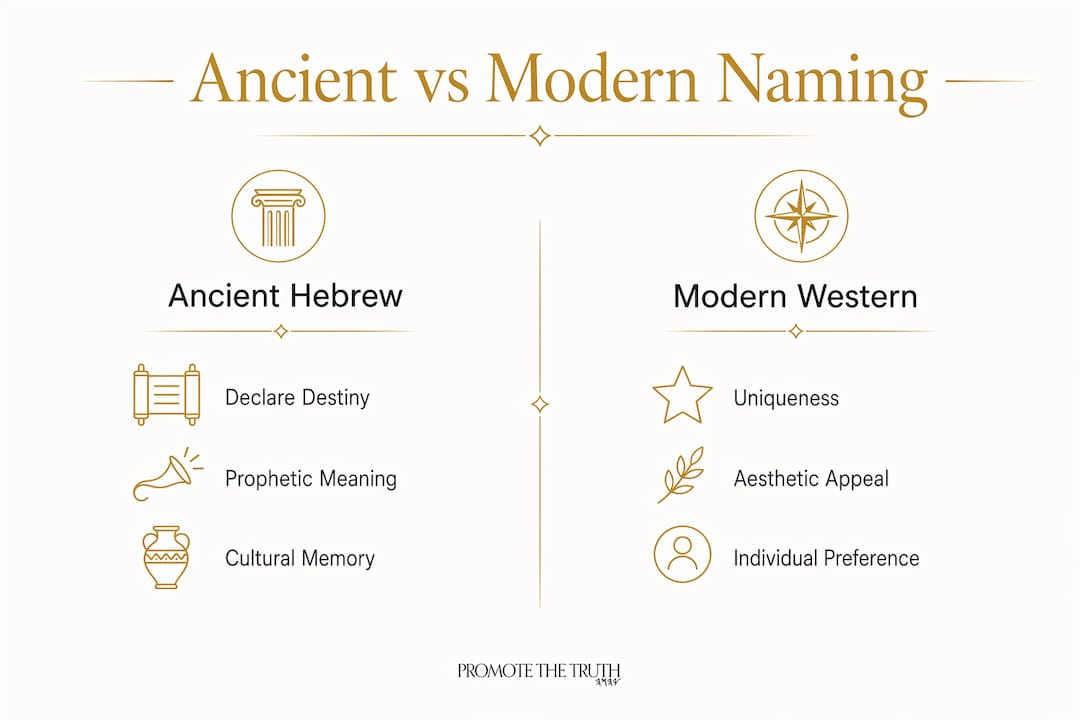
Here is how ancient and modern naming practices compare:
| Feature | Ancient Abariy (Hebrew) Naming | Modern Western Naming |
|---|---|---|
| Primary purpose | Declare destiny and preserve lineage | Express individuality or aesthetic preference |
| Repetition of names | Valued as honor and communal memory | Often avoided to emphasize uniqueness |
| Meaning emphasis | Central to the naming decision | Secondary or ignored entirely |
| Relationship to community | Name tied individual to family and covenant | Name primarily tied to personal identity |
| Spiritual dimension | Name as Set-apart (divine) declaration or calling | Rarely considered in naming decisions |
This contrast matters for anyone studying scriptural (biblical) identity today. When you read a genealogy in the Ta’anak (Old Testament) and see names repeated across generations, you are reading a community’s declaration of who they are and what they value. The name was the thread that held the social fabric together. Losing that thread, as we will see, had serious spiritual consequences.
Names encapsulate collective memory and lineage values, cementing community identity across generations in oral cultures. That is not a minor cultural footnote. It is the reason the scriptural (biblical) text records names so carefully and why genealogies carry theological weight, not just historical data.

What does Set-apart (divine) renaming reveal about spiritual identity?
The most theologically significant naming events in Scripture are not births. They are renamings. Name changes in Scripture such as Abaram (Abram) to Abarahm (Abraham), Ya’aqab (Jacob) to Yisharal (Israel), and Shama’aun (Simon) to Kapa (Peter) signify Set-apart (divine) authority and vocational transition. Each renaming marks a moment where YAHUAH declares a new identity, a new calling, and a new covenant relationship.
| Original Name | New Name | Meaning of Change |
|---|---|---|
| Abaram (Abram) (“exalted father”) | Abarahm (Abraham) (“father of many nations”) | Covenant expansion and generational promise |
| Shariy (Sarai) (“my princess”) | Sharah (Sarah) (“princess of nations”) | Elevated calling and covenantal inclusion |
| Ya’aqab (Jacob) (“supplanter”) | Yisharal (Israel) (“one who wrestles with God”) | Spiritual transformation and national identity |
| Shama’aun (Simon) (“he has heard”) | Kapa (Peter) (“rock”) | Vocational declaration and foundational purpose |
The scriptural (biblical) perspective is clear: identity is not self-made but received from the Creator. Renaming is the most direct expression of that truth. When YAHUAH renames someone, He is not updating a label. He is declaring a new reality, a new vocation, and a new standing in the covenant community.
The inverse is equally instructive. Loss or erasure of a name correlates with spiritual exile or bondage, emphasizing the link between name and covenant identity. In ancient Near Eastern cultures, to have your name blotted out was to cease to exist in the community’s memory. It was the ultimate form of spiritual and social death. The scriptural (biblical) record uses this imagery deliberately when describing the consequences of covenant unfaithfulness.
Pro Tip: Study the Abariy (Hebrew) and Aramiyt (Aramaic) origins of Bariyt Hadash (New Testament) names. Many carry layered meanings that are invisible in Yuuniy (Greek) or English translations, and recovering those meanings changes how you understand the person’s role in Scripture.
Set-apart (Divine) renaming reflects vocational calling and covenantal identity, not personal or cultural preference. That is a foundational principle for anyone seeking to understand their own identity through the lens of Scripture.
How can studying scriptural names deepen your identity today?
The scriptural significance of names is not confined to the ancient world. Understanding the cultural meaning of names in the scriptural (biblical) text has direct implications for how you understand yourself, your calling, and your place within the community of faith.
Here are practical ways to engage with this study:
-
Research your own name’s origins. Many names used in faith communities trace back to Abariy (Hebrew) or Aramiyt (Aramaic) roots. Understanding those roots often reveals a meaning that speaks directly to your character or calling.
-
Study the names of YAHUAH. The names and titles used for the Creator throughout the Ta’anak reveal His character and His relationship with His people. Knowing those names deepens prayer, worship, and trust.
-
Use scriptural (biblical) name study in community settings. Small groups, family set-apartness (devotion), and educational courses can use name meanings as entry points into deeper conversations about identity, vocation, and covenant.
-
Read genealogies as identity documents. Rather than skipping the “begats,” treat each name as a data point about the community’s values, history, and relationship with YAHUAH.
-
Connect name meanings to personal calling. scriptural (biblical) naming as relational means that knowing a name is entering into another person’s life mystery and vocation. Apply that same lens to your own name and the names of those you are in covenant relationship with.
Modern individuals without clear Set-apart (divine) naming often experience a sense of exile from purpose. Restoring a connection to the Aluah (God) given meaning behind names correlates with spiritual restoration and a renewed sense of direction. That is not a therapeutic observation. It is a scriptural (biblical) pattern, visible from Barashiyt (Genesis) through the Bariyt Hadash (New Testament).
The Ta’anak’s historical context provides the cultural soil in which these names grew. Studying that context transforms name study from an interesting curiosity into a serious tool for understanding who YAHUAH says you are.
Key takeaways
Ancient scriptural names function as prophetic blueprints of identity, vocation, and covenant relationship, making their study foundational for any serious scriptural (biblical) faith.
| Point | Details |
|---|---|
| Names reveal destiny | Abariy (Hebrew) naming embedded character and calling into a child’s identity from birth. |
| Sham means more than a label | The Abariy (Hebrew) word sham connects name to reputation, essence, and existence. |
| Set-apart (Divine) renaming signals transformation | YAHUAH’s renamings of Abaram (Abram), Ya’aqab (Jacob), and Shama’aun (Simon) declared new vocations and covenantal standing. |
| Names preserve communal memory | Ancient name systems used repetition to honor lineage and cement community identity across generations. |
| Name loss signals exile | Erasure of a name in Scripture represents spiritual bondage and covenantal rupture, not just social loss. |
Why we believe name study is the most overlooked door into scripture
Most believers we have encountered approach the Scripture (Bible) as a collection of stories, laws, and prophecies. Very few approach it as a document saturated with identity declarations. That gap is significant. When you read the name Yiramiyahu (Jeremiah) and discover it means “YAHUAH will exalt,” the entire book of Yiramiyahu (Jeremiah) shifts. You are no longer reading about a reluctant nabiya (prophet). You are reading about a man whose very name declared YAHUAH’s faithfulness over a life that looked, from the outside, like failure.
That reframe is available to every reader. It does not require advanced Abariy (Hebrew) scholarship. It requires the willingness to slow down and ask what a name means before moving on to the narrative.
What I find most compelling is the consistency of the pattern. Across the Ta’anak and the Bariyt Hadash, names function as covenantal anchors. They hold the story together. When YAHUAH changes a name, something real has shifted in the spiritual order. When a name is threatened or erased, something real is at stake. The text is not being dramatic. It is being precise.
Our encouragement to you is this: treat every name in Scripture as a word worth pausing on. The study of Set-apart (divine) names and their meanings is one of the most direct paths into understanding what YAHUAH was doing in any given moment of scriptural (biblical) history. Do not rush past the names to get to the action. The names are the action.
— Maria
Deepen your study with Promote The Truth resources
Promote The Truth has spent years researching, restoring, and teaching the original message of the Scriptures, including the profound significance of ancient names and the Name of YAHUAH Himself.

If you want to go deeper into the meaning of scriptural names and their connection to identity, the Scripture Study Series offers video teachings drawn directly from ancient Abariy (Hebrew) and Aramiyt (Aramaic) manuscript sources. For those who want access to the text itself, the original scriptures collection provides a meticulously translated restoration of the Ta’anak and Bariyt Hadash. You can also access downloadable scripture resources for personal or group study. These are true treasures for anyone serious about understanding the eternal message of YAHUAH’s Word.
FAQ
What does the Abariy (hebrew) word sham mean?
Sham is the Abariy (Hebrew) word for name, and it links directly to reputation, essence, and existence. It communicates that a person’s name is inseparable from their identity and character in the scriptural (biblical) worldview.
Why did YAHUAH change names in the Scripture (bible)?
Name changes like Abaram (Abram) to Abarahm (Abraham) and Ya’aqab (Jacob) to Yisharal (Israel) signify Set-apart (divine) authority, vocational transition, and covenantal transformation. YAHUAH renamed people to declare a new identity and calling, not to update a personal preference.
How did ancient cultures use names to preserve community identity?
Premodern name systems relied on duplication rather than uniqueness to facilitate social identification and community memory. Repeating ancestral names honored lineage and kept collective values alive across generations.
What happens when a name is lost or erased in scripture?
Loss or erasure of a name in the scriptural (biblical) record signals spiritual exile, covenantal rupture, and social death. It represents the severance of a person or community from their identity and belonging before YAHUAH.
How can I apply scriptural (biblical) name study to my own faith?
Start by researching the Abariy (Hebrew) or Aramiyt (Aramaic) meaning of names you encounter in Scripture, including your own name if it has scriptural (biblical) roots. Treat each name as a declaration of character and calling, and use that lens to understand both the scriptural (biblical) narrative and your own identity before YAHUAH.