
For truth seekers, the question is not simply what a translation says, but what the earliest available manuscript evidence actually supports. If the Bariyt Hadash (New Testament) has been transmitted through multiple languages and textual traditions, then every claimed restoration should be tested carefully against the surviving evidence.
The Truth Scriptures (TST) presents the Bariyt Hadash through a restoration approach that draws on ancient Abariy (Hebrew) and Aramiyt (Aramaic) sources, together with the wider manuscript record. But how can a reader evaluate whether a restored name, phrase, or reading is genuinely supported?
This study provides five practical checks for examining original-language restorations: the manuscript source, linguistic consistency, historical usage, comparison with Yuuniy (Greek) witnesses, and the translation methodology behind the restored reading. Along the way, we will examine the evidence behind the Truth Scriptures, explain how the restoration process works, and show where readers can study the completed text for themselves.
The goal is simple: do not accept a restoration merely because it sounds ancient—test it against the manuscript evidence.
Key Takeaways
-
The restored Bariyt Hadash (New Testament) is presented through a manuscript-focused restoration approach that draws on Abariy (Hebrew) and Aramiyt (Aramaic) linguistic and textual evidence, while also comparing the surviving Yuuniy (Greek) manuscript tradition. Supporting sources such as the Dead Sea Scrolls, the Turah Shamaruniyt (Samaritan Pentateuch), and the Leningrad Codex can help illuminate ancient Scriptural language, names, quotations, and terminology.
-
Scriptural restoration requires careful manuscript comparison, linguistic reconstruction, historical analysis, and a documented translation methodology, with significant restoration decisions supported by identifiable manuscript or linguistic evidence whenever possible.
-
A trustworthy restoration translation should identify its manuscript sources, explain important translation decisions, provide translator notes, and include research tools—such as restored Scriptural Names, reference indexes, and manuscript comparisons—to help readers examine the evidence for themselves.
-
Some publications described as “restored” provide limited transparency regarding their manuscript sources, translation methodology, or restoration decisions, making independent verification difficult. Truth seekers should therefore ask what evidence supports each restored name, phrase, or reading.
-
The Truth Scriptures (TST) presents a manuscript-focused restoration using restored Abariy (Hebrew) and Aramiyt (Aramaic) terminology, supported by translator notes, documented research, and study resources designed to help readers examine the Scriptural evidence for themselves.
Table of Contents
What Does It Mean to Say the Bariyt Hadash Was Restored?
Restoration means something very specific. It is not a paraphrase, a modern interpretation, or simply another translation of the familiar Yuuniy (Greek) New Testament. Rather, it is an effort to restore the Bariyt Hadash (New Testament) by returning to the earliest available Abariy (Hebrew) and Aramiyt (Aramaic) manuscript traditions that many researchers believe underlie the surviving Yuuniy (Greek) text.
This research recognizes that the earliest Scriptural writings preserved Abariy (Hebrew) and Aramiyt (Aramaic) names, idioms, expressions, and theological terminology that were often translated, adapted, or replaced as the text passed into Yuuniy (Greek). The Abariy (Hebrew)/Aramiyt (Aramaic) Origins Research explains why this linguistic transition occurred and examines how it influenced the transmission of the Scriptural text.
How Restoration Translations Are Produced
Producing a restoration translation involves far more than translating words from one language into another. It requires a careful examination of the earliest available Abariy (Hebrew) and Aramiyt (Aramaic) manuscript evidence, comparison of textual witnesses, and documentation of significant translation decisions. The goal is not to preserve tradition for its own sake, but to restore the Scriptural text as faithfully as the surviving manuscript evidence allows.
The process generally includes the following steps:
-
Manuscript Comparison. Available Abariy (Hebrew) and Aramiyt (Aramaic) manuscript witnesses are carefully compared, noting where the texts agree and where they differ.
-
Semitic Language Analysis. Names, idioms, grammar, and sentence structure are evaluated according to established Abariy (Hebrew) and Aramiyt (Aramaic) usage rather than relying solely on later Yuuniy (Greek) manuscript traditions.
-
Textual Reconstruction. Where appropriate, translators examine whether the surviving evidence supports an earlier Abariy (Hebrew) or Aramiyt (Aramaic) reading that may better explain the existing manuscript tradition.
-
Documenting Translation Decisions. Significant textual variants, restored names, and translation choices are documented through translator notes, manuscript references, and supporting resources so readers can examine the evidence for themselves.
-
Independent Review. Each section undergoes multiple rounds of review to improve consistency, accuracy, and alignment with the available manuscript evidence before publication.
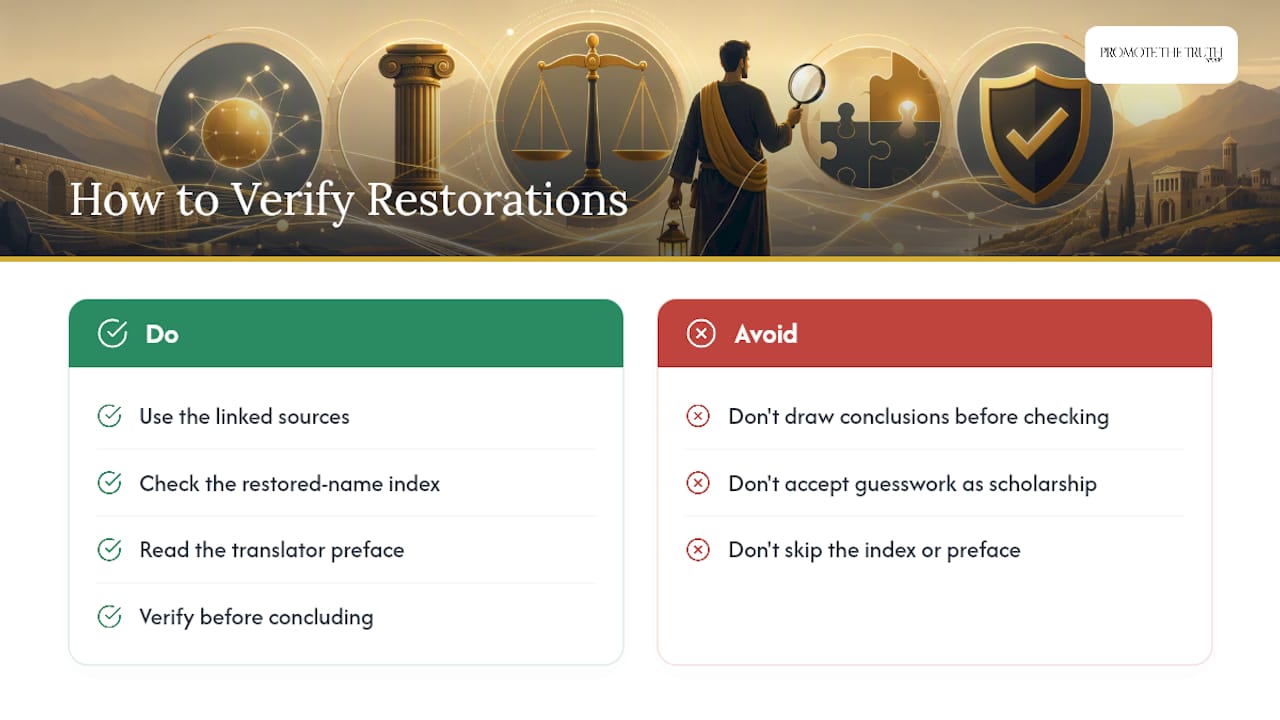
Study Tip: When evaluating any restoration translation, begin by reading the translator’s preface. A trustworthy translation clearly identifies its manuscript sources, explains its translation philosophy, and documents how difficult textual decisions were reached rather than simply claiming accuracy.
No restoration translation removes every uncertainty. Some passages are supported by extensive manuscript evidence, while others rely on fewer surviving witnesses. Where direct Abariy (Hebrew) or Aramiyt (Aramaic) manuscript evidence is limited, textual reconstruction requires careful scholarly judgment informed by the available evidence. A manuscript-based translation should acknowledge those limitations openly and allow readers to examine the evidence rather than presenting every conclusion as beyond question.
How Do You Evaluate a Restoration Translation?
Not every translation that calls itself “restored” is built on careful manuscript research. Before investing your time or resources in any restoration translation, it is worth asking whether its claims are supported by verifiable evidence. A reliable restoration should encourage readers to examine the manuscript record for themselves rather than simply accepting the translator’s conclusions.
When evaluating a restoration translation, consider the following questions:
-
Named manuscript citations. Does the translation reference specific manuscript sources—such as the Dead Sea Scrolls, the Leningrad Codex, or other ancient textual witnesses—or does it simply refer to “ancient manuscripts” without identifying them?
-
Documented translation methodology. Does the translation include a preface or explanation describing how translation decisions were made, or are those decisions left unexplained?
-
A restored-name index. Can you trace why a particular Scriptural name or title was restored and identify the manuscript or linguistic evidence supporting that decision?
-
Interlinear or word-level support. Does the translation allow readers to compare individual words with the underlying Abariy (Hebrew) or Aramiyt (Aramaic) text rather than relying solely on the English rendering?
-
A clear distinction between study and devotional editions. Is the translation designed for careful manuscript study, or is it primarily a simplified devotional rendering presented as a restoration?
Translations developed for serious manuscript study will often include several of these features, together with supporting resources such as interlinear study resources, allowing readers to examine the underlying language and manuscript evidence for themselves.
At the same time, watch for potential warning signs. Be cautious of translations that claim to restore the original Scriptures without identifying specific manuscript sources, providing a documented translation methodology, or explaining why particular translation choices were made. Genuine manuscript research should welcome careful examination and independent verification rather than discourage questions.
If you want to learn how to evaluate a translation more carefully, our practical guide to evaluating translation accuracy explains the process in greater detail and provides practical principles for comparing manuscript evidence and translation decisions.
Where to Study the Restored Bariyt Hadash
If your study of Shem-Tob’s Hebrew Matthew has shown you the importance of returning to the earliest available manuscript evidence, the next step is to examine the Scriptures themselves. The Truth Scriptures (TST) presents a complete restoration of both the Ta’anak and the Bariyt Hadash, drawing on ancient Abariy (Hebrew) and Aramiyt (Aramaic) manuscript evidence and related textual traditions. Explore the complete Truth Scriptures translation and discover how the restoration of the Set-Apart Name, YAHUAH, original Scriptural names, and a manuscript-focused translation philosophy can provide a deeper understanding of the Scriptural text.
If you are ready to begin your study, this sequence provides a solid foundation:
-
Start with the Truth Scriptures Translation and examine the restored Ta’anak and Bariyt Hadash for yourself.
-
Read the translator’s preface to understand the manuscript evidence and translation methodology behind the restoration.
-
Continue with the Study Truth Scriptures Translation Features: A Deep Guide to explore the distinctive features of the translation in greater detail.
-
Join a Scripture study, online course, or virtual retreat when you are ready to examine the original-language evidence alongside other truth seekers.
Whether you are researching Shem-Tob’s Hebrew Matthew, the Set-Apart Name, YAHUAH, or the original Abariy (Hebrew) and Aramiyt (Aramaic) Scriptural traditions, the Truth Scriptures Translation provides a manuscript-focused foundation for deeper Scriptural study. Instead of relying solely on secondary commentary, examine the evidence directly and continue your study through the earliest available Scriptural sources.
A Note From Promote The Truth: Why This Work Matters
I’m Maria, and Promote The Truth exists to research, restore, and teach the original message of Scripture by carefully examining the earliest available Abariy (Hebrew) and Aramiyt (Aramaic) manuscript evidence. Every article we publish is built around one goal: helping readers move beyond tradition and examine the manuscript evidence for themselves.
The Truth Scriptures are the result of years of manuscript research, textual comparison, and restoration work—not assumptions or inherited translation traditions. Our commitment is to preserve the original Scriptural Names, language, and context as faithfully as the available evidence allows.
As you continue your study, I encourage you to examine the sources cited throughout this article, compare the manuscript evidence, explore the restored-name index, and read the translator’s preface before reaching your own conclusions. The pursuit of truth begins by testing the evidence, and that has always been the mission of Promote The Truth.
— Maria
Ready to Study the Restored Text Yourself?
Most Scriptures (Bible) translations ask readers to trust the translator's conclusions without giving them direct access to the manuscript evidence behind those decisions. The Truth Scriptures take a different approach. Translated directly from ancient Abariy (Hebrew) and Aramiyt (Aramaic) manuscripts, they restore the Set-Apart Names, include detailed translator's notes, a comprehensive manuscript preface, and a restored-name index so you can examine the evidence for yourself instead of relying on tradition alone.
If this study has challenged you to look beyond commentary and return to the earliest available manuscript evidence, the next step is to explore the Original Scriptures. Discover how the Truth Scriptures restore the Ta'anak and Bariyt Hadash directly from the original manuscript traditions and compare the restoration for yourself.
Start by exploring the Truth Scriptures Translation, where you can read the restored text with the Set-Apart Names preserved from the earliest available manuscript evidence. If you prefer a searchable digital library for personal study and research, the Truth Scriptures™ Digital Collection provides a convenient way to study, search, annotate, and compare the restored Scriptures.
Not ready to begin with the complete collection? Download the free Scripture Names and Places Reference and compare the restored Scriptural names with the manuscript evidence yourself. When you're ready to study more deeply, join the Digital Video Academy Virtual Retreats, where you'll learn directly from the ancient Abariy (Hebrew) and Aramiyt (Aramaic) manuscripts alongside other dedicated truth seekers.
Don't simply accept what this article says—examine the manuscript evidence for yourself. Begin your journey today with the Original Scriptures and discover how the earliest available manuscripts restore the original message of Scripture.
Frequently Asked Questions
Was the Bariyt Hadash (New Testament) originally written in Yuuniy (Greek) or Abariy (Hebrew)?
The prevailing scholarly view holds that the Bariyt Hadash (New Testament) was originally written in Yuuniy (Greek). However, the restoration perspective maintains that the Bariyt Hadash originated in Abariy (Hebrew) and Aramiyt (Aramaic) before being transmitted into Yuuniy (Greek). The Truth Scriptures translation reflects this restoration approach by presenting an English translation based on Abariy (Hebrew) and Aramiyt (Aramaic) manuscript research.
What manuscripts support the restoration of the Bariyt Hadash to Abariy (Hebrew) and Aramiyt (Aramaic)?
The restoration process draws upon a wide range of ancient manuscript witnesses, including the Dead Sea Scrolls, the Samaritan Pentateuch, the Leningrad Codex, the Aleppo Codex, and the Codex Cairensis. These sources help researchers compare names, idioms, linguistic patterns, and textual readings when restoring the Scriptural text.
How much does the Truth Scriptures translation cost?
Current pricing for the Truth Scriptures, including the Truth Scriptures Digital Collection, is available on the official Truth Scriptures product pages. Visit the website for the latest editions, digital resources, and pricing information.
Is a restoration translation the same as a paraphrase?
No. A restoration translation seeks to restore the Scriptural text by consulting ancient Abariy (Hebrew) and Aramiyt (Aramaic) manuscripts and documenting translation decisions through manuscript research and translator notes. A paraphrase, by contrast, restates an existing translation in simpler language without returning to the original manuscript evidence. Reviewing the translator’s preface, manuscript notes, and restored-name index is one of the best ways to understand a translation’s methodology.
Where can I begin studying the restored Bariyt Hadash for free?
A great place to start is with the free Scripture Names and Places download, which introduces the restored Scriptural names and their manuscript foundation. You can also explore free sample chapters, such as Abariym (Hebrews) 1, and read the translator’s preface before deciding whether to study the complete Truth Scriptures collection.