Kabbalah is the Jewish mystical tradition that explains how the Infinite—Ein Sof, or the Infinite One—interacts with creation through a structured system of ten divine emanations known as the Sefirot, often illustrated as the Tree of Life. It is not a separate religion but an esoteric tradition within Judaism that seeks to explore the hidden, spiritual dimensions of the Turah (Torah) and the relationship between Aluah (God), creation, and humanity. Often described as the inner or mystical dimension of Judaism, Kabbalah has profoundly influenced Yahudiym (Jewish) theology, philosophy, and spirituality for centuries. Three key facts provide the foundation for understanding this tradition:
-
Kabbalah exists within Yahudiym (Judaism), complementing Halacha (Jewish law) rather than replacing it; the Jewish Virtual Library describes it as the “soul” of revealed law.
-
Its central texts are the Zohar (a mystical commentary on the Turah (Torah), written in Aramiyt (Aramaic) and Abariy (Hebrew)) and the Sefer Yetzirah (an early cosmological work). Both remain foundational to all later Kabbalistic study.
-
Isaac Luria’s 16th-century school in Safed reshaped the tradition by introducing concepts such as tzimtzum (divine contraction) and tikkun (cosmic repair), which continue to define how most people encounter Kabbalistic philosophy today.
The word Kabbalah (קבלה) literally means “to receive” — it refers to transmitted, received wisdom, not to secrecy or conspiracy. That distinction matters from the very start.
Table of Contents
-
How Do Authentic Kabbalah Teachings Differ from Popular Distortions?
-
How Does Academic Scholarship Approach Kabbalah Differently from Devotional Teaching?
What Do Kabbalah Beliefs Actually Teach?
The core aim of Kabbalah is to reveal the hidden meaning within Turah (Torah) and to explain how an infinite, unknowable Aluah (God) can be present within a finite world. Those two questions drive every major doctrine in the tradition.
Kabbalists hold that the Turah (Torah) operates on multiple levels simultaneously. The surface narrative is real and binding, but beneath it lies a symbolic architecture that maps the structure of reality itself. Studying that architecture is not an academic exercise; it is understood as a spiritual act that affects both the student and the cosmos.
Three headline doctrines shape this worldview:
Tzimtzum describes Aluah’s (God’s) voluntary contraction to create space for the world. Without this act of withdrawal, nothing other than the Infinite could exist. The concept, developed fully by Isaac Luria, explains how a perfect, all-encompassing Aluah (God) could produce an imperfect world without contradiction.
Shekhinah is the Set-apart (Divine) Presence that dwells within creation — the immanent face of Aluah (God) as opposed to the transcendent Ein Sof. In Kabbalistic thought, the Shekhinah is associated with the lowest Sefirah, Malkhut, and with the community of Yisharal (Israel). When the Yahudiym (Jewish) people suffer exile, the Shekhinah is said to share that exile.
Tikkun olam (repair of the world) is the ethical and spiritual consequence of the whole system. Human beings, through righteous action, prayer, and study, participate in restoring the set-apart (divine) sparks scattered during the cosmic “shattering of the vessels” (shevirat ha-kelim). This gives every mitzvah (commandment) a cosmic dimension beyond its legal function.
Kabbalah has never been universally accepted across Yahudiym (Judaism). Traditional authorities consistently required that students master Turah (Torah) and Talmud before approaching mystical texts, and many mainstream Yahudiym (Jewish) communities today regard Kabbalistic study as specialized rather than obligatory. That context is worth holding throughout any serious engagement with the tradition.
What Are the Central Mystical Concepts in Kabbalah?
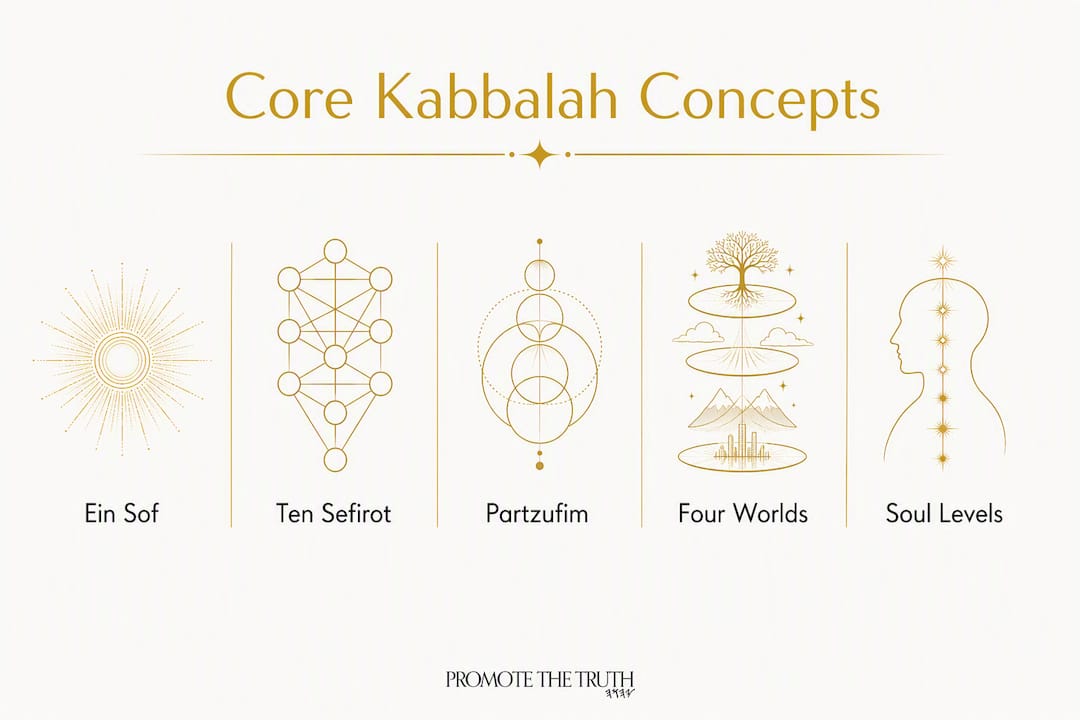
Ein Sof: the Infinite Beyond All Description
Ein Sof (literally “without end”) is the name Kabbalists give to Aluah (God) as Aluah (God) truly is — boundless, unknowable, and beyond any attribute or description. No human concept applies to Ein Sof directly. All set-apart (divine) qualities that Scripture attributes to Aluah (God) are understood as expressions of the Sefirot, not of Ein Sof itself.

The Ten Sefirot and the Tree of Life
The Ten Sefirot are channels of Set-apart (Divine) influence through which Ein Sof interacts with creation. Each Sefirah carries a specific quality or function. The first, Keter (Crown), represents Aluah’s (God’s) will to create; the remaining nine unfold in a structured sequence down to Malkhut (Kingdom), which corresponds to the physical world and the Shekhinah.

| Sefirah | Meaning | Core Quality |
|---|---|---|
| Keter | Crown | Set-apart (Divine) will; the first impulse of creation |
| Chokhmah | Wisdom | Pure, undifferentiated insight |
| Binah | Understanding | Structured, analytical comprehension |
| Chesed | Lovingkindness | Expansive grace and generosity |
| Gevurah | Strength/Judgment | Discipline, boundaries, and discernment |
| Tiferet | Beauty/Harmony | Balance between Chesed and Gevurah |
| Netzach | Victory/Eternity | Endurance, creative drive |
| Hod | Splendor | Humility, receptivity, gratitude |
| Yesod | Foundation | Channel connecting upper and lower realms |
| Malkhut | Kingdom | The Shekhinah; the world as it is |
The Tree of Life arranges these ten Sefirot into three vertical columns (pillars) connected by twenty-two pathways, each associated with a letter of the Abariy (Hebrew) alphabet. Kabbalists use this diagram as a contemplative map, tracing how set-apart (divine) energy flows from Ein Sof through the Sefirot into physical reality.
Pro Tip: Treating the Sefirot as separate set-apart (divine) beings is considered idolatrous within traditional Kabbalah. They are channels or qualities of the one Aluah (God), not independent entities.
Partzufim: Persona-Like Configurations
Lurianic Kabbalah reorganized the Sefirot into larger structural groupings called Partzufim (literally, “faces” or “configurations”). These include Arikh Anpin (the Long Face, associated with patience and Keter) and Ze’ir Anpin (the Short Face, associated with the six middle Sefirot). The Partzufim represent a more dynamic, relational model of set-apart (divine) activity than the earlier, more static Sefirot schema.
The Four Worlds
Kabbalistic cosmology describes four levels of reality between Ein Sof and the physical world:
| World | Name | Meaning | Soul Level |
|---|---|---|---|
| Atzilut | Emanation | Closest to Ein Sof; pure set-apart (divine) light | Yechidah (unity) |
| Beriah | Creation | The realm of set-apart (divine) thought and the Throne | Chayah (living essence) |
| Yetzirah | Formation | The messenger (angelic) realm; where form takes shape | Neshamah (higher soul) |
| Assiyah | Action | The physical and material world | Ruach / Nefesh |
Soul Levels
Kabbalistic anthropology identifies five levels of the human soul: nefesh (the vital, instinctual self), ruach (the emotional and moral self), neshamah (the higher intellectual soul), chayah (the living essence connected to set-apart (divine) life), and yechidah (the point of absolute unity with Ein Sof). Mystical practice aims to progressively awaken these higher levels, with neshamah and the levels above it typically becoming accessible only through sustained spiritual practice.
How Did Kabbalah Develop Through History?
The tradition did not appear fully formed. It grew through centuries of textual transmission, geographic movement, and creative reinterpretation.
| Period | Location | Key Development |
|---|---|---|
| 1st–6th century CE | Land of Yisharal (Israel) Babaliy / (Babylon) | Merkavah mysticism; early throne-chariot speculation; proto-Kabbalistic texts |
| ~3rd–6th century CE | Unknown (possibly early medieval) | Sefer Yetzirah composed; foundational cosmological and linguistic speculation |
| — | Provence, France; Catalonia, Spain | Medieval Kabbalah emerges; Sefer ha-Bahir appears; systematic Sefirot doctrine develops |
| Late 13th century | Castile, Spain | Moses de León composes (or compiles) the Zohar, the tradition’s most influential text |
| 16th century | Safed, Ottoman Palestine | Isaac Luria develops Lurianic Kabbalah; tzimtzum, shevirat ha-kelim, and tikkun become central |
| 18th century | Eastern Europe | Ba’al Shem Tov founds Hasidism; Kabbalistic ideas reach ordinary Yahudiym (Jewish) communities |
| 20th century | Germany / United States / Yisharal (Israel) | Gershom Scholem establishes academic study of Kabbalah as a historical discipline |
| Late 20th century | Global | Popularization, New Age adaptations, and renewed traditional interest |
Medieval Spain and 16th-century Safed stand as the two decisive centers of Kabbalistic development. Moses de León’s Zohar gave the tradition its canonical text. Isaac Luria’s school in Safed gave it a comprehensive cosmological system that reshaped prayer, practice, and communal life throughout the Yahudiym (Jewish) world.
Gershom Scholem’s 20th-century scholarship was equally transformative, though in a different respect. By treating Kabbalah as a historical and textual phenomenon with traceable sources and a discernible development, Scholem established the academic framework upon which all subsequent serious study has been built.
What Are The Primary Texts of Kabbalah?
The Zohar
The Zohar is the most authoritative and widely studied text in the Kabbalistic tradition. Written primarily in Aramiyt (Aramaic) with Abariy (Hebrew) passages, it presents itself as a mystical commentary on the Turah (Torah) and is traditionally attributed to the 2nd-century sage Rabbi Shimon bar Yochai. Modern scholarship, following Gershom Scholem, attributes its composition to Moses de León in 13th-century Castile, though the question of authorship remains debated.
The Zohar explores the inner meaning of Turah (Torah) portions, the nature of the Sefirot, the soul's journey, and the dynamics of the relationship between the set-apart (divine) and humanity. It is widely regarded as the central medieval mystical commentary and the text most responsible for shaping later Kabbalistic thought. English readers have access to several translations, including the multi-volume Stanford University Press edition by Daniel Matt, which pairs the Aramiyt (Aramaic) text with extensive scholarly notes.
Sefer Yetzirah
The Sefer Yetzirah ("Book of Formation") is among the oldest surviving Yahudiym (Jewish) mystical texts, likely composed sometime between the 3rd and 6th centuries CE. It describes how Aluah (God) created the world through combinations of the twenty-two Abariy (Hebrew) letters and the ten Sefirot, making it the earliest known source to use the term "Sefirot" in a cosmological sense. Its brevity (only a few thousand words) belies its influence; virtually every later Kabbalistic system builds upon its framework.
The Lurianic Corpus
Isaac Luria himself wrote almost nothing. His teachings were transmitted orally and later recorded by his primary disciple, Chaim Vital, in works such as the Etz Chaim ("Tree of Life") and Pri Etz Chaim. These texts introduced tzimtzum, shevirat ha-kelim (the shattering of the vessels), and tikkun as a unified cosmological narrative explaining the origin of evil and the purpose of human existence. Lurianic Kabbalah presents these concepts as a framework for understanding cosmic restoration, and they remain the dominant conceptual vocabulary of Kabbalah today.
Later Commentaries and Accessible Editions
Hasidic literature, particularly the works of the Ba'al Shem Tov's successors and the Chabad tradition's Tanya (by Rabbi Schneur Zalman of Liadi), translated Lurianic ideas into accessible ethical and devotional language. For English readers beginning serious study, pairing a scholarly introduction—such as Scholem's Kabbalah or Major Trends in Jewish Mysticism—with a reputable translation of Zohar selections provides the strongest foundation. The primary texts are dense; reading them without commentary or the guidance of a qualified teacher is rarely productive.
How is Kabbalah Practiced Today?
Kabbalistic practice is not a set of rituals separate from Yahudiym (Jewish) life. It is, at its core, a way of performing ordinary Yahudiym (Jewish) observance with heightened intentionality and awareness of the cosmic dimensions involved.
Standard practices include:
-
Textual study with a teacher: Reading the Zohar, Sefer Yetzirah, or Lurianic texts with commentary, ideally in a structured setting with a qualified guide who can contextualize difficult passages.
-
Prayer with Kavanah: Kavanah means intentionality or directed attention. Kabbalistic prayer involves focusing on the specific Sefirot or divine names associated with each prayer, transforming liturgy into contemplative practice.
-
Meditation and Visualization: Kabbalistic practice includes meditation and visualization on the Sefirot, often guided by specific textual traditions rather than improvised techniques.
-
Gematria: The numerical value of Abariy (Hebrew) letters is used to find hidden connections between words and concepts in Scripture. Gematria is an analytical tool, not a form of fortune-telling; its use is grounded in numerological symbolism woven throughout the Abariy (Hebrew) text.
-
Ethical Action as Tikkun: Every act of justice, charity, and compassion is understood as participating in cosmic repair. This makes ordinary ethical life a form of mystical practice.
Theoretical vs. Practical Kabbalah
Theoretical Kabbalah concerns itself with understanding the structure of divinity and creation — the Sefirot, the Four Worlds, the soul’s nature. Practical Kabbalah involves techniques intended to produce effects in the world, including the use of divine names, amulets, and invocations. Practical techniques were historically restricted and often discouraged except under strict conditions, because of the risk of misuse and the spiritual danger involved for unprepared practitioners.
Pro Tip: Traditional authorities consistently recommend grounding yourself in Turah (Torah) study and Halacha before approaching Kabbalistic texts. Studying Kabbalah in isolation — without a teacher, without communal context, and without prior textual grounding — is widely considered both ineffective and potentially harmful to one’s spiritual development.
Who Traditionally Studied Kabbalah, and Has That Changed?
The classical answer is straightforward: Kabbalah was restricted to mature, learned individuals who had already mastered Turah (Torah) and Talmud and demonstrated moral seriousness. The Talmud itself records that certain mystical topics — particularly the account of creation (Ma’aseh Bereshit) and the chariot vision of Yihazaqal (Ezekiel) (Ma’aseh Merkavah) — were not to be taught publicly or to beginners.
The reasons for these restrictions were practical as much as protective. Kabbalistic texts are dense, symbolically layered, and easily misread. A student without solid textual grounding might mistake metaphor for literal description, or mistake the Sefirot for independent set-apart (divine) beings — a confusion traditional Kabbalists considered a serious theological error. The restrictions also reflected concern about practical Kabbalah’s potential for misuse and the social disruption that charismatic mystical movements had historically caused.
Modern access looks very different. The printing press began democratizing Kabbalistic texts in the 16th century. Hasidism in the 18th century brought Kabbalistic ideas to ordinary Yahudiym (Jewish) communities through accessible ethical teaching and storytelling. Academic study in the 20th century made texts available to scholars regardless of religious affiliation. And the late 20th century brought a wave of popular interest that stripped Kabbalistic symbols from their Yahudiym (Jewish) context entirely.
For readers who want to engage responsibly today, the most reliable path remains the traditional one: seek a teacher within an established Yahudiym (Jewish) community, begin with foundational Turah (Torah) study, and approach mystical texts through structured courses rather than self-directed reading. University courses in Yahudiym (Jewish) studies offer a rigorous academic entry point for those whose interest is primarily scholarly.
How Do authentic Kabbalah Teachings Differ from Popular Distortions?
The distance between traditional Kabbalistic teaching and its popular adaptations is significant, and worth understanding clearly before investing time or money in any particular resource.
Common adaptations and distortions
-
New Age reworkings borrow Kabbalistic symbols (the Tree of Life, the Sefirot, gematria) and reframe them within non-Yahudiym (Jewish) spiritual frameworks, often combining them with astrology, tarot, or Western occultism. The symbols are real; the context is not.
-
Celebrity-brand Kabbalah reduces the tradition to motivational philosophy and wellness practices, typically severing all connection to Torah, Halacha, and Jewish communal life.
-
Occult reinterpretations treat the Sefirot and divine names as tools for magical manipulation, a use that traditional Kabbalists and mainstream Yahudiym (Jewish) authorities consistently reject.
Scholars and traditional authorities warn that removing Kabbalistic symbols from their Yahudiym (Jewish) textual and ritual context produces something that is neither authentic Kabbalah nor a coherent spiritual system.
How Authentic Kabbalah Differs
Authentic Kabbalistic teaching is grounded in Turah (Torah) and Halacha, transmitted through qualified teachers, and aimed at deepening ordinary religious life rather than replacing it. Traditional authorities emphasize that Kabbalah is meant to enrich marriage, family, and communal obligations — not encourage withdrawal from the world or pursuit of personal power.
Key differences at a glance:
-
Authentic Kabbalah requires prior Turah (Torah) and Talmud study; popular versions typically do not.
-
Authentic teaching is transmitted through qualified teachers within Yahudiym (Jewish) communities; popular versions are often self-directed or sold as courses without religious context.
-
Authentic Kabbalah is theosophical — focused on understanding Aluah (God) and creation; popular versions often focus on personal benefit or esoteric power.
-
Authentic texts are the Zohar, Sefer Yetzirah, and Lurianic corpus; popular versions frequently cite secondary or invented sources.
Red flags to watch for
-
Claims that Kabbalah offers secret powers, health cures, or financial success for purchase.
-
Teaching that denies or ignores the role of Turah (Torah) and Halacha in Kabbalistic practice.
-
Syncretic frameworks that blend Kabbalah with unrelated religious or occult traditions without acknowledging the departure from Jewish context.
-
No qualified teacher or established community behind the teaching.
-
Promises of rapid initiation or advanced knowledge without prerequisite study.
Within Yahudiym (Judaism) itself, debates continue about how widely Kabbalah should be taught, whether commercial Kabbalah centers misrepresent the tradition, and how to balance accessibility with the integrity of esoteric transmission. These are live conversations, not settled questions.
How Does Academic Scholarship Approach Kabbalah Differently from Devotional Teaching?
Gershom Scholem’s contribution to the study of Kabbalah cannot be overstated. Before Scholem, the tradition was either dismissed by rationalist Yahudiym (Jewish) scholars as superstition or treated by practitioners as timeless, ahistorical truth. Scholem treated it as neither. His foundational works—particularly Major Trends in Jewish Mysticism (1941) and the encyclopedic Kabbalah (1974)—established Kabbalah as a historical phenomenon with traceable sources, identifiable authors, and a development shaped by specific social and intellectual contexts.
That approach changed everything. It became possible to date texts, trace influences, and distinguish authentic medieval Kabbalistic ideas from later additions or misattributions. It also made Kabbalah accessible to readers who were not themselves practicing Yahudiym (Jews) because the historical-critical method does not require religious commitment.
Devotional teaching operates from a different premise. Its goal is not historical accuracy but the lived spiritual effect of transforming the practitioner’s relationship with Aluah (God), Turah, and the community. Both aims are legitimate. The problem arises when readers confuse them—treating a scholarly introduction as a guide to practice or treating a devotional text as a reliable historical source.
A responsible reading path for someone beginning serious engagement with Kabbalah might look like this:
-
Start with a scholarly introduction: Scholem’s Kabbalah or a modern academic overview gives you the historical and textual framework.
-
Read primary text selections: A reputable translation of Zohar selections (such as Daniel Matt’s The Zohar: Pritzker Edition) with commentary.
-
Engage a qualified teacher or community: Academic knowledge and private reading are not substitutes for guided transmission within a living tradition.
-
Pair with foundational Turah study: Understanding the ancient Abariy (Hebrew) roots of the Turah gives you the linguistic and conceptual foundation that Kabbalistic reading assumes.
Key Takeaways
Kabbalah is a Yahudiym (Jewish) mystical tradition rooted in the Turah, structured around the Ten Sefirot and Ein Sof, transmitted through primary texts like the Zohar and Sefer Yetzirah, and decisively reshaped by Isaac Luria’s 16th-century school in Safed.
| Point | Details |
|---|---|
| Kabbalah is within Yahudiym (Judaism) | It is the mystical dimension of Yahudiym (Jewish) law and Turah (Torah), not a separate religion or standalone belief system. |
| Central texts are the Zohar and Sefer Yetzirah | The Zohar (attributed to Moses de León) and Sefer Yetzirah are the foundational primary sources for all serious study. |
| Lurianic Kabbalah is the dominant modern form | Isaac Luria’s concepts of tzimtzum, shevirat ha-kelim, and tikkun define how most people encounter Kabbalistic philosophy today. |
| Responsible study requires grounding and a teacher | Traditional and contemporary authorities agree that Turah and Talmud study should precede Kabbalistic study, with a qualified teacher guiding the process. |
| Popular adaptations often distort the tradition | New Age and celebrity versions remove Kabbalistic symbols from their Yahudiym (Jewish) context, producing frameworks that differ substantially from authentic teaching. |
A Note on Responsible Engagement with Kabbalah
At Promote The Truth, we are committed to careful, text-centered study of the Scriptures, grounded in ancient Abariy (Hebrew) and Aramiyt (Aramaic) manuscript sources, historical research, and honest engagement with what the original texts communicate. That same commitment shapes our approach to subjects such as Kabbalah. We recognize its historical significance within Yahudiym (Jewish) thought while carefully distinguishing between the teachings of the Scriptures, later mystical developments, and modern interpretations.
We believe that meaningful study begins with the primary sources. Whether exploring the Ta’anak (Old Testament), the Bariyt Hadash (New Testament), or the historical development of Jewish mystical traditions, readers benefit most from examining the original languages, manuscript evidence, and historical context before drawing conclusions. A manuscript-based approach encourages careful interpretation, informed discussion, and a deeper appreciation of the history surrounding the Scriptures.
For those who desire to study the Scriptures more deeply, Promote The Truth provides structured courses, the Truth Scriptures, and digital teachings resources designed to help readers engage with the ancient Abariy (Hebrew) and Aramiyt (Aramaic) texts with confidence. Rather than relying on speculation or tradition alone, we encourage every reader to examine the evidence, explore the manuscript foundations, and pursue a deeper understanding of the Word of YAHUAH through disciplined, text-centered study.
Useful Sources for Further Study
Continuing your study of Kabbalah responsibly means working from authoritative primary texts, reputable translations, and honest secondary scholarship. The following resources represent a curated starting point.
Primary texts:
- The Zohar (Pritzker Edition) — Daniel Matt’s multi-volume translation with extensive commentary is the most authoritative English edition available. Begin with the single-volume The Essential Zohar for an accessible entry point.
Secondary scholarship:
-
Kabbalah: An Overview — Jewish Virtual Library — A reliable, accessible introduction to the tradition’s history, key concepts, and major figures, written from a scholarly perspective.
-
What Is Kabbalah? — Chabad.org — A devotional introduction from within the Hasidic tradition, useful for understanding how Kabbalah is taught and practiced in a living community.
-
Kabbalah and Jewish Mysticism — Judaism 101 (JewFAQ) — A clear, community-oriented overview that addresses common questions and misconceptions without requiring prior knowledge.
-
What Is Kabbalah? — ReformJudaism.org — Offers a liberal Jewish perspective on Kabbalistic practice and its place in contemporary Jewish life.
-
Kabbalah — Encyclopedia.com — Summarizes the academic consensus on Kabbalah’s development, including Gershom Scholem’s foundational contributions.
Choosing translations and teachers:
Look for translations that include the original language alongside the English, with commentary that identifies the source text and its manuscript tradition. Avoid editions that paraphrase freely without noting departures from the original. For teachers, seek individuals affiliated with established Yahudiym (Jewish) communities or accredited academic institutions — credentials and community accountability matter.
Promote The Truth Resources:
For readers who want to complement their study of Kabbalah with a careful, manuscript-based study of the Scriptures, Promote The Truth provides resources designed to deepen your understanding of the ancient Abariy (Hebrew) and Aramiyt (Aramaic) texts. At the center of these resources is theTruth Scriptures, an English restoration translation of the Ta’anak (Old Testament) and the Bariyt Hadash (New Testament), translated directly from ancient manuscript sources and accompanied by a transparent translation methodology.
Understanding the Scriptures in their original linguistic and historical context provides a strong foundation for exploring theology, history, and Jewish mystical traditions with greater clarity. Rather than relying solely on later interpretations or secondary sources, readers are encouraged to examine the manuscript evidence and the source languages for themselves.
To support that journey, the Scripture Study Series offers structured video lessons that guide readers through key Scriptural passages, historical background, and translation principles. Whether you are beginning your study or seeking a deeper understanding of the Truth Scriptures, the resources available through Promote The Truth are designed to help you engage thoughtfully with the Word of YAHUAH, the manuscript tradition, and the historical context of the Scriptures.