
Seven is the primary scriptural (biblical) symbol of set-apart (divine) completion, set-apartness (holiness), and perfection, and understanding what is the significance of seven in scriptures reshapes how you read the entire scriptural (biblical) text. The number appears over 700 times across the Ta’anak and Bariyt Hadash (Old and New Testaments), making it the most theologically loaded number in all of scriptures. Its meaning is not accidental. From the creation week in Barashiyt (Genesis) to the visions of Hazun (Revelation), seven marks the moments when YAHUAH declares something finished, set-apart (holy), and whole. Scholars in scriptural (biblical) numerology use the term heptadic structure to describe this recurring pattern, and once you see it, you cannot unsee it.
What is the significance of seven in scripture?
Seven’s scriptural significance begins at the very foundation of the scriptural (biblical) story: the creation account in Barashiyt (Genesis). YAHUAH completed creation in six days and rested on the seventh, sanctifying that day as the Shabat (Sabbath). That single act established the template for all of seven’s meaning throughout scripture.
The seventh day was not simply a pause. It was a declaration of completion. YAHUAH set it apart as set-apart (holy), which means the number seven carries the weight of both finished work and set-apart (sacred) rest from its very first appearance in the text.
This pattern repeats with remarkable consistency across both Ta’anak and Bariyt Hadash (Testaments):
-
Creation week: Six days of work, one day of set-apart (sacred) rest Barashiyt (Genesis) 2:2–3
-
Shabat (Sabbath) year: Six years of labor, one year of release and restoration
-
Yubal (Jubilee) cycle: Seven sets of seven years, culminating in the 50th year of freedom
-
Priestly rituals: Blood sprinkled seven times before the altar Uiyqara (Leviticus) 4:6
-
Yiriyhu (Jericho): Yisharal (Israel) marched around the city seven times on the seventh day before the walls fell Yahusha (Joshua) 6
Each of these examples follows the same logic. Six represents human effort and incompleteness. Seven represents the set-apart (divine) finishing touch. Bible scholar Tim Mackie describes seven as not just a count but a narrative signal to readers of completeness and holiness. That framing is the key to reading the number correctly throughout scriptures.
Pro Tip: When you encounter the number six in scriptures, pay attention to what follows. The text often builds toward a seventh element that signals resolution or set-apart (divine) action.
For readers who want to go deeper on the Shabat’s (Sabbath’s) role in this pattern, Promote The Truth offers a thorough resource on the Shabat (Sabbath) in the scriptures that traces the seventh-day theme across the full scriptural (biblical)text.
How does seven govern justice, favor (mercy), and covenant in the Scriptures (Bible)?
Seven’s significance extends far beyond the creation week. The number governs some of the most socially radical laws in all of scriptures, particularly those tied to debt, slavery, and forgiveness.
-
The seventh-year debt release: Dabariym (Deuteronomy) 15 commands that every seventh year all debts are canceled and Abariy (Hebrew) slaves are freed. This was not a suggestion. It was a covenantal obligation tied directly to the rhythm of seven.
-
Seventy times seven: When Kapa (Peter) asked how many times he should forgive, Yahusha (Jesus) answered “seventy times seven” Matatiyahu (Matthew) 18:22. The number is not a literal count of 490 offenses. It signals complete and unlimited forgiveness, using seven’s symbolic weight to make the point.
-
The linguistic root: The Abariy (Hebrew) word for seven (shaba) and the word for oath (shaba) share the same root, derived from saba, meaning satisfaction or fullness. When Abarahm (Abraham) and Abiymalak (Abimelech) made a covenant at Bar-Shaba (Beersheba), the name of that place literally means “well of seven” or “well of the oath.” The number and the promise were the same concept.
This linguistic connection is one of the most underappreciated insights in scriptural (biblical) numerology. Seven was not just a number the ancient Abariym (Hebrews) happened to use. It was woven into the very language of covenant-making. To swear an oath was, in a sense, to “seven yourself” before YAHUAH.
Pro Tip: Read Barashiyt (Genesis) 21:22–34 alongside Dabariym (Deuteronomy) 15. The covenant at Bar-Shaba (Beersheba) and the seventh-year release law illuminate each other in ways that deepen your understanding of both passages.
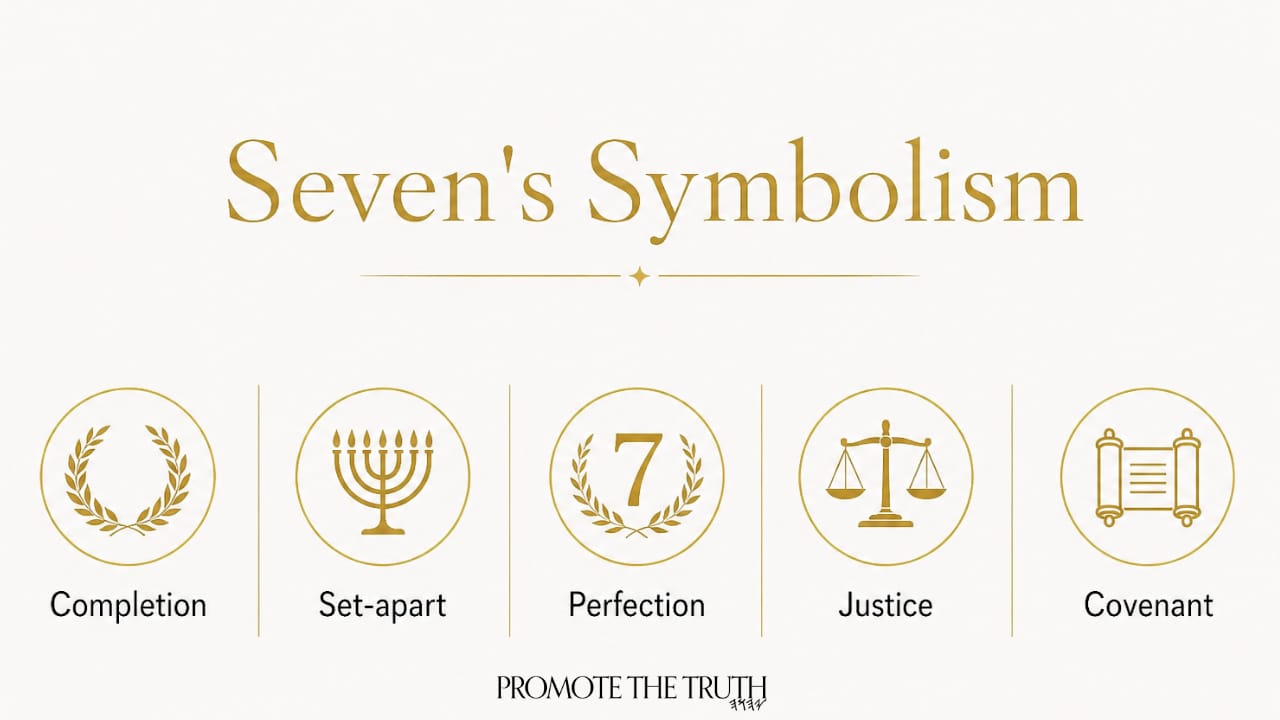
The social justice dimension of seven is also worth sitting with. The seventh-year release was designed to prevent permanent poverty and generational debt bondage. Seven did not just mark set-apart (divine) completion. It actively enforced favor (mercy) within human community.
Where does seven appear as a symbol of spiritual perfection?
The book of Hazun (Revelation) is the most concentrated display of seven’s symbolic power in all of scripture. Hazun (Revelation) mentions seven 55 times, organizing its entire structure around the number. That density is not coincidence. It signals that the book’s author intends every cluster of seven to communicate fullness and set-apart (divine) completeness.

| Cluster in hazun (Revelation) | What it represents |
|---|---|
| Seven Qahal (churches) | The complete body of believers addressed |
| Seven seals | The full scope of set-apart (divine) Mashapat (judgment) |
| Seven Tarua’ah (trumpets) | The complete announcement of YAHUAH’s authority |
| Seven bowls | The total outpouring of set-apart (divine) wrath |
| Seven Ruha (spirits) | The fullness of the Ruha (Spirit) before the throne |
Beyond Hazun (Revelation), Yahusha (Jesus) spoke seven final statements from the stake (cross). These seven sayings are understood by theologians as a complete declaration of his mission, covering forgiveness, relationship, suffering, abandonment, physical need, fulfillment, and surrender. The number seven frames his death as a finished and perfect work.
Healing rituals in scriptures also follow the pattern. Na’aman (Naaman) was told to wash in the Yiradan (Jordan) River seven times before his leprosy was healed 2 Malakiym (Kings) 5:10. The seven dips were not medically necessary. They were a test of complete obedience, and healing came only at the seventh. For readers interested in how healing and wholeness connect in scriptures, Promote The Truth has a practical guide on scriptural healing that explores these themes directly.
Seven also appears in the gifts of the Set-Apart Ruha (Holy Spirit), the seven lamps of the Manarah (menorah), and the seven days of Yum Pasaha (Passover) and Yum Matsah (the Feast of Unleavened Bread). Each instance reinforces the same message: seven marks the point where YAHUAH’s work is whole and complete.
What are the limits of interpreting seven symbolically?
Not every mention of seven in scripture carries symbolic weight. Some references are simply literal details of a narrative. Para’ah’s (Pharaoh’s) dream involved seven fat cows and seven thin cows, and Yusaf (Joseph) interpreted them as seven years of plenty followed by seven years of famine. The number there is prophetic and literal at the same time, not purely symbolic.
Aluah’s (God’s) ways transcend human symbolic frameworks, as Yisha’aiyahu (Isaiah) 55:9 makes clear: “For as the heavens are higher than the earth, so are My ways higher than your ways, and My thoughts than your thoughts.” That verse is a standing caution against forcing every number into a rigid theological grid.
“Seven is a prime number, indivisible in ancient numerical systems, reflecting set-apart (divine) unity and integrity.” This mathematical uniqueness gave ancient Near Eastern cultures an intuitive sense that seven stood apart from other numbers. It could not be broken into equal parts, which made it a fitting symbol for set-apart (divine) wholeness.
The right approach is to read seven in context. When the text clusters sevens deliberately, as in Hazun (Revelation) or the creation account, the symbolism is intentional. When seven appears as a count in a historical narrative, treat it as a number first and a symbol second. Balanced discernment protects you from reading meaning into places where the text does not intend it.
Key Takeaways
Seven is the most theologically significant number in scripture, functioning as YAHUAH’s consistent marker of completion, covenant, and set-apart (holiness) across every major section of the scriptural (biblical) text.
| Point | Details |
|---|---|
| Symbol of set-apart (divine) completion | Seven marks the moment YAHUAH declares a work finished, from Barashiyt (creation) to Hazun (Revelation). |
| Rooted in creation | The seventh-day Shabat (Sabbath) rest in Barashiyt (Genesis) 2:2–3 established seven’s meaning for all of scriptures. |
| Tied to covenant language | The Abariy (Hebrew) roots of shaba (seven) and shaba (oath) are the same, linking seven to every covenant promise. |
| Governs justice and favor (mercy) | Dabariym (Deuteronomy) 15’s seventh-year release law shows seven as a rhythm of restoration, not just a symbol. |
| Requires careful interpretation | Not every scriptural (biblical) seven is symbolic; context determines whether the number carries theological weight. |
Seven as a living pattern, not just a symbol
We have spent years studying scriptural (biblical) numerology, and the number seven keeps surprising us. Most readers treat it as a theological footnote, a curiosity you mention in a Scriptures (Bible) study before moving on. That is a mistake.
What strikes us most is how seven functions as a structural principle rather than a decoration. The creation week does not just mention seven. It is built on seven. Hazun (Revelation) does not just use seven as a literary device. It organizes its entire message around clusters of seven. That kind of architectural use tells you the authors understood seven as the shape of completion itself.
The covenant connection is the insight we return to most often. The fact that shaba and shaba share a root means that every time an ancient Abariy (Hebrew) reader encountered the number seven, they felt the weight of a sworn promise. That is not a modern interpretation layered onto the text. It is baked into the language. Reading the original Abariy (Hebrew) and Aramiyt (Aramaic) sources makes this connection visceral in a way that English translations rarely capture.
Our honest caution is this: scriptural (biblical) numerology attracts both serious scholars and careless speculation in equal measure. The discipline requires you to let the text lead. When scriptures cluster sevens with clear intent, follow that signal. When it does not, resist the urge to find hidden meaning. The number is powerful precisely because its use is deliberate, not because it appears everywhere.
— Maria
Promote The Truth’s resources for deeper scriptural study
Studying the symbolism of seven is far richer when you can hear it taught and see it traced across the full text.
Promote The Truth’s Scripture Study Series offers video teachings that walk through scriptural (biblical) themes, including number symbolism, covenant language, and the Abariy (Hebrew) roots of key scriptural concepts. These teachings draw from ancient manuscript sources and are designed for readers who want more than surface-level answers. For those ready to engage the text directly, the Truth Scriptures digital collection provides a meticulously translated restoration of the Ta’anak and Bariyt Hadash from original Abariy (Hebrew) and Aramiyt (Aramaic) sources, giving you the foundation to study seven’s significance in its original linguistic context.
FAQ
How many times does seven appear in the Scriptures (Bible)?
Seven appears over 700 times in scriptures, making it the most frequently used symbolic number in both the Ta'anak (Old Testament) and Bariyt Hadash (New Testament).
Why is seven called the number of completion in the Scriptures (Bible)?
Seven signals completion because YAHUAH rested on the seventh day after creation, sanctifying it as set-apart (holy). That pattern of six plus one establishing wholeness repeats throughout scripture in laws, rituals, and prophecy.
What is the Abariy (Hebrew) connection between seven and oaths?
The Abariy (Hebrew) words shaba (seven) and shaba (to swear an oath) share the same root, saba, meaning fullness or satisfaction. This means covenant-making and the number seven were linguistically inseparable in ancient Abariy (Hebrew) thought.
Does every mention of seven in the Scriptures (Bible) carry symbolic meaning?
No. Some references to seven are literal narrative details rather than theological symbols. Context determines intent, and readers should let the text lead rather than assume every seven carries hidden meaning.
What role does seven play in the book of Hazun (Revelation)?
Hazun (Revelation) uses seven 55 times, organizing its structure around seven Qahal (churches), seals, tarua'ah (trumpets), and bowls. Each cluster signals the fullness and completeness of YAHUAH’s message and authority.
Recommended
-
Scripture Study Series YouTube Video Channel - Promote The Truth
-
The Role of the Shabat (Sabbath) in Scripture: A Scriptural (Biblical) Guide
-
Unveiling the Mysteries of the Creator’s Calendar: A Journey through Time — PROMOTE THE TRUTH
-
Lunar-Solar vs. Gregorian: Exploring YAHUAH’s Calendar — PROMOTE THE TRUTH