
Scriptural (Biblical) archaeology is defined as the study of material remains that illuminate the historical settings, cultures, and events described in the Scriptures (Bible). The role of archaeology in Scriptural (Biblical) history is to provide physical evidence that grounds Scripture in real geography, real rulers, and real daily life. Discoveries like the Miysha (Mesha) Stele, Hazaqiyahu’s (Hezekiah’s) Tunnel, and the Dead Sea Scrolls have transformed how scholars and believers alike read the ancient text. Far from threatening faith, archaeological evidence confirms that the Scriptural (Biblical) world was a living, breathing historical reality. At Promote The Truth, we believe that understanding this evidence deepens your engagement with the original Scriptural message.
What is the role of archaeology in Scriptural (Biblical) history?
Scriptural (Biblical) archaeology is a recognized scholarly discipline. It sits at the intersection of field excavation, ancient linguistics, and textual criticism. The formal term scholars use is “Syro-Palestinian archaeology,” though “Scriptural (Biblical) archaeology” remains the widely accepted label for research directly tied to the Scriptural (Biblical) text.
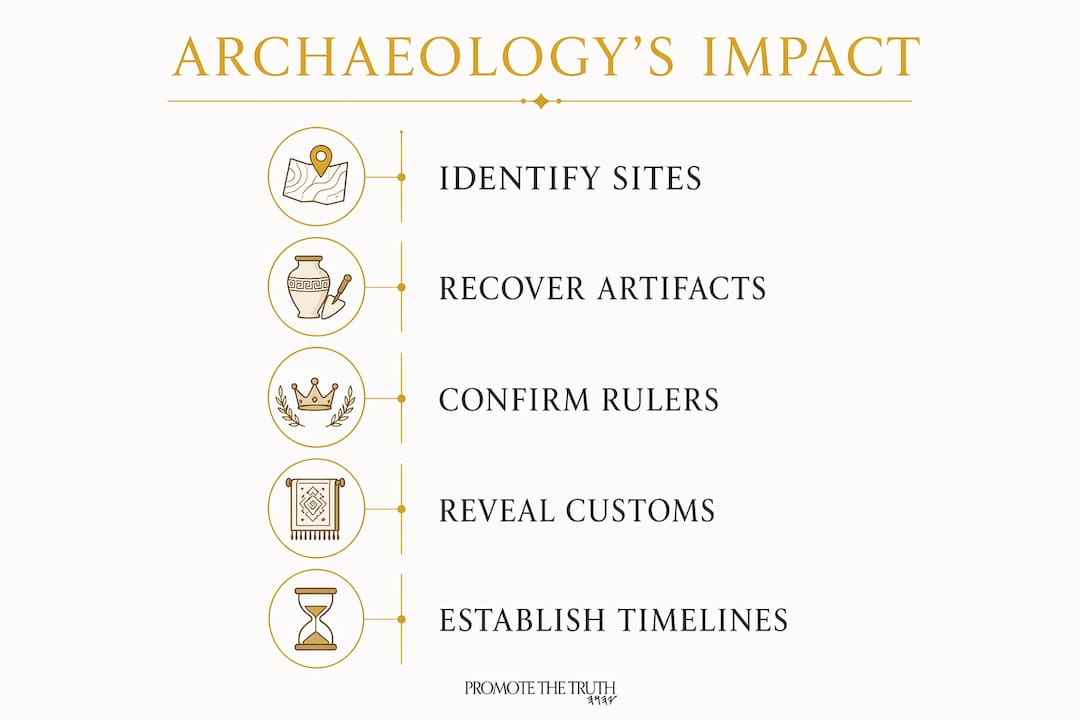
The discipline does three things well. It identifies physical locations mentioned in Scripture. It recovers artifacts that reveal how people lived, worshiped, and governed. It produces inscriptions and texts that confirm names, events, and customs recorded in the Scriptures (Bible).
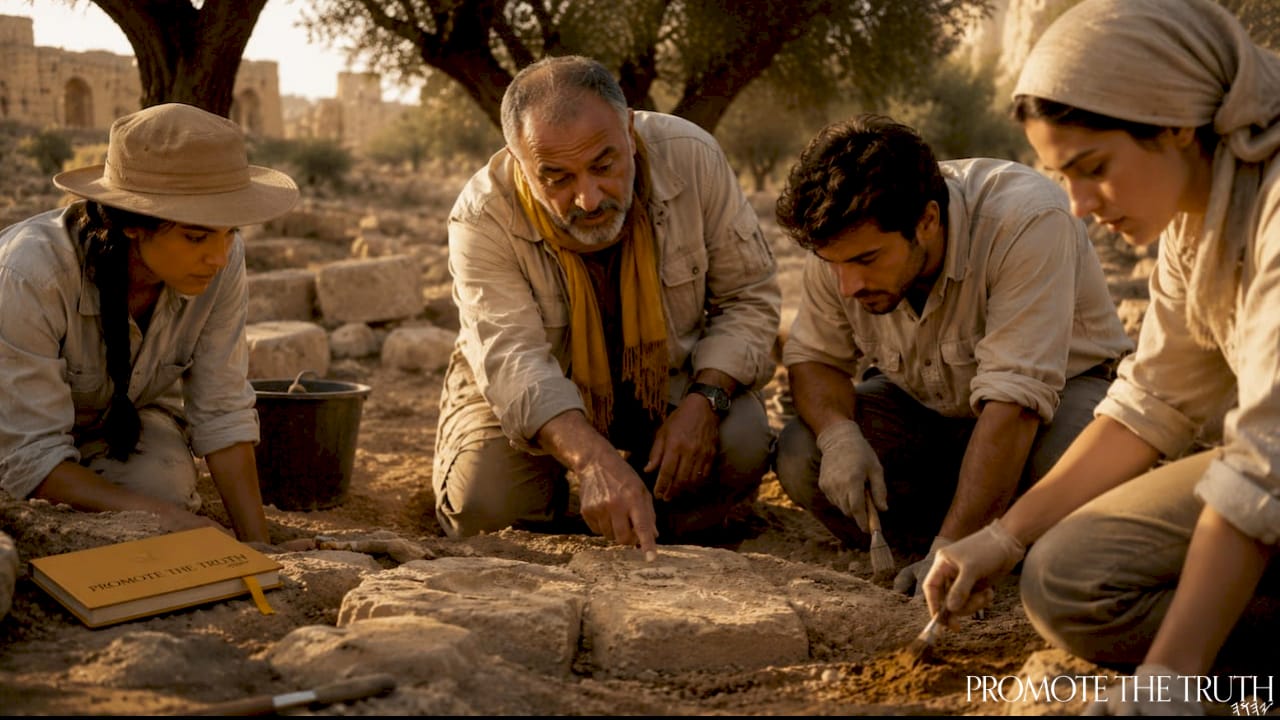
Archaeology provides tangible evidence for places, rulers, customs, and warfare in Scripture. That evidence turns abstract Scriptural (Biblical) references into concrete historical realities. When you read about Malaki (King) Hazaqiyahu (Hezekiah) cutting a tunnel through solid rock to protect Yirushalam’s (Jerusalem’s) water supply, you can walk that tunnel today. It is 1,750 feet long and still intact beneath the City of Duiyd (David).
How does archaeology contribute tangible evidence to Scriptural (Biblical) history?
The most persuasive contributions from archaeology in Scriptural (Biblical) studies come in three forms: inscriptions, excavated sites, and scientific dating.
Inscriptions that name Scriptural (Biblical) figures
The Miysha (Mesha) Stele, discovered in 1868, is one of the most significant finds in the field. This basalt stone, erected by the Muabiy (Moabite) Malaki (king) Miysha (Mesha), references the “house of Duiyd (David)” outside the pages of Scripture. That single phrase confirmed to skeptics that the Duiyd related (Davidic) dynasty was a historical institution, not a literary invention. The Tel Dan Stele, found in northern Yisharal (Israel) in 1993, contains the same phrase and reinforces the same conclusion.
Ugaritic texts discovered at Ras Shamra in modern Aram (Syria) have illuminated Scriptural (Biblical) Abariy (Hebrew) vocabulary and poetic forms. Scholars now read passages in Tahliym (Psalms) and Aiyub (Job) with far greater precision because of those tablets. The linguistic overlap between Ugaritic and Scriptural (Biblical) Abariy (Hebrew) resolved long-standing translation debates that no amount of theological reasoning alone could settle.
Excavated sites and chronological frameworks
Key findings from archaeological excavation include:
-
Hazaqiyahu’s (Hezekiah’s) Tunnel in Yirushalam (Jerusalem), confirming the account in 2 Malakiym (Kings) 20:20 with physical precision
-
Magadun (Megiddo/Armageddon), where 30 layers of occupation reveal the city’s role across multiple Scriptural (Biblical) eras
-
Lakiysh (Lachish), whose destruction layer matches the Ashuriy (Assyrian) invasion described in 2 Malakiym (Kings) 18
-
Khirbet Qeiyafa, a fortified city in the Shephelah dated to the early Iron Age, supporting the existence of a centralized Yahudahiy (Judahite) state during Duiyd’s (David’s) era
Recent radiometric dating from sites across the Shephelah and Nagab (Negev) now permits a five-part chronological framework for Yahudah’s (Judah’s) kingdom development up to the 586 BCE destruction of Yirushalam (Jerusalem). That level of precision was impossible a generation ago. It means the historical backbone of the Ta’anak (Old Testament) can now be tested against an empirically grounded timeline.
How has Scriptural (Biblical) archaeology changed its methods over time?
The discipline has undergone a century-long transformation that every serious student of Scripture needs to understand.
The early proof-driven era
-
William F. Albright led the American school of biblical archaeology in the early 20th century. His goal was explicit: use the spade to confirm Scriptural (Biblical) narratives.
-
Albright’s students excavated sites across the Levant with that agenda firmly in place. Some findings supported their conclusions. Others were later shown to be misinterpreted.
-
The collapse of the proof model came gradually. Scholars realized that archaeology could not simply verify or falsify Scripture. The material record is fragmentary, and ancient texts are complex literary documents, not field reports.
Scriptural (Biblical) archaeology’s primary role has shifted from trying to prove the Scriptures (Bible) to studying everyday life in the Iron Age, treating the Scriptures (Bible) as one of several important historical sources. That shift produced better scholarship and, paradoxically, stronger evidence for Scriptural (Biblical) historicity.
Modern Scriptural (Biblical) archaeology now draws on isotopic analysis to trace ancient trade routes, residue analysis to identify food and ritual substances in pottery, and zooarchaeology to understand dietary laws and economic patterns. No single discipline can independently interpret the Levant’s data. Fluency in multiple methods is now considered standard practice.
Pro Tip: When reading archaeological reports about Scriptural (Biblical) sites, check whether the study uses radiometric dating alongside ceramic typology. Studies that combine both methods produce the most reliable chronological conclusions.
Recent archaeological focus has also shifted toward data revealing ritual, subsistence, and identity complexities in daily life. Headlines about the Duiyd related (Davidic) kingdom still dominate popular coverage, but the deeper scholarly work now reconstructs how ordinary Yisharaliym (Israelites) and Yahudahiym (Judahites) ate, prayed, and organized their households.
Does archaeology prove or disprove the Scriptures (Bible)?
This question comes up constantly, and the honest answer requires precision.
Archaeology is best used not to mechanically prove or disprove the Scriptures (Bible) but to explore its physical and political environment. Scholars call this “productive tension.” The material record sometimes aligns perfectly with the Scriptural (Biblical) text. Sometimes it raises questions that demand careful interpretation. Neither outcome should alarm a thoughtful reader of Scripture.
Consider what archaeology actually does for faith:
-
It confirms that Scriptural (Biblical) cities existed at the times and places described
-
It verifies that rulers named in Scripture held real political power
-
It shows that laws, rituals, and customs described in the Turah match the broader ancient Near Eastern world
-
It removes the assumption that the Scriptures (Bible) is disconnected from history
“Archaeology guards against superficial biblical readings by insisting narratives be seen in historical contexts, supporting faith by grounding Scripture in real history rather than myth.” — Psephizo
Archaeology confirms Scriptural (Biblical) credibility and enriches understanding without supplanting the authority and personal engagement that faith requires. The goal is not to replace Scripture with a trowel. The goal is to read Scripture with the full weight of its historical world behind it.
Learning to read Scripture in historical context is one of the most rewarding skills a believer can develop. Archaeology is the primary tool that makes that reading possible.
How does archaeological knowledge improve Scriptural (Biblical) study and teaching?
The practical applications of Scriptural (Biblical) archaeology are significant for anyone who teaches, preaches, or studies Scripture seriously.
| Application | Without Archaeology | With Archaeology |
|---|---|---|
| Understanding geography | Abstract place names | Real terrain, distances, and strategic significance |
| Interpreting prophecy | Symbolic readings only | Grounded in political and cultural realities of the era |
| Reading legal texts | Rules without context | Laws matched to ancient Near Eastern treaty forms |
| Studying poetry | Literary analysis alone | Vocabulary clarified by Ugaritic and Aramiyt (Aramaic) parallels |
| Teaching narrative history | Story-level comprehension | Confirmed chronology and verified rulers |
Standing in archaeological sites of the Set-apart (Holy) Land enriches Scriptural (Biblical) understanding by clarifying scale, terrain, and cultural references. Scholars describe the experience as reading a “fifth bashurah (gospel).” When you stand at the base of Masada or walk through the ruins of ancient Kapar Nahum (Capernaum), the Bashurah (Gospels) stop being abstract and start being spatial.
For those who study the Ta’anak and its historical context, archaeology provides the cultural scaffolding that makes the text legible. The book of Amuts (Amos) makes far more sense when you understand the economic stratification of 8th-century Yisharal (Israel) that excavations at Shamarun (Samaria) have revealed.
Pro Tip: Pair your Scripture reading with a reliable archaeological atlas of the Scriptural (Biblical) world. The Oxford Bible Atlas and the Zondervan Atlas of the Scriptures (Bible) both integrate excavation data with scriptural references, giving you a visual framework that commentary alone cannot provide.
The Yisha’aiyahu (Isaiah) Dead Sea Scrolls represent one of the most dramatic examples of how archaeological discovery directly impacts textual study. Found at Qumran in 1947, the Great Yisha’aiyahu (Isaiah) Scroll predates the previously oldest known Abariy (Hebrew) manuscript by roughly 1,000 years. Its near-perfect agreement with the Masoretic Text confirmed the reliability of the transmission process across a millennium.
For teachers and preachers, integrating archaeological findings into lessons transforms abstract doctrine into grounded historical reality. Congregations engage differently when they understand that the walls of Yiriyhu (Jericho), the palace of Ahab, and the pool of Shalha (Siloam) are not literary devices. They are excavated facts.
Key takeaways
Scriptural (Biblical) archaeology’s greatest contribution is not proving Scripture but illuminating the world in which Scripture was written, making every passage richer and more precise.
| Point | Details |
|---|---|
| Archaeology grounds Scripture in history | Physical evidence confirms Scriptural (Biblical) cities, rulers, and customs as historical realities. |
| The discipline has matured significantly | Modern methods include isotopic analysis and residue testing, far beyond early proof-driven excavation. |
| Faith and evidence are compatible | Archaeology supports Scriptural (Biblical) credibility without replacing the personal engagement faith requires. |
| Inscriptions confirm Scriptural (Biblical) names | The Mesha Stele and Tel Dan Stele both reference the house of Duiyd (David) outside the Scriptural (Biblical) text. |
| Practical study improves with context | Archaeological knowledge clarifies geography, law, poetry, and prophecy for teachers and students alike. |
Why we think archaeology deserves a permanent place in your Scripture study
We have spent years working through ancient manuscript sources and historical records, and one conviction has only grown stronger. Archaeology does not threaten the Word of YAHUAH. It honors it.
The scholars who worry that a broken pottery shard might undermine faith have misunderstood both archaeology and Scripture. The discipline, at its best, does what Promote The Truth has always sought to do: it takes the ancient text seriously enough to ask hard questions about its historical world.
What strikes us most is how often the material record surprises even seasoned researchers. A site dismissed as insignificant yields an inscription. A layer of ash confirms a destruction the text described. These moments are not coincidences. They are the accumulated weight of a historical tradition that has been faithfully preserved.
The future of Scriptural (Biblical) archaeology is genuinely exciting. Advances in ground-penetrating radar, DNA analysis of ancient remains, and machine-assisted reading of damaged inscriptions will open sites and texts that previous generations could not access. We are at the beginning of a new era of discovery, not the end of one.
Our encouragement to you is this: do not wait for the headlines. Engage with the evidence now. Read the excavation reports. Study the inscriptions. Walk the sites if you can. Every layer of understanding you add to your Scripture study brings you closer to the original intent of the eternal message.
— Maria
Explore scripture resources enriched by archaeological context
Promote The Truth has built a body of study resources designed to integrate the historical and archaeological context of Scripture with the original Scriptural text. If you want to move beyond surface-level reading and into the world the Scriptural (Biblical) writers actually inhabited, these resources are your next step.

The Scripture Study Series video channel offers in-depth teachings that draw on historical analysis, manuscript research, and the kind of contextual understanding that archaeology makes possible. Each lesson is designed to help you read the Word of YAHUAH with the full weight of its ancient world behind it. You can also explore the original scriptures collection for access to authentic textual sources that complement your archaeological study. External resources like archaeology’s Scriptural (Biblical) evidence can further enrich your understanding of how the material record supports Scripture.
FAQ
What is Scriptural (Biblical) archaeology?
Scriptural (Biblical) archaeology is the study of material remains, including sites, artifacts, and inscriptions, that illuminate the historical settings and events described in the Scriptures (Bible). It is a scholarly discipline combining field excavation with textual criticism and ancient linguistics.
How does archaeology support Scriptural (Biblical) history?
Archaeology supports Scriptural (Biblical) history by confirming the existence of named rulers, cities, and customs through physical evidence such as inscriptions, destruction layers, and excavated structures. The Miysha (Mesha) Stele, Hazaqiyahu’s (Hezekiah’s) Tunnel are two of the most cited examples.
Does archaeology prove the Scriptures (Bible) is true?
Archaeology does not prove or disprove the Scriptures (Bible) in a theological sense. It provides a historical framework that confirms many Scriptural (Biblical) details while encouraging careful, contextual interpretation of the text rather than mechanical proof-seeking.
What is the most important archaeological discovery for Scriptural (Biblical) studies?
The Dead Sea Scrolls, discovered at Qumran in 1947, are widely considered the most significant find. The Great Yisha’aiyahu (Isaiah) Scroll confirmed the reliability of the Abariy (Hebrew) textual tradition across roughly 1,000 years of manuscript transmission.
How has Scriptural (Biblical) archaeology changed in recent decades?
Scriptural (Biblical) archaeology has shifted from the early 20th-century goal of proving Scriptural (Biblical) narratives, associated with William F. Albright, toward a multidisciplinary study of everyday life, identity, and ritual in the Iron Age, using methods like isotopic analysis and residue testing.