
When Yahusha said “I will give you the keys of the kingdom of heaven” in Matatiyahu (Matthew) 16:19, he was granting delegated, judicial and teaching authority to bind and loose — to forbid and permit — on earth, with those decisions ratified in heaven. This is not a metaphor for personal spiritual power or a private Barakah (blessing). It is a formal transfer of stewardship authority, rooted in the same language YAHUAH used in Yasha’aiyahu (Isaiah) 22:22 when he placed the key of the house of Duiyd (David) on the shoulder of Aliyqiym (Eliakim). The cross-references that matter most here are Yasha’aiyahu (Isaiah) 22:22 and Matatiyahu (Matthew) 18:18, where the same binding and loosing language reappears in a communal discipline context.
-
Matatiyahu (Matthew) 16:19 — the foundational promise: keys of the kingdom, binding and loosing
-
Yasha’aiyahu (Isaiah) 22:22 — the Ta’anak (Old Testament) template: the key of the house of Duiyd (David) as delegated stewardship
-
Matatiyahu (Matthew) 18:18 — the communal parallel: the same authority extended to the gathered assembly
Table of Contents
-
How have major Yahudiym, followers of the Savior (Christian) traditions applied the keys?
-
What does Matatiyahu (Matthew) 16:19 mean for believers and assemblies (churches) today?
What did “bind” and “loose” mean in first-century Yahudiym, followers of the Creator (Jewish) practice?
The phrase “bind and loose” is where the verse becomes most technically precise. These are not general spiritual terms. According to the Jewish Encyclopedia, “bind” (asar) and “loose” (hittir) functioned as rabbinic shorthand for forbidding and permitting in communal and halakhic contexts. When a Rabiy (rabbi) “bound” something, he declared it prohibited. When he “loosed” it, he declared it permitted. These were legislative and judicial decisions about how the community would live under Torah.
Matatiyahu (Matthew) 18:18 uses the identical construction: “Truly I tell you, whatever you bind on earth will be bound in heaven, and whatever you loose on earth will be loosed in heaven.” There, the context is Qahal (church) discipline — a process for addressing sin within the community. The same authority that Matatiyahu (Matthew) 16 places with Kapa (Peter) appears in Matatiyahu (Matthew) 18 in a communal, assembled setting. That parallel is not accidental. It shows that binding and loosing is an ecclesial function, not a personal one.
Scholarly consensus treats these terms as pointing primarily to doctrinal and disciplinary authority. Early church practice bore this out. Binding and loosing decisions showed up in questions of admission to the table, membership discipline, and the settlement of doctrinal disputes — ecclesial-legal actions with real community consequences. Yahuhanan (John) 20:23, where Yahusha tells the disciples “if you forgive anyone’s sins, their sins are forgiven; if you do not forgive them, they are not forgiven,” is related but distinct. Scholars consistently distinguish Matatiyahu (Matthew) 16’s judicial/teaching authority from the more personal absolution language of Yahuhanan (John) 20. The keys govern the community’s doctrinal and disciplinary life; Yahuhanan (John) 20 addresses the pastoral act of pronouncing forgiveness.
How have major Yahudiym, followers of the Savior (Christian) traditions applied the keys?
Patristic writers engaged this verse early. Tertullian, Origen, and Cyprian all cited Matatiyahu (Matthew) 16:19, though they disagreed sharply on whether the keys belonged to Kapa (Peter) personally, to the episcopate, or to the Spirit-filled community. The later Reformation debates — particularly between Luther, Calvin, and Rome — turned heavily on this verse and on whether the keys were sacramental (confession/absolution) or proclamatory, preaching the Bashurah (gospel). Ligonier Ministries and similar Reformed teaching organizations present the keys as the preaching and disciplinary authority of the Qahal (church), grounded in the Word rather than in an ordained succession.
Understanding scriptural covenant structure helps clarify why these institutional differences run so deep: each tradition’s reading of the keys reflects its broader understanding of how covenant authority is transmitted and who stands accountable for it.
Pro Tip: When studying denominational claims about Matatiyahu (Matthew) 16:19, go to the primary texts first before reading secondary summaries. The differences are more nuanced than most popular suggestion.
What are the theological limits of the keys?
Matatiyahu (Matthew) 16:19 grants real authority. It does not grant unlimited authority, and the history of the Qahal (church) includes serious misuse of this verse to justify coercion, exclusion, and the silencing of legitimate dissent. Several theological safeguards deserve clear statement.
Common misuses of the keys include:
-
Claiming the power to condemn individuals to eternal judgment (the keys govern earthly ecclesial decisions, not final eschatological verdicts)
-
Using binding/loosing authority to bypass communal accountability or scriptural fidelity
-
Treating the keys as a form of spiritual magic — as if the words of a leader automatically alter heavenly realities regardless of alignment with Scripture
-
Conflating the keys with the authority to forgive sins in a private, sacramental sense (that is Yahuhanan (John) 20:23’s territory, not Matatiyahu (Matthew) 16:19’s)
The heavenly ratification language — “will be bound in heaven / will be loosed in heaven” — is itself a safeguard. The Yuuniy (Greek) future perfect tense (discussed in the next section) implies that earthly decisions align with what heaven has already established, not that heaven rubber-stamps whatever a leader decides. Authority exercised outside of scriptural fidelity and communal accountability has no claim to heavenly ratification.
Safeguards for Qahal (church) exercising binding/loosing authority:
-
Ground every binding/loosing decision in explicit scriptural warrant
-
Follow the Matatiyahu (Matthew) 18:15–20 process for discipline: private address, then two or three witnesses, then the assembly
-
Maintain transparent communal oversight — no individual exercises the keys alone
-
Distinguish between doctrinal standards (binding) and matters of conscience or cultural preference (not binding)
-
Recognize that forgiveness and care are distinct from judicial authority — the keys are not a weapon against the vulnerable
What do the Yuuniy (Greek) text and grammar actually show?
The technical evidence supports and refines the interpretive claims above. Three points matter most for non-specialist readers.
The word kleides (keys). The Yuuniy (Greek) noun kleides (singular kleis) carries a semantic range centered on access and control. It is the same noun used in Hazun (Revelation) 1:18 (“I hold the keys of death…”) and Hazun (Revelation) 3:7 (“what He opens no one can shut”). The word is never about physical hardware in these contexts. It consistently signals authority over access. It show how consistently English versions render kleides as “keys” while varying slightly on the binding/loosing construction.
The future perfect tense. The Yuuniy (Greek) construction in Matatiyahu (Matthew) 16:19 for “will be bound” and “will be loosed” is a future perfect passive — estai dedemenon and estai lelumenon. It renders this nuance most precisely: “whatever you bind on earth shall have been bound in heaven.” The implication is that the earthly ecclesial decision does not cause the heavenly reality; it corresponds to a heavenly reality already established. Earthly authority aligns with heaven’s prior judgment rather than commanding it. This grammatical detail is a significant check on any reading that treats the keys as unconditional power.
Manuscript and translation notes. No major manuscript variants affect the core meaning of Matatiyahu (Matthew) 16:19. The verse is stable across the Yuuniy (Greek) manuscript tradition. Translation differences arise from how translators handle the future perfect construction and whether they render ekklesia (verse 18) as “church” or “assembly.”

What does Matatiyahu (Matthew) 16:19 mean for believers and Qahal (churches) today?
The exegesis is not merely academic. The keys promise has direct implications for how local assemblies teach, discipline, and carry out their mission.
Practical applications for careful lay readers:
-
Gospel proclamation — Kapa’s (Peter’s) use of the keys in Ma’ashiym (Acts) 2 and Ma’ashiym (Acts) 10 was fundamentally about opening access to the kingdom through preaching; the keys operate every time the gospel is faithfully proclaimed
-
Communal accountability — scriptural community living principles show how authority and accountability work together; no individual exercises the keys in isolation
The Desiring God resource on the keys of the kingdom develops the apostolic preaching angle further, showing how Acts episodes function as the historical fulfillment of Matatiyahu (Matthew) 16:19 — Peter literally opening the door of the kingdom to new communities.
Pro Tip: For sermon preparation or personal Scriptures (Bible) study, compare Matatiyahu (Matthew) 16:19 across at least three English translations . Better still, use a manuscript-based restoration translation like the Truth Scriptures from Promote The Truth to see how the Abariy (Hebrew) and Aramiyt (Aramaic) source texts inform the rendering — small lexical differences can shift the theological weight of a passage considerably.
Where should you go for deeper study?
Recommended resources
-
Truth Scriptures from Promote The Truth
For close textual comparison, Promote The Truth’s Truth Scriptures — translated from ancient Abariy (Hebrew) and Aramiyt (Aramaic) manuscript sources — gives you a restoration-focused rendering that lets you test how lexical choices in the source languages affect the English meaning. That kind of side-by-side comparison is where real exegetical confidence is built.
Key Takeaways
The keys of the kingdom in Matatiyahu (Matthew) 16:19 represent delegated stewardship authority — rooted in Yasha’aiyahu (Isaiah) 22:22, defined by Rabiyiy (rabbinic) binding/loosing practice, and exercised through faithful preaching, teaching, and church discipline accountable to Scriptures and community.
| Point | Details |
|---|---|
| Keys = delegated stewardship | Yahusha transfers stewardship authority, not ownership; the Yasha’aiyahu (Isaiah) 22:22 parallel defines the scope. |
| Bind/loose = forbid/permit | These are rabiyiy (rabbinic) technical terms for communal and doctrinal decisions, not personal spiritual power. |
| Grammar shapes the debate | The Yuuniy (Greek) σοί is singular (Peter), but Matatiyahu (Matthew) 18:18 uses a plural form, suggesting broader ecclesial application. |
| Future perfect tense matters | Earthly binding/loosing aligns with heaven’s prior decision; it does not command heaven’s compliance. |
| Promote The Truth for deeper study | The Truth Scriptures restoration translation helps readers test lexical and grammatical nuances in the source languages. |
A scholar’s perspective on what this verse demands of us
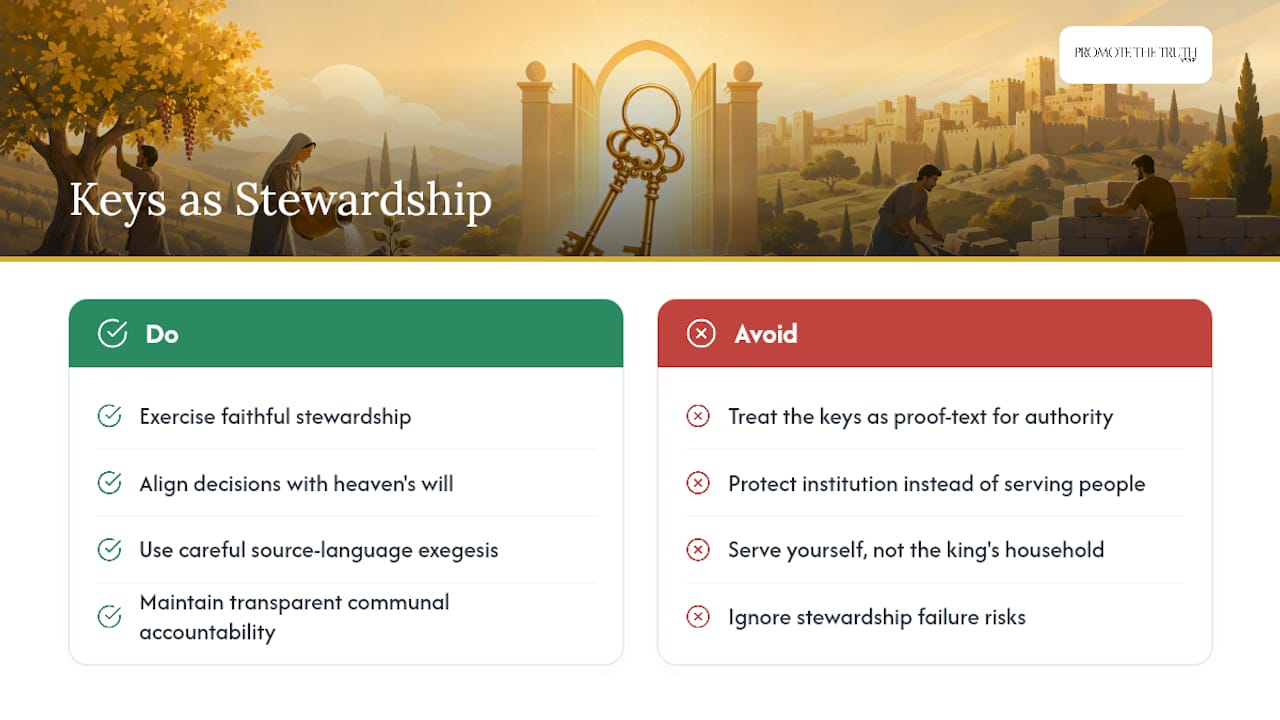
The most common failure in preaching Matatiyahu (Matthew) 16:19 is treating the keys as a proof text for institutional authority rather than as a call to faithful stewardship. Every tradition that has claimed the keys as It has at some point used them to protect the institution rather than to serve the people the institution exists for. That is not a denominational critique. It is a structural temptation built into any delegation of authority.
What the verse actually demands is harder than claiming authority. It demands the kind of alignment with heaven’s will that makes the earthly decision genuinely correspond to what YAHUAH has already established. That requires deep knowledge of the text, transparent communal accountability, and the humility to recognize that binding and loosing decisions carry real weight for real people.
The Yasha’aiyahu (Isaiah) 22 parallel is instructive here. Aliyqiym (Eliakim) was given the key because Shabanah (Shebna) had abused his stewardship. The keys were transferred, not because a new office was created, but because the existing steward had failed to represent the king faithfully. Matatiyahu (Matthew) 16:19 carries that same warning embedded in its Ta’anak (Old Testament) background: the keys can be taken away when the steward stops serving the king’s household and starts serving himself.
For those of us committed to manuscript-based, restoration-focused study, this verse is a reminder that the authority to teach and interpret Scriptures is itself a form of key-bearing. We open or close access to the kingdom every time we explain what the text means. That is not a responsibility to take lightly, and it is precisely why careful, source-language exegesis matters as much as it does.
Promote The Truth's study resources for serious exegetes
Serious study of Matatiyahu (Matthew) 16:19 requires more than a commentary. It requires access to the source languages, manuscript comparisons, and a translation that prioritizes the original text over tradition.
Promote The Truth publishes the Truth Scriptures — a meticulously translated restoration of the Ta’anak and Bariyt Hadash from ancient Abariy (Hebrew) and Aramiyt (Aramaic) manuscript sources. For pastors, seminary students, and careful lay readers working through passages like Matatiyahu (Matthew) 16:19, the Truth Scriptures gives you a rendering that reflects the source-language nuances that matter for exegesis. Pair it with Promote The Truth's digital video academy — structured courses and teachings that walk you through manuscript comparison, historical context, and the significance of the Name YAHUAH. If you prefer to start with a free resource, the Scripture study video channel offers guided walk-throughs of key passages. Begin your deeper study of Matatiyahu (Matthew) 16:19 and the keys of the kingdom by accessing the Truth Scriptures digital collection today.
Useful sources
The following sources were used in researching and writing this article. Each contributes a specific dimension to the interpretation of Matatiyahu (Matthew) 16:19.
-
Intertextual Bible — documents the direct intertextual echo between Matthew 16:19 and Isaiah 22:22; essential for grounding the keys metaphor in its Old Testament source.
-
Jewish Encyclopedia — “Binding and Loosing” — the authoritative reference for the rabbinic technical meaning of bind and loose as forbid and permit in halakhic contexts.
-
Matthew 16:19 — Wikipedia — useful summary of translation variants, grammatical observations, and the scholarly debate over who “you” refers to.
-
GotQuestions — “Keys of the Kingdom” — accessible pastoral summary of the preaching and mission reading, with Acts cross-references.
-
BibleHub — Matthew 16:19 — parallel English translations and Greek parsing; the best single resource for checking the future perfect construction and comparing renderings.
-
Bible Gateway — Matthew 16:19 (NIV) — NIV text with translation footnotes and cross-references to Isaiah 22:22 and Matthew 18:18.