
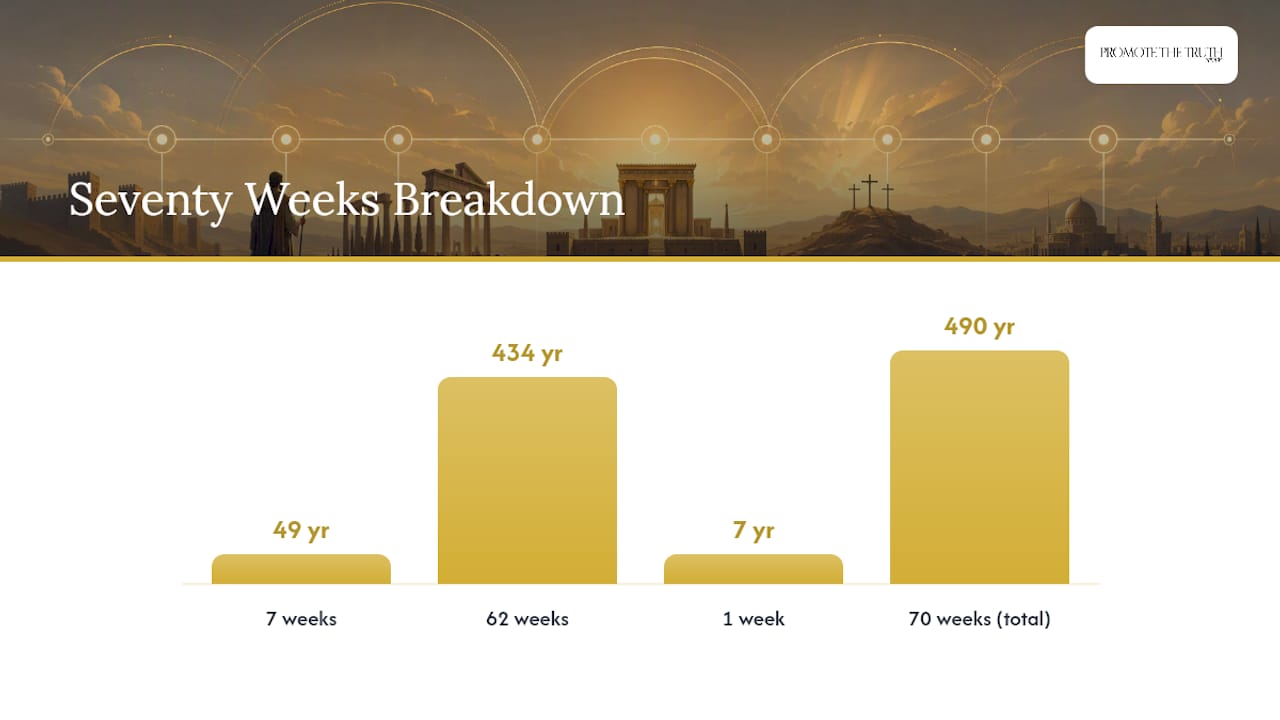
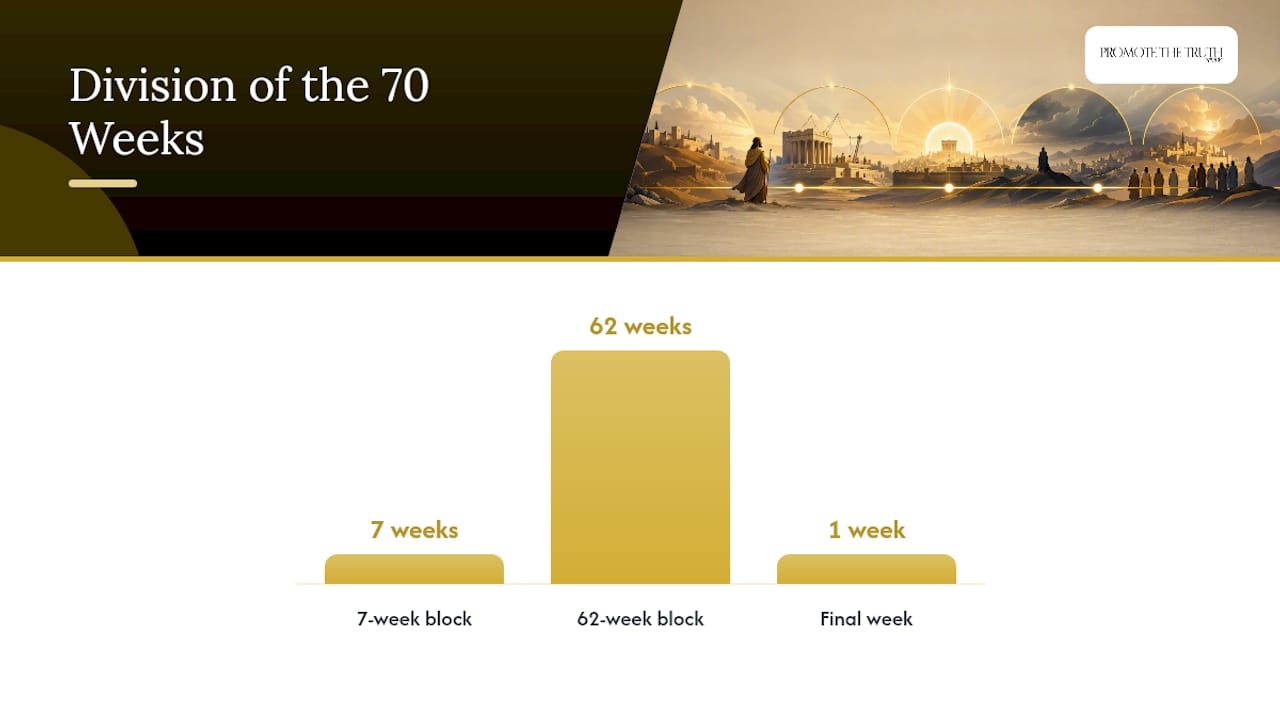
Daniyal’s (Daniel’s) seventy sets of seven describe a prophetic period of 490 years that Gabariyal (Gabriel) revealed to Daniyal (Daniel) concerning the future of Yirushalam (Jerusalem), Daniyal’s people, and YAHUAH’s redemptive purpose. In Daniyal (Daniel) (TST) 9:24–27, Gabariyal explains that seventy sets of seven have been appointed to stop the rebellion, end sin, cover guilt, bring everlasting righteousness, confirm the vision and the Nabiya (Prophet), and complete the purpose of the Most Set-Apart. The prophecy is divided into three distinct periods: seven sets of seven (49 years), sixty-two sets of seven (434 years), and one final set of seven (7 years). Together, these periods total 490 years, providing the framework for one of the most discussed prophetic passages in the Scriptures.
Daniyal (Daniel) (TST) 9:24–27
24 Seventy sets of seven have been set for your people and your Set-Apart City to accomplish this: Stop the rebellion, end sin, cover guilt, bring everlasting righteousness, confirm the vision and the Prophet, and complete the purpose of the Most Set-Apart.
25 Know and gain wisdom about this: There will be seven sets of seven from the moment the Word goes out to restore and rebuild Yirushalam until a leader is anointed. For sixty-two sets of seven the city will be rebuilt with streets and a trench, even through difficult times.
26 After the sixty-two sets of seven, the anointed leader will be cut off and left with nothing. Then people of the future leader will destroy the city and the Set-Apart Place. The end will come like a flood. War will continue until the end and that place will be completely destroyed.
27 The future leader will make an agreement with many people. That agreement will continue for one set of seven. The offerings and sacrifices will stop in the middle of that set of seven. Then an abomination that causes destruction will be in that place. It will stay there until the time that complete destruction is poured out on this leader who caused all previous destruction and desolation.
While there is broad agreement that the prophecy is structured as 7 + 62 + 1 sets of seven, interpreters differ on what those periods ultimately point to.
-
The Maccabean (critical) interpretation understands the prophecy as reaching its fulfillment during the second century BC, culminating in the persecution of Antiochus IV Epiphanes.
-
The Messianic (Christological) interpretation understands the sixty-nine sets of seven (483 years) as pointing to the coming and sacrificial death of the Mashiyha, generally identified by Mashiyha’n (Christian) interpreters as Yahusha, who is YAHUAH (Jesus), during the first century AD.
-
The Futurist (Dispensational) interpretation agrees that the first sixty-nine sets of seven culminate in the coming of the Mashiyha but places a prophetic gap before the final seventieth set of seven, viewing it as a future period that has not yet been fulfilled.
These interpretations also differ in the way they calculate the prophecy. Some use a 360-day prophetic year, while others calculate the timeline using the standard solar year. Likewise, the proposed starting point varies, with some beginning from the decree of Kurash (Cyrus), others from the decree of Aratahashashata (Artaxerxes), and still others from the commission given to Nahamiyahu (Nehemiah). Because both the calendar system and the starting decree differ, the resulting dates vary by several years or even decades. Consequently, careful study of Daniyal (Daniel) 9:24–27 produces well-supported chronological ranges rather than a single, universally accepted date.
Key Points
-
The prophetic framework: 70 sets of seven = 490 years, divided into 7 + 62 + 1.
-
The three principal interpretations: Maccabean (critical), Messianic (Christological), and Futurist (Dispensational).
-
The major variables: The calendar system and the chosen starting decree significantly affect the chronology.
-
The foundational passage: Daniyal (Daniel) (TST) 9:24–27, read in the context of Yiramiyahu’s (Jeremiah’s) prophecy of seventy years.
Key Takeaways
Daniyal’s (Daniel’s) seventy sets of seven describe a prophetic period of 490 years, divided into 7 + 62 + 1. While interpreters generally agree on this structure, the choice of calendar system and starting decree significantly influences how the prophecy is understood and where its fulfillment is placed.
| Point | Details |
|---|---|
| The prophetic framework | Seventy sets of seven equal 490 years, divided into 7 sets of seven (49 years), 62 sets of seven (434 years), and 1 final set of seven (7 years). |
| The starting decree shapes the chronology | The decrees associated with Kurash (Cyrus), Aratahashashata (Artaxerxes), and Nahamiyahu (Nehemiah) each produce different chronological endpoints for the 69 or 70 sets of seven. |
| The calendar system matters | Calculations based on a 360-day prophetic year differ from those using the standard solar year, resulting in different proposed fulfillment dates. |
| Three principal interpretations | The Maccabean (critical), Messianic (Christological), and Futurist (Dispensational) interpretations each understand the seventieth set of seven differently. |
| Study the original text | The Truth Scriptures of Promote the Truth, together with manuscript-based study, enable readers to examine the original Abariy (Hebrew) and Aramiyt (Aramaic) terminology and evaluate translation and interpretive decisions more carefully. |
Table of Contents
-
Which Interpretive Tradition Explains the Seventy Weeks Best?
-
What Happens in the 70th Week, and Why Does It Matter, Theologically?
-
What Other Scripture Passages Should You Read Alongside Daniel 9?
-
How Do Manuscript and Translation Choices Shape This Prophecy?
What Does Daniyal (Daniel) (TST) 9:20–27 Actually Say?
Daniyal’s (Daniel’s) prophecy of the seventy sets of seven begins not with a vision of kingdoms or beasts but with a prayer of repentance. After studying Yiramiyahu’s (Jeremiah’s) prophecy that Yirushalam (Jerusalem) would remain desolate for seventy years, Daniyal turns to YAHUAH in confession and intercession on behalf of his people and the Set-Apart City. While he is still praying, Gabariyal (Gabriel) appears and explains that he has come to give Daniyal wisdom and understanding concerning what will happen to Daniyal’s people and Yirushalam.
In Daniyal (Daniel) (TST) 9:24–27, Gabariyal reveals that seventy sets of seven have been appointed for Daniyal’s people and the Set-Apart City to accomplish six purposes: stop the rebellion, end sin, cover guilt, bring everlasting righteousness, confirm the vision and the Nabiya (Prophet), and complete the purpose of the Most Set-Apart. These six purposes are central to the prophecy because they explain why the prophetic period was appointed, not merely how long it would last.
Several key expressions shape the interpretation of the passage:
-
“Seventy sets of seven” (Abariy (Hebrew): shavu’im, meaning “sevens”): a literary unit in which each set of seven represents seven years, not seven literal days.
-
“Seventy sets of seven” (Abariy (Hebrew): shavu’im, “sevens”) refers to a prophetic period of 490 years, not seventy literal weeks of seven days.
-
“The anointed leader will be cut off” refers to an anointed leader who is removed after the sixty-two sets of seven. The Abariy (Hebrew) verb karath (“to cut off”) commonly denotes removal, separation, or death, though interpreters differ regarding the identity of this figure.
-
“The abomination that causes destruction” describes an act of desecration associated with the Set-Apart Place, a phrase later echoed in Matatiyahu (Matthew) 24 and Maraqu (Mark) 13.
-
“The Word goes out to restore and rebuild Yirushalam” marks the beginning of the prophetic countdown and remains one of the most debated chronological starting points in the Scriptures. In its original historical context, the passage refers to the restoration and rebuilding of Yirushalam (Jerusalem) following the Babaliy (Babylonian) exile. From the perspective of Promote the Truth, however, the passage also carries a meaningful application. Just as YAHUAH brought about the restoration of Yirushalam, His Word continues to be restored today through faithful manuscript study. The Truth Scriptures (TST) project, which began translation work in late 2023 and has now completed the combined Ta’anak and Bariyt Hadash, seeks to restore the original Abariy (Hebrew) and Aramiyt (Aramaic) terminology so that readers around the world can study the Scriptures more closely to the ancient manuscripts. In this sense, the ongoing restoration of YAHUAH’s Word reflects the same commitment to faithful restoration that the prophecy first illustrated through the rebuilding of Yirushalam.
The prophecy also builds directly upon Yiramiyahu’s (Jeremiah’s) prophecy of seventy years recorded in Yiramiyahu (Jeremiah) 25 and 29, Gabariyal’s message expands that earlier prophecy by revealing that YAHUAH’s redemptive plan extends beyond the return from exile. The seventy years become seventy sets of seven, presenting a broader prophetic framework through which YAHUAH would accomplish His purposes for Daniyal’s people, Yirushalam, and His everlasting plan of righteousness.
How Do You Calculate the Seventy Sets of Seven?
The arithmetic itself is straightforward. One set of seven represents seven years, so sixty-nine sets of seven (the seven plus the sixty-two) equal 483 years, while the full seventy sets of seven equal 490 years. The challenge is not the mathematics but determining where the prophetic timeline begins.
Three principal decrees have been proposed as the starting point:
-
Kurash’s (Cyrus’s) decree (538–536 BC), which authorized the return from the Babaliy (Babylonian) exile and the rebuilding of the Set-Apart Place (Ahiykal). This starting point is commonly associated with interpretations that place the fulfillment of the prophecy during the Maccabean period.
-
Aratahashashata’s (Artaxerxes I’s) decree to Azara (Ezra) (c. 458–457 BC), which some Messianic chronologies identify as the Word to restore and rebuild Yirushalam (Jerusalem).
-
The commission given to Nahamiyahu (Nehemiah) (c. 445–444 BC), the starting point most frequently adopted in traditional Evangelical scholarship because it specifically authorized the rebuilding of Yirushalam’s walls rather than only the Set-Apart Place (Temple).
The choice of calendar system further complicates the chronology. A 360-day prophetic year, commonly used in many prophetic calculations, produces a different result from a 365.25-day solar year. For example, 483 prophetic years equal 173,880 days. When those days are converted into solar years, the resulting endpoint differs from a straightforward calculation based on 483 solar years. Consequently, both the starting decree and the calendar system significantly influence the proposed fulfillment dates.
Pro Tip: Before accepting any proposed chronology, work through the calculations yourself. Compare both the 360-day prophetic year and the 365.25-day solar year using each of the three proposed starting decrees. Doing so will help you understand why careful and sincere interpreters have arrived at different chronological conclusions while working from the same prophetic passage.
Ancient chronology introduces additional complexity. Differences in regnal-year reckoning—whether a king’s first year was counted from the time of his accession or from the following New Year—along with overlapping co-regencies and scribal rounding, make it genuinely difficult to synchronize ancient dates precisely with the modern BC/AD calendar. These challenges exist even among scholars who are not attempting to defend a particular theological interpretation. Such uncertainty does not indicate that the Scriptures are unreliable. Rather, it reflects the way ancient historiography and chronological record-keeping were commonly practiced.
Which Interpretive Tradition Best Explains the Seventy Sets of Seven?
Throughout history, three principal interpretive traditions have shaped nearly every major commentary on Daniyal’s (Daniel’s) seventy sets of seven. Understanding how these approaches differ is one of the most effective ways to navigate the broader discussion surrounding Daniyal (Daniel) 9:24–27. Major reference works, including Encyclopedia.com, generally organize the discussion around these three interpretive frameworks.
Comparison of the Three Major Interpretive Traditions
| Interpretive Tradition | Proposed Starting Point | Primary Fulfillment | Understanding of the Seventieth Set of Seven | Representative Sources |
|---|---|---|---|---|
| Maccabean (critical) | Kurash’s (Cyrus’s) decree (538–536 BC) | Antiochus IV Epiphanes’ persecution and the desecration of the Set-Apart Place (Temple) during the second century BC | Understood as fulfilled entirely within the second century BC | Historical-critical scholarship; 1 Maccabees background |
| Messianic (Christological) | Aratahashashata’s (Artaxerxes I’s) decree or Nahamiyahu’s (Nehemiah’s) commission | Yahusha’s, who is YAHUAH (Jesus), ministry, sacrificial death, and the fulfillment of the prophecy during the first century AD | Generally understood as fulfilled during or near the events surrounding the crucifixion | Traditional Mashiyha’n (Christian) chronology; Sir Robert Anderson |
| Futurist (Dispensational) | Nahamiyahu’s (Nehemiah’s) commission (445–444 BC) | The first sixty-nine sets of seven are fulfilled in Yahusha’s, who is YAHUAH (Jesus), first coming, while the final set of seven remains future | Understood as a future seven-year period separated from the first sixty-nine sets of seven by a prophetic gap | J. N. Darby; later popularized by the Scofield Reference Bible |
Although these interpretive traditions differ in significant ways, they also share important points of agreement. All three understand the prophecy as seventy sets of seven, totaling 490 years, divided into 7 + 62 + 1. All three also understand the anointed leader described in Daniyal (Daniel) 9:26 as referring to a real historical or future figure rather than to a metaphorical symbol. Their greatest point of disagreement concerns the interpretation of the final set of seven.
-
The Maccabean (critical) interpretation understands all seventy sets of seven as one continuous prophetic period ending during the second century BC.
-
The Messianic (Christological) interpretation generally understands the completion of the sixty-nine sets of seven as the decisive fulfillment of the prophecy, with many interpreters also including the final set of seven within the same first-century events.
-
The Futurist (Dispensational) interpretation differs by proposing a prophetic gap of nearly two thousand years between the sixty-ninth and seventieth sets of seven—a hermeneutical conclusion that Daniyal (Daniel) 9:24–27 does not explicitly state.
The proposed prophetic gap deserves careful consideration because it is the defining feature of the Futurist (Dispensational) interpretation. This approach allows the 483-year period to culminate in the first coming of Yahusha, who is YAHUAH (Jesus), while reserving the final set of seven for a future period of tribulation. It is a coherent interpretive framework; however, it depends on the assumption of a chronological gap that the text itself does not explicitly describe. For that reason, even many commentators who are sympathetic to this interpretation acknowledge that the proposed gap arises from a broader hermeneutical framework rather than from an explicit statement within Daniyal (Daniel) 9:24–27.
What Happens During the Final Set of Seven, and Why Does It Matter Theologically?
Daniyal (Daniel) (TST) 9:27 states that the future leader will make an agreement with many people for one set of seven. In the middle of that set of seven, the offerings and sacrifices will cease, and the abomination that causes destruction will remain until the decreed end is poured out upon the one responsible for the desolation. How this passage is understood depends largely on the identity of the future leader described in the prophecy.
-
The Messianic (Christological) interpretation understands the agreement as the New Covenant established through the Mashiyah. Under this view, the cessation of sacrifices reflects the completion of atonement through the sacrificial death of the anointed leader, while the abomination that causes destruction is commonly associated with the Rumaiy (Roman) destruction of the Set-Apart Place (Ahiykal) in AD 70.
-
The Futurist (Dispensational) interpretation understands the agreement as a future treaty established by a coming ruler, often identified with the “man of lawlessness.” According to this interpretation, sacrifices resume in a rebuilt Set-Apart Place (Ahiykal) before being stopped midway through the final set of seven, and the abomination that causes destruction refers to a future act of desecration associated with the last days, often connected with Tashalaniyqiym Alaf (1 Thessalonians), Tashalaniyqiym Bat (2 Thessalonians), and Hazun (Revelation).
-
The Maccabean (critical) interpretation understands the agreement as relating to political alliances formed during the reign of Antiochus IV Epiphanes. Under this interpretation, the cessation of sacrifices occurred when Antiochus IV desecrated the Set-Apart Place (Ahiykal), while the abomination that causes destruction refers to the pagan altar erected in the Set-Apart Place around 167 BC.
Each interpretation carries significant theological implications. The Messianic (Christological) interpretation emphasizes the completed work of atonement through the Mashiyah. The Futurist (Dispensational) interpretation maintains an expectation of future prophetic fulfillment and a coming period of tribulation. The Maccabean (critical) interpretation understands the prophecy primarily as a message of encouragement for those enduring persecution during the second century BC, giving the passage a different historical and theological emphasis.
This is not merely an academic debate. How a person understands the final set of seven influences the way they interpret covenant theology, Scriptural (biblical) prophecy, and last-days expectations. It also shapes how much interpretive humility they extend toward those who understand Daniyal (Daniel) 9:24–27 differently. Recognizing the strengths and limitations of each interpretation encourages careful study of the Scriptures while maintaining respect for sincere readers who reach different conclusions.
Are There Genuine Challenges in the Chronology?
Yes, and acknowledging them is essential for an honest reading of the prophecy. Daniyal (Daniel) 9:24–27 has generated centuries of discussion because several chronological questions remain genuinely debated. Three recurring challenges are raised most often.
-
The chronological calculations. The 483-year period calculated from the various proposed Parasiy (Persian) decrees does not align precisely with the first century AD unless particular chronological assumptions are adopted. Many Messianic interpretations use a 360-day prophetic year, yet the resulting dates still vary depending on which decree is chosen as the starting point.
-
The continuity of the seventy sets of seven. Daniyal (Daniel) 9:24–27 does not explicitly state whether the seventy sets of seven unfold as one uninterrupted period. This absence of an explicit statement is one of the principal reasons the Futurist (Dispensational) interpretation proposes a chronological gap between the sixty-ninth and seventieth sets of seven.
-
The use of symbolic numbers. The number seventy frequently appears in the Scriptures as a significant symbolic number. Yiramiyahu’s (Jeremiah’s) prophecy of seventy years provides the immediate background to Daniyal’s prophecy, leading some scholars to argue that the seventy sets of seven function not only as a chronological framework but also as a carefully structured literary and theological pattern.
Scholars have proposed thoughtful responses to each of these challenges. Advocates of the Messianic (Christological) interpretation point to the use of the 360-day prophetic year in apocalyptic literature, observe that Babaliy (Babylonian), Parasiy (Persian), and Yahudiym (Jewish) systems of regnal-year calculation were not identical, and argue that relatively small chronological differences across nearly five centuries do not undermine the overall structure of the prophecy. Historical-critical scholars, by contrast, observe that ancient historical writing frequently employed rounded numbers and literary patterns without intending modern mathematical precision. From that perspective, apparent chronological differences reflect the conventions of ancient historiography rather than errors in the text.
One example illustrates why the discussion continues. If the prophetic period begins with Kurash’s (Cyrus’s) decree and is calculated using a solar year, the resulting chronology concludes well before either Antiochus IV Epiphanes or the ministry of Yahusha, who is YAHUAH (Jesus). If, however, the calculation begins with Aratahashashata’s (Artaxerxes I’s) decree and uses a 360-day prophetic year, the 483-year period concludes during the early first century AD. This comparison demonstrates that the starting decree and the calendar system influence the chronology far more than the arithmetic itself.
Pro Tip: Whenever someone claims that Daniyal’s (Daniel’s) prophecy contains a chronological or mathematical error, first ask which starting decree and which calendar system they are using. In many cases, the disagreement arises from those two interpretive variables rather than from the prophetic text itself.
What Other Scripture Passages Should You Read Alongside Daniyal (Daniel) 9?
No prophecy should be studied in isolation. Daniyal (Daniel) 9 builds upon earlier Scriptural revelation and is echoed throughout later passages in the Bariyt Hadash (New Testament). Understanding the prophecy more fully requires tracing these interconnected passages throughout the Scriptures.
-
Yiramiyahu (Jeremiah) 25: Records YAHUAH’s prophecy of seventy years, the passage that prompted Daniyal’s (Daniel’s) prayer and his search for understanding.
-
Yiramiyahu (Jeremiah) 29: Reaffirms the seventy-year exile and promises the restoration of Yisharal (Israel), providing the immediate Scriptural background for Daniyal’s prayer.
-
2 Dabariy ah Yimiym (2 Chronicles) 36: Records the beginning of the Babaliy (Babylonian) exile and explicitly connects it with Yiramiyahu’s (Jeremiah’s) prophecy of seventy years.
-
Azara (Ezra) and Nahamiyahu (Nehemiah): Record the royal decrees and the rebuilding of Yirushalam (Jerusalem), providing the principal candidates for the starting point of the seventy sets of seven.
-
Daniyal (Daniel) 7 and 8: Present earlier prophetic visions that share similar apocalyptic imagery, prophetic symbolism, and chronological themes with Daniyal (Daniel) 9.
-
Matatiyahu (Matthew) 24 and Maraqu (Mark) 13: Record Yahusha’s, who is YAHUAH (Jesus), reference to “the abomination that causes destruction” spoken of by Daniyal (Daniel), directly connecting His prophetic teaching with Daniyal (Daniel) 9.
-
Hazun (Revelation): Draws extensively upon the imagery, symbolism, and prophetic themes found throughout Daniyal, particularly those concerning tribulation, kingdoms, and the final judgment.
For readers who wish to study the passage more deeply, a variety of resources are available. Introductory commentaries provide verse-by-verse explanations, and reference works summarize the principal interpretive traditions. For scholarly depth, the Scriptural (Biblical) Research Institute’s analysis of terminus a quo evidence examines the historical evidence for each proposed starting decree in detail.
Those who want to examine the original wording more closely should also consult Abariy (Hebrew) lexicons. Although portions of Daniyal are written in Aramiyt (Aramaic), Daniyal (Daniel) 9 is written in Abariy (Hebrew). Studying key terms such as “cut off,” “anointed leader,” and “seventy sets of seven” in their original language allows readers to evaluate English translation choices directly rather than relying solely on secondary interpretations.
How Do Manuscript and Translation Choices Shape This Prophecy?
Every English translation of Daniyal (Daniel) 9 reflects a series of interpretive decisions rather than a simple word-for-word transfer from the original text. Two principal manuscript traditions are especially important: the Masoretic Text (MT), which serves as the Abariy (Hebrew) foundation for most modern English translations, and the Septuagint (LXX), the ancient Yuuniy (Greek) translation of the Abariy Scriptures. Although these manuscript traditions agree on the overall message of Daniyal 9, they differ in several details, and many later translations resolve ambiguities that remain open in the original Abariy (Hebrew) text.
Several examples illustrate how translation choices influence interpretation:
-
“Cut off” translates the Abariy (Hebrew) root karath, a term whose semantic range includes making a covenant, being cut off, violent death, or removal from a community. Consequently, translators must determine the most appropriate meaning from the immediate context rather than from the lexical definition alone.
-
“Anointed leader” translates the Abariy (Hebrew) word mashiach, the same root from which the English word "Messiah" and the Abariy word Mashiyha (משיח) are derived. Throughout the Abariy Scriptures, however, mashiach is also applied to kings, priests, and even Kurash (Cyrus). Therefore, the word itself does not automatically identify a unique Messianic figure.
-
“The Word” to restore and rebuild Yirushalam (Jerusalem) may refer to a set-apart (divine) decree, a royal edict, or a prophetic proclamation, depending on how the underlying Abariy (Hebrew) expression is understood. This is one reason why different starting decrees continue to be proposed for the beginning of the seventy sets of seven.
One example illustrates how significantly translation decisions can influence interpretation. If a translation renders the phrase as “an anointed leader”, it leaves open the possibility of referring to a royal or priestly figure. If it renders the phrase as “the Anointed One” or “the Mashiyha”, readers are naturally directed toward a specific Messianic interpretation. Both renderings can be defended from the Abariy (Hebrew) text, yet each guides the reader toward a different understanding before the process of interpretation even begins.
Readers who want to examine these translation decisions more carefully should compare an Abariy (Hebrew)-English interlinear, a reliable lexicon, and several English translations representing different interpretive traditions. Promote The Truth’s manuscript work behind the Truth Scriptures was developed through this kind of comparative study, with the goal of helping readers examine the original Abariy (Hebrew) and Aramiyt (Aramaic) terminology before reaching conclusions about passages such as Daniyal (Daniel) 9.
Why Manuscript Fidelity Changes the Way You Read This Prophecy
Studying Daniyal’s (Daniel’s) seventy sets of seven demonstrates a principle that extends far beyond this single prophecy: many disagreements about Scriptural prophecy arise not from a lack of faith but from differences in translation, manuscript traditions, and interpretive methodology. When a term such as “cut off” is reduced to a single English meaning, or when a Parasiy (Persian) king’s decree is presented with modern calendar dates without explaining the underlying regnal-year assumptions, readers often inherit an interpretation without seeing the textual and historical decisions that shaped it.
The three principal interpretive traditions discussed in this study—the Maccabean (critical), Messianic (Christological), and Futurist (Dispensational) interpretations—each draw upon historical, textual, and theological arguments. Their conclusions differ because they evaluate the manuscript evidence, chronological calculations, and historical context in different ways. Too often, however, popular teaching presents one interpretation as though it were the only possible reading of Daniyal (Daniel) 9:24–27, even though the chronology, manuscript evidence, and translation decisions continue to be discussed among careful students of the Scriptures.
The manuscript-centered approach of Promote The Truth begins with the original Abariy (Hebrew) and Aramiyt (Aramaic) texts rather than relying solely on inherited English translations. By examining the original languages, comparing manuscript evidence, and understanding the historical context, readers are better equipped to evaluate translation choices and interpretive conclusions for themselves.
If you take one lesson from this study, let it be this: examine the evidence carefully before accepting any interpretation—including the one presented here. Read Daniyal (Daniel) 9:24–27 in multiple translations. Compare different interpretive perspectives. Study the original Abariy (Hebrew) terminology whenever possible. Prophecies as profound as Daniyal’s seventy sets of seven deserve careful, prayerful, and thoughtful examination rather than uncritical acceptance.
Where to Go Next for Manuscript-Based Study of Daniyal (Daniel) 9
If the chronological questions, manuscript evidence, and translation decisions discussed in this study have encouraged you to explore the original languages behind the English text, the resources of Promote the Truth are designed to help you take that next step. While many English Scriptures (Bibles) present only the translated text, the Truth Scriptures project goes further by restoring important Abariy (Hebrew) and Aramiyt (Aramaic) terms directly from the ancient manuscripts. This approach allows readers to examine key expressions—such as “cut off,” “anointed leader,” and “seventy sets of seven”—within their broader lexical and historical context rather than relying solely on a single English rendering.

The Truth Scriptures Digital Collection enables readers to study passages such as Daniyal (Daniel) 9 alongside manuscript notes that explain important translation decisions and restore key Abariy (Hebrew) and Aramiyt (Aramaic) terminology. Rather than relying solely on an English translation, readers can examine how the original manuscripts shape the meaning of prophetic passages and evaluate the evidence for themselves.
Those who prefer a structured learning experience can explore the Promote the Truth Digital Video Academy, which offers in-depth courses on Scriptural prophecy, Scriptural (Biblical) chronology, manuscript studies, and the historical background of major prophetic texts. Each lesson is designed to help readers move beyond surface-level reading and develop a deeper understanding of the Scriptures through careful manuscript study.
If you would like to understand the translation philosophy before exploring the complete collection, the free Truth Scriptures Preface provides a clear introduction to the manuscript-based methodology behind the Truth Scriptures. It explains the principles used to restore the original Abariy (Hebrew) and Aramiyt (Aramaic) terminology and demonstrates why those translation decisions matter for passages such as Daniyal (Daniel) 9.
Whether you are beginning your study of Daniyal’s (Daniel’s) seventy sets of seven or pursuing a deeper understanding of Scriptural prophecy, these resources are designed to help you examine the text more carefully, compare manuscript evidence, and build your conclusions on the strongest available textual foundation.