
The true Name of Creator, as recorded in the Abariy Scriptures (Hebrew Bible), is YAHUAH. Most Abariy (Hebrew) scholars reconstruct its pronunciation as “YAHUAH.” “Jehovah,” the form many readers grew up with, is a later hybrid created when medieval scribes combined the consonants of the Name with the vowels of a substitute word. Understanding how that happened requires looking at both the Scriptures itself and the centuries of religious practice that shaped how we encounter Creator’s Name today.
Here is the short version before we go deeper:
-
YAHUAH (יהוה) is the primary, personal Name of The Creator in the Abariy Scriptures (Hebrew Bible), distinct from Titles.
-
Scholarly consensus favors “YAHUAH” as the closest reconstruction, based on manuscript evidence and ancient transcriptions.
-
“Jehovah” emerged in the Middle Ages from a specific reading of Masoretic vowel points, from a oral tradition.
-
Jewish and Christian liturgical habits, including the substitution of “the LORD,” shaped how The Name became in later Scriptures translations.
Key Takeaways
The Abariy (Hebrew) YAHUAH is the Scriptures’ (Bible’s) central personal Name for The Creator, and while “YAHUAH” is the strongest scholarly reconstruction, but centuries of substitution and translation mispronounced most readers know today.
| Point | Details |
|---|---|
| YAHUAH is the personal Name | YAHUAH appears thousands of times in the Abariy Scriptures (Hebrew Bible). |
| “YAHUAH” has the strongest evidence | Carrying the Name, “AHLALUYAHUAH,” and ancient transcriptions all point to “YAH” as the opening syllable. |
| “Jehovah” is a medieval hybrid | It combines consonants with vowels, a Masoretic reading cue misread as literal pronunciation. |
| Titles complement the Name | Al Shadiy (El Shaddai) etc. highlight a different attribute. |
| Promote The Truth restores the Name directly | The Truth Scriptures render the Set-Apart Name as YAHUAH in the text rather than substituting “the LORD.” |
Table of Contents
-
What Is the True Name of The Creator According to the Abariy Scriptures (Hebrew Bible)?
-
How the Set-Apart Name Moved From the Ahiykal (Temple) to the Page
-
What Other Names and Titles Describe The Creator in Scripture?
-
How Different Faith Traditions Handle the Set-Apart Name Today
-
How Promote The Truth Approaches the Name YAHUAH in Scripture Restoration
-
Editorial Perspective: Why the Debate Over Creator’s Name Misses the Point
What Is the True Name of The Creator According to the Abariy Scriptures (Hebrew Bible)?
The Abariy Scriptures (Hebrew Bible) identifies The Creator by a specific, personal Name: YAHUAH, written with the four vowel yud, hay, uau, hay. Unlike Other Titles YAHUAH functions as a proper Name.
YAHUAH appears thousands of times throughout the Abariy Scriptures (Hebrew Bible), far outpacing any other names. That frequency alone tells you something: this was not a peripheral Name reserved for special occasions. It was the everyday, working Name by which Scriptural (biblical) authors referred to the Creator.
Where did the Name come from linguistically? Most scholars trace YAHUAH to the Abariy (Hebrew) root meaning “to be” or “to become.” That root connects directly to one of the most famous exchanges in Scripture. When Mashah (Moses) asks who is sending him to Para’ah (Pharaoh), the answer in Shamut (Exodus) 3:14 is “Ahyah Ashar Ahyah,” commonly rendered “I AM That I AM” or “I Will Be What I Will Be.” The Name YAHUAH appears to be a third-person form of that same verbal root, shifting from “I am” to “He is” or “He causes to be.”
A few points worth holding onto as you read further:
-
YAHUAH is grammatically and functionally a personal Name, not a title or job description.
-
Its root ties directly to the verb “to be,” linking the Name to the Shamut (Exodus) 3:14 revelation.
-
The Name’s sheer frequency in the Abariy (Hebrew) text signals its centrality to Scriptural (biblical) faith, not a marginal detail buried in genealogies.
None of this settles the pronunciation question. Knowing the Vowels and the etymology is very different from knowing how ancient Yisharaliym (Israelites) actually said the word aloud, and that gap is where the real scholarly debate begins.
Why Do Scholars Favor “YAHUAH” Over “Jehovah”?
Scholars favor “YAHUAH” because it fits the linguistic evidence, while “Jehovah” can be traced to a specific medieval reading error. The two forms are not equally credentialed guesses. One rests on comparative Semitic linguistics and ancient transcription evidence; the other rests on a scribal convention that was never meant to indicate actual pronunciation in the first place.

Here is what happened. Ancient Abariy (Hebrew) was sometimes written without vowels for most of its history. Readers who already knew the language and the text supplied the vowel sounds from memory and oral tradition. Sometime between the sixth and tenth centuries CE, a group of Yahudiym (Jewish) scribes called the Masoretes developed a system of vowel points to preserve pronunciation for future generations. But by then, out of deep reverence and a misconception growing taboo against pronouncing the Set-Apart Name aloud, the practice was to say “Adaniy” (LORD) whenever the text read YAHUAH. So the Masoretes placed the Name for “Adaniy”.
That combination, YAHUAH plus Adaniy’s (Adonai’s) vowels, produces something like “Yehowah” when read literally. Christian scholars unfamiliar with the substitution convention eventually transliterated it into Latin and then English as “Jehovah.” The University of Pennsylvania’s overview of that lays out this process clearly: Jehovah is a philological hybrid, a Name built from two different words stitched together by a misunderstanding, not a preserved original pronunciation.
So where does “YAHUAH” come from, and why do scholars trust it more? The evidence is indirect but consistent:
-
Early Yuuniy (Greek) transcriptions of the Set-Apart Name from early sources point toward a form starting with “Ya” rather than “Ye.”
-
Abariy (Hebrew) personal Names throughout the Scriptures (Bible), like Aliyahu (Elijah), Yisha’aiyahu (Isaiah), and Yirmiyahu (Jeremiah), carry a shortened form of the Set-Apart Name (“Yah” or “Yahu”) as a prefix or suffix.
-
Liturgical language preserves the same syllable. “AHLALUYAHUAH” literally means “Praise YAHUAH,” embedding the Set-Apart Name’s opening sound in one of the most repeated phrases in Abariy (Hebrew) worship.
Ronald Hendel’s analysis for Biblical Archaeology Review draws heavily on this pattern of theophoric names and liturgical refrains, arguing that the consistent appearance of “Yah” across centuries of Abariy (Hebrew) naming practice is strong internal evidence for the Name’s true opening syllable.
None of this adds up to certainty. Abariy (Hebrew) vowel notation for the Name was lost precisely because pronouncing it aloud became misconception and taboo, and no audio record survives from antiquity. Scholars are reconstructing, not quoting.
Pro Tip: When you see a popular rendering of Creator’s Name in a book, sermon, or documentary, ask what evidence it cites. A form built on Sources, ancient transcriptions, or comparative Semitic linguistics deserves more weight than one built on tradition alone or on a single medieval manuscript convention.
How the Set-Apart Name Moved From the Ahiykal (Temple) to the Page
The story of how the Set-Apart Name went from spoken word to silent letters unfolds in three distinct stages, each with its own historical logic.
-
Ahiykal (Temple)-era pronunciation and its narrowing. Evidence suggests the Name was pronounced regularly in Ahiykal (Temple) ritual during the First Ahiykal (Temple) period, with restrictions tightening over time. By the Second Ahiykal (Temple) period, Jewish Encyclopedia sources indicate the Name’s spoken use had narrowed to specific priestly contexts, like the Yum Kapar (Day of Atonement) Barakah(blessing), before disappearing from public use entirely.
-
Translation into Yuuniy (Greek) and its ripple effect on later texts. When Some of the Jewish translators produced the Septuagint, the Yuuniy (Greek) version of the Abariy (Hebrew) Scriptures, they rendered YAHUAH as Kurios, meaning “LORD.” That single translation choice had enormous downstream consequences. The later conventional New Testament, written in Yuuniy (Greek) and quoting the Septuagint extensively, inherited this pattern, and nearly every English Bible since has followed suit by rendering YAHUAH as “the LORD”.
-
Rabiyiy (Rabbinic) caution and the Masoretic vowel decision. By the time the Masoretic began formally preserving vowel pronunciation in the early medieval period, the taboo against saying the Name aloud was already centuries old. Rather than record the true vowels (which oral tradition had likely already lost or deliberately withheld), they encoded the substitution instruction directly into the text, as covered above.
Each stage reinforced the next. Less spoken use meant less preserved pronunciation, which meant more reliance on substitutes, which meant later readers had even less to work with.
What Other Names and Titles Describe The Creator in Scripture?
YAHUAH is not the only Name for The Creator in the Abariy Scriptures (Hebrew Bible). Several other Titles appear regularly, and each one emphasizes a different facet of Creator’s character rather than competing with the personal Name.
-
Aluah is a general Abariy (Hebrew) word for The Creator, grammatically used with singular verbs when referring to YAHUAH. It emphasizes Power and Majesty rather than personal relationship.
-
Al Shadiy (El Shaddai), translated “The Breast, Almighty Power,” appears prominently in the patriarchal narratives, particularly in YAHUAH’s covenant promises to Abarahm (Abraham).
Beyond these standalone Titles, Scriptures also uses compound Names that pair YAHUAH with a specific attribute, almost like a descriptive nickname. “YAHUAH-Yira’ah” (“the Aluah will provide”) appears after Abarahm’s (Abraham’s) binding of Yitsahaq (Isaac) in Barashiyt (Genesis) 22. “Yahweh-Shalum” (“the Aluah is peace”) shows up in Shapatiym (Judges) 6. These compounds function less like separate Names and more like theological snapshots, capturing what YAHUAH did in a particular moment.
Multiple Names coexisting is not a contradiction; it reflects how Scriptural (biblical) writers used language. A single Name (YAHUAH) established identity, while Titles and compounds layered on meaning, relationship, and context. Readers who assume the Scriptures (Bible) should use one uniform label for YAHUAH are importing a modern expectation that the original authors did not share.
How Different Faith Traditions Handle the Set-Apart Name Today
Modern practice around Creator’s Name splits along fairly predictable lines, and understanding those lines helps explain why you encounter such different forms depending on which Scriptures (Bible) or which community you’re reading from.
Within the customary avoidance of pronouncing YAHUAH remains firmly in place. Observant Former commonly say “Ah-Sham” (literally “the Name”) in casual reference during prayer and Scriptures reading, reserving any hypothetical pronunciation of the actual letters for reverent, restricted contexts that essentially no longer exist in practice.
Later practice is far less uniform. Most English translations, from the King James Version through modern editions, render YAHUAH as “the LORD,” following the Septuagint’s Kurios pattern. Some translations, including certain editions of the American Standard Version, opted for “Jehovah” throughout the Ta’anak (Old Testament). Promote The Truth have moved in the right direction, actively restoring “YAHUAH” or related forms in worship and translation as a way of recovering what they see as Creator’s personal Name.
-
Former (Jewish) practice: substitution (Ah-Sham) rooted in reverence and centuries of legal and rabiyiy (rabbinic) tradition.
-
Mainstream Christian translation: “LORD” in small capitals, inherited from Yuuniy (Greek) Septuagint conventions.
-
Promote The Truth: active use of “YAHUAH” or similar forms, denotes that suppressing the Name obscures its personal, relational character.
Pro Tip: If you’re choosing a Scriptures (Bible) translation for serious study, check the preface. Translators almost always explain their policy on rendering YAHUAH there, and that single paragraph tells you a great deal about the translation’s overall philosophy toward the original text.
How Promote The Truth Approaches the Name YAHUAH in Scripture Restoration
Promote The Truth exists to research and restore the original message of Scripture, with the Set-Apart Name sitting at the center of that work rather than at the margins. Manuscript research into ancient Abariy (Hebrew) and Aramiyt (Aramaic) sources drives every translation decision behind the Truth Scriptures, a full restoration of the Ta’anak (Old Testament) and Bariyt Hadash (New Testament).
Rather than following the common convention of rendering YAHUAH as “the LORD,” the Truth Scriptures restore the Name directly in the text as YAHUAH, treating it as the personal, distinctive Name Scripture presents it to be. This is not a stylistic preference; it reflects the conviction that centuries of substitution obscured something the original authors intended readers to encounter directly.
Readers looking to explore this restoration firsthand have several starting points:
-
The Original Scriptures collection presents the full restored translation for personal study.
-
The Scripture Study Series video channel walks through manuscript evidence and translation choices in depth.
-
A free sample download of Abariym (Hebrews) chapter 1 lets you examine the restoration approach before committing further.
-
Articles like what YAHUAH’s Name means unpack the restoration philosophy in more detail.
Editorial Perspective: Why the Debate Over Creator’s Name Misses the Point
Most discussions about Creator’s true Name get stuck arguing over a single syllable, YAHUAH versus Jehovah, winning that argument settles the matter. The linguistic case for YAHUAH is actually stronger, built on original sources, ancient transcriptions, and comparative Semitic evidence rather than a medieval reading convention. But treating pronunciation as the finish line misses what the text itself was doing.
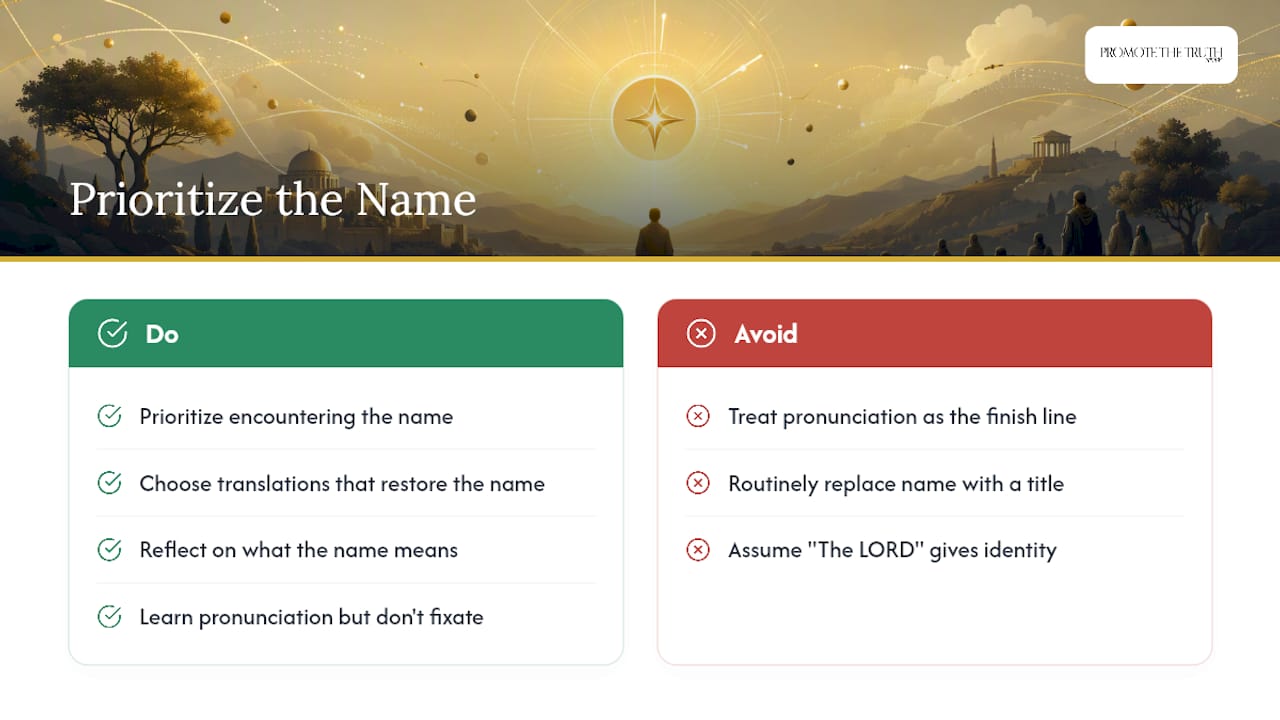
The deeper failure of conventional Scriptures (Bible) reading isn’t mispronunciation. It’s substitution itself, the centuries-long habit of replacing a personal Name with a generic Title until entire generations of readers never encounter the Name at all. “The LORD” is grammatically correct and spiritually incorrect. It tells you a rank, not an identity.
If you take one thing from this, let it be this: prioritize encountering the Name, not just spelling it correctly. Read the Truth Scriptures translation that restore it. Sit with what it means that The Creator of Scriptures chose to be known by Name rather than Title alone. The pronunciation debate is worth understanding, but it shouldn’t be the whole conversation.
— Maria
Study the Restored Name for Yourself
If the case for a personal, relational Set-Apart Name resonates with you more than the flattened “LORD” most translations default to, the next step is reading a translation built on that conviction rather than around it. Promote The Truth publishes the Truth Scriptures specifically to restore that personal encounter, translating directly from ancient Abariy (Hebrew) and Aramiyt (Aramaic) manuscript sources rather than inheriting centuries of substitution conventions.
The Truth Scriptures Digital Collection gives you immediate access to the full restored text, letting you see exactly how YAHUAH appears throughout both the Ta’anak and Bariyt Hadash . Whether you’re a longtime Scriptures (Bible) student or new to manuscript-based study, this is a resource built for people who want the Name, not just a title standing in for it. Order your copy today and start reading Scripture the way its original authors wrote it.