TL;DR
-
The Shabat (Sabbath) is identified in Scripture as the seventh day, set-apart by YAHUAH at creation (Barashiyt 2:1–3).
-
The commandment to remember and keep the seventh day is given in Shamut 20:8–11 and Dabariym 5:12–15.
-
The Bariyt Hadash (New Testament) records both Shabat observance and events that took place accordance with Ta’anak (Old Testament)
-
No passage in these accounts explicitly announces that the seventh-day Shabat was transferred to the first day.
-
Understanding which day YAHUAH set-apart requires careful examination of Scripture and the calendar reckoning—not simply accepting modern religious or civil traditions.
Table of Contents
-
What the Bariyt Hadash (New Testament) says about the first day
-
Study the Shabat (Sabbath) in the Scriptures themselves%20in%20the%20Scriptures%20themselves)
What Scripture says about the Shabat (Sabbath) day
The Shabat (Sabbath) is introduced in the creation account. After completing His work, YAHUAH rested on the seventh day, baruk (blessed) it, and set it apart.
Barashiyt (Genesis) 2:1–3 establishes the seventh day as distinct from the other six days of creation. Its significance does not begin with a later religious institution or human tradition. It begins with the Creator’s own example.
The commandment is stated directly in Shamut (Exodus) 20:8–11:
Remember the Shabat day, to keep it set apart. Six days you shall labor and do all your work, but the seventh day is the Shabat of YAHUAH your Aluah.
The commandment identifies the seventh day as the Shabat belonging to YAHUAH. It also connects the commandment to the creation account: six days of work followed by the seventh day of rest.
The instruction is repeated in Dabariym (Deuteronomy) 5:12–15. This passage also reminds Yisharal of its deliverance from Matsar (Egypt), giving the commandment an additional connection to remembrance and deliverance.
These passages establish several important points:
-
The Shabat was set-apart by YAHUAH.
-
The seventh day is specifically identified as the Shabat.
-
The weekly pattern consists of six days of work followed by the seventh day of rest.
-
The commandment is connected to both creation and YAHUAH’s deliverance of His people.
The question, therefore, should not be approached simply as modern religious customs. The starting point must be what the Scriptures actually identify as the seventh day.
When the Shabat (Sabbath) begins and ends
Understanding the Shabat also requires understanding how Scripture describes the beginning and ending of a day.
In Barashiyt (Genesis) 1:5, the creation account describes day and date account.
Uiyqara (Leviticus) 23:32 also uses the expression when describing the observance of the appointed day.
These passages are important when studying Scriptural timekeeping. They direct attention to the boundaries of a day rather than assuming that the modern midnight-to-midnight civil calendar determines Scriptural observance.
Two considerations are especially important:
The boundary
The Scriptural language of dawn to dusk must be considered when examining the beginning and ending of a set-apart day. A fixed clock hour should not be confused with the changing time.
The calendar reckoning
Identifying the seventh day requires more than translating it into a modern weekday name. The calendar system used to count the days must also be examined. Readers should not assume that every modern calendar convention represents the calendar reckoning presented in Scripture.
For a fuller examination of this subject, consult <u>Promote The Truth’s</u> resource: <u>YAHUAH’s Calendar</u>
This is especially relevant when considering how the weekly cycle and appointed times should be understood.
What the Bariyt Hadash (New Testament) says about the first day
The Bariyt Hadash (New Testament) contains several references to the first day of the week. These passages should be examined in context rather than treated as automatic evidence that the Shabat was changed.
The following references are particularly relevant:
| Scripture passage | What the passage records |
| Matatiyahu (Matthew) 28:1 | The first day in the resurrection account |
| Maraqu (Mark) 16:2 | The women come to the tomb on the first day |
| Luqah (Luke) 24:1 | The women arrive at the tomb on the first day |
| Yahuhanan (John) 20:1 | The tomb is found empty on the first day |
| Ma’ashiym (Acts) 20:7 | A gathering at Taruas (Troas) to break bread |
| Qaranatiym Alaf (1 Corinthians) 16:2 | Instructions concerning setting aside contributions |
| Hazun (Revelation) 1:10 | A reference to the “Day of YAHUAH” in the passage’s wording |
These passages describe different events. They should not be combined into a single claim that the first day replaced the seventh-day Shabat.
For example, Qaranatiym Alaf (1 Corinthians) 16:2 discusses setting aside contributions on the first day. The passage should be read according to its actual instruction.
Likewise, Ma’ashiym (Acts) 20:7 records a gathering at Taruas (Troas). The event deserves examination in its context.
The New Testament also records continued Shabat observance:
-
Luqah (Luke) 4:16 describes Yahusha’s custom of going to the gathering on the Shabat.
-
Ma’ashiym (Acts) 13:14–15 records a gathering on the Shabat.
-
Ma’ashiym (Acts) 13:44 describes people coming together to hear the Word on the following Shabat.
-
Ma’ashiym (Acts) 17:2 records Shaul’s (Paul’s) custom of reasoning from the Scriptures on the Shabat.
These accounts should be considered alongside the first-day passages. Reading both groups of references helps prevent a single verse from being used to establish something it does not explicitly say.
Does Scripture Say the Shabat Was Changed?
This is one of the central questions in the discussion.
The commandment in Shamut (Exodus) 20:8–11 identifies the seventh day as the Shabat. The Bariyt Hadash (New Testament) records Yahusha observing the Shabat.
It is important to distinguish between two different things:
-
The Shabat commandment: The seventh day is identified as the day set-apart by YAHUAH.
-
A claimed change of commandment: A transfer of the Shabat would require clear Scriptural support rather than an assumption.
A gathering on a particular day and a commandment establishing that day as the Shabat are not automatically the same thing.
Readers should examine the passages carefully and ask whether the text actually states that a change occurred.
The purpose of Scriptural study is not to defend a tradition simply because it is familiar. It is to examine what is written, consider the surrounding context, and test interpretations against the Word of YAHUAH.
A Scriptural Example: The Burial and Resurrection Accounts
The account in Luqah provides a useful example of why the sequence of events matters.
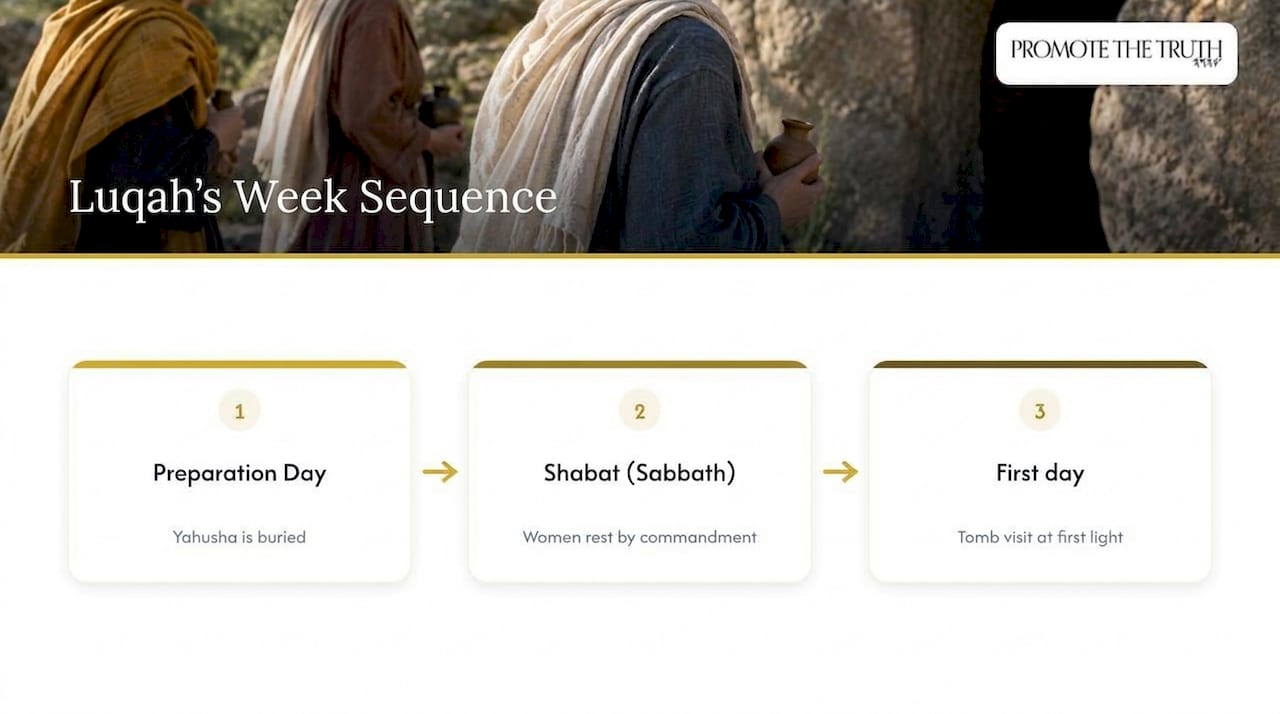
In Luqah (Luke) 23:53–56, the burial of Yahusha is described. The women who had followed Him prepared spices and ointments. The passage then specifically states that they rested on the Shabat according to the commandment.
In Luqah (Luke) 24:1, the women returned to the tomb on the first day of the week.
The sequence is significant:
-
The burial takes place before the Shabat.
-
The women rest on the Shabat according to the commandment.
-
They return to the tomb on the first day of the week.
This account distinguishes the Shabat from the first day. It does not describe the first day as a replacement for the Shabat.
The passage also demonstrates why reading Scripture in sequence is important. Rather than beginning with a conclusion drawn from later traditions, readers can follow the events as the text presents them.
When studying these accounts, consider the wording, the order of events, and the relationship between the Shabat and the first day.
Why the original names and manuscripts matter
The discussion about the Shabat is not only about weekday terminology. It also involves how Scripture has been transmitted, translated, and presented to modern readers.
Names, words, and calendar expressions can be affected by translation choices. When readers rely only on familiar English terminology, they may overlook important distinctions in the original languages and the way those expressions are used in context.
<u>Promote The Truth</u> emphasizes studying Scripture with attention to the original Abariy (Hebrew) and Aramiyt (Aramaic) sources, restored names, and the meaning of the text.
This is one reason the correct names matter.
The Set-Apart Name YAHUAH should not be replaced by conventional titles when discussing the identity of the Creator. Likewise, Scriptural names and book names should be approached carefully rather than automatically adopting familiar modern forms.
For example, the passages in this study are identified using the names from the Scripture Names resource:
-
Barashiyt (Genesis)
-
Shamut (Exodus)
-
Uiyqara (Leviticus)
-
Dabariym (Deuteronomy)
-
Luqah (Luke)
-
Ma’ashiym (Acts)
-
Yahuhanan (John)
Restoring names is part of approaching the text with greater attention to its original context. It also helps readers recognize the connections between passages when studying the Scriptures.
The purpose is not simply to use different spellings. It is to encourage careful study of the Word and to examine the meaning carried through its names and language.
Our perspective
We and many others believe the question is best settled by reading, not by tradition. The commandment names the seventh day. The Bariyt Hadash (New Testament) shows Yahusha keeping it, shows believers gathering on the first day, and never announces a transfer. Having studied the text this way, we hold that the seventh day remains the day set-apart by the Creator, and that careful study of the original Abariy (Hebrew) and Aramiyt (Aramaic) sources, with the original names and meanings restored, lets each reader see this for themselves.
That is why the Truth Scriptures™ Translation exists: so that you can read the Ta’anak and the Bariyt Hadash with the restored Set-Apart Name YAHUAH and the original terminology in front of you, and test every claim in this article against the text.
Maria
Study the Shabat (Sabbath) in the Scriptures themselves
The Shabat should be studied through the Scriptures themselves, with attention to the creation account, the commandments, the appointed times, and the accounts recorded in the Bariyt Hadash (New Testament).
<u>Promote The Truth</u> provides resources intended to help readers examine the Scriptures through restored names, original-language research, and <u>the Truth Scriptures™ Translation</u>.
Readers who want to continue their study can explore:
-
<u>YAHUAH’s Calendar</u> — for further study of the Scriptural calendar and its reckoning.
-
<u>Truth Scriptures™ Translation</u> — to learn about the restoration translation and its approach to the Scriptural text.
-
<u>Truth Scriptures Digital Collection</u> — for access to the digital collection.
-
<u>Names and Places Resource</u> — to follow restored Scriptural names while studying.
The goal is to encourage readers to examine the evidence, read the passages in context, and seek understanding through the Word of YAHUAH.
If you want to read the passages above in a restoration translation, the Truth Scriptures™ Translation is our English restoration of the Ta’anak and the Bariyt Hadash, drawn from ancient Abariy and Aramiyt manuscript sources. A digital collection is also available. For guided study, the 1st and 2nd PTT “RENEWED” Virtual Retreats are each listed at £197 one-off on our retreat page.

FAQ
Is the Shabat Saturday or Sunday?
Scripture identifies the Shabat as the seventh day of the week. The names Saturday and Sunday belong to the modern weekday system. To establish the Scriptural day of observance, readers must examine the calendar reckoning being used rather than assume that a modern weekday label settles the question.
Does the Bariyt Hadash (New Testament) say that the Shabat was changed to another day?
The passages examined in this article record first-day events and gatherings, but they do not explicitly announce that the seventh-day Shabat was transferred to the first day. Readers should examine those passages in their full context.
Did Yahusha observe the Shabat?
Luqah (Luke) 4:16 records that observing the Shabat was Yahusha’s following commandments. So He observed the Shabat as He has come to fulfil the Law.
When does the Shabat (Sabbath) start?
Scripture uses dawn to dusk for Shabat. For the calendar reckoning used in PTT study, consult the <u>YAHUAH Calendar resource</u>.
Why are restored Scriptural names important?
Names and terminology are part of how readers encounter the Scriptural text. <u>Promote The Truth</u> emphasizes restored names and original-language study to help readers examine the Word with attention to its original context.