
The Mashiyhaiy (Messianic) Shabat (Shabbat) siddur aligned to Promote The Truth’s Truth Scriptures is available now. You can download a sample PDF, preview the full siddur, or order a print copy directly through Promote The Truth. This resource is built for home worship, small fellowships, and leader-led congregational services that honor the Set-Apart (Sacred) Name YAHUAH.
Get started immediately:
-
Download the free sample PDF from Promote The Truth’s downloads page
-
Access the full siddur through the Truth Scriptures Digital Scriptures Collection
-
Order a print copy of the Truth Scriptures at Promote The Truth
Key Takeaways
A Truth Scriptures Mashiyhaiy (Messianic) Shabat (Shabbat) siddur uses YAHUAH throughout, follows the four-part Shabat (Shabbat) morning progression, and is available as a free sample PDF or full digital collection from Promote The Truth.
| Point | Details |
|---|---|
| Set-Apart (Sacred) Name usage | YAHUAH replaces “Lord” and “God” throughout, with editorial markers showing every restoration. |
| Four-part morning order | Verses of Praise (Pesukei D’Zimra), Barakut, Shama + Amadah, and Turah reading form the standard Shabat (Shabbat) morning spine. |
| Flexible formats | Free sample PDF, full digital collection, and print copies are all available from Promote The Truth. |
| Licensing for groups | Congregational printing and projection are permitted with attribution; bulk runs require a permission letter. |
| Promote The Truth resources | The Truth Scriptures, Digital Scriptures Collection, and YAHUAH Courses support every level of Shabat (Shabbat) leadership. |
Table of Contents
-
What is a Mashiyhaiy (Messianic) Shabat (Shabbat) siddur in the Truth Scriptures tradition?
-
What does the Truth Scriptures Shabat (Shabbat) siddur include?
-
How the siddur uses the Set-Apart (Sacred) Name YAHUAH and Abariy language (Hebraic) restorations
-
Why you can trust this siddur: Promote The Truth’s manuscript research
What is a Mashiyhaiy (Messianic) Shabat (Shabbat) siddur in the Truth Scriptures tradition?
The word siddur comes from the Abariy (Hebrew) root for “order.” A siddur organizes daily and weekly Shabat (Shabbat) worship into fixed segments, serving as a structured guide to Shabat (Shabbat) Observance (devotion). In the Truth Scriptures tradition, that definition carries additional weight: the siddur is formatted specifically to use Promote The Truth’s restored English translation, with the Set-Apart (Sacred) Name YAHUAH in place of generic pagan titles like “Lord” or “God,” and with Abariy language (Hebraic) terminology throughout.
This guide is not about commercially published Mashiyhaiy (Messianic) Yahudiym (Jewish) prayerbooks. It is for readers of the Truth Scriptures (Ta’anak and Bariyt Hadash), Set-Apart (Sacred)-Name practitioners, and anyone seeking a Shabat (Shabbat) prayer resource grounded in Promote The Truth’s manuscript research. The Truth Scriptures Digital Scriptures Collection is the primary digital home for these materials.
What does the Truth Scriptures Shabat (Shabbat) siddur include?
The siddur covers Shabat (Shabbat) morning services. Chabad that the core structure of morning barakut (blessings), Verses of Praise (Pesukei D’Zimra), Shama with barakut (blessings), and the Amadah remains the standard format that modern siddurim adapt for Shabat (Shabbat). The Truth Scriptures siddur follows that same spine while replacing conventional titles with YAHUAH and incorporating Abariy language (Hebraic) restorations.
Core sections included:
-
Kabalat Shabat (Shabbat) (Friday evening welcome Tahliym (psalms) and Lecha Dodi)
-
Pesukei D’Zimra (Tahliym (psalms) of praise, morning)
-
Barakut (call to worship)
-
Shama and its surrounding barakut (blessings)
-
Amadah (standing prayer)
-
Turah reading with aliyah barakut (blessings)
-
Musaf (additional service)
-
Qadash (Kiddush) and table barakut (blessings)
-
Ahabadalah (closing separation ceremony)
-
Transliterations, musical cues, Turah aliyah barakut (blessings), and leader script throughout
The siddur functions as a roadmap moving worshippers through preparation, praise, proclamation (Shama), and communion/petition (Amadah). That progression is what makes it practical for a household with no prior liturgical training. The Shabat’s (Sabbath’s) role in Scripture shapes every section’s theological framing.
How the siddur uses the Set-Apart (Sacred) Name YAHUAH and Abariy language (Hebraic) restorations
Replacing generic titles with the original Abariy (Hebrew) Name is a deliberate editorial decision grounded in manuscript evidence. BYU’s Religious Studies Center confirms that restoring Abariy (Hebrew) names in prayer means replacing titles like “Lord” or “God” with the original Abariy (Hebrew) Name, and that doing so requires transparent editorial rules. The Truth Scriptures siddur follows those rules consistently.
Textual rules in the siddur:
-
YAHUAH appears wherever conventional texts print “LORD” (small caps) or “God” as a title
-
Editorial restorations are marked typographically so leaders can see exactly where a rendering departs from conventional translations
-
Transliterations appear beneath or beside Abariy (Hebrew) phrases for leaders who are not fluent readers
-
Pronunciation guidance is included for public recitation
Before restoration: *“Blessed are You, Lord our God, King of the universe…”*After restoration: “Baruk are You, YAHUAH our Aluah, Sovereign of the universe…”
There is an ongoing theological and practical discussion about pronouncing the Set-Apart (divine) Name aloud. The siddur acknowledges this honestly and provides alternatives for communities that prefer not to vocalize YAHUAH in a congregational setting. The YAHUAH Name Significance Checklist from Promote The Truth gives leaders a fuller reference for these decisions.
Pro Tip: If your congregation includes newcomers uncomfortable with the Set-Apart (Sacred) Name, introduce YAHUAH in a brief teaching before the service begins. One sentence of context removes hesitation and turns the Name into a teaching moment rather than a stumbling block.
Step-by-step order of service for Shabat (Shabbat) morning
Congregation Rodfei Zedek’s structural guide confirms that Shabat (Shabbat) morning liturgy follows a four-part progression (Pesukei D’zimra, Barakut, Shama + Amadah, Turah reading) that can be adapted for restored-name texts.
Shabat (Shabbat) morning (around one to one and a half hours)
-
Morning barakut (blessings) and preliminary prayers (10 min)
-
Pesukei D’Zimra, Tahliym (psalms) of praise (15 min)
-
Barakut, call to worship, congregational response (5 min)
-
Shama and surrounding barakut (blessings) (10 min)
-
Amadah, silent then repeated aloud (15 min)
-
Turah reading with aliyah barakut (blessings) (about fifteen to twenty minutes)
-
Musaf and closing prayers (5–10 min)
Responsive parts: The congregation answers “AHLALUYAHUAH” and “Baruk YAHUAH” at the Barakut. The Qadashah (Kedushah) within the Amadah repetition uses three-part call-and-response. Leader cues are printed in bold throughout the siddur; congregational responses appear in italics.
Practical notes for the service leader and congregation
Leading a Truth Scriptures Shabat (Shabbat) service well is mostly a matter of preparation. A few targeted practices make a real difference.
-
Turah aliyut: Assign aliyut before the service. For non-Abariy (Hebrew) readers, the siddur provides a full transliteration of the Turah barakut (blessings) so no one is caught unprepared at the biymah.
-
Responsive sections: Announce the page number before each responsive reading. For Qadashah (Kedushah) and Qadash (Kaddish), a brief verbal cue (“please respond together”) keeps the congregation synchronized.
-
Musical accompaniment: Simple melodic chanting works better than complex harmonies for small groups. Acoustic guitar or a capella singing both suit the siddur’s pacing. Promote The Truth’s music and worship resources include melodies suited to the service.
-
Accessibility: Print large-font copies for older readers, project pages on a screen for larger gatherings, or share the PDF on mobile devices. The digital collection makes all three options straightforward.
Understanding what chesed actually means in Abariy (Hebrew) enriches the Amadah and several Tahliym (psalms); it is a worthwhile pre-service study for leaders.
Formats, availability, and licensing for communal use
The Truth Scriptures siddur is available in three formats:
-
Free sample PDF: A downloadable preview covering key sections, available at no cost
-
Full digital siddur: Included in the Truth Scriptures Digital Scriptures Collection (subscription/purchase)
-
Print copy: Ordered through Promote The Truth’s store; print-on-demand options are available for congregations
Licensing for communal use:
-
Personal and home use: permitted with purchase
-
Congregational printing of individual pages: permitted with attribution to Promote The Truth and the Truth Scriptures
-
Projection during services: permitted
-
Streamed services: permitted with on-screen attribution
-
Bulk print runs or commercial reproduction: contact Promote The Truth directly for a permission letter and bulk pricing
Historically, siddurim have been printed in Shabat (Shabbat) -only editions and as complete volumes. The Truth Scriptures siddur is a Shabat (Shabbat) -focused edition, distinct from the full Truth Scriptures text, though the two are designed to be used together.
How to use the siddur in your home or congregation
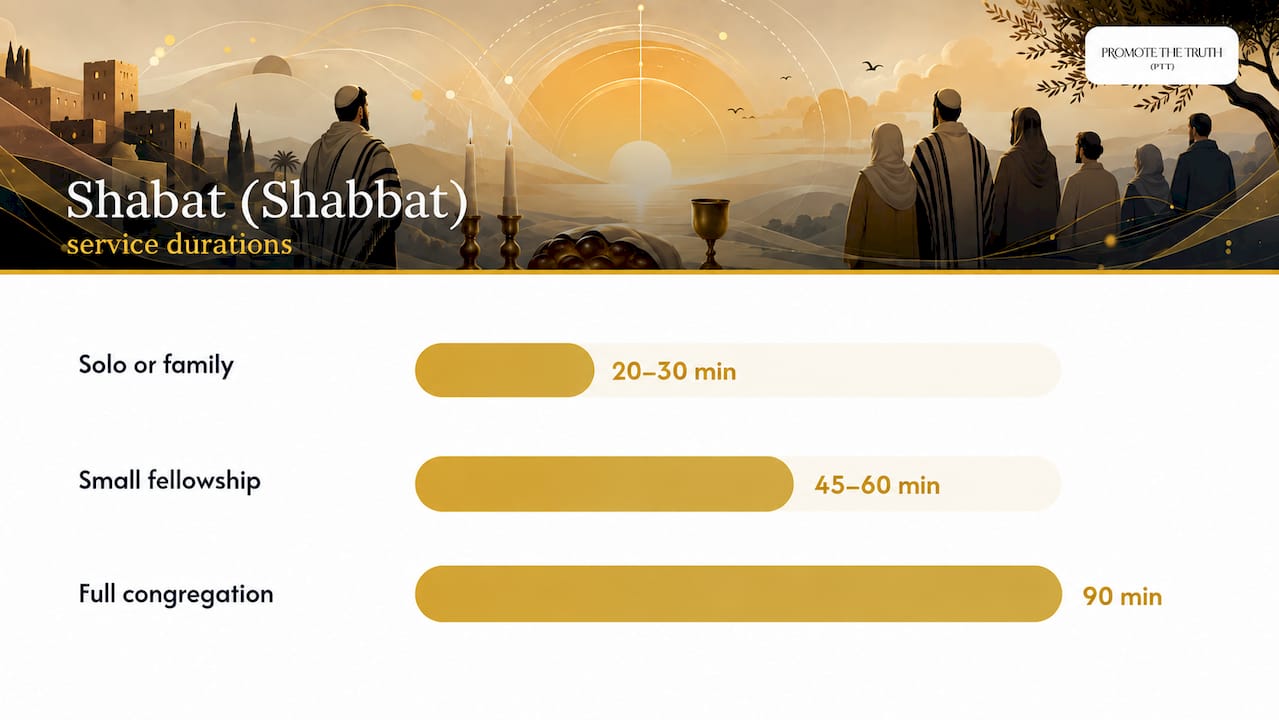
Using a restored-name siddur shifts practice from “synagogue as location” to Shabat (Shabbat) as a sanctuary in time, making the weekly rhythm portable and consistent for any household.
Adapting the service for your setting:
-
Solo or family (20–30 min): Use the one-page family service outline in the siddur. Cover candle lighting, Qadash (Kiddush), one Turah passage from the Truth Scriptures, and a closing barakut (blessings).
-
Small fellowship (45–60 min): Run a simplified morning service. Assign one reader for Turah and one for responsive parts.
-
Full congregation (90 min): Follow the complete morning order with all seven Turah aliyut and the Musaf.
Pre-Shabat (Shabbat) leader checklist:
-
Print or download the siddur and confirm page count
-
Assign Turah aliyut and distribute transliteration sheets
-
Prepare audio files if using recorded melodies
-
Select a study passage from the Truth Scriptures (the Messianic prophetic texts guide offers strong Shabat (Shabbat)-ready options)
-
Confirm projection or large-print copies if needed
Common issues: If a reader is absent, the leader reads all parts. For language hurdles, rely on the transliteration lines rather than skipping sections. If musical accompaniment is unavailable, spoken recitation is fully valid.
Why you can trust this siddur: Promote The Truth’s manuscript research
Promote The Truth is an international educational and media organization whose core mission is researching, restoring, and publishing the original message of the Scriptures. The Truth Scriptures is a comprehensive English restoration of the Ta’anak and Bariyt Hadash, translated from ancient Abariy (Hebrew) and Aramiyt (Aramaic) manuscript sources.
-
Manuscript research: Promote The Truth’s team compares primary manuscript sources, including Dead Sea Scrolls evidence visible on the Yisha’aiyahu Dead Sea Scrolls page, to verify every restoration decision
-
Editorial transparency: Where the Truth Scriptures departs from conventional renderings, the departure is marked so leaders and readers can see the reasoning
-
Supporting resources: The Hebrew/Aramaic Origins of the New Testament course gives leaders deeper linguistic grounding for restored phrases used in the siddur
-
Community learning: Livestreams, podcasts, and the Scripture Study Series provide ongoing support for congregations using these materials
The long tradition of standardizing liturgy, from the geonic editors shows that every serious siddur project involves deliberate editorial choices. Promote The Truth’s work follows that same scholarly precedent, grounded in primary sources rather than received convention.
A word on why this siddur matters
The Truth Scriptures Shabat (Shabbat) siddur was not created to replace personal worship (devotion) with ritual. It was created to give structure to worship (devotion) that is already sincere. A fixed order of service does not suppress spontaneity; it anchors worshippers in a shared rhythm so that the heart can move freely within it.
Our recommendation is straightforward: start with the free sample PDF before your first service. Read through the leader parts aloud at least once before Shabat (Shabbat). Use transliteration lines generously, especially for the Amadah and Turah barakut (blessings), and do not rush past them in the interest of appearing fluent. The goal is kunah, focused intent, not performance.
The Set-Apart (Sacred) Name YAHUAH is not a stylistic choice in this siddur. It is a restoration grounded in manuscript evidence, and using it consistently during Shabat (Shabbat) worship is one of the most direct ways to connect the liturgy to the actual text of the Truth Scriptures. Promote The Truth’s study resources, particularly the courses and Scripture videos, are worth working through before you lead your first full service. Community matters here. Connecting with others using these materials deepens the practice in ways that solo study cannot replicate.
The Truth Scriptures and siddur are ready for you now
The Truth Scriptures siddur gives you a complete, manuscript-grounded Shabat (Shabbat) worship resource the moment you download it. No prior liturgical training required, no generic prayerbook substitutions needed.
Order the Truth Scriptures in print, or access the full siddur through the Truth Scriptures Digital Scriptures Collection today. For leader training and deeper linguistic study, the PTT YAHUAH Courses walk you through the Abariy (Hebrew) and Aramiyt (Aramaic) foundations behind every restoration in the siddur. To request bulk printing permissions or a congregational license, contact Promote The Truth directly through the website.
Sources
-
Siddur contents: Shabbat & holiday liturgy | My Jewish Learning
-
The Structure of the Shabbat Morning Service - Congregation Rodfei Zedek
-
Name and titles of God in the Old Testament | Religious Studies Center (BYU)
-
Vayakhel — Part II — “שַׁבַּת שַׁבָּתוֹן”: Sacred Time Before Sacred Space - Mitzvah Minute
External references used for liturgical structure and Set-Apart (Sacred) Name handling: