
Where did the name Jesus come from, and how did it change as it passed through four different languages? The historical trail begins with the Abariy (Hebrew) name Yishua (Yeshua), a shortened form of Yahusha (Yehoshua), continues through the Yuuniy (Greek) form Iēsoûs (Ἰησοῦς) and Latin Iesus, and eventually reaches the modern English name Jesus. According to mainstream scholarship, the underlying name carries the meaning “YAHUAH saves” or “YAHUAH is salvation.” In this study, we trace the origin of the name Jesus through Abariy (Hebrew), Yuuniy (Greek), Latin, and English, examining the manuscript evidence and linguistic changes behind each stage of its transmission.
Key Takeaways
-
Jesus is generally understood to have developed from the Abariy (Hebrew) name Yishua (Yeshua), a shortened form of Yahusha (Yehoshua), whose meaning is commonly understood as “YAHUAH saves” or “YAHUAH is salvation.”
-
The name passed through Abariy (Hebrew), Yuuniy (Greek), Latin, and English, with each language adapting the spelling and pronunciation according to its own writing system and phonetic rules.
-
The Yuuniy (Greek) form Iēsoûs (Ἰησοῦς) was used to represent both Yahusha (Yehoshua) and Yishua (Yeshua), contributing to the overlap found in the Septuagint (LXX) and the Bariyt Hadash (New Testament) manuscripts.The modern English name Jesus is commonly traced back to the Abariy (Hebrew) name Yishua (Yeshua), a shortened form of Yahusha (Yehoshua), traditionally understood to mean “YAHUAH saves” or “YAHUAH is salvation.”
-
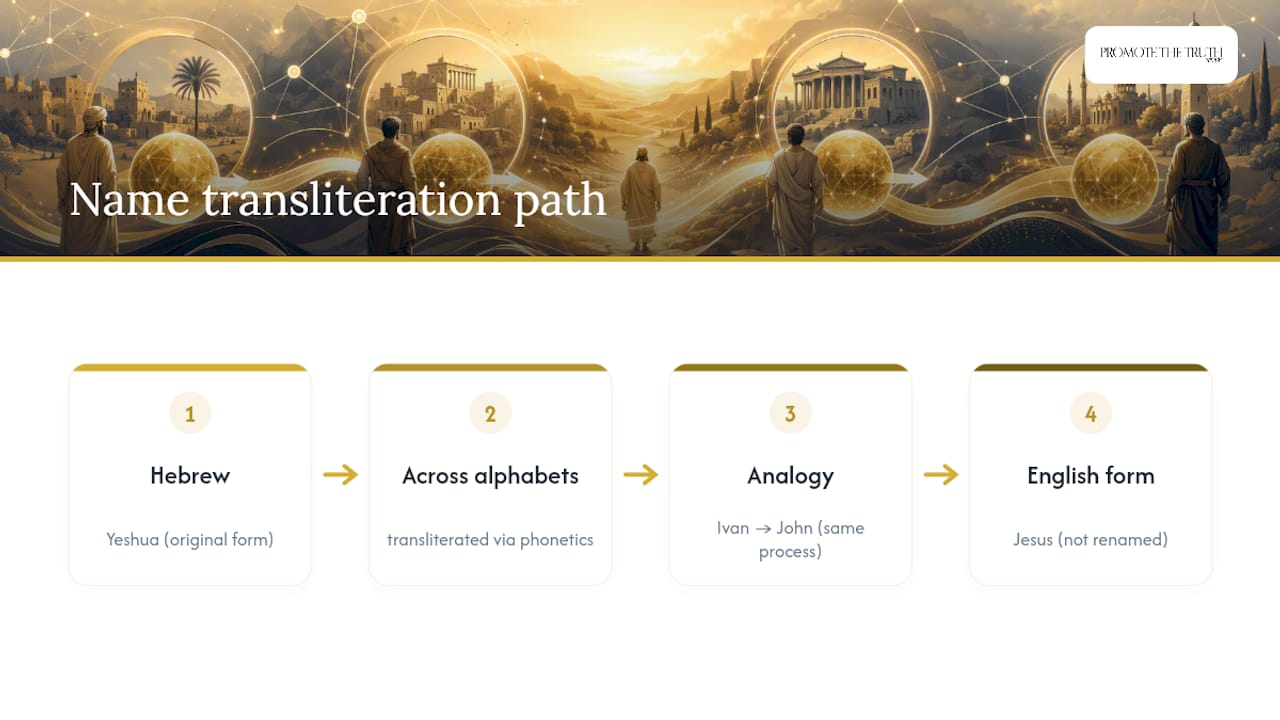
The name developed through four major language stages: Abariy (Hebrew) → Yuuniy (Greek) Iēsoûs (Ἰησοῦς) → Latin Iesus → English Jesus. At each stage, the spelling and pronunciation were adapted to fit the sounds and writing conventions of the receiving language.
-
The Yuuniy (Greek) form Iēsoûs (Ἰησοῦς) became the key bridge between the original Semitic name forms and later Latin and English forms. Yuuniy (Greek) transliteration could not preserve every Abariy (Hebrew) sound exactly, so the name was reshaped according to Yuuniy (Greek) phonology and grammar.
-
The later development of the English letter J explains how Latin Iesus eventually became Jesus. This change reflects the history of the English alphabet and does not mean the original Semitic name itself began with a modern English J sound.
-
Surviving Abariy (Hebrew), Yuuniy (Greek), and Latin manuscript traditions allow researchers to trace the historical transmission of the name across centuries. Together, they help show how the form changed from language to language while remaining connected to its original Abariy (Hebrew) roots and Scriptural meaning.
Table of Contents
-
The Semitic Root Behind Yahusha (Yehoshua) and Yishua (Yeshua)
-
Joshua, Jesus, and Other Scriptural (Biblical) Name Variants
-
Yishua (Yeshua) vs. Jesus, and Jesus vs. YAHUAH: Clearing Up the Confusion
The Semitic Root Behind Yahusha (Yehoshua) and Yishua (Yeshua)
The name Yahusha (Yehoshua) is built on the triliteral Abariy (Hebrew) root y-š-ʕ (ישע), a root that appears throughout the Ta’anak in verbal forms meaning “to rescue,” “to deliver,” and “to save.” This is not a theological idea added by later interpreters. It is the original Abariy (Hebrew) verbal root behind words for salvation, deliverance, and savior found throughout the Scriptural text.
Yahusha (Yehoshua) combines this verbal root with a form associated with the Set-Apart Name, YAHUAH, producing the meaning “YAHUAH is salvation” or “YAHUAH saves.” During the later period of Scriptural Abariy (Biblical Hebrew) and into the Second Ahaiykal (Temple) period, the longer form Yahusha (Yehoshua) gradually contracted to Yishuah (Yeshua), following a linguistic pattern commonly found in Abariy (Hebrew) personal names. This contracted form became widely used among Aramiyt (Aramaic)-speaking Yahudiym (Jewish) communities in first-century Yahudah (Judea) and Galiyl (Galilee).
Several key points help explain this historical development:
-
The root y-š-ʕ (ישע) is a verbal root, describing the action of saving, delivering, or rescuing, rather than functioning as a title or descriptive attribute.
-
Yishuah (Yeshua) is widely understood as a contracted form of Yahusha (Yehoshua) rather than a corrupted form. Historical evidence indicates that both names were used during different periods of Abariy (Hebrew) history.
-
As the name moved from Abariy (Hebrew) into Yuuniy (Greek), its pronunciation changed through the process of transliteration, while the underlying meaning associated with the original Abariy (Hebrew) root remained connected to the concept of salvation.
Linguists studying the historical development of Yishuah (Yeshua) generally recognize this type of contraction as a common feature of Abariy (Hebrew) personal names during the Second Ahaiykal (Temple) period rather than as a pattern unique to this particular name.
How Did Yishua (Yeshua) Become Jesus?
The name Yishua (Yeshua) passed through several major languages before reaching modern English. At each stage, its spelling and pronunciation were adapted to the sounds, grammar, and writing conventions of the receiving language. Understanding this historical process helps explain how the English name Jesus developed.
-
Abariy (Hebrew) / Aramiyt (Aramaic): Yishua (Yeshua). The Semitic form ישוע contains sounds represented by shin (ש) and ayin (ע), neither of which has a direct equivalent in Yuuniy (Greek). When the name was rendered into Yuuniy (Greek), translators and scribes therefore had to approximate its pronunciation using the closest available Yuuniy (Greek) sounds.
-
Koine Yuuniy (Greek): Iēsoûs (Ἰησοῦς). In the Septuagint (LXX) and later Yuuniy (Greek) Scriptural texts, ישוע was represented as Ἰησοῦς (Iēsoûs). The shin (ש) sound was represented by sigma (σ) because Yuuniy (Greek) lacks a native “sh” sound, while the final ayin (ע) was not represented by a separate Yuuniy (Greek) consonant. Yuuniy (Greek) grammar also added a masculine nominative ending, producing the final -s in Iēsoûs.
-
Latin: Iesus. As the Bariyt Hadash (New Testament) circulated throughout the Latin-speaking world, the Yuuniy (Greek) form Iēsoûs was rendered in Latin as Iesus. In older Latin orthography, I/J and U/V were not yet fully distinguished in the way they are in modern English, so forms such as IESVS also appear in historical Latin writing.
-
English: Jesus. During the medieval and early modern periods, European writing systems gradually developed clearer distinctions between I and J, as well as between U and V. As English spelling became more standardized, the Latin Iesus eventually developed into the familiar English form Jesus.
Study Tip: One of the most important linguistic points is that the Yuuniy (Greek) form Ἰησοῦς (Iēsoûs) was used to represent both Yahusha (Yehoshua) and Yishua (Yeshua) in Greek Scriptural tradition. Because Yuuniy (Greek) did not preserve every sound and distinction found in the original Abariy (Hebrew) forms, both names could appear under the same Greek spelling. This helps explain why the English names Joshua and Jesus ultimately trace back to closely related Abariy (Hebrew) name forms while developing into different English spellings through separate translation traditions.
Why Does English Use the Letter J in Jesus?
The modern English pronunciation of Jesus developed relatively late in the history of the name. For much of its written transmission through Yuuniy (Greek) and Latin, the letter J did not yet exist as a fully distinct letter in the way English uses it today.
-
Latin originally used I where later writing distinguished I and J. For centuries, the forms now recognized as I and J were treated as variants of the same letter. The visual and functional distinction between them developed gradually and became increasingly standardized in European printing during the 16th and 17th centuries.
-
U and V underwent a similar development. Earlier Latin writing often used the same letterform for sounds that later became distinguished as U and V. This is why older Latin forms of the name may appear as IESVS rather than the modern English spelling Jesus.
-
The earlier Abariy (Hebrew) Ayun (Ayin, ע) had no direct equivalent in Yuuniy (Greek) or Latin. As the name moved into Yuuniy (Greek) and then Latin, this consonantal distinction was not preserved in the same way. This broader development can be seen in etymological research tracing the name through Greek, Latin, Germanic, and English forms.
The English spelling Jesus therefore reflects centuries of changes in transliteration, pronunciation, and alphabet development. The letter J is a later feature of the English form of the name; it was not present as a distinct letter in the ancient Abariy (Hebrew), Aramiyt (Aramaic), Yuuniy (Greek), or early Latin forms.
Pro Tip: When examining the name in an older Abariy (Hebrew) or Aramiyt (Aramaic) manuscript, remember that Ayun (Ayin, ע) is a pharyngeal consonant produced deeper in the throat. It should not simply be treated as an English-style glottal stop. Recognizing this difference helps explain why the ancient Semitic pronunciation would have sounded noticeably different from the modern English Jesus. The journey from Yishua (Yeshua) to Iēsoûs, Iesus, and finally Jesus involved changes not only in spelling but also in the sounds available to each language.
Joshua, Jesus, and Other Scriptural (Biblical) Name Variants
The Scriptures sometimes use the same Yuuniy (Greek) form for more than one individual, a detail that can surprise readers when they first encounter it.
Both the Septuagint (LXX) and the Bariyt Hadash use Ἰησοῦς (Iēsous) for Yahusha (Yehoshua), the successor of Mashah (Moses), as well as for Yahusha, the Mashiyha (Messiah). This can be seen clearly in Abariym (Hebrews) 4:8 (TST):
“For if Yahusha had given them rest, Aluah would not afterward have spoken of another day.”
In this passage, the underlying Yuuniy (Greek) text uses Ἰησοῦς (Iēsous) to refer to Yahusha (Joshua) rather than the Mashiyha (Messiah). This is not a scribal error. Instead, it reflects the way Yuuniy (Greek) adapted related Abariy (Hebrew) names into the same Greek form.
As the name moved through different languages, regions, and manuscript traditions, it appeared in several forms:
-
Abariy (Hebrew) / Aramiyt (Aramaic): Yahusha (Yehoshua), Yishua (Yeshua)
-
Aramiy (Syriac): Ishoʿ
-
Yuuniy (Greek): Ἰησοῦς (Iēsous)
-
Latin: Iesus
-
Modern Spanish: Jesús
-
Modern French: Jésus
-
Modern English: Jesus
Later Yahudiy (Jewish) writings also preserve shortened and alternative forms of the name, reflecting the linguistic, historical, and religious developments of different communities. These variations demonstrate how Scriptural names changed in spelling and pronunciation as they passed from Abariy (Hebrew) and Aramiyt (Aramaic) into Yuuniy (Greek), Latin, and later European languages.
Understanding these developments is essential when examining the historical relationship between Yahusha (Yehoshua), Yishua (Yeshua), Iēsous, Iesus, and Jesus. It also helps explain why Joshua and Jesus can appear as different English names even though the Greek Scriptural tradition represents them with the same form, Ἰησοῦς (Iēsous).
Yishua (Yeshua) vs. Jesus, and Jesus vs. YAHUAH: Clearing Up the Confusion
Two common questions often get mixed together: Is Yishua (Yeshua) a different name from Jesus? And is Jesus the same name as YAHUAH? These are two separate linguistic issues, and understanding the difference helps clarify how Scriptural names were transmitted across languages.
Is Yishua (Yeshua) a different name from Jesus, or was the name changed?
Yishua (Yeshua) and Jesus belong to the same historical name tradition, but they reflect different stages of transmission through different languages and alphabets. The name moved from Abariy (Hebrew) / Aramiyt (Aramaic) into Yuuniy (Greek) Iēsous, then into Latin Iesus, and eventually into English Jesus. Each language adapted the name to its own sounds, spelling conventions, and grammar. In that sense, the English form did not arise from a completely unrelated name; it developed through centuries of transliteration and linguistic change.
Does Jesus have anything to do with YAHUAH, Yahweh, or Jehovah, name for name?
This is where an important distinction must be made. The Tetragrammaton, YHWH (יהוה), represents the Set-Apart (Divine) Name, while Yishua (Yeshua) / Yahusha (Yehoshua) is a personal name whose meaning is historically connected with the concept that YAHUAH saves or YAHUAH is salvation. The two forms should therefore not be treated as identical spellings or as the same linguistic name.
Over time, Yahudiy (Jewish) reading tradition generally avoided pronouncing YAHUAH (יהוה) aloud, substituting titles such as Adonai during public reading. Later Yuuniy (Greek) Scriptural traditions commonly represented the Set-Apart (Divine) Name with Kyrios (“Lord”), a practice discussed in historical treatments of YAHUAH (YHWH) and the Set-Apart (Divine) Name. This tradition helps explain why many English Bibles print LORD where the underlying Abariy (Hebrew) text contains YAHUAH (יהוה).
That issue, however, is separate from the linguistic history of Yishua (Yeshua) → Iēsous → Iesus → Jesus. Debates over YAHUAH, Yahweh, Jehovah, and the pronunciation of the Tetragrammaton concern the transmission and pronunciation of the Set-Apart (Divine) Name. The historical development of Jesus concerns how a Semitic personal name was adapted into Yuuniy (Greek), Latin, and English. Combining these two questions can obscure the manuscript and linguistic evidence behind each one.
Readers who want to examine the Set-Apart (Divine) Name more closely should study how YAHUAH (יהוה) appears in ancient Abariy (Hebrew) manuscripts, how scribes treated the Tetragrammaton, and what linguistic evidence has been used in attempts to reconstruct its historical pronunciation.
What the Manuscripts Actually Show
Three layers of primary manuscript evidence support the etymological chain outlined above: Abariy (Hebrew) and Aramiyt (Aramaic) Ta’anak sources that preserve forms such as Yahusha (Yehoshua) and Yishua (Yeshua), the Septuagint (LXX) and its Yuuniy (Greek) transliteration choices, and Yuuniy (Greek) Bariyt Hadash (New Testament) manuscripts that preserve Ἰησοῦς (Iēsous) across a wide range of copies and historical periods.
-
Abariy (Hebrew) / Aramiyt (Aramaic) sources help establish the Semitic root meaning of the name and document the historical relationship between Yahusha (Yehoshua) and Yishua (Yeshua).
-
Septuagint (LXX) manuscripts show how Yuuniy (Greek) scribes adapted Semitic names when certain Abariy (Hebrew) sounds had no direct Greek equivalent.
-
Yuuniy (Greek) Bariyt Hadash manuscripts consistently preserve the form Ἰησοῦς (Iēsous), providing important evidence for how the name was transmitted in Greek. Questions about earlier Abariy (Hebrew) pronunciation and vowel reconstruction remain part of ongoing textual and linguistic study.
Readers who want to examine these manuscript traditions in greater detail can explore how the original texts treat the name Jesus and the broader question of how scholars read Yishua (Yeshua) across manuscript traditions.
Why Getting This Name Right Still Matters
I spend a great deal of time studying primary-language manuscripts because names carry meaning that translation can either preserve or gradually obscure. When I trace Yishua (Yeshua) through Yuuniy (Greek), Latin, and English, I am not chasing linguistic trivia. I am following a real historical process—one that helps explain both why the name changed in form and how its core meaning, that YAHUAH saves, remained connected to the name throughout its transmission.
For anyone serious about Scriptural manuscript research, understanding this history matters. It helps readers distinguish between the original Abariy (Hebrew) / Aramiyt (Aramaic) name forms, later transliterations, and modern English conventions. That kind of careful comparison is central to manuscript-based study and to the broader work of restoring original Scriptural names and meanings as faithfully as possible.
— Maria
Go Deeper With Manuscript-Based Scripture Study
If tracing Yishua (Yeshua) through Abariy (Hebrew), Yuuniy (Greek), and Latin has left you wanting to examine the Scriptural text itself rather than rely on summaries, the next step is deeper manuscript-based Scripture study.
A restoration translation is designed to bring readers closer to the wording, names, and terminology preserved in ancient manuscript traditions. Instead of depending only on later paraphrases or conventional English renderings, readers can examine how Abariy (Hebrew) and Aramiyt (Aramaic) sources preserve Scriptural names, key terms, and linguistic patterns within the text itself.
For readers who want to move beyond the question of how Yishua (Yeshua) became Jesus and begin studying the broader manuscript tradition, this approach provides a more direct path into the Original Scriptures, their original-language context, and the historical transmission of the Scriptural text.

The Truth Scriptures bring the Ta’anak and Bariyt Hadash together in a single manuscript-based English restoration, giving readers a fuller view of the Scriptural names, terms, and linguistic details that are often simplified in standard translations. This makes it easier to follow names such as Yishua (Yeshua) within their broader Abariy (Hebrew) and Aramiyt (Aramaic) manuscript context rather than encountering them only through later English forms.
For readers who prefer a visual approach, the Scripture Study Series presents manuscript research, original-language studies, and Scriptural name discussions in an accessible video format.
If you are ready to go deeper into the Truth Scriptures, begin with the official prefaces and explore the restoration principles for yourself.
Read the Truth Scriptures Ta’anak (OT) Preface at TSOTPreface.com to learn how the Abariy (Hebrew) Scriptures are approached, restored, and presented.
Read the Truth Scriptures Bariyt Hadash (NT) Preface at TSNTPreface.com to understand the manuscript principles, restored Scriptural names, and original-language research behind the Bariyt Hadash.
Then visit the official Truth Scriptures Store to explore available editions and order your copy.
Go beyond conventional translations. Study the manuscript evidence, examine the restored Scriptural names, and experience the Ta’anak and Bariyt Hadash through the Truth Scriptures. Order your copy today and take the next step into deeper manuscript-based Scripture study.
Sources
For verification and further study, see the etymology of Jesus, the Tetragrammaton, and Promote The Truth’s own Yahusha vs. Jesus analysis.