
In Uiyqara (Leviticus) 16, the phrase “goat angel,” sometimes used in popular study circles, refers to Azazal (Azazel) (עֲזָאזֵל), the named recipient of the live scapegoat on Yum Kapar (Yom Kippur). Within the text of Uiyqara (Leviticus), Azazal is not presented as a mighty one (deity) or as part of the Abariy (Hebrew) sacrificial system. Rather, Azazal functions as the designated recipient of the live goat, to which the iniquities of the children of Yisharal (Israel) are confessed before it is sent into the wilderness. The ritual deliberately sets the two goats in parallel—one for YAHUAH and one for Azazal.
Three textual anchors establish this immediately:
-
Uiyqara (Leviticus) 16:8–10 explicitly assigns one goat for YAHUAH and the other for Azazal, revealing the two-part structure of the Yum Kapar (Yom Kippur) ceremony.
-
The Masoretic Text preserves the spelling עֲזָאזֵל (Azazal (Azazel) as it appears in the standard Abariy (Hebrew) text, although the precise meaning and etymology of the term remain debated.
-
Qumran manuscripts, including the 11QTemple Scroll and 4Q180, attest an alternate spelling, ʿAzazʾel, which includes the theophoric element El, a feature absent from the Masoretic spelling.
Later writings, particularly 1 Hanuk (1 Enoch) and various rabbinic midrashim, develop Azazal (Azazel) into the figure of a fallen messenger (angel). These interpretations belong to the post-scriptural (biblical) reception of the tradition rather than to the ritual presentation found in Uiyqara (Leviticus) 16 itself. Distinguishing between the Scriptural text and its later interpretations is essential for careful, manuscript-based study of the Truth Scriptures.
Table of Contents
-
What Does the Goat Messenger (Angel) passage in Uiyqara (Leviticus) 16 Actually Say?
-
How Do Scholars Interpret the Abariy (Hebrew) Term עֲזָאזֵל (Azazal(Azazel)?
-
How Did Azazal (Azazel) Become a Fallen Messenger (Angel) in Later Tradition?
-
Is the Azazal (Azazel) Ritual an Offering to a Desert Deity?
What Does the Goat Angel Passage in Uiyqara (Leviticus) 16 Actually Say?
The ritual described in Uiyqara (sn-Leviticus) 16 is precise and carefully structured. Aahran (Aaron) presents two male goats at the entrance of the Tent of Appointment and casts Pur (lots) over them. The lots determine which goat is “for YAHUAH” and which is “for Azazal.” As recorded in Uiyqara (Leviticus) 16:8–10 records, one goat is presented to YAHUAH as a sin offering, while the other is kept alive before YAHUAH. Later, Aahran lays both his hands upon the head of the live goat, confesses over it all the iniquities, rebellious sins, and other sins of the children of Yisharal (Israel), and then sends it into the wilderness by the hand of a man appointed for the task.
Aahran shall cast Pur, meaning cast lots, over the two male goats. One lot is labeled for YAHUAH, and the other lot is labeled for the Azazal, meaning the scapegoat. Aahran shall present the goat, which was selected as the lot for YAHUAH, as a sin offering.But the goat that was selected for the Azazal shall be left standing alive before YAHUAH and used for making atonement, by sending it into the wilderness to Azazal, as a scapegoat.” — Uiyqara (Leviticus) TST -16:8–10
The structural parallel is deliberate. YAHUAH and Azazal appear as the two designated recipients within a single ritual. The goat for YAHUAH is presented as the sin offering, while the live goat for Azazal bears the iniquities, rebellious sins, and other sins of the children of Yisharal before being sent into the wilderness. The text does not describe the live goat as an act of worship or sacrifice to Azazal. Rather, it functions as the means by which the offenses of the people are carried away from the camp.
Key Observations from the Truth Scriptures Text
-
Aahran lays both his hands on the head of the live goat and confesses over it all the iniquities, rebellious sins, and other sins of the children of Yisharal, placing them upon the goat’s head before sending it into the wilderness (Uiyqara [Leviticus] 16:21).
-
The live goat carries on itself all their offenses to a desolate region of land before being released into the wild (Uiyqara [Leviticus] 16:22).
-
The stated purpose of the ceremony is to make atonement for the Set-Apart Place, the Tent of Appointment, the Altar, the Priests, and the people of Yisharal (see Uiyqara [Leviticus] 16:16–20, 33–34). The text presents the ritual as an act of atonement and purification before YAHUAH, not as an act of appeasement or worship directed toward Azazal.
How Do Scholars Interpret the Abariy (Hebrew) Term עֲזָאזֵל Azazal (Azazel)?
The term עֲזָאזֵל Azazal (Azazel) appears four times in Uiyqara (Leviticus) 16 and nowhere else in the Ta’anak (Old Testament). Because of its unique occurrence, its meaning has long been debated. Scholars primarily rely on Abariy (Hebrew) linguistics, manuscript evidence, and ancient translation traditions when interpreting the term. Three major interpretations have emerged.
| Interpretation | Abariy (Hebrew) / Root Basis | Theological Implication |
|---|---|---|
| Proper Name (Theophoric) | ʿAzaz + ʾEl — “El is strong” or “strength of El” | Azazal is understood as the name of a supernatural being. |
| Descriptive Compound | ʿAzaz + ʾAzal — “the fierce one who departs” or “the one sent away” | Azazal describes the role or function of the live goat within the ritual. |
| Place Name | Related to the Aramiyt (Aramaic) root ʾazal (“to go away”) | Azazal refers to a remote wilderness location rather than to a personal being. |
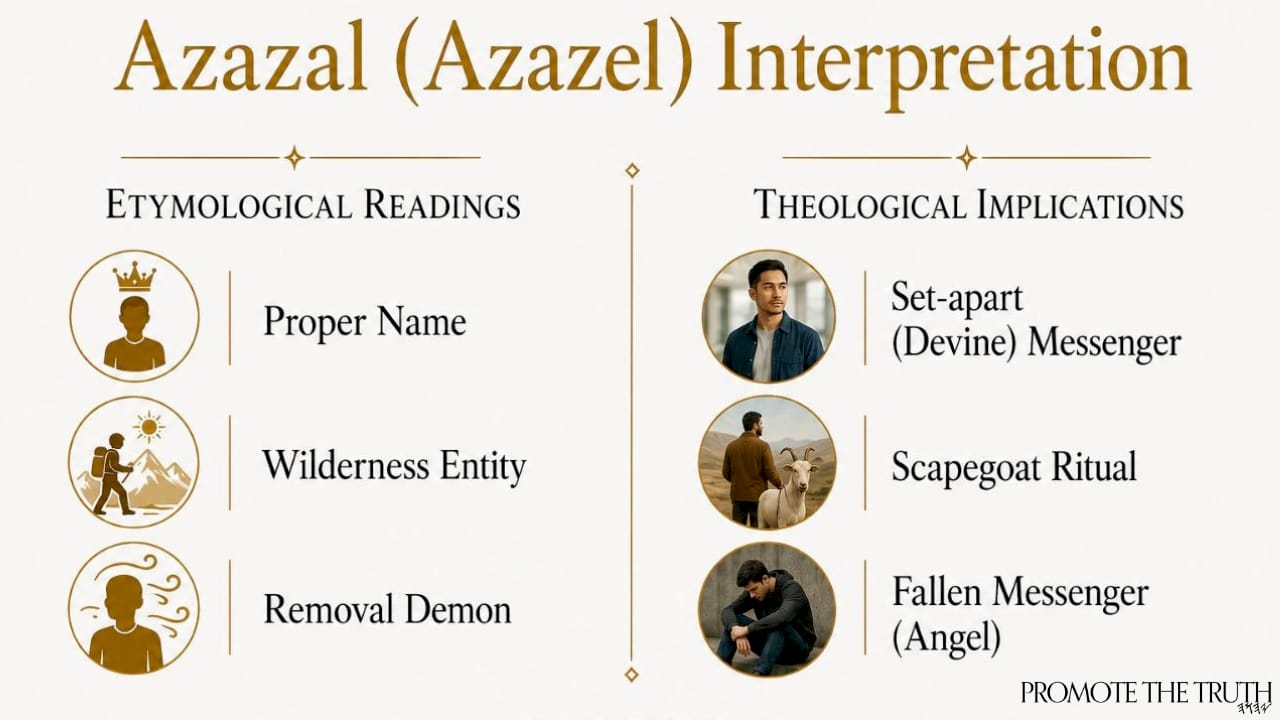
The Masoretic Text preserves the spelling עֲזָאזֵל Azazal (Azazel). Some scholars argue that earlier textual witnesses, including certain Qumran manuscripts, preserve the form ʿAzazʾel, a spelling that contains the theophoric element El and may therefore suggest a personal, supernatural referent. According to this interpretation, later scribal traditions may have preserved or adopted a different spelling, reducing the visibility of the theophoric element. Other scholars, however, dispute this conclusion, making the issue one of ongoing textual and linguistic debate rather than scholarly consensus.
William Tyndale’s 1530 English translation introduced the term “scapegoat” as a rendering of Azazal (Azazel), a translation choice that shifted the emphasis from the identity of Azazal to the function of the live goat within the ritual. By rendering the term according to its perceived role rather than as a proper name, Tyndale influenced the way many later English translations and readers understood Uiyqara (Leviticus) 16.
Key Observations
-
The Abariy (Hebrew) root ע.ז.ז is associated with meanings such as “strong,” “strength,” or “fierce.”
-
Some Turah Shamaruniyt (Samaritan Pentateuch) readings preserve a form that scholars compare with the theophoric ʿAzazʾel, contributing to the discussion about the term’s original form.
-
The Septuagint (LXX) renders the term in different ways, including expressions meaning “the one sent away” and, in some traditions, references associated with a rugged or remote place. These variations reflect early uncertainty regarding the meaning of Azazal.
Pro Tip: When studying Abariy (Hebrew) roots and textual variants in passages such as Uiyqara (Leviticus) 16, pay close attention to the spelling preserved in different manuscript traditions. Even a single consonantal variation can influence how scholars interpret a term, whether as a descriptive expression, a place name, or a personal name. Comparing the Masoretic Text, theTurah Shamaruniyt (Samaritan Pentateuch), the Septuagint, and the Qumran manuscripts provides valuable insight into the history of the text and the range of scholarly interpretations.
How Did Azazal (Azazel) Become a Fallen Messenger (Angel) in Later Tradition?
The demonological portrait of Azazal (Azazel), familiar in many popular teachings, originates in Second Temple apocalyptic literature rather than in Uiyqara (Leviticus) itself. The Book of Hanuk (1 Enoch) identifies Azazal as one of the leaders of the rebellious messengers (angels) who descended to the earth, taught humanity forbidden arts—including weaponry and cosmetics—and contributed to the corruption of the created order. This portrayal is vivid, detailed, and highly influential, but it belongs to post-Scriptural (biblical) literature rather than to the Turah (Torah).
The whole earth has been corrupted through the works that were taught by Azazel; to him ascribe all sin.” — 1 Hanuk (1 Enoch) 10:8
This passage from 1 Hanuk (1 Enoch) illustrates how later apocalyptic tradition expanded the figure of Azazal into a moral agent responsible for widespread human corruption. The chronological distinction is important. 1 Hanuk (1 Enoch) was composed during the Second Ahiykal (Temple) period, centuries after Uiyqara (Leviticus) was written. Many scholars understand this tradition as a later interpretation that associates the Azazal of the scapegoat ritual with a fallen messenger (angel), whereas the Turah (Torah) itself leaves the identity of Azazal undefined.
The Jewish Encyclopedia notes that some later rabbinic traditions moved in a different direction, interpreting Azazal not as a supernatural being but as a rugged cliff or remote wilderness location from which the live goat was released. The Talmud, Yoma 67b, reflects this geographical interpretation. Together, these traditions demonstrate that both apocalyptic and rabbinic Judaism wrestled with a term that the Turah (Torah) does not explicitly explain.
Is the Azazal (Azazel) Ritual an Offering to a Desert Deity?
Comparative ritual studies answer this clearly: no. Scholarship on Uiyqara (Leviticus) 16 consistently classifies the Azazal ritual as an elimination ritual, a category well documented throughout the Ancient Near East (ANE). In elimination rituals, impurity is symbolically transferred to a human or animal representative and then removed into the wilderness or another place associated with separation or chaos. The purpose is the purification of the community and the Set-Apart Place, not communication with or appeasement of a power associated with the wilderness.
The scriptural (biblical) ritual is uniquely focused on the removal of impurity from the sanctuary rather than on placating any powerful desert deity.” — Harding University, comparative analysis of Uiyqara (Leviticus) 16
Comparable ANE practices include Hatiy (Hittite) substitution rites and Aram Nahriy (Mesopotamian) purification ceremonies, in which animals or objects bearing impurity were sent into the wilderness or across a river. While the ritual described in Uiyqara (Leviticus) 16 shares this pattern of symbolic removal, it differs in one significant respect: the Abariy (Hebrew) text consistently presents the entire ceremony as an act performed before YAHUAH. The live goat sent to Azazal does not establish a relationship with Azazal; rather, it symbolizes the removal of the iniquities of the children of Yisharal (Israel) from among the people.
Key Observations from the Scriptural Text
-
The live goat carries the iniquities of the children of Yisharal away from the Set-Apart Place, rather than serving as an offering to Azazal.
-
No prayer, sacrificial formula, or act of worship accompanies the departure of the live goat.
-
Throughout Uiyqara (Leviticus) 16, the ceremony is presented as an act of atonement and purification carried out before YAHUAH…
What Do the Manuscripts Actually Show?
The manuscript evidence for Azazal (Azazel) spans four major textual traditions, each providing important insight into the interpretation of the term and the transmission of the text.

| Manuscript Witness | Spelling/Form | Key Implication |
|---|---|---|
| Masoretic Text | Standard spelling preserved in the Masoretic tradition. | |
| 11QTemple Scroll (Qumran) | ʿAzaz+ʾel | Preserves a spelling that includes the theophoric element El, which some scholars interpret as evidence of a personal name. |
| 4Q180 (Qumran) | Related form | Associates Azazal with the Watcher tradition found in Second Ahiykal (Temple) literature. |
| Turah Shamaruniyt (Samaritan Pentateuch) | Form compared withʿAzaz+ʾel | Provides an independent textual witness that contributes to the discussion of the term’s original form. |
Some scholars argue that the Qumran and Turah Shamaruniyt (Samaritan Pentateuch) readings preserve an earlier form than the Masoretic Text, suggesting that the theophoric element El may have been more explicit in earlier textual traditions. Others dispute this conclusion, making the relationship between these textual traditions an ongoing subject of scholarly debate rather than an established fact. Likewise, the Septuagint (LXX) reflects uncertainty in how its translators understood the term, employing renderings that do not consistently treat Azazal as a proper name…
or restoration translations, these textual variants have practical significance. A translation that renders Azazal (Azazel) as “scapegoat” follows William Tyndale’s functional interpretation and translates the term according to the goat’s role in the ritual rather than preserving it as a proper name. By contrast, a translation that retains “Azazal”—as the Truth Scriptures does—allows readers to examine the manuscript evidence and evaluate the interpretive question for themselves.
The Yisha’aiyahu (Isaiah) Dead Sea Scroll demonstrates that the Qumran manuscripts frequently preserve textual readings that differ from the later Masoretic Text. While each textual variant must be evaluated on its own merits, the Dead Sea Scrolls have become an essential witness in the study of the transmission and history of the Abariy (Hebrew) Scriptures.
What Does This Mean for Teaching Uiyqara (Leviticus) 16?
Sound teaching on Uiyqara (Leviticus) 16 requires distinguishing between three interpretive layers that are often conflated in popular study.
-
The Scriptural text — Uiyqara (Leviticus) 16 presents the Azazal ritual as part of Yum Kapar (Yom Kippur). The text identifies one goat for YAHUAH and one for Azazal, but it does not explicitly define the identity of Azazal.
-
Reception history — The fallen-messenger (angel) portrait of Azazal originates in 1 Hanuk (1 Enoch) and later Second Ahiykal (Temple) apocalyptic literature. These writings are valuable for understanding the development of Second Ahiykal (Temple) theology, but they should not automatically be read back into Uiyqara (Leviticus) as though they explain the original intent of the Turah (Torah).
-
Interpretive tradition — Throughout history, Jewish and Christian interpreters have proposed different understandings of Azazal, including a supernatural being, a wilderness location, or a symbolic designation for the live goat. Each interpretation should be evaluated in light of the manuscript evidence, the Abariy (Hebrew) text, and the immediate literary context.
Equating the Azazal goat with Shatan (Satan), as some devotional interpretations do, relies on later interpretive traditions rather than on an explicit statement in Uiyqara (Leviticus) 16 itself. Likewise, prophetic and messianic passages that later communities connected with atonement theology were written within their own literary and historical contexts and should be interpreted on their own terms before being applied to the Yum Kapar (Yom Kippur) ritual.
Pro Tip: When teaching Uiyqara (Leviticus) 16, begin by introducing the manuscript evidence. Comparing theMasoretic Text, the Qumran manuscripts, the Samaritan Pentateuch, and the Septuagint (LXX) helps your audience understand why some restoration translations, including the Truth Scriptures, preserve Azazal as a proper name, while translations such as the King James Version (KJV) follow William Tyndale’s rendering, “scapegoat.” Examining these manuscript traditions allows readers to engage directly with the textual evidence before considering later theological interpretations.
Where Can You Go Deeper into This Topic?
For readers who want to examine the Azazal (Azazel) passage in greater depth, the following primary texts and scholarly resources provide valuable insight into the Abariy (Hebrew) text, manuscript evidence, and the history of interpretation.
Primary Texts to Consult
-
Uiyqara (Leviticus) 16 in an Abariy (Hebrew) interlinear or the Truth Scriptures restoration translation.
-
11 Hanuk (1 Enoch), Chapters 8–10, for the Second Ahiykal (Temple) apocalyptic portrayal of Azazal.
-
The 11QTemple Scroll and 4Q180 in the Dead Sea Scrolls Study Edition, for the relevant Qumran manuscript evidence.
Manuscript and Scholarly Resources
-
TheTorah.com — An in-depth analysis of Azazal, including the Abariy (Hebrew) form, manuscript variants, and the history of interpretation.
-
Rabbi Jonathan Sacks — A thoughtful theological discussion of the two-goat ceremony and the significance of the scapegoat ritual.
-
Jewish Encyclopedia — An overview of Azazal in rabbinic literature and the Talmudic tradition.
-
Harding University — A comparative Ancient Near East (ANE) analysis of Uiyqara (Leviticus) 16 and the elimination ritual.
-
Andrews University Seminary Studies AUSS — An academic study examining 1 Hanuk (1 Enoch) and the Apocalypse of Abraham as important witnesses to the reception history of Azazal.
Promote The Truth Resources for Continued Study
For readers who want to continue exploring Uiyqara (Leviticus) 16, Azazal (Azazel), Yum Kapar (Yom Kippur), and the Truth Scriptures from a manuscript-based perspective, Promote The Truth offers the following resources:
-
Scripture Study Series Videos — In-depth, manuscript-based teaching on passages such as Uiyqara (Leviticus) 16, restoration theology, and the historical context of the Scriptures.
-
Truth Scriptures Restoration Translation — An English restoration translation of the Ta’anak (Old Testament) and Bariyt Hadash (New Testament), translated from ancient Abariy (Hebrew) and Aramiyt (Aramaic) manuscript sources, preserving Azazal (Azazel) as a proper name and documenting key translation decisions.
-
Digital Video Academy Courses — Structured courses covering Abariy (Hebrew) roots, manuscript variants, textual criticism, and the translation philosophy behind the Truth Scriptures.
-
Divergent Church Biblical reading Resources — A complementary resource offering additional perspectives on Scriptural interpretation and approaches to studying the Scriptures.
Key Takeaways
Azazal (עֲזָאזֵל) in Uiyqara (Leviticus) 16 serves as the designated recipient of the live goat in the Yum Kapar (Yom Kippur) ritual. The passage presents the ceremony as an act of atonement and purification before YAHUAH, while the interpretation of Azazal as a fallen messenger (angel) emerges from later Second Ahiykal (Temple) literature rather than from the Turah (Torah) itself.
| Point | Details |
|---|---|
| Azazal’s Ritual Role | The live goat bears the iniquities of the children of Yisharal and carries them away into the wilderness. The text presents this as an act of removal and purification, not as an offering or act of worship to Azazal. |
| Manuscript Variants Matter | Qumran and Turah Shamaruniyt (Samaritan Pentateuch) witnesses preserve textual forms that some scholars associate with ʿAzazʾel, contributing to the discussion of the term’s original form and meaning alongside the Masoretic Text. |
| William Tyndale’s “Scapegoat” | In 1530, William Tyndale translated Azazal as “scapegoat,” emphasizing the goat’s ritual function rather than preserving the term as a proper name. This translation influenced many later English Scriptures (Bibles). |
| The Fallen-Messenger (Angel) Interpretation | The portrait of Azazal as a fallen messenger (angel) is developed in 1 Hanuk (1 Enoch) and other Second Ahiykal (Temple) writings, rather than in Uiyqara (Leviticus) 16 itself. |
| Promote The Truth’s Approach | The Truth Scriptures preserves Azazal as a proper name, allowing readers to examine the Abariy (Hebrew) text, manuscript evidence, and historical interpretations before reaching their own conclusions. |
Why a Manuscript-Rooted Reading of This Passage Matters
The popular “goat angel” interpretation, though often well intentioned, frequently reads centuries of Second Ahiykal (Temple) apocalyptic tradition back into a passage that predates those writings by hundreds of years. At Promote The Truth, we believe that faithful study of the Scriptures begins with the manuscript evidence. Before considering later interpretations or theological traditions, readers should first examine what the Abariy (Hebrew) text, the ancient manuscripts, and the historical context actually reveal.
When translating Uiyqara (Leviticus) 16 for the Truth Scriptures, we intentionally preserved Azazal as a proper name rather than replacing it with “scapegoat.” William Tyndale’s 1530 translation provided an interpretive solution that profoundly influenced English Scriptures (Bible) translations for centuries, but it did not resolve the underlying textual question. The Masoretic Text, the Qumran manuscripts, the Turah Shamaruniyt (Samaritan Pentateuch), and the broader manuscript tradition continue to be examined by scholars as they evaluate the identity and meaning of Azazal. By preserving the proper name, the Truth Scriptures allows readers to engage directly with the manuscript evidence instead of inheriting a single interpretive conclusion through translation.
A lasting understanding of the Word of YAHUAH should be grounded in the manuscript tradition rather than in later translation decisions alone. That is why Promote The Truth is committed to providing a restoration English translation rooted in ancient Abariy (Hebrew) and Aramiyt (Aramaic) manuscript sources. Our mission is to equip readers to study the Truth Scriptures with confidence, examine the textual evidence for themselves, and build their understanding upon the Word of YAHUAH as faithfully preserved in the ancient manuscripts.
Study the Truth Scriptures with Promote The Truth
The Truth Scriptures restoration translation approaches passages such as Uiyqara (Leviticus) 16 with the manuscript-based precision that serious Scriptural study deserves. Rather than simply inheriting William Tyndale’s rendering of “scapegoat” and the interpretive tradition that followed, the Truth Scriptures preserves Azazal as it appears in the Abariy (Hebrew) text, allowing readers to examine the manuscript evidence and evaluate the passage in its original context. It also encourages careful consideration of the textual variants preserved in sources such as the Qumran manuscripts and the Turah Shamaruniyt (Samaritan Pentateuch), giving readers a deeper appreciation of the history and transmission of the Scriptures.
The Scripture Study Series takes you through passages like Uiyqara (Leviticus) 16 verse by verse, explaining significant manuscript variants, historical context, and how these details influence translation and interpretation. For those seeking a structured, course-based approach, the Digital Video Academy provides in-depth teaching on Abariy (Hebrew) roots, Aramiyt (Aramaic) studies, manuscript evidence, textual criticism, and the restoration philosophy behind the Truth Scriptures.
Whether you are beginning your journey or deepening years of study, Promote The Truth provides the resources to help you explore the Word of YAHUAH with confidence. Start studying the Truth Scriptures today and discover Uiyqara (Leviticus) 16 through the lens of the ancient manuscripts, restoration English, and careful, text-centered scholarship.
Useful Sources
| Source | Type | What it Contributes |
|---|---|---|
| Uiyqara (Leviticus) 16 (Abariy [Hebrew] Text) | Primary Scriptural Source | The two-goat ceremony, the assignment of Azazal, and the ritual instructions for Yum Kapar (Yom Kippur). |
| TheTorah.com — Azazal (Azazel) Analysis | Scholarly Secondary Source | Analysis of manuscript forms, Septuagint (LXX) renderings, linguistic evidence, and the history of interpretation. |
| Jewish Encyclopedia — Azazel | Scholarly Secondary Source | Overview of rabbinic and Talmudic interpretations, including the geographical understanding of Azazal. |
| Harding University Thesis | Scholarly Secondary Source | Overview of rabbinic and Talmudic interpretations, including the geographical understanding of Azazal. |
| Andrews University Seminary Studies (AUSS) | Scholarly Secondary Source | Examination of 1 Hanuk (1 Enoch) and the Apocalypse of Abraham as witnesses to the reception history of Azazal. |
| Wikipedia — Azazel | General Reference | An introductory overview of the Second Ahiykal (Temple) fallen-messenger (angel) tradition and the history of interpretation. |
| BibleTools — Revelation Commentary | Commentary | A discussion of interpretations that distinguish Azazal from Shatan (Satan) in devotional and theological readings. |
Primary Sources: Uiyqara (Leviticus) 16, 1 Hanuk (1 Enoch) 8–10, the 11QTemple Scroll, and 4Q180.
Secondary Sources: The remaining references provide scholarly, encyclopedic, historical, or interpretive discussions of the primary Scriptural and manuscript evidence.