
The twelve Emissaries (apostles) originally bore Abariy (Hebrew) or Aramiyt (Aramaic) names before those names were transmitted through the Yuuniy (Greek) text of the Bariyt Hadash (New Testament) and eventually developed into the forms more familiar to readers today. For example, Shama’aun (Shimon) was also known by the Aramiyt (Aramaic) name Kapa (Kepha), later rendered as Peter; Ya’aqab (Ya’akov) became James; Yahuhanan (Yohanan) became John; and Matatiyahu (Mattityahu) became Matthew.
Not every name, however, can be reconstructed with the same level of certainty. Some, such as Thaddaeus, remain the subject of ongoing scholarly discussion because the surviving Abariy (Hebrew), Aramiyt (Aramaic), and Yuuniy (Greek) manuscript traditions preserve more than one form across different textual traditions.
The reference table below compares the original names of the twelve Emissaries (apostles), their most likely Abariy (Hebrew) or Aramiyt (Aramaic) forms, their meanings, and the current level of scholarly confidence based on the available manuscript, historical, and linguistic evidence.
Key Takeaways
-
Most Emissaries’ (apostles’) names preserve Abariy (Hebrew) or Aramiyt (Aramaic) roots, and several are theophoric names connected with the Set-Apart Name, YAHUAH, reflecting their Scriptural, cultural, and linguistic heritage.
-
As these names passed through Yuuniy (Greek), Latin, and English, they underwent transliteration, linguistic adaptation, and phonological development, resulting in forms that can differ significantly from their earlier pronunciation and spelling.
-
The identity and original name associated with Thaddaeus remain subjects of scholarly discussion because the surviving manuscript traditions preserve multiple textual variants and no single reconstruction has achieved universal scholarly consensus.
-
Examining the original Abariy (Hebrew) and Aramiyt (Aramaic) names provides valuable insight into the language, culture, and Scriptural setting of the first-century Emissaries (apostles), including the significance of theophoric names associated with the Set-Apart Name, YAHUAH.
-
Understanding the manuscript history and linguistic development of these names helps readers better appreciate how the Bariyt Hadash (New Testament) and its personal names were transmitted across different languages and textual traditions.
Table of Contents
Original Emissary (Apostle) Names: A Quick-Reference Table
Recovering the original names of the twelve Emissaries (apostles) requires tracing them backward through centuries of linguistic transmission. Yuuniy (Greek) writers rendered Abariy (Hebrew) and Aramiyt (Aramaic) names using the sounds and letters available in their own language. Later, Latin scribes adapted those Yuuniy (Greek) forms, and English translators inherited many of the resulting Latinized names.
At each stage, pronunciation and spelling shifted, sometimes moving the familiar English forms farther from their earlier Abariy (Hebrew) and Aramiyt (Aramaic) roots. The table below traces that transmission for all twelve Emissaries (apostles), comparing their likely original names, later forms, and the meanings associated with those names in their original linguistic and cultural setting.
| Original Emissary (Apostle) | Abariy (Hebrew) / Aramiyt (Aramaic) Name | Yuuniy (Greek) Form | Meaning | Manuscript / Historical Notes | Attestation |
|---|---|---|---|---|---|
| Shama’aun Kapa (Simon Peter) | Shama’aun (Shimon); Kapa (Kepha) | Simōn, Petros, Kēphas | “He has heard”; “Rock” | Shama’aun is the personal name, while Kapa (Kepha) is the Aramiyt (Aramaic) name given to him. Both forms are reflected in the Bariyt Hadash (New Testament) tradition. | Well attested |
| Ariyah (Andrew) | Ariyah | Andreas | PTT restored Abariy (Hebrew) form; Andreas means “manly” or “courageous” in Yuuniy (Greek) | Ariyah is the restored Abariy (Hebrew) name used in PTT and the TST, while the surviving Yuuniy (Greek) manuscript tradition preserves Andreas. | PTT/TST restored form; Greek form well attested |
| Ya’aqab (James), son of Zabadiyah (Zebedee) | Ya’aqab (Ya’akov) | Iakōbos | “He grasps the heel” or traditionally “May YAHUAH protect” | The Abariy (Hebrew) name Ya’aqab is deeply rooted in the Ta’anak, while Iakōbos is the corresponding Yuuniy (Greek) form preserved in the Bariyt Hadash. | Well attested |
| Yahuhanan (John) | Yahuhanan (Yohanan) | Iōannēs | “YAHUAH is compassionate” or “YAHUAH has shown favor” | The name is well established within Abariy (Hebrew) tradition, while the Yuuniy (Greek) manuscripts preserve the corresponding form Iōannēs. | Well attested |
| Piyliyp (Philip) | Piyliyp | Philippos | PTT restored Abariy (Hebrew) form; Philippos means “lover of horses” in Yuuniy (Greek) | Piyliyp is the restored Abariy (Hebrew) name used in PTT and the TST, while the surviving Yuuniy (Greek) manuscript tradition preserves Philippos. | PTT/TST restored form; Greek form well attested |
| Natanal Baratalam (Bartholomew) | Natanal Baratalam | Bartholomaios | Natanal: “Aluah has given”; Baratalam: “son of Talmai” | In PTT and the TST, this Emissary is identified as Natanal Baratalam. Baratalam functions as a patronymic, meaning “son of Talmai.” The Yuuniy (Greek) tradition preserves Bartholomaios. | PTT/TST restored identification; Greek Bartholomaios well attested |
| Matatiyahu (Matthew) | Matatiyahu (Mattityahu) | Matthaios | “Gift of YAHUAH” | The name reflects an Abariy (Hebrew) theophoric form incorporating the Set-Apart Name, YAHUAH, while the Yuuniy (Greek) manuscript tradition preserves Matthaios. | Well attested |
| Tama (Thomas) | Tama / Te’oma (Aramiyt) | Thōmas, Didymos | “Twin” | Tama / Te’oma comes from the Aramiyt (Aramaic) word for “twin.” The Yuuniy (Greek) text also uses Didymos, which likewise means “twin.” | Well attested |
| Ya’aqab (James), son of Halap (Alphaeus) | Ya’aqab (Ya’akov), son of Halap | Iakōbos, son of Alphaios | “He grasps the heel” or traditionally “May YAHUAH protect” | Distinguished from Ya’aqab (James), son of Zabadiyah (Zebedee) primarily by his patronymic, “son of Halap (Alphaeus).” | Well attested |
| Yahudah, son of Ya’aqab | Yahudah, son of Ya’aqab | Ioudas Iakōbou | “YAHUAH is praised” | In the TST, this Emissary is identified as Yahudah, son of Ya’aqab in Luqah 6:16 and Ma’asiym 1:13. Other textual traditions use names such as Thaddaeus or Lebbaeus in corresponding lists. | Well attested in Luqah and Ma’asiym; identification across other textual traditions varies |
| Shama’aun the Qana (Simon the Zealot) | Shama’aun (Shimon); Kana’aniy / Qana | Simōn ho Kananaios, Simōn ho Zēlōtēs | “He has heard”; title associated with zeal / eagerness | The personal name Shama’aun is well attested. The TST uses forms such as Kana’aniy and describes him in Ma’asiym 1:13 as “the eager one.” | Well attested |
| Yahudah Aiysh Qariyut (Judas Iscariot) | Yahudah Aiysh Qariyut | Ioudas Iskariōtēs | “YAHUAH is praised; man of Qariyut” | Yahudah is well attested. In PTT usage, Aiysh Qariyut is understood as “man of Qariyut (Kerioth).” The Yuuniy (Greek) manuscript tradition preserves Iskariōtēs. Other scholarly explanations for the origin of the epithet Iscariot have also been proposed. | Personal name well attested; PTT interprets Aiysh Qariyut as “man of Qariyut” |
Reading this table alongside the Bariyt Hadash (New Testament) lists of the Twelve reveals an important pattern. Matatiyahu (Matthew), Maraquh (Mark), Luqah (Luke), and Ma’ashiym (Acts) do not always present the twelve Emissaries (apostles) in the same order, and the Emissary identified in the TST as Yahudah, son of Ya’aqab appears under different names in other textual traditions, including Thaddaeus and Lebbaeus. Rather than automatically indicating inconsistency, these variations reflect the complex naming practices and textual transmission of the first century, when many Yahudiym (Judeans) and Galiyliym (Galileans) could be known by more than one personal name, patronymic, nickname, or identifying designation. This manuscript and historical context is an important key to understanding the different Emissary lists, and we will examine it in greater detail later in this study.
Another striking feature of the table is that several of the Emissaries’ names preserve distinctly Abariy (Hebrew) linguistic and theophoric elements. Names such as Yahuhanan and Matatiyahu clearly preserve elements associated with the Set-Apart Name, YAHUAH, while other names reflect deeply rooted Abariy (Hebrew) and Aramiyt (Aramaic) naming traditions. This is more than a linguistic curiosity. These names provide valuable insight into the cultural, historical, and Scriptural setting of the twelve Emissaries (apostles) and help readers understand how their names were transmitted through Abariy (Hebrew), Aramiyt (Aramaic), Yuuniy (Greek), Latin, and eventually English.
Understanding these original and restored names is therefore important for anyone seeking to study the Bariyt Hadash (New Testament) through the available manuscript, historical, and linguistic evidence rather than relying only on later English forms.
Each Emissaries (Apostle’s) Original Name, Explained
Here’s where the table above finds its foundation. The following sections examine the linguistic, historical, and manuscript evidence behind each name, allowing readers to see why a particular reading is widely accepted, strongly supported, or remains the subject of scholarly discussion.
-
Kapa (Peter) — Shama’aun (Shimon)
Shama’aun (Shimon) was the original Abariy (Hebrew) name of Kapa (Peter), meaning “he has heard.” It was a common Abariy (Hebrew) name, also borne by the patriarch Shama’aun (Simeon), one of the twelve sons of Ya’aqab (Jacob).
Later, Yahusha, who is YAHUAH, gave Shama’aun the name Kapa, meaning “rock.” The Yuuniy (Greek) manuscripts preserve this name in two forms: the transliterated Kēphas (Cephas) and the translated Petros (Peter).
Because both Kapa (Cephas) and Petros (Peter) appear throughout the Bashurah (Gospels) and the Bariyt Hadash (New Testament), this name provides one of the clearest and best-documented examples of how a Scriptural name was preserved, transliterated, and translated across the Abariy (Hebrew), Aramiyt (Aramaic), and Yuuniy (Greek) manuscript traditions. It also demonstrates how the manuscript evidence preserves both the original Semitic form and its later Greek rendering, allowing readers to trace the historical transmission of the name across multiple linguistic traditions.
-
Ariyah (Andrew). Unlike his brother Kapa (Peter), whose Aramiyt (Aramaic) name is directly reflected in the surviving manuscript tradition, Ariyah (Andrew) appears in the extant Yuuniy (Greek) manuscripts as Andreas (Ἀνδρέας). In the PTT/TST presentation, Ariyah is used as the restored Abariy (Hebrew) form, while Andreas represents the well-attested Yuuniy (Greek) form preserved in the manuscript evidence. The Greek name Andreas is commonly understood to mean “manly,” “brave,” or “courageous.” Because the surviving Yuuniy (Greek) manuscripts do not preserve an earlier Abariy (Hebrew) or Aramiyt (Aramaic) form of this name, the table appropriately identifies Ariyah as a PTT/TST restored form and Andreas as the well-attested Yuuniy (Greek) manuscript form.
-
Ya’aqab (James), Son of Zabadiyah (Zebedee)
Ya’aqab (James) comes from the Abariy (Hebrew) name Ya’aqab (Jacob), the name of the patriarch descended from Abarahm, Yitsahaq, and Ya’aqab. The name is traditionally associated with the meaning “he grasps the heel,” reflecting the birth account of Ya’aqab (Jacob) and Ashu (Esau) in Barashiyt (Genesis).
As the name passed into Yuuniy (Greek) as Iakōbos and later into Latin as Iacobus, it eventually developed into the distinct English forms Jacob and James. Although these English names appear different, both trace back to the same original Abariy (Hebrew) name.
This linguistic history provides one of the clearest examples of how a single Abariy (Hebrew) name can change across Yuuniy (Greek), Latin, and English while preserving its underlying identity. It also helps explain why the Emissary commonly called James in English is better understood within his original Abariy (Hebrew) context as Ya’aqab.
-
Yahuhanan (John). The name Yahuhanan means “YAHUAH is compassionate” or “YAHUAH has shown favor,” making it a clearly theophoric Abariy (Hebrew) name connected with the Set-Apart (Divine) Name, YAHUAH. In the Yuuniy (Greek) manuscript tradition, the name appears as Iōannēs; Latin preserved a closely related form, and English eventually developed the familiar name John. Among the names of the twelve Emissaries (apostles), this is one of the more securely attested examples of an original Abariy (Hebrew) name being transmitted through Yuuniy (Greek), Latin, and English.
-
Piyliyp (Philip). In the PTT/TST presentation, Piyliyp is used as the restored Abariy (Hebrew) form. By contrast, the surviving Yuuniy (Greek) manuscript tradition preserves the name Philippos, meaning “lover of horses.” Because the extant Yuuniy (Greek) manuscripts do not preserve an earlier Abariy (Hebrew) or Aramiyt (Aramaic) form for this Emissary, the table distinguishes between the PTT/TST restored form, Piyliyp, and the well-attested Yuuniy (Greek) form, Philippos. This distinction reflects PTT/TST’s commitment to identifying restored Abariy (Hebrew) forms while clearly distinguishing them from the names preserved in the surviving manuscript tradition.
-
Natanal Baratalam (Nathanael Bartholomew/Bar Talmai). Baratalam (Bar Talmai) is not a personal name but a patronymic, meaning “son of Talmai.” This strongly suggests that the emissary’s (apostle’s) personal name appears elsewhere in the Bashurah (Gospels) as Natanal (Nathanael), meaning “Aluah has given.” Yahuhanan’s Bashurah (John’s Gospel) never mentions Baratalam (Bartholomew), while the Synoptic Bashurah (Gospels) never mention Natanal (Nathanael). This complementary pattern has led many scholars to conclude that Natanal (Nathanael) and Baratalam (Bar Talmai) refer to the same individual, reflecting the ancient practice of identifying a person by both a personal name and a family designation (patronymic).
-
Matatiyahu (Matthew). Matatiyahu, meaning “The Gift of YAHUAH,” is a clear theophoric Abariy (Hebrew) name connected with the Set-Apart Name, YAHUAH. In the Yuuniy (Greek) manuscript tradition, the name appears as Matthaios (Ματθαῖος). The tax collector identified as Luiy (Levi) in Maraqu (Mark) and Luqah (Luke) is widely understood by scholars to refer to the same individual, illustrating the first-century practice of a person being known by more than one name or designation. This provides another strong example of how Abariy (Hebrew) names could coexist with alternative forms across different linguistic, cultural, and manuscript traditions.
-
Tama (Thomas). Tama is not an English translation of another personal name. It comes from the Aramiyt (Aramaic) word meaning “twin.” In Yahuhanan’s Bashurah (John’s Gospel), the Yuuniy (Greek) text also uses Didymos, which carries the same meaning, “twin.” This makes Tama one of the clearest examples in the Emissary lists of an Aramiyt (Aramaic) designation being preserved alongside its Yuuniy (Greek) equivalent. Over time, what may originally have functioned as a descriptive designation or nickname became established as the personal name by which this Emissary is commonly known.
-
Ya’aqab (James), son of Halap (Alphaeus). This second Ya’aqab (James) bears the same Abariy (Hebrew) name as Ya’aqab (James), son of Zabadiyah (Zebedee). The Bashurah (Gospels) distinguish the two primarily by their patronymics—that is, by identifying them through their fathers’ names. This kind of naming distinction was common in first-century Yahudiym (Judean) culture and helped differentiate individuals who shared the same personal name.
-
Yahudah, Son of Ya’aqab (Thaddaeus / Lebbaeus)
Yahudah, son of Ya’aqab is the form used in the TST and aligns with Luqah (Luke) 6:16 and Ma’asiym (Acts) 1:13. In other manuscript traditions, the corresponding Emissary is identified as Thaddaeus, while some manuscripts of Matatiyahu (Matthew) preserve the variant Lebbaeus. These names are generally understood to refer to the same individual rather than to three separate Emissaries (apostles).
For PTT purposes, the primary restored name should therefore be Yahudah, son of Ya’aqab, while Thaddaeus and Lebbaeus are best presented as alternate manuscript forms. The personal name Yahudah is well attested and means “YAHUAH is praised” or “praise.” The exact origin and meaning of Thaddaeus and Lebbaeus, however, remain less certain and are still discussed in textual and linguistic scholarship.
This distinction is important when studying the original names of the twelve Emissaries (apostles) because it shows how different Bariyt Hadash (New Testament) manuscript traditions can preserve alternate names, titles, or textual variants for the same person.
-
Shama’aun the Qana (Simon the Zealot). This second Shama’aun (Shimon) among the twelve Emissaries (apostles) is distinguished from Shama’aun Kapa (Simon Peter) by the title Qana, associated with zeal or eagerness. In the Yuuniy (Greek) manuscript tradition, he appears as Simōn ho Kananaios and Simōn ho Zēlōtēs.
The personal name Shama’aun is well attested, while the exact sense of his title remains debated. Some scholars connect it with the first-century Zealot movement, while others understand it more generally as a description of strong religious zeal or devotion. Because the surviving Abariy (Hebrew), Aramiyt (Aramaic), and Yuuniy (Greek) evidence does not conclusively settle the issue, the meaning of the title Qana / Kananaios / Zēlōtēs remains an ongoing subject of historical and manuscript study.
-
Yahudah Aiysh Qariyut (Judas Iscariot)
Yahudah is the Abariy (Hebrew) source behind the names Yahudah (Judah) and Judas. The name is commonly associated with “praise” and may also reflect a theophoric connection to the Set-Apart Name, YAHUAH.
The identifying title Aiysh Qariyut (Ish Kerioth) is traditionally understood to mean “man of Qariyut (Kerioth),” identifying Yahudah by place of origin rather than describing his character. This interpretation aligns with the PTT usage of Yahudah Aiysh Qariyut.
Other explanations have also been proposed. A minority of scholars have suggested that Iscariot could be connected with the Sicarii, a group of first-century Yahudiym (Judeans) associated with political violence. The surviving Abariy (Hebrew), Aramiyt (Aramaic), and Yuuniy (Greek) manuscript evidence does not conclusively settle the origin of the epithet, so its precise historical derivation remains debated.
Why Ya’aqab Is “James” in the NT and “Jacob” in the OT—But Both Are Ya’aqab in the PTT TST
The difference between Ya’aqab, James, and Jacob may seem significant at first, but all three forms trace back to the same Abariy (Hebrew) name. In conventional English translations, Ya’aqab is usually rendered as Jacob in the Ta’anak (Old Testament) but as James when referring to certain men in the Bariyt Hadash (New Testament). In the PTT Truth Scriptures Translation (TST), however, the name is consistently restored as Ya’aqab, preserving the connection between the earlier and later Scriptural texts. In PTT usage, Jacob — Ya’aqab is understood as “YAHUAH succeeds,” while James — whose real name is Ya’aqab — is understood as “YAHUAH rises up.”
This difference did not appear overnight. Scriptural names changed gradually as they passed through different languages, writing systems, and cultures. Understanding this process is important for anyone studying the original Abariy (Hebrew) and Aramiyt (Aramaic) background of the Scriptures and seeking to understand why familiar English names sometimes look very different from their earlier forms.
Three linguistic processes help explain how many names found in modern English Bibles developed: transliteration, translation, and phonological development.
-
Transliteration represents the sounds or letters of a name in another writing system rather than translating its meaning. For example, Ya’aqab was represented in Yuuniy (Greek) as Iakōbos, while Yahuhanan appears in Greek as Iōannēs.
-
Translation conveys the meaning of a word rather than attempting to preserve its original pronunciation. A clear example is Kapa (Kepha), the Aramiyt (Aramaic) word meaning “rock,” which corresponds to the Yuuniy (Greek) Petros, also meaning “rock.”
-
Phonological and linguistic development describes the changes in sound and form that occur as names move between languages over centuries. This helps explain how names beginning with a Y sound in Abariy (Hebrew) can eventually appear with the English letter J, as seen in forms such as Ya’aqab → Jacob and Yahuhanan → John.
Understanding these processes provides important context for names such as Ya’aqab (James/Jacob), Yahusha, Yahuhanan (John), and many other Scriptural names. Rather than assuming that these forms changed arbitrarily, examining their linguistic and manuscript history allows readers to trace how they were transmitted through Abariy (Hebrew), Aramiyt (Aramaic), Yuuniy (Greek), Latin, and eventually English.
The PTT TST approach restores Ya’aqab consistently in both the Ta’anak and Bariyt Hadash, making the shared identity behind Jacob and James immediately visible to the reader instead of separating one original name into two familiar English forms.
Here is a polished version with stronger grammar, better historical precision, clearer flow, and tighter PTT SEO while retaining your link and terminology:
Here’s the fuller linguistic chain behind several well-known Scriptural names:
-
Ya’aqab → Iakōbos (Yuuniy/Greek) → Iacobus (Latin) → Jacobus/Jacomus (medieval Latin variants) → James (English).
-
Yahusha → Iēsous (Yuuniy/Greek) → Iesus (Latin) → Jesus (English). The same transmission pattern that reshaped the names of the Emissaries (apostles) also reshaped the familiar English form of their Teacher’s name.
-
Yahuhanan → Iōannēs (Yuuniy/Greek) → Ioannes (Latin) → John (English) through later European forms and spelling developments.
-
Shaul → Saulos (Yuuniy/Greek) → Saul (English), while the same Emissary was also known as Paulos (Paul). Shaul (Paul) did not simply have his Abariy name translated into “Paul”; rather, the Bariyt Hadash (New Testament) preserves both Shaul/Saulos and Paulos, reflecting the multilingual naming practices of the Rumaiy (Roman) world.
Hellenistic Yuuniy (Greek) played a major role in the transmission of these Scriptural names. When the Septuagint (LXX) translated the Abariy (Hebrew) Scriptures into Yuuniy (Greek) centuries before the earthly ministry of Yahusha, who is YAHUAH, it established widely used Greek forms for many Abariy (Hebrew) personal names. Later Bariyt Hadash (New Testament) writers, composing in Koine Yuuniy (Greek) for readers throughout the Rumaiy (Roman) world, often followed established Yuuniy (Greek) naming conventions already familiar from the Septuagint rather than creating entirely new transliterations.
This helps explain why many names of the Emissaries (apostles) closely resemble earlier Septuagint forms. Their English names are therefore the result of a long process of transmission through Abariy (Hebrew), Aramiyt (Aramaic), Yuuniy (Greek), Latin, and later European languages, rather than direct English renderings of the earliest Semitic forms.
Pro Tip: When tracing an English Scriptural name back to its Abariy (Hebrew) or Aramiyt (Aramaic) roots, endings such as “-os,” “-as,” or “-us” can sometimes signal a later Yuuniy (Greek) or Latin grammatical adaptation. These endings may not belong to the underlying Semitic name itself, so always compare the Yuuniy (Greek) and Latin forms with the earlier Abariy (Hebrew) or Aramiyt (Aramaic) form before drawing a conclusion.
When One Emissary (Apostle) Bears Three Names
Among the twelve Emissaries (apostles), Yahudah, son of Ya’aqab presents one of the most interesting questions of identification in the Bariyt Hadash (New Testament) manuscript tradition. In the TST, this Emissary is identified as Yahudah, son of Ya’aqab, following the wording preserved in Luqah (Luke) 6:16 and Ma’ashiym (Acts) 1:13. In other textual traditions, however, the corresponding Emissary appears as Thaddaeus, while some manuscripts of Matatiyahu (Matthew) preserve the variant Lebbaeus.
These differences are best understood as alternate names, designations, or manuscript variants associated with the same Emissary rather than as evidence for three separate individuals. This is why the table lists Yahudah, son of Ya’aqab as the primary PTT/TST form, while Thaddaeus and Lebbaeus are treated as alternate forms preserved in other manuscript traditions.
The personal name Yahudah is well attested and is commonly understood to mean “YAHUAH is praised” or “praise.” By contrast, the precise origin and meaning of Thaddaeus and Lebbaeus remain less certain. This makes the case especially valuable for understanding how names could vary across Matatiyahu (Matthew), Maraquh (Mark), Luqah (Luke), and Ma’ashiym (Acts) while still referring to the same member of the Twelve.
Scholars reconcile these differences in several ways, and none of them requires treating the twelve Emissaries (apostles) as anything other than a fixed group:
-
Ancient Yahudiym (Judean) men could be known by a personal name, a patronymic, and sometimes an additional nickname or designation, with different forms used depending on context.
-
Thaddaeus may have functioned as an alternate name or nickname for Yahudah, son of Ya’aqab, similar to the way Shama’aun (Simon) was also known as Kapa (Kepha).
-
Scribes copying Matatiyahu’s Bashurah (Matthew’s Gospel) in different regions may have preserved or substituted a more familiar form, which helps explain why the textual variant appears within the manuscript tradition rather than uniformly across all four lists.
-
The Free Bible Commentary’s chart of apostle names presents Natanal Baratalam (Bartholomew/Nathanael) as another example of how one Emissary could be known by more than one name or designation.
For the PTT/TST presentation, the table therefore uses Yahudah, son of Ya’aqab as the primary restored form, while Thaddaeus and Lebbaeus are treated as alternate textual forms preserved in other manuscript traditions. The personal name Yahudah is well attested, but the exact relationship among Yahudah, Thaddaeus, and Lebbaeus remains a matter of textual and historical interpretation.
No surviving manuscript has definitively established which of these names this Emissary considered his primary everyday name. A careful manuscript-based approach therefore acknowledges the evidence that is secure while leaving the unresolved details open rather than forcing certainty where the textual record does not provide it.
What These Names Reveal About Faith and Identity
Theophoric names incorporate a Set-Apart (Divine) element directly into a person’s name, making the name itself a declaration about Aluah and, in many cases, about YAHUAH. In ancient Abariy (Hebrew) naming traditions, theophoric elements connected with the Set-Apart Name, YAHUAH, commonly appear in shortened forms within personal names, including forms represented in PTT transliteration as Yahu- and related elements. Other names contain the more general Al (El) element, referring to Aluah.
This pattern can be seen in names such as Yahuhanan, understood in PTT as “YAHUAH is compassionate,” and Matatiyahu, meaning “The Gift of YAHUAH.” These were more than personal labels. They reflected the faith, language, cultural identity, and Scriptural worldview of the people who carried them.
For the twelve Emissaries (apostles), examining these original Abariy (Hebrew) and Aramiyt (Aramaic) names helps recover layers of meaning that can become less visible after transmission through Yuuniy (Greek), Latin, and English. Understanding these theophoric Scriptural names therefore provides valuable insight into both the linguistic history of the Bariyt Hadash (New Testament) and the faith and identity of its first-century Yahudiym (Judean) and Galiyliym (Galilean) setting.
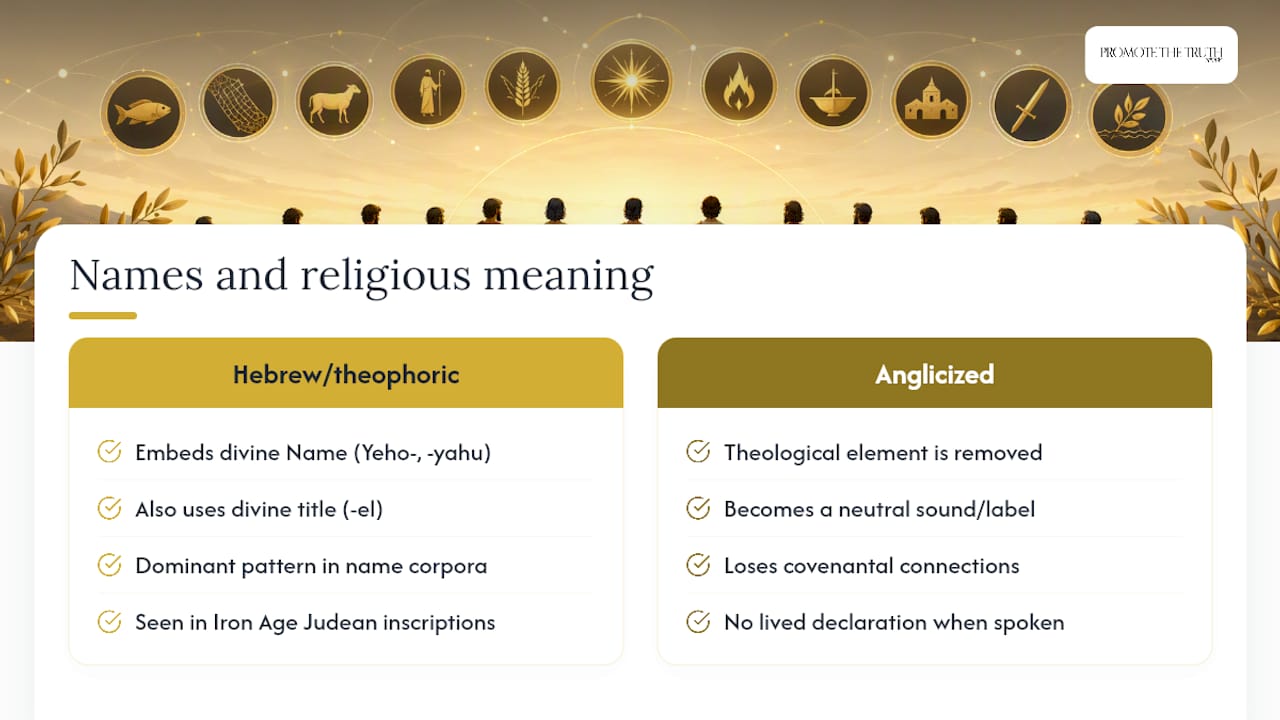
Among the twelve Emissaries (apostles), this naming pattern is not isolated. Several names preserve clear Abariy (Hebrew) theophoric elements connected with the Set-Apart Name, YAHUAH. Yahuhanan, for example, is understood in PTT as “YAHUAH is compassionate,” while Matatiyahu means “The Gift of YAHUAH.” Even Ya’aqab, although not strictly theophoric in the same grammatical sense, is deeply rooted in the patriarchal narrative and the covenantal world of the Ta’anak.
Archaeological name corpora show that these YAHUAH-based theophoric names were not merely literary constructions. Inscriptions from Iron Age Yahud (Judea) preserve similar elements in the names of ordinary people, not only in the names of Nabiyaiym (prophets), Malakiym (kings), or other prominent Scriptural figures. Statistical studies of Scriptural name collections likewise identify YAHUAH-based formations as a major pattern within the broader corpus of ancient Abariy (Hebrew) personal names.
A name such as Matatiyahu was more than a label used to distinguish one person from another. It carried meaning every time family, friends, and neighbors spoke it aloud: “The Gift of YAHUAH.” When that name is transmitted into the familiar English form Matthew, much of that immediately recognizable theophoric meaning becomes less visible to the modern reader.
That difference matters when reading the Bashurah (Gospels) in their original linguistic and cultural setting. A first-century Yahudiy (Judean) or Galiyliy (Galilean) audience hearing a name such as Yahuhanan could recognize the Abariy (Hebrew) meaning embedded within it. Modern English readers encountering John usually do not hear that same connection unless they trace the name back through its earlier forms.
How to Pronounce the Original Names Correctly
Pronouncing Abariy (Hebrew) and Aramiyt (Aramaic) names becomes much easier once you understand the basic transliteration patterns. Some consonants and guttural sounds do not have exact English equivalents, so simplified English spellings can sometimes hide important differences in the original pronunciation.
A few practical examples help illustrate the pattern. Ya’aqab may be pronounced approximately “yah-ah-KAHB,” with the apostrophe indicating a consonantal break or guttural sound rather than a silent mark. Yahuhanan may be rendered approximately “yah-hoo-HAH-nahn,” with the consonants pronounced more distinctly than in the English form John. Matatiyahu can be broken down as “mah-tah-tee-YAH-hoo,” preserving the theophoric element associated with YAHUAH. Shama’aun may be pronounced approximately “sha-mah-AH-oon,” reflecting its Semitic form more closely than the familiar English Simon.
One of the most common mistakes when pronouncing original Abariy (Hebrew) and Aramiyt (Aramaic) names is flattening unfamiliar guttural or consonantal sounds into ordinary English vowels or a simple “h.” Doing so can blur distinctions that were meaningful in the original languages and can make different names sound more alike than they originally would have.
The Evidence Scholars Use to Reconstruct These Names
Reconstructing the original Abariy (Hebrew) or Aramiyt (Aramaic) form of a Scriptural name requires comparing multiple lines of evidence rather than relying on a single manuscript tradition, later English spelling, or preferred pronunciation. Scholars examine Yuuniy (Greek) Bariyt Hadash (New Testament) manuscripts to identify how personal names were preserved, transliterated, and sometimes varied across different textual traditions.
Researchers also study onomastic evidence—personal names preserved in ancient inscriptions, ossuaries, coins, seals, and administrative documents from the Second Ahiykal (Temple) Period. These sources help establish which Abariy (Hebrew) and Aramiyt (Aramaic) name forms were actually in use among first-century Yahudiym (Judeans) and Galiyliym (Galileans). In addition, the Septuagint (LXX) provides an important comparison because it shows how earlier Abariy (Hebrew) names were represented in Yuuniy (Greek) before the surviving manuscripts of the Bariyt Hadash (New Testament).
When these independent lines of manuscript, historical, linguistic, and onomastic evidence agree, a name can be reconstructed with greater confidence. Names such as Yahuhanan (John), Ya’aqab (James), Matatiyahu (Matthew), Shama’aun (Simon), and Tama (Thomas) have strong linguistic and textual support for their underlying Semitic forms. In other cases, the surviving evidence requires greater care. For example, the TST identifies one Emissary as Yahudah, son of Ya’aqab, while other textual traditions preserve forms such as Thaddaeus and Lebbaeus. Likewise, PTT/TST restored forms such as Ariyah (Andrew) and Piyliyp (Philip) should be distinguished from the Yuuniy (Greek) forms Andreas and Philippos that are directly preserved in the surviving Greek manuscript tradition.
This distinction is important. A responsible manuscript-based study of the original names of the twelve Emissaries (apostles) should clearly separate what is directly attested in surviving manuscripts, what can be reconstructed from linguistic and historical evidence, and what is presented as a PTT/TST restored form. Doing so allows the earliest available evidence to guide the study while helping readers understand how these names were transmitted through Abariy (Hebrew), Aramiyt (Aramaic), Yuuniy (Greek), Latin, and eventually English.
Why Recovering These Names Still Matters Today
Names carried profound theological significance for the men who walked with Yahusha, and many of those meanings became less visible as the Scriptures were transmitted through Yuuniy (Greek), Latin, and later English translations. Every time a reader encounters John instead of Yahuhanan, the connection to the meaning of the original name—“YAHUAH is compassionate”—is no longer immediately apparent. While the individual remains the same, an important layer of the original Scriptural testimony can become less visible to the reader.
One of the most striking patterns revealed by the manuscript evidence is how frequently the Set-Apart Name, YAHUAH, appears within the personal names of early believers. This pattern was not limited to only a few individuals. Many Emissaries (apostles), Nabiyaiym (prophets), and faithful servants bore names containing references to YAHUAH, reflecting the language, faith, and culture of ancient Yisharal. Their names remind us that the Set-Apart Name was woven into everyday life long before later translation traditions emerged.
Today, manuscript researchers continue comparing Abariy (Hebrew), Aramiyt (Aramaic), and Yuuniy (Greek) sources to better understand how these names were preserved and transmitted throughout history. If you want to examine that evidence for yourself, the Truth Scriptures provide a restoration based on ancient manuscript research, helping readers rediscover the original Scriptural names, terminology, and testimony preserved in the earliest available sources.
— Maria
Go Deeper With the Truth Scriptures
If tracing Ya’aqab through Iakōbos to James has shown you how much can change as Scriptural names pass from one language to another, then the next step is not simply to read about the evidence—it is to examine the Original Scriptures more closely for yourself.
The Truth Scriptures restoration is designed to bring readers back toward the earliest available Abariy (Hebrew) and Aramiyt (Aramaic) manuscript evidence, where names such as Yahuhanan, Matatiyahu, and Ya’aqab retain meanings and linguistic connections that are often less visible in later Yuuniy (Greek), Latin, and English forms.
For readers who are no longer satisfied with inherited spellings alone and want to understand what lies behind the familiar English text, this kind of manuscript-based study opens a deeper path. It allows you to compare the names, terminology, and Scriptural patterns closer to their original linguistic setting and to see details that can easily disappear after centuries of transmission.
The goal is not merely to replace one spelling with another. It is to recover the meaning, context, and testimony carried by the original names—and to encourage readers to test what they have been taught against the earliest evidence available.

The Truth Scriptures restoration brings together the complete Ta’anak and Bariyt Hadash, restoring the Set-Apart Name, YAHUAH, the original Abariy (Hebrew) and Aramiyt (Aramaic) names, and thousands of manuscript-based readings within their full Scriptural context. Rather than presenting these restorations as isolated references, the Truth Scriptures allows readers to encounter them throughout the text as part of a unified manuscript-based restoration.
Do not stop at reading about the evidence—examine it for yourself. Begin with the Original Scriptures and compare the restored names, terminology, and manuscript evidence firsthand. If you would like to experience the translation approach before exploring the complete collection, download the free Abariym (Hebrews) Chapter 1 sample.
Prefer to learn through guided teaching? The Scripture Study Series examines Abariy (Hebrew) and Aramiyt (Aramaic) manuscript evidence in a clear, step-by-step format, helping readers study the Scriptures through their earliest available linguistic and textual sources.
The manuscript evidence is available. The restored names are there to be examined. The next step is yours—read, compare, and discover what becomes visible when you return to the Original Scriptures.
Sources
Recommended
Continue exploring the original Abariy (Hebrew) and Aramiyt (Aramaic) manuscript tradition with these in-depth studies from Promote The Truth: